4.1 1st Cent of Ptolemies (P I --- V(5)
 Call Kai
 Learn
 Practice Test
 Spaced Repetition
 Match
 Flashcards
 Knowt Play
1/14

There's no tags or description
Looks like no tags are added yet.
15 Terms
Ptolemy I Soter (declared king in 305)
Originally, Alex’s general who became Satrap (governor) of Egypt after his death
Married to Berenike I; children are Ptolemy II, Arsinoe I, Arsinoe II
Built the foundation of Ptolemaic rule and connected his legitimacy to Alex (brought his body back to Alexandria)

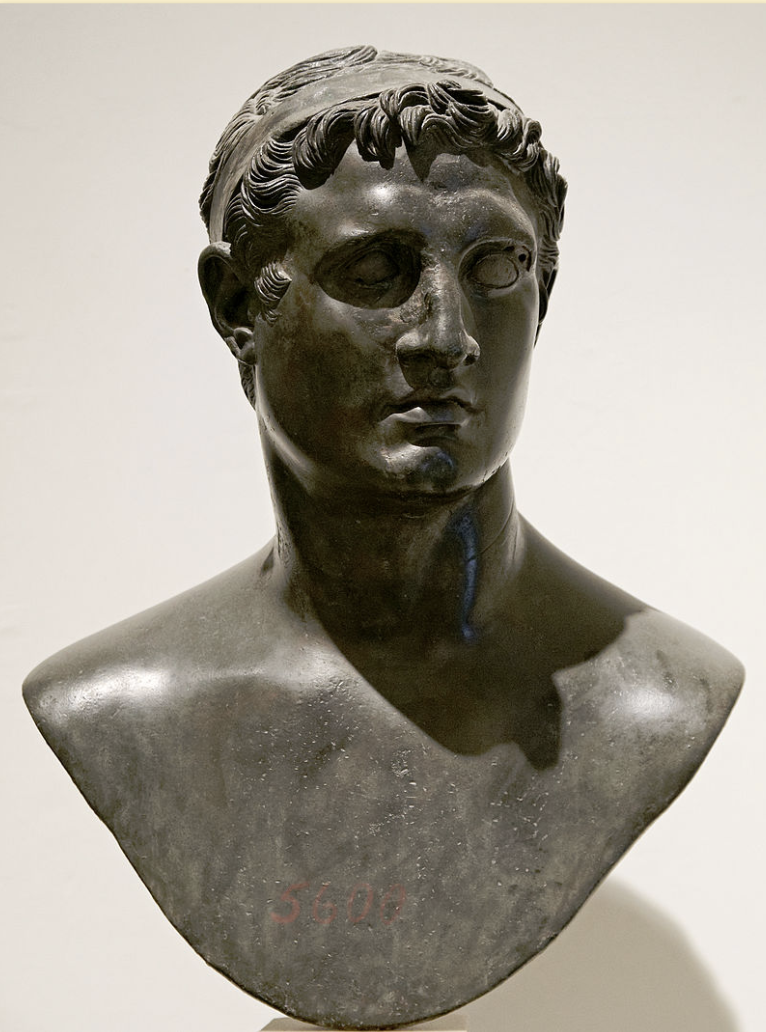
Ptolemy Soter I
3rd cent. Hellenistic/Greek style depiction

Satrap Stele
Granite Egyptian-style stele from 311 BCE or 4th cent.
The text presents Alexander as a legitimate Egyptian King and Ptolemy as a powerful prince in Egypt
Important: Ptolemy used Egyptian traditions + royal language to legitimize his rule. Strong evidence that a Macedonian ruler could present himself within Egyptian political + religious traditions

Coins of Alexander and Ptolemy I (4th cent.)
Meaning: earlier coins used Alex’s image; the later coins named Ptolemy as king
Matters? Coinage communicated authority and helped establish Ptolemy’s transition from Alexander’s successor to an independent king
Note: Horn of Ammon=represents strength and leadership
Ptolemy II Philadelphus (King from 285) (308-246 BCE)
Married to sister Arsinoe I then divorced and re-marrried to older sis Arsinoe II
Used diplomacy and dynastic marriages to manage relations w other kingdoms
sought a buffer zone around Egypt, esp against Seleucids
Royal family imagery and brother-sister marriage becomes important tools of dynastic identity

Ptolemy II + Arsinoe II Coin
Gold coins showing joined portraits of Ptolemy II and Arsinoe II
Coins makes the royal couple and their family lineage visible
Matters? royal imagery, sibling marriage, divine honors supported legitimacy. Coins were political messaging as well as money.

Ptolemy III Euergetes (king from 246) (284-222 BCE)
Son of Ptol II and Asinoe I (who is exiled)
marries Berenike II, connected to Cyrene (she was advertised as wife and sister)
He extends control along the Syrian coast, though he lost Aegean possessions
Significance: continued Ptolemaic expansion and use of religious honors to support the dynasty
Canopis Decree (238 BCE)
It honored the king and his family as gods and recognized their benefactions to Egypt. Written inthree scripts and displayed in temples, it demonstrates how the Ptolemies worked with Egyptian priests and religious traditions to legitimize their rule.
Ptolemy IV Philophater (king from 222) (246-204BCE)
Son of Ptol lll and Berenike II, marries sister Arsinoe III
Battle of Raphia
217 Battle of Raphia: tremendous battle in on-going war with Seleucids and their King Antiochus III
Ptolemies won and took over Syria-Coele and used large #’s of Egyptian soldiers in battle (first time for this regime)
Ptolemy V Epiphanes (king from 205) (210-181BCE)
became king as child, Ptol IV died in 204
Courtiers fought for control, mother, Arsinoe III asassinated
Battle of Panion 200: Ptolemies lost
Ptolemies lost Coele-Syria to the Seleucid-Antiochus lll

Rosetta Stone 196 BCE after battle of Panion
Royal decree written in 3 scripts, hieroglyphic, Demotic and Greek
Matters: Ptolemy V faced territorial losses and political instability after Panion. Rosetta Stone shows how the Ptolemaic ruler used priestly support, royal honors, and Egyptian religious traditions to strengthen his legitimacy.
Ptol V marries?
Marries Cleopatra I (daughter of Antiochus III)
After Ptol V death?
Poisoned by generals at 29
from this point instability, loss of territory, revolts weakened regime —→ Rome starts to become increasingly involved in Meditteranean