Elements of NE midterm
 Call Kai
 Learn
 Practice Test
 Spaced Repetition
 Match
 Flashcards
 Knowt Play
1/39

There's no tags or description
Looks like no tags are added yet.
40 Terms
rate of decay
dN/dt: rate of change of nuclei or rate of decay [nuclei/s]
λ: decay constant [s-1]
N(t): number of nuclei present at time t [nuclei]

number of nuclei remaining
N(t): number of nuclei present at time t or number of nuclei remaining [nuclei]
N0; initial number of nuclei
λ: decay constant [s-1]
t: time [s]

number of atoms
N0: initial number of atoms/nuclei [atoms] or [nuclei]
m: sample mass [g]
NAV: avogadro’s number [6.022 × 10¹⁰ atoms/mol]
M; molar mass [g/mol]

activity
A=-dN/dt —> A=λN(t) —> A=A0e-λt
A: rate of decay [1bq=1decay/sec] or [1ci=3.7E10bq]
dN/dt: rate of change of nuclei [nuclei/s]
N(t): number of nuclei remaining
λ: decay constant [s-1]
t: time [s]

specific activity
SA: specific activity [bq/g]
A: activity [bq]
m: sample mass [g]

half-life
t1/2: half-life: time required for the radioactive nuclei to decay [s]
λ: decay constant [s-1]

mean lifetime
mean lifetime: average lifetime of a nucleus [s]

production and decay
R: constant production rate [nuclei/s]
dN/dt: rate of change of nuclei or rate of decay [nuclei/s]
N(t): number of nuclei remaining
λ: decay constant [s-1]

production and decay relationship
R > λN : production is greater than decay = N increases
R < λN : decay is greater than production= N decreases
R = λN : production is equal to decay = N stays constant
number of produced nuclei remaining
only valid when N(0)=0
R: constant production rate [nuclei/s]
N(t): number of nuclei remaining
λ: decay constant [s-1]
t: time [s]
R/λ: max number of nuclei approached when production and decay balance


decay chain
a decay chain occurs when one isotope decays into another isotope, which can also be radioactive and decay again.
in the pic: the parent isotope ‘A’ decays and produces ‘B’ (daughter isotope) which also decays and produces D and E which can also be radioactive and can continue the chain
finding number of daughter nuclei remaining
we must first find NA(t): since the parent nuclei A is only decaying, we can use the normal formula…
NA(t)=NA(0)e-λAt
then we can find NB(t) under the conditions that NB(0)=0 and λA ≠ λB

parent activity

daughter activity

secular equilibrium
decay constant of parent is much smaller than decay constant of daughter:
λA « λB
half-life of parent is much greater than half-life of B:
t1/2,A»t1/2,B
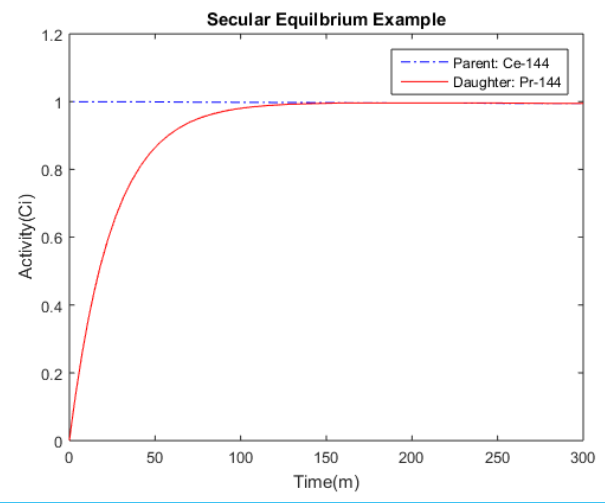
transient equilibrium
λA > λB
t1/2,A < t1/2,B

no equilibrium
λA ≅ λB
t1/2,A ≅ t1/2,B

in a question involving mass, number of atoms, activity, and specific activity
follow the sequence

if abundance (gamma symbol) is given
1] if given as percentage —> convert to decimal (divide by 100)
2] multiply it by the number of atoms formula (N0)
![<p>1] if given as percentage —> convert to decimal (divide by 100)</p><p>2] multiply it by the number of atoms formula (N<sub>0</sub>)</p>](https://assets.knowt.com/user-attachments/2f22848e-fb30-4a48-b7c7-cc1a86da5100.png)
neutron source
a material or nuclear reaction that produces free neutrons
when the reactor shuts down
neutrons are always present in a reactor core, even when the reactor is shut down.
why do we need neutron sources
neutron sources keep the neutron level high enough to be detected during reactor shutdown or start-up
which helps operators monitor the reactor safely
intrinsic sources
neutrons produced by materials already present in the reactor core for other purposes
example materials: fuel, moderator, burnable poision
installed sources
materials or components placed in the reactor specifically to produce neutrons
intrinsic source vs installed source
intrinsic sources already exist inside the reactor for another purpose while installed sources are deliberately added to produce neutrons
spontaneous fission
spontaneous fission occurs when a heavy nuclide splits without absorbing an incoming neutron
produces fission fragments & free neutrons

number of atoms per unit volume
“number of atoms” = N
“per unit volume“ = (per 1cm3)
the following equation represents atom density (number of atoms per unit volume = N)
N: atom density [ atoms / cm3 ]
ρ: density [ g / cm3 ]
NAV: avogadro’s number [ 6.022 × 10¹⁰ ]
M: molar mass [g/mol]

density

nuclide density
a material can contain different isotopes of the same element
for example, uranium can contain both U-235 and U-238
each isotope has its own density

total number density
basically N = N1 + N2 + N3 +…
N: total number density [ atoms / cm3 ]
N i : number density of isotope i [ atoms / cm3 ]

average atomic mass
Ā: average atomic mass or average molar mass [ g/mol ]
A i : molar mass of isotope i [ g/mol ]
N i / N = enrichment percentage (convert to decimel)
the addition of the fraction (in decimal form) should equal 1 (100%)

microscopic cross section
microscopic cross section (σ): describes the likelihood of a neutron interacting with one nucleus [cm2 or barns]
macroscopic cross section
macroscopic cross section (∑): describes the interaction probability per unit distance traveled through a material
∑ = Nσ
∑: macroscopic cross section [ cm-1 ]
N: atom number density [ atoms / cm3 ]
σ: microscopic cross section [ cm2 ] or [barns]

barns
1 barn = 10 -24 cm2
units of σ
macroscopic cross section of multiple different isotopes
(Total macroscopic cross section)
sum…
∑ = ∑i Ni σi
fi = Ni / N —> Ni = Nfi
The parentheses is the average microscopic cross section σ=fiσ (ex: σ = f235σ235 + f238σ238 )

Average microscopic cross section
σ=fiσ
(ex: σ = f235σ235 + f238σ238 )
Average macroscopic cross section
Σ=Nσ
macroscopic cross section with volume fraction

macroscopic cross section with mass fraction

Steps to find the macroscopic cross section given enrichment
Step 1: calculate the average atomic mass
Step 2: calculate the total atomic number density
Step 3: calculate the average microscopic cross section
Step 4: calculate the macroscopic cross section