Art History Midterm Fall
 Call Kai
 Learn
Learn Practice Test
 Spaced Repetition
 Match
Match Flashcards
 Knowt Play
 Podcast
1/159

There's no tags or description
Looks like no tags are added yet.
Name | Mastery | Learn | Test | Matching | Spaced | Call with Kai | Chat |
|---|
No analytics yet
Send a link to your students to track their progress
160 Terms
petroglyphs
Rock carvings
pictographs
Rock paintings
palimpsest
A manuscript or piece of writing material on which the original writing has been effaced to make room for later writing but of which traces remain.

ochre
A natural clay earth pigment that is yellow or red.

Paleolithic
"old", the earliest period of the Stone Age, characterized by the use of stone tools

Mesolithic
The "middle" period of the Stone Age, marked by the transition from hunting and gathering to agriculture.
Neolithic
"Young and fresh" The latest period of the Stone Age, characterized by the development of agriculture and the use of polished stone tools.

Bronze Age
3300 BCE to 1200 BCEA historical period characterized by the use of bronze, proto-writing, and other early features of urban civilization.
parietal art
Art that is created on the walls of caves or rock shelters, including graffiti.
Çatalhöyük
A Neolithic town that flourished ca. 7500 BCE, Anatolia in modern-day Türkiye. Enter homes from the top-means of defense
compressed dirt and mud
lots of parietal art and figures

henge
circular raised land formation, manmade, way of marking land as special/sacred

post and lintel construction
A building system where strong horizontal elements are held up by vertical elements.

tongue and groove joints
on top of the post there are bumps to secure the lintel
megalith
large stone

trilithon
A structure consisting of two large vertical stones supporting a third stone set horizontally across the top. 24ft

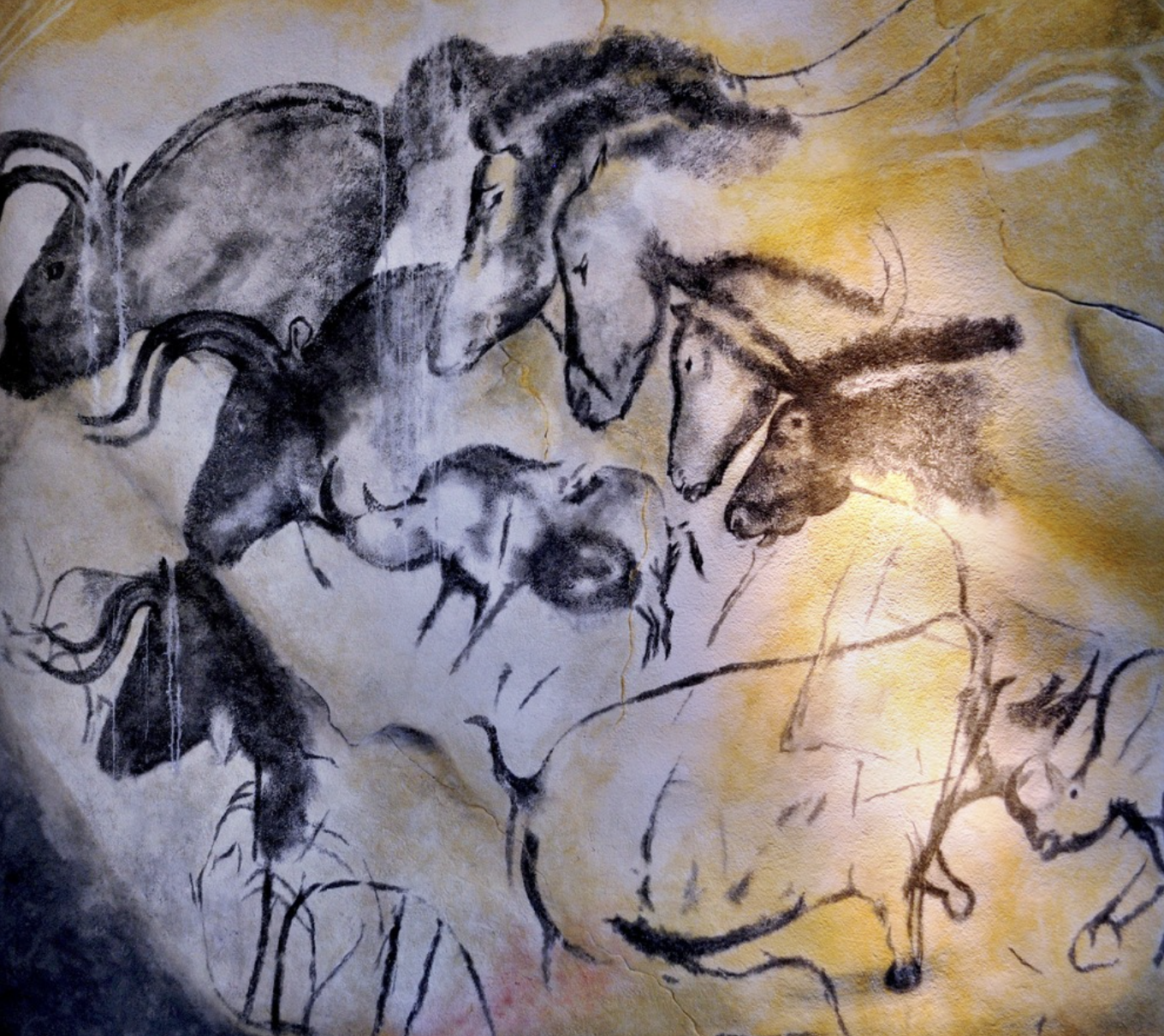
Chauvet Cave
Chauvet cave, Ardèche, France: Lions, rhinos, bears, 30,000BCE
known for its prehistoric paintings of lions, rhinos, and bears
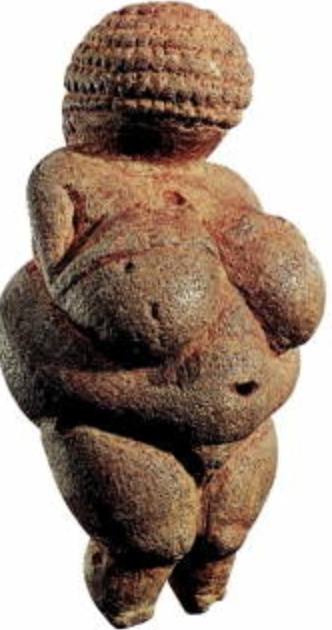
Venus of Willendorf
"Venus", limestone tinted with red ochre, 24,000-22,000 BCE, 11.1 cm high, Natural History Museum, Vienna
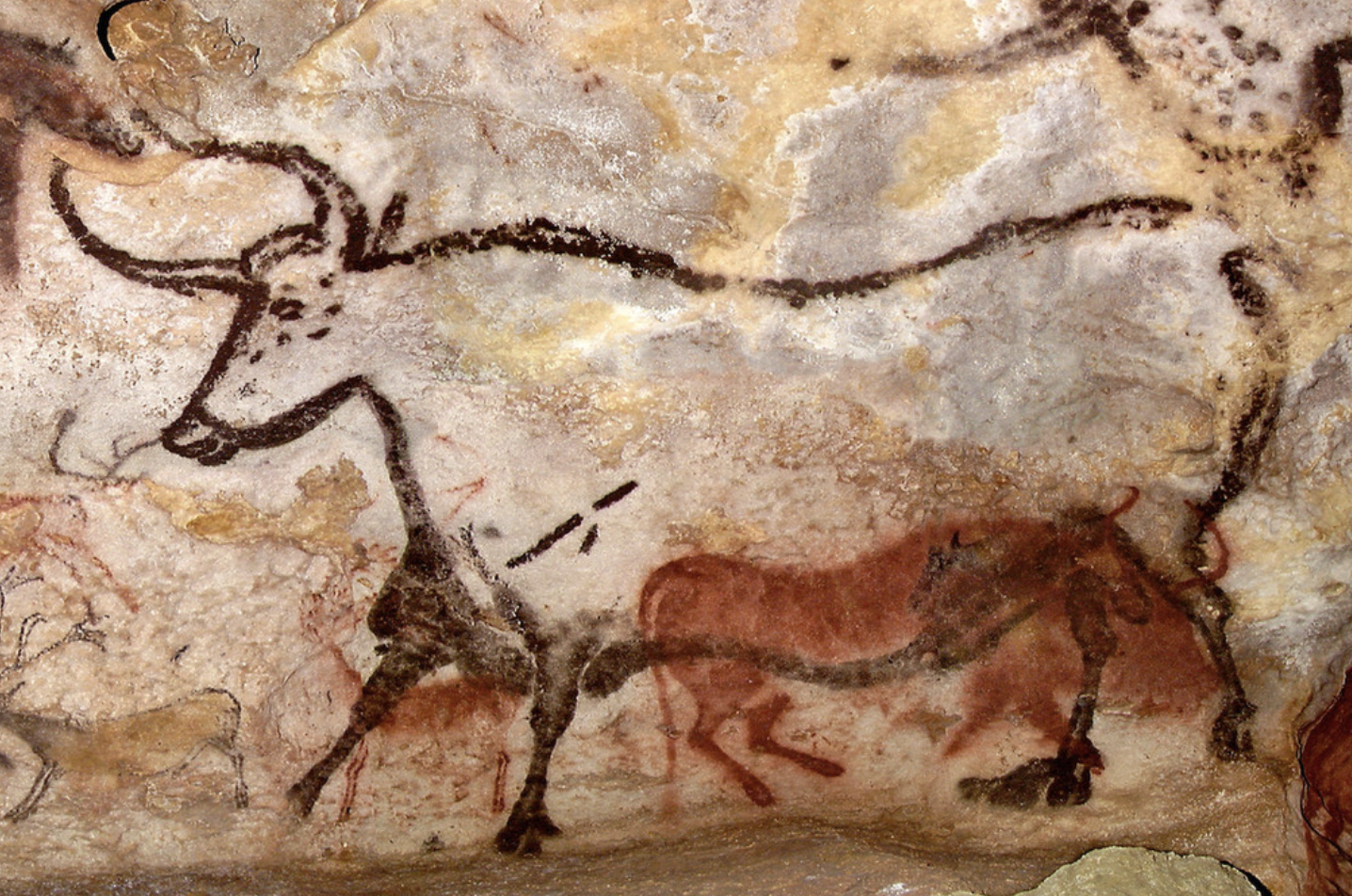
Lascaux Cave
Lascaux Cave, Dordogne, France: Hall of the Bulls and "Chinese" horse, 15,000-20,000 BCE

Stonehenge
Bluestone and sarsen stones, 2000 BCE, circle 97 feet in diameter, trilithons 24 feet high, Salisbury Plain, Wiltshire, England.

Nebra Sky Disk
bronze and gold, 1700 BCE, 30 cm/12 inch diameter, Halle, Germany.

Mesopotamia
(Greek: between the rivers) Tigris, Euphrates first major city
Hippopotamus
(Greek: river horse)

Sumer/Sumerian
The first major civilization in Mesopotamia. cultural hub
Assyria/Babylon
Two significant ancient civilizations in Mesopotamia, Akkadian Empire: development of cities, law, math and astronomy
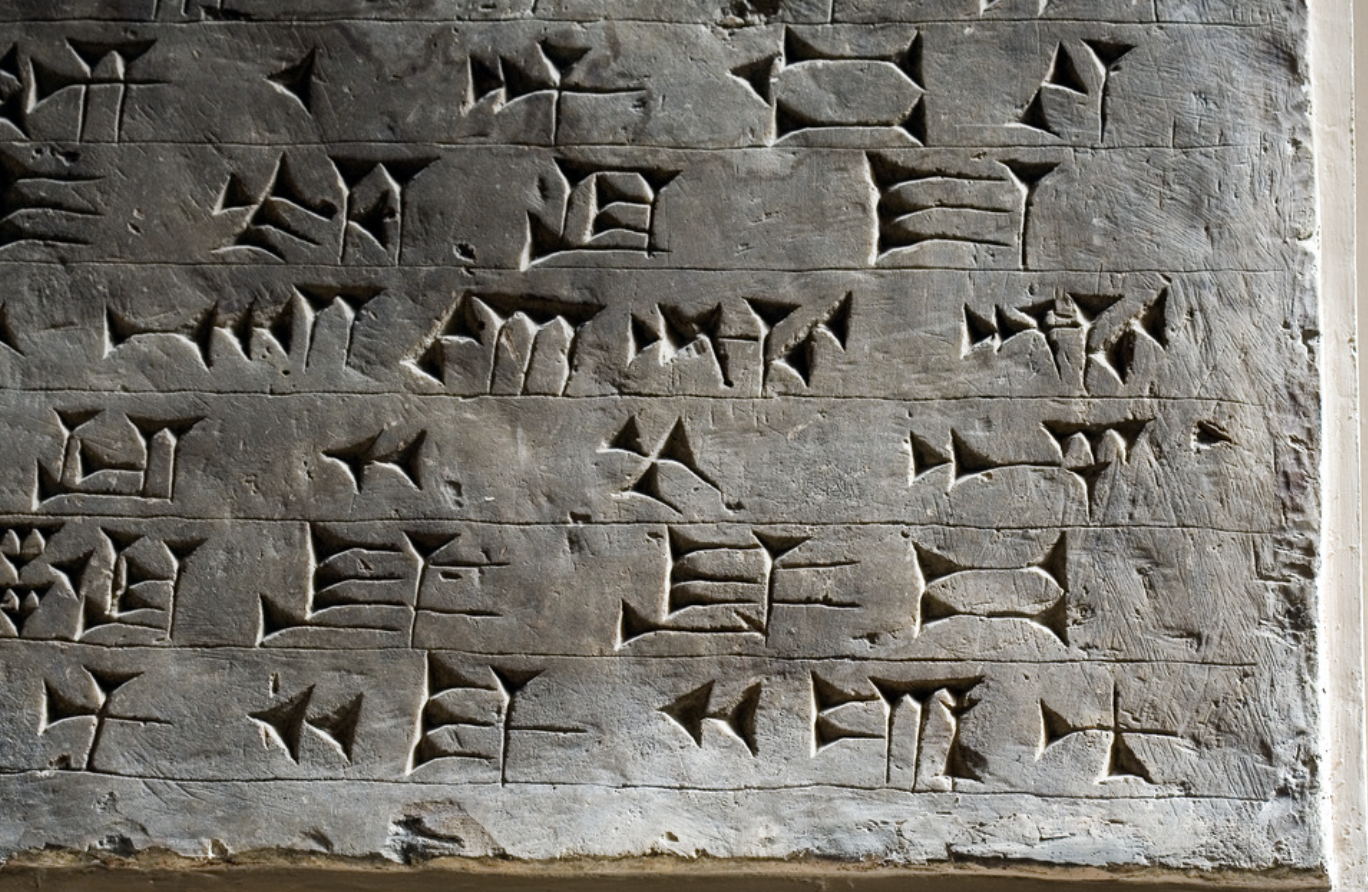
Cuneiform
A writing system developed around 3000 BCE. pictograms pressed into a clay tablet with a stylus.
votive sculptures
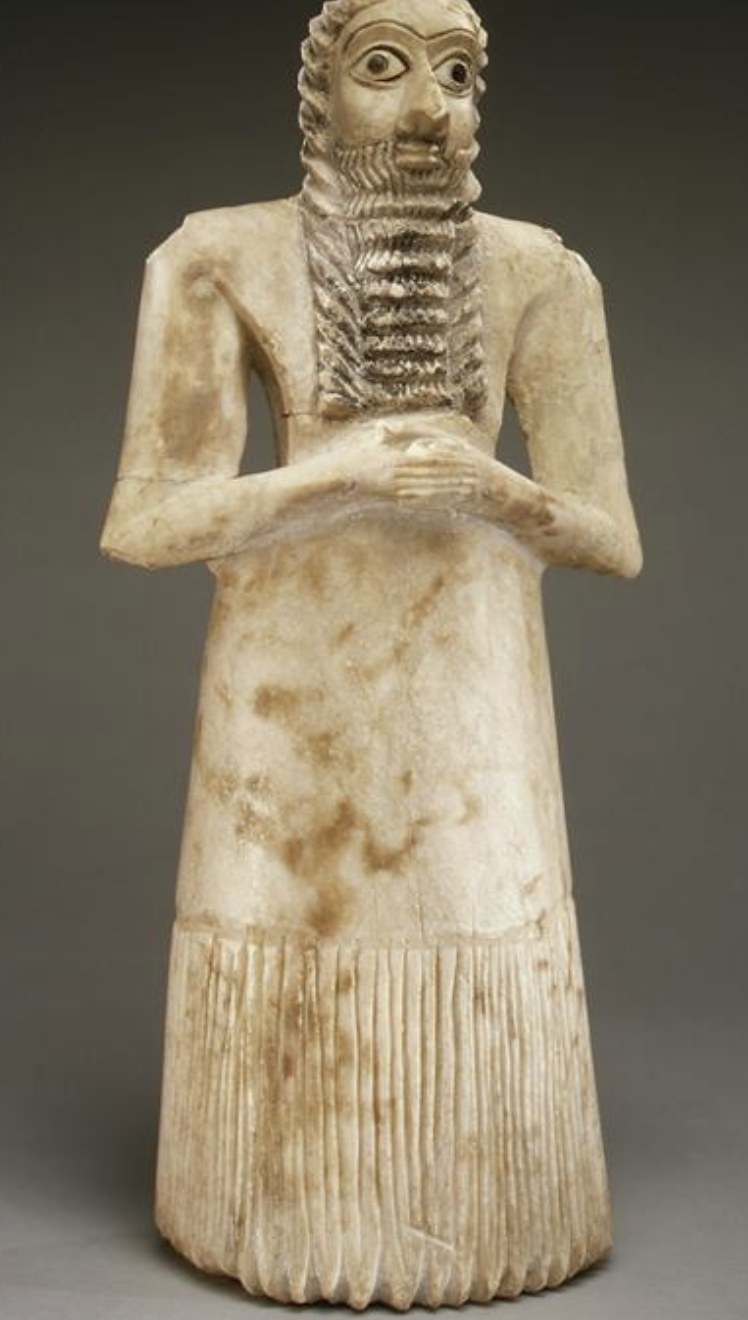
Sculptures created as offerings to deities. clasped hands, wide-eyes gaze worshiper, found at burial sites

registers
Horizontal bands used in art to organize scenes.

hieratic scale
A system of depicting figures in art to signify importance.
relief
A sculptural technique where the sculpted elements remain attached to a solid background.
iconoclasm
The destruction of religious images; looting/stealing of Iraqi Museum, Baghdad, 2003, is an example.
stele
A stone slab, usually used as a grave marker

ziggurat
A massive structure built in ancient Mesopotamia, resembling a terraced pyramid. Squat, stepped pyramid, manmade mountains. Usually, temples each city had a patron deity.

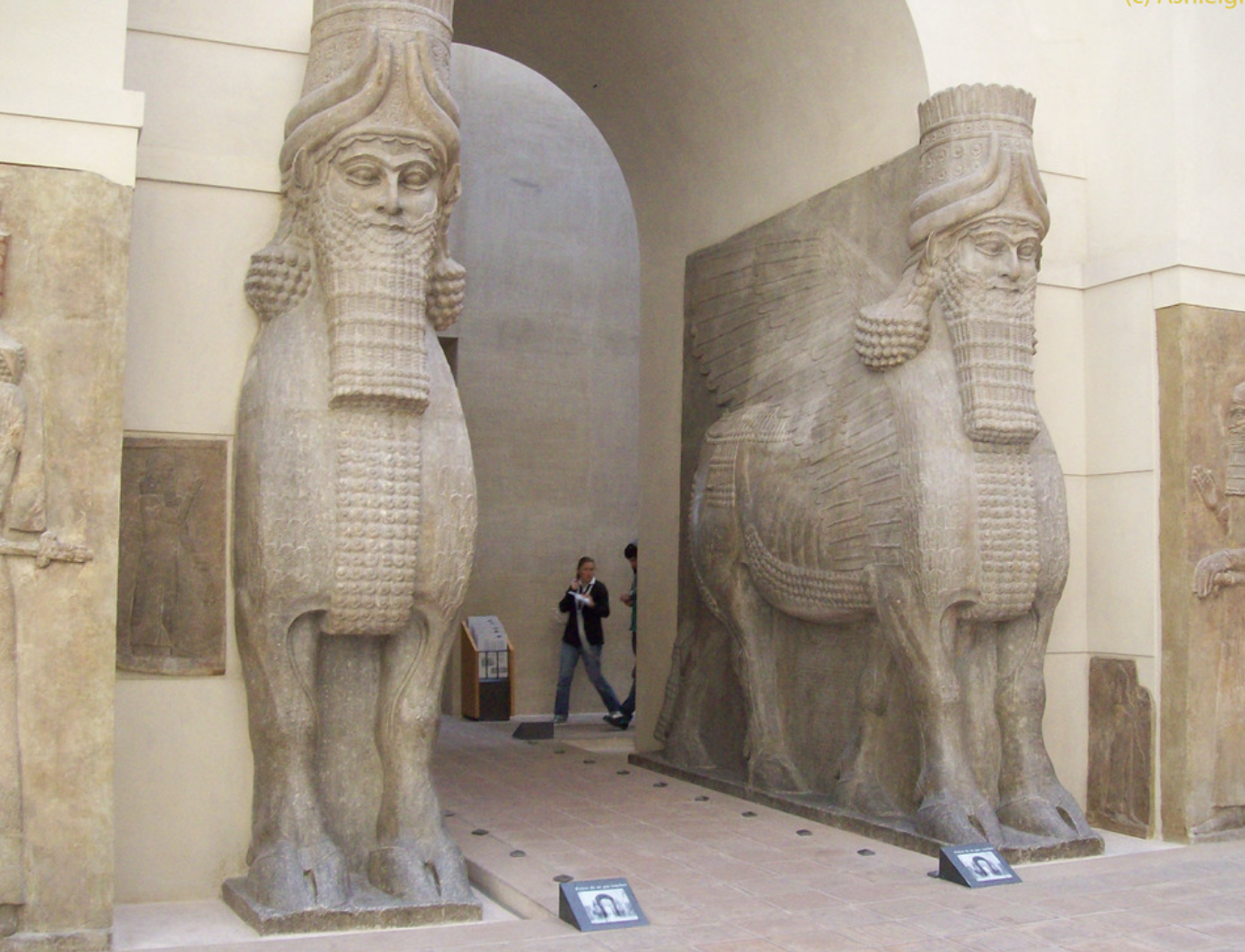
lamassu
A protective guardian deity depicted with human head on bull body with wings. Stood outside town/palace entrances.
Standing Male Worshipper
(votive figure), 2800 BCE, gypsum alabaster, shell, black limestone, bitumen, 29.5 x 10 cm, Sumerian, from the Square Temple at Eshnunna (modern Tell Asmar, Iraq), The Metropolitan Museum of Art, New York City
Goat in a Thicket
gold, copper, shell, limestone & lapis lazuli, c. 2600 BCE, found at Ur, 18 in. high x 12 in. wide {there are two: one in the British Museum, London, and the other in the University of Pennsylvania Museum in Philadelphia}

Standard of Ur
shell, limestone, lapis lazuli, and bitumen, 2500 BCE, 21.59 x 49.53 x 12 cm. British Museum, London

Victory Stele of Naram-Sim
sandstone, 2250 BCE, 6'7" high, Louvre Museum, Paris.
grave marker, subtractive relief, pictograms + cuneiform, hieratic scale- Naram-Sim higher relief, represented quasi-divine (god-like, horns)
Naram-Sim leading Akkadian Army to victory over the Zagros Mountain people falling
palimpsest

Head of an Akkadian Ruler
(Sargon of Akkad), bronze, Akkadian Period, ca. 2200 BCE, 12 in. high, Iraq Museum, Baghdad, Iraq

Michael Rakowitz, The Invisible Enemy Should Not Exist
An artwork created with various materials including Iraqi date cans in 2018.

Ishtar Gate
blue glazed bricks, 570 BCE, constructed by order of King Nebuchadnezzar II, Pergamon Museum Berlin

tombs
Burial places for the dead.
sarcophagus
A stone coffin, often adorned with sculptures.
necropolis
A large ancient cemetery with elaborate tomb monuments.
Old Kingdom
First period in ancient Egyptian history.
Middle Kingdom
An intermediate period in ancient Egyptian history.
New Kingdom
Most recent period in ancient Egyptian history.
hieroglyphs
A writing system used in ancient Egypt, developed around 3000 BCE.

pyramid
stepped or triangular

papyrus
A material used in ancient Egypt for writing.

mummification
The process of preserving a body after death.

pharaoh
The title of the god-king in ancient Egypt.

Orientalism
A term used to describe the representation of Eastern cultures by Western artists.
low relief
A type of carving subtractive sculpture where the figures project only slightly from the background.

King Djoser
Known for the stepped pyramid at Saqqara.

Khufu, Khafra, Menkaure
Pharaohs associated with the construction of the Great Pyramids. Oldest- Khufu (the great pyramid), Khafra (sphinx), youngest- Menkaure, smallest pyramid
Imhotep
The first named architect in history.

Thutmose
A notable sculptor in ancient Egypt. made Nefertiti bust

Ra
The sun and chief deity in ancient Egyptian mythology.
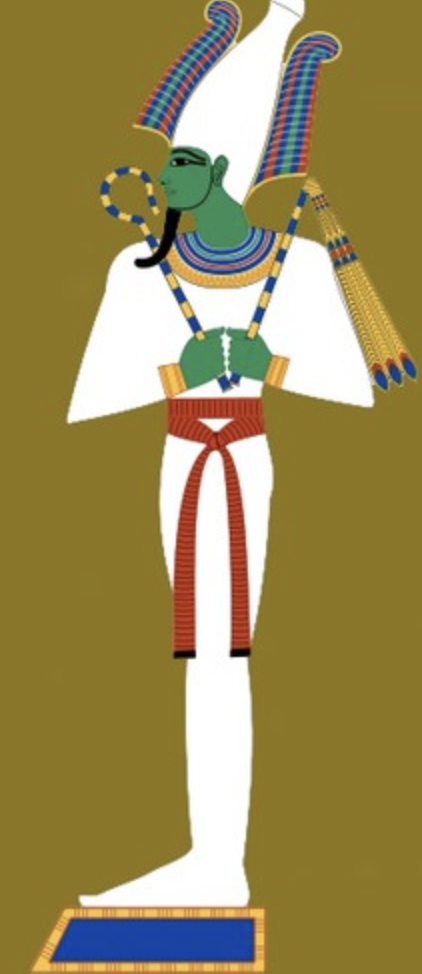
Osiris
The mythical founder of Egypt.
Isis
Osiris's consort in ancient Egyptian mythology.
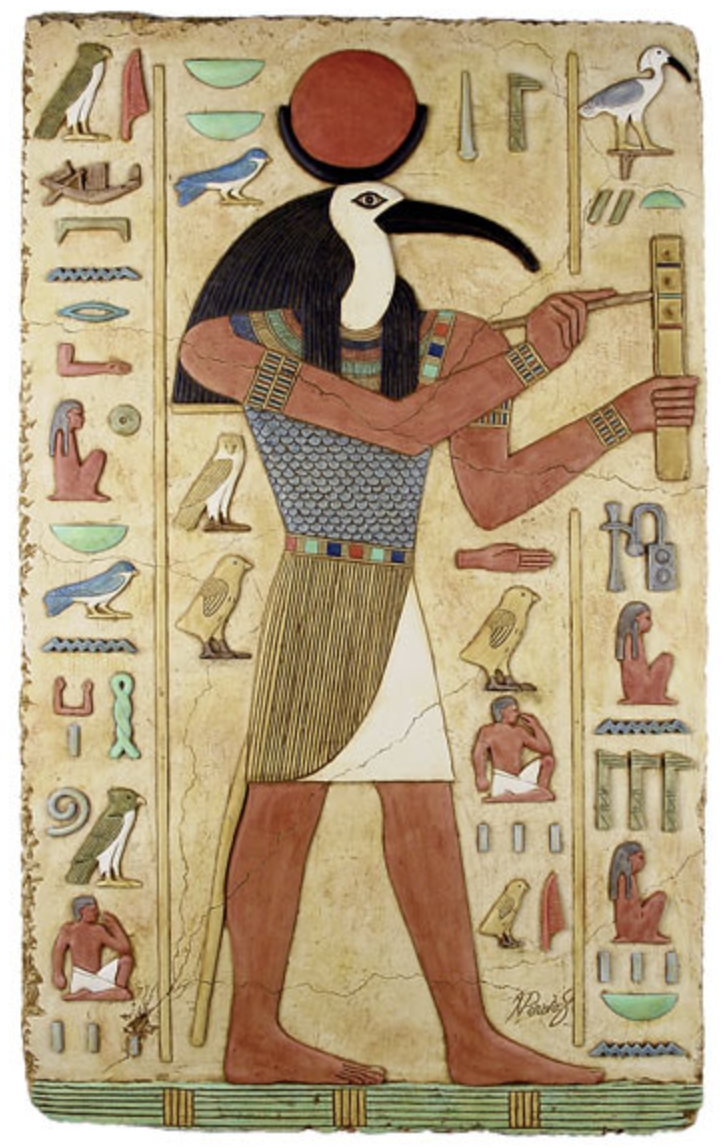
Horus
The son of Osiris and Isis. (falcon) symbol of lower Egypt

Anubis
The Egyptian god associated with mummification and the afterlife.

Hatshepsut
A female pharaoh who ruled c. 1507-1458 BCE.

Akhenaten and Nefertiti
Notable figures in ancient Egyptian history.

Tutankhamun
A pharaoh who ruled from 1333-1323 BCE.
Napoleon Bonaparte
Known for his campaign in Egypt from 1798-1801 CE.

Palette of Narmer
siltstone, around 3200-3000 BCE, 64 x 42 cm(2ft tall), Egyptian Museum, Cairo
non-functional symbolic form of makeup palette, early dynastic period, ceremonial and elaborate relief on both sides, composite view
*King as unifier of upper and lower Egypt (founder of first dynasty)

The Pyramid of Djoser
Designed by Imhotep, limestone built in 2650 BCE at Saqqara.

Great Pyramid
limestone & granite, c. 2600 BCE, 146 meters high, Giza ((served as the tomb of the pharaoh Khufu)
originally had gold tip and covered in white limestone

Great Sphinx of Giza
limestone, c. 2500 BCE, Giza
head of khafre, not in good shape now broken

King Menkaura and Queen
Greywacke stone, 2490 BCE, 142.2 x 57.1 x 55.2 cm, found at Giza, Menkaura Valley Temple, Boston, Museum of Fine Arts

Standing Hippopotamus aka 'William'
1900 BCE, faience, 20 cm x 7.5 cm x 11.2 cm, The Metropolitan Museum of Art

Great Hypostyle Hall
Temple of Amun-Ra, sandstone and mudbrick Middle-New Kingdom, Karnak, Luxor (Thebes) (papyrus style capitals & architrave = post and lintel)

House Altar depicting Akhenaten, Nefertiti and Three of their Daughters
limestone, c. 1350 BCE Egyptian Museum, Cairo

Funerary Mask of Tutankhamun
gold, lapis lazuli, carnelian, obsidian, turquoise and glass paste, 21.3 x 15.5 x 19.3 in, Egyptian Museum, Cairo

Thutmose, Bust of Nefertiti
limestone and stucco, 1345 BCE, 19 in high, Egyptian Museum, Cairo
found in an artist studio used to paint other portrait of her

Geometric Period
c. 900 - 700 BCE
Orientalizing Period
c. 725 - 650 BCE
Archaic Period
mid 7th century - 480 BCE
Classical Period
c. 480 - 323 BCE
Late Classical
380 - 323 BCE
Hellenistic Period
323 - 32 BCE
Kourus/Kouroi
Male youth
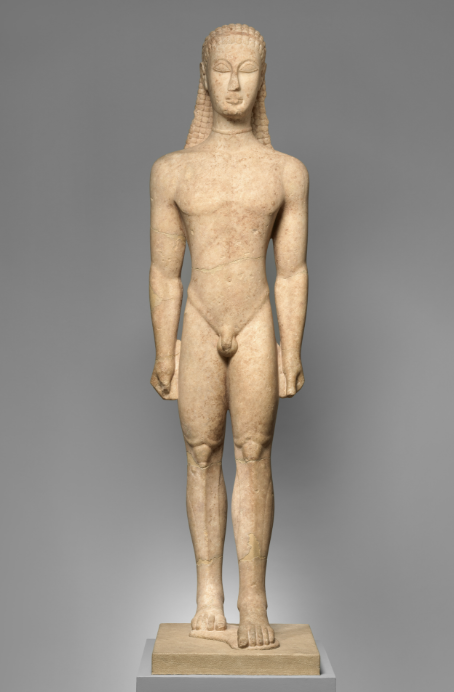
Kore/Korae
Female youth

Cannon of proportions
Written rules for achieving ideal human proportions, emphasizing symmetria (ideal proportions)
Polykleitos
1:7 proportion ratio for ideal human figures
Lysippos
1:8 proportion ratio for ideal human figures
Contrappostos
Natural position of a statue
Doric
Oldest temple order in Greek architecture

Ionic
Middle temple order in Greek architecture

Corinthian
Youngest temple order in Greek architecture

Panthenian procession
Religious and civic event to honor Athena

Acropolis
Houses religious temples dedicated to the gods, acts as a symbol of Athens' power

Temple
Building devoted to the worship, or regarded the dwelling place, of a god

Cella
Inner area of a temple

Pediment
Triangle architectural element above a building's doors or windows

Optical refinements
Subtle use of architectural adjustment to counteract visual distortions and to create a perfect illusion
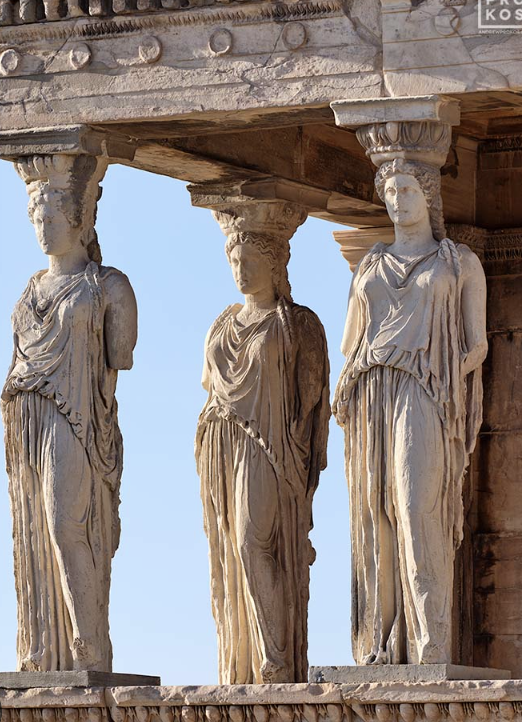
Caryatids
Carved stone statue of a draped female figure, used as a pillar
Gigantomachy
Battle between the Olympian Gods and the race of giants called the Gigantes, who were offspring of Gaia (Earth)
Etruscan culture
Etruscan culture in Italy, c. 1,000 - 270 BCE