The Great Depression and Deglobalisation
 Call Kai
 Learn
 Practice Test
 Spaced Repetition
 Match
 Flashcards
 Knowt Play
1/94

There's no tags or description
Looks like no tags are added yet.
95 Terms
How did the great depression begin and how did it spread?
Began with the NYSE crash
Spread through currency and banking crises as gold broke down
Some key characteristics of the global contraction that occured because of the Great Depression
1929-1932
Decrease in industrial production
Decrease in prices (deflation)
Increase in unemployment
The collapse of international trade
What are some key characteristics of the economic recovery that took place post great depression
1932 onwards
Slow
Unemployment remained high
Political radicalisation and growing international tensions
What happened during the wall street crash?
1929-1932
Stock prices doubled from 1926-1929
After the crash there was a brief rally in 1930, the index was back at the 1929 level by early 1931
Mid 1932: Stock prices drop by 80%
Partial recovery from 1933, by 1935 stock prices were still only half of what they were in 1929

What happened to world trade during the Great Depression?
The value of world trade fell from 1930-1932
Export volume decreased by 25%
Export prices decreased by 50%

What happened to industrial output during the great depression
Industrial output decreased severly by 1932, especially in North America
Food supply was stable but raw material output decreased
All prices fell: Raw materials, food, manufactures
European exports fell by more than 60% in 11/19 countries
North America and Germany faced the most severe decrease
Decrease was milder in Japan, Britain, and Scandinavia
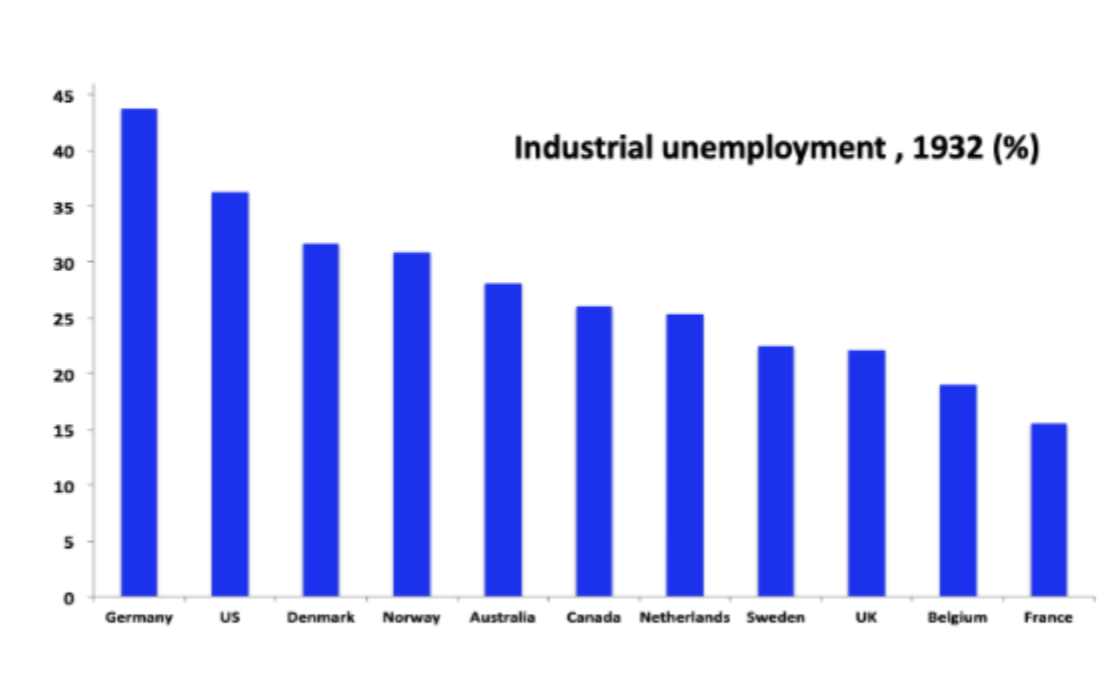
What were industrial employment rates like in different countries as a result of the Great Depression?
Highest unemployment rates were seen in the United States and Germany
Middle rates seen in Britain
Lowest rates seen in France, but they were actually still high

What happened to whole sale prices as a result of the Great Depression?
Prices decreased everywhere from 1929-1931
UK and US had “off gold” prices: Stopped falling from 1932-1933, increased from 1933-1934
French “on gold” prices: Fell until 1935, only started increasing in 1936
The deflation cycle
Gold standard meant that money supply was tight and so high interest rates were observed
Government spending or loose monetary policy cannot stimulate the economu
So in a crisis, we see deflation, which leads to cuts in output and exports
Industrial companies buy less coal, cotton, etc.
Primary producers face falling export earnings and so they cut their manufacturing imports
Lower exports than imports, means gold flows out
Money supply is tightened further, aggrevating deflation

Explain the four depression patterns observed worldwide
US:
Recession deeper and longer
Banking crises and industrial depression
Industrial exporters: Germany, Austria, and Belgium
Hit by the decreased demand for manufacturing
Germany and Austria faced a banking and currency crisis in 1931
Other European countries:
Recession more moderate
Banking remained stable in countries like Britain and France
Banking crises seen in Hungary and Romania
Periphery:
Primarky exporters were hit by the fall in export prices
Severe balance of payments problems
Currency crises
What were the causes of the US banking crisis? When did it happen?
1930-1933
Burst of the stock market bubble of 1929 reduced investor confidence
Real estate market collapsed
Banks with increased mortgage lending failed: Bank of US (Dec 1930), banks in Chicago and New York (1931-1932)
What were the consequences of the US banking crisis?
People switched from deposits to cash which meant a decrease in money supply
Bank failure raised the cost of credit intermediation
What did Bernanke argue in 1983 regarding the US banking crisis?
US bank failure raised the cost of credit intermediation
What were some of the macro economic shocks caused by the US banking crisis?
Falling money supply led to a demand shock
The rising cost of credit intermediation meant a supply shock
What is an important realization made by Grossman?
Grossman, 1994: 1930s banking crises only occured in countries that were still on the gold standard
Monetarist theory
Large changes in money supply has a large effect on prices and output
Friedman’s rule: Central banks should target a small, constant rate of growth in the money supply
What are some realizations made by Friedman and Schwars in A Monetary History of the United States?
1963
Applied the idea of monetarist theory to the great depression
The fed broke friedman’s rule: they tightened money supply when they should have provided liquidity
Evidence: US money supply fell by 30% between 1929 and 1933
What is Temin’s critique of Friedman and Schwartz?
1976
The fall inoutput caused a lower demand for money which is what caused a decrease in the money supply
Banks failed because they were insolvent (Bad loans) and not because they were illiquid and so providing liquidity would not have helped
He also said that Friedman and Schwarz missed international perspective: They were US centered but in reality international payments played a key role in the depression
The banking crisis in Austria
1931
From 1929: US lending to Europe dried up, France and the US accumulated reserves and refused to help
1929: Bodencreditansat failed, so it merged with the creditanstalt
Vienna banks operated as though the Hasburg empire still existed and provided heavy loans to infprofitable industries
Crisis started in May 1931: When Austria’s largest bank collapsed after an auditor’s report
Bank run spread to currency which meant the central banks reserves were exhausted and people switched their money to gold, it was too late for any foreign exchange control
The central bank broke and so panic spread to germany
The banking crisis in Germany
1931
Schnabel, 2004: Germany had a twin crisis where failures of large banks led to a bank run and also had a currency crisis along with a loss of gold reserves
Government response including nationalising banks, exiting from gold in July/august of 1931, and foreign exchange controls on froeign loans to stop gold from flowing out
The traditional view to contagion says that it was caused by over extended industrial lending by big banks, like the case in Austria
A recent view, brought up by Ferguson and temin in 2003 suggests that Weimar budget problems brought down currency, and with it banks because Brunings june 1932 statement on reparations dried up foreign loans (Austrian crisis did not cause the German one)
Further contagion occured because foreign credits were frozen which forced other creditors to restrict withdrawals and the crises spread to Hungary, Romania, and Switzerland
The banking crisis in britain
Contagion came from the german suspension of gold putting pressure on the pound and insufficient gold causing a run on the bank of england
Britain faced two deficits
A current account deficit: A trade deficit due to an overvalued pound at the pre war parity and the liquidation of overseas assets during WW1
Capital account deficit: Long term lending abroad financed by short term borrowing meant that by 1930 reserves and liquid assets were less than short term liabilities and the missing cash caused a panic. As a consequence the United kingdom became extremely dependent on world trade and gorwth in the periphery.
New macroeconmic policy enforced after gold was abandoned in 1931
Expansion of liquidity through a lower interest rate from 1932
Introduction of a general tariff
What happened in october of 1931 regarding the banking crisis?
In september, panic spread in the US as bank failure increased and the fed lost gold
By octoer, the ded increased the interest rate sharply mid depression which was a standard central bank response for an economy under gold
The fed chose international stability over domestic prosperity which is the opposite of what the bank of england did
The result was increased deflation which led to the US decline lasting another year and deepened deflation in europe
What happened mid 1932 regarding gold?
Gold collapses
Before Britain: 7 countries were already off gold, including Australia, New Zealand, and Argentina
After Britain: 24 more countries left gold, including sweden, denmark, norway, finland, ireland, greece, and portugal
Some countries stayed on gold but exchange controls made gold ineffective: Estonia, germany, austria, hungary, bulgaria, czechoslovakia, romania, and latvia
By mid 1932, the only countries still on gold were poland, us, france, belgium, netherlands, switzerland, italy, and Lithuania. However, only france, the us, the netherlands, and belgium had no exchange controls at all.
Why was monetary policy similar all over the world during the depression?
Because gold caused everything
Deflation was global and so all countries saw monetary contraction
Policies pushed for austerity instead of expanding aggregate demand
Recovery only started when Britain and the United States left gold
Why did gold work before? Compare gold before 1914 vs. gold in the 1920s
Before 1914:
The sterling was just as good as gold, bullion rarely shipped
Trust in sterling was high and so there was a global trade currency
Central banks held sterling reserves
Gold production grew rapidly, suppporting a steady increase in money supply
Britian had a huge currenta ccount surplus but they exported capital and so other countries did not see a decrease in gold
Major central banks cooperated to avoid running out of reserves
1920s:
US had a huge current account suprlus but hoarded it and so other countries had less gold causing deflation
Gold accumulated in France and the united states which menat a shortage of credit in the world economy
No cooperation between major central banks
What was the first major problem that caused gold to fail?
Incorrect exchange rates:
The US returned to gold at a pre war parity despite war time inflation
Insufficient gold coverafe and so the fed sterilised the current account surplus
Other countries returned at higher parities (UK) or lower parities (France), which meant large trade imbalances
Sterilisation
Central bank sells securities, to provide gold inflow, absorbing liquidity and so they leave the monetary base unchanged
What did Bernanke and Eichengreen say?
A major second problem that caused gold to fail was the missallocation of gold:
Fed and banque de france sterilised gold inflows to prevent inflation
US and France faced no penalty
Increased US tariffs meant a lower current account in other countries, they now faced deficits and so they had to deflate to keep their gold parity
What is the trillema faced by fixed exchange rate systems during the war?
Macro policy can only include 2/3:
Full capital mobility
Fixed exchange rate
Independent monetary policy
Gold standard and eurozone countries: Chose capital mobility and fixed exchange rates
What were the three possible solutions to the trillema faced by fixed exchange rate countries?
Abandon gold: UK, US, sterling bloc
Capital controls to prevent gold outflow: Germany and central europe
France and the gold bloc: No devaluation meant that they had to increase tariffs

What happened to countries who devalued more during the depression?
They saw larger recovery by 1935:
More depreciation by 1935 also meant more industrial production
A 10 point fall under exchange rate meant 7 more points in industrial output
Early devaluers were above their 1929 level of industrial output by 1935
France and belgium saw a decrease by 30%
What were the positive effects of devaluation?
Boosting aggregate demand
Competitiveness
Central bank could print money as a last resort
Increased recovery at home but it hurt other countries balance of payments
What did other countries have to do as a result of bad balance of payments due to the British devaluation?
They needed protection:
They increased tarrifs, the Hawley smoot tarrif in the US in 1930 and Britain left free trade by the end of 1932
They also added import quotas and exchange restrictions
Gold bloc countries increased tariffs more than others
What was the downside that came with countries using protectionism to protect their economies?
The decreasing recover of world trade.

Compare the difference in growth between countries who left gold, the gold bloc, and counrties who stayed on gold but had exchange controls:
Countries who left gold saw growth of 1.9-3.9% a year
The gold bloc saw growth of -0.4-1.6% a year
Germany (Kept gold parity but enforced exchanged controls) showed growth of 2.5% a year
How did spain deal with the depression?
Only european country with a flexible exchange rate in 1929
Government could boost aggregate demand
Banks lended freely as Bagehot advised in 1873
How did portugal and greece fair during the depression?
They both faced mild recessions with no bank crises
How did Japan fair during the Great Depression?
Restored gold in 1930 after deflating their currency
Unable to maintain gold and so they left in 1931 and depreciated
Like spain, they avoided the worst of the depression
How did africa and asia fair during the Great Depression?
They were primary exporters who were hurt by the decrease in agricultural prices
Infant industries could not develop without foreign capital markets
Colonies could not implement independent monetary policy
How did Italy and Poland fair during the Great Depression?
Remained on gold until the mid 1930s: they saw deflation and a decrease in output
Poor loands to industrial and agricultural sectors
Bank crises avoided by direct government intervention
How did argentina fair during the Great Depression?
First country in the depression
Exited from gold in december of 1929
Managed to reover by 1935 and avoided foreign debt default unlike the rest of south america
What were some attempts at international cooperation between 1931-1933?
Coordinated reflation was needed
Hoover moratorium on reparations (July 1931)
BIS special advisory committee (Dec 1931: To adjust intergovernmental debts)
Lausanne conference on reparations (June 1932)
World economic conference in London (June-July 1933)
While attempting international cooperation to combat the great depression, what were some old and new political obstacles?
Old:
Reparations
War debt
New:
Roosevelt
Hitler
What happened at the Lausanne conference?
1932
January: German chancellor demands the cancellation of reparations
Britain and Italy support Germany, France isolates
The United states is indifferent but wants its war debts back
France and germany’s elections delay the conference
The conference had a face saving deal for france but war debts were unsolved
France’s face saving deal: Germany deposited bonds issued only if they were able to pay, bonds were actually never issues and were burned in 1948
War debts: Hoover refused to postpone the december 1932 payment and so France and others defaulted, US only ended this in 1934
What happened in the world economic conference in London?
1933
June: Britain, US, and France’s central banks agree to keep currencies within +- 3%, stabilisting the currencies
News leajs and so the dollar becomes stronger and US prices drop
Roosevelt rejects this to protect reflation
3 July 1933: Roosevelt wrecks the conference
Negotiotians about the re-introduction of gold, decreasing trade barriers, and war debts
Roosevelt argues that the sound internal economic situation of a nation is a greater factor in its well being than the price of currency
Keynes says that Roosevelt was right
What is Feinstein’s verdict on the London conference?
conference failure is often blamed on roosevelt
But the real conditions for cooperation were absent: Countries had domestic interests in mind, wanted to build their own currencies and trading blocs
Countries that were left out like most of Latin America retreated into protectionism
How did the lack of cooperation post the London conference lead to an increase in protectionism?
Devaluation raised aggregate demand, improved competitivenes, and made the central bank available as a leder of last resort
But countries that remained on gold had to keep a balance of pauments which they did through a restriction on imports, higher tariffs, import quotas and exchange restrictions
How did the sterling area deal with the effects of the depression?
They rebuilt competitiveness by devaluation in september of 1931, and creating an import duties act in 1932 featuring 10% on imports except for food, raw materials, and goods that were already dutable and manufacturing imports faced a tariff of 20%
The introduction of preferential trade within the sterling bloc
Since they were now freed from gold: The bank of england could decrease the interest rate, and access to cheap borrowing actually created a housing boom from 1932-1935
Unemployment was only eliminated after the rearmament of 1937
No systemstic anti cyclical policy
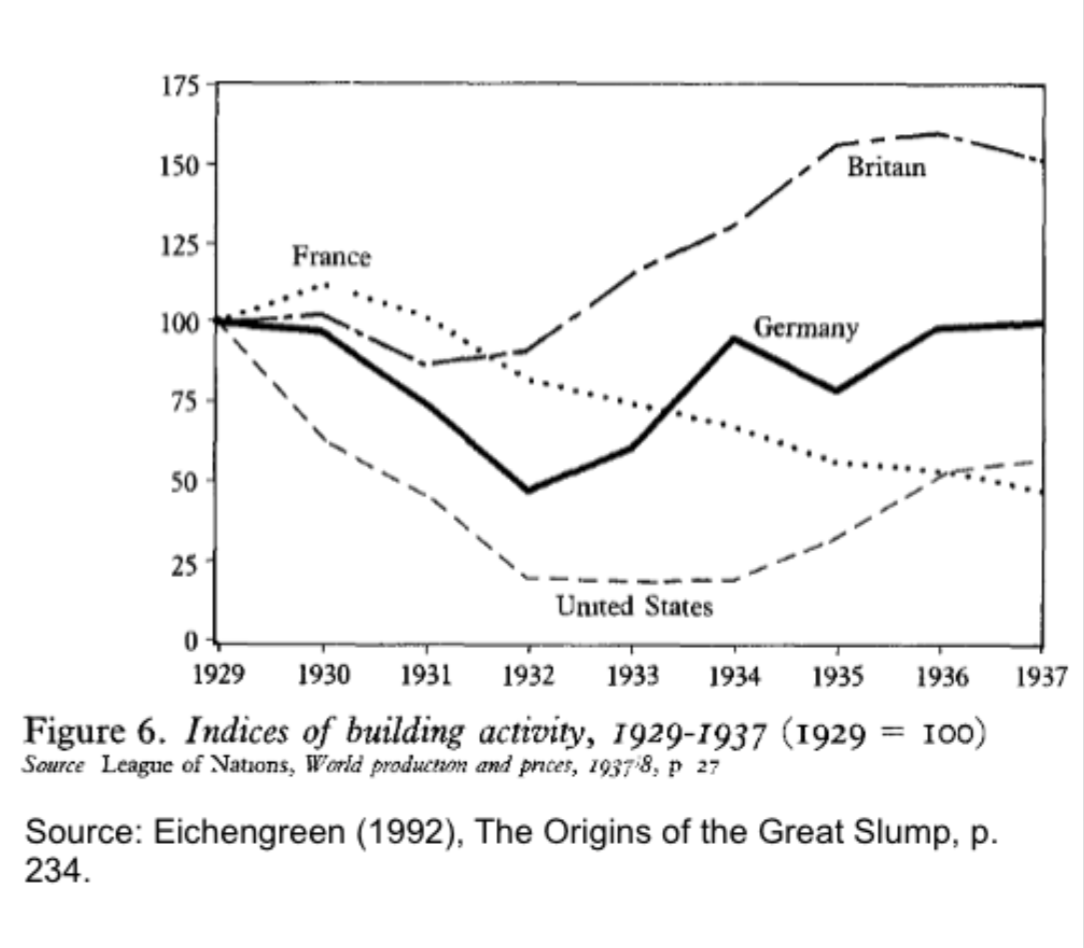
The british building boom
Because of cheap money
Building rose steadily after 1932
How did Keynes believe the situation should be managed?
Believed that output and employment depended on aggregate demand
Demand management should happen through:
Moderating the boom and bust cucle
Fiscal and montary policy should be anti-cyclical
Government spending has a multiplier effect
Why was Keyne’s solution difficult to implement?
Hard to forecast when an economy turns
Policy lags can make spending pro cyclical
Hard to make governments save in a boom because there is a risk of overheating
What was Keyne’s general theory?
1936
Gave a theoritical case for the policies made possible by leaving gold and he backed roosevelt
How did british devaluation help the sterling area take shape?
Devaluation put pressure on countries exporting to Britain and countries that have sterling reserves
Scandinavian countries left gold with the pound and pegged to the sterling later
By January 1932: Japan, Bolivia, and Venezuela also pegged
When did the sterling area take shape?
1931-1933
How did birtish imperial policy help the sterling are take shape?
Colonies were pegged to teh sterling
All the dominions, except canada held reserves in sterling
Bank of england provided credits to countries pegging to the sterling
Why did countries peg to the sterling?
India and the colonies were compelled to do so
Australia, new zaeland, and south africa wanted to stay competitive in britain
Smaller european countries and latin america: Britain was their main market
How was the peg maintained?
If the local currency was too strong:
Print your own currency and use it to buy british pound
If the local currency was too weak:
Local central bank would use sterling reserves to buy back their own currency from the market, raising its value
Currency boards in colonies held the same amount of home currency in sterling reserves
The rigid peg was backed by large sterling reserves in countries like india, australia, new zealand, south africa, and portugal
Targetting the parity without large reserves happened in scandinavia
The british common wealth declaration
27 july 1933
Commitment to increasing prices
Keeping money cheap
Keeping sterling exchange rates stable
Sterling area was formalised
What happened at the Ottawa conference?
1932
Common wealth goods were given preferential treatment in Britain and vice versa
How was the Ottawa conference asymmetric?
The dominions refused to expose their young manufacturing industries so they raised tariffs on non common wealth manufacturing
Britain gave preferential access to common wealth food and raw materials
Colonies has to accept the deal, they were not represented at the conference
What were the benefits of being in the sterling area?
Exchange stability: Stable currency and supporting recovery with cheap money, from late 1933-1938 a stable sterling to dollar rate meant no exchange rate volatility
London provided sterling reserves for members: gold from south africa and india kept the system convertible, to settle trade deficits with countries outside the sterling bloc
Recovered faster and less unemployment than gold standard countries

What were some of the results of the Ottawa conference?
Uk trade shifted towards the empires and the sterling area
Dominions share of uk imports doubled
Every major economy outside the bloc lost its share
How was India’s recovery blocked?
India was the exception within the sterling area: it was a major primary exporter and so it was hit by the decrease in raw material prices, peg was mandatory, and devaluation was needed
The ruppee was overvalued and london rejected floating it in 1931
Tight money and austerity prevented revovery: High interest rate, cuts to public health, education, and irrigation
Outcome: GDP decreased between 1929-1939, Discontent that some historians allocate as the start of the decolonisation movement
How was latin america affected by the great depression?
Falling prices for primary exports meant devaluation
They had no foreign exchange but had to pay for imports in foreign exchange and so their reserves were exhausted
Devaluation raised the burden of external debts leading to defaults
No US capital exports
What were some of the consequences of the effects of the Great depression on latin america?
Devaluation provided the central bank with increased liquidity
Defaults meant that the government could spend more and promote the domestic industry
Defaults were taken lightly
How did latin america recover from the Great Depression?
Import substiuting industries (ISI):
Primary exports and maunfacturing imports was unsustainable
Increased tariffs to protect domestic industry but preferential tariffs on imported capital goods
Active governments:
Import quotas and tariffs in Brazil and Chile
Expansionary fiscal policy in colombia
Rapid recovery:
Brazil and colombia regained 1929 GDP by 1932 before exports recovered
Manufacturing grew faster than GDP
What were the two different ways countries stayed on gold?
Nazi Germany and its trading partners: Controls to limit capital movements meant that the mark kept its formal value but monetary and fiscal policy were freed
France and the gold bloc: Full capital mobility at pre depression levels were maintained through continued deflation and austerity
What were the origins of the gold bloc?
Built on the 19th century Latin monetary union which included holland, poland, lithuania, and czechoslovakia
Declared adeherence to gold after the world economic conference that took place in july of 1933
Symbolic: No futher cooperation between central banks or the government
Why did countries on the gold bloc face a long depression?
Gold had to be defended by conservative fiscal policy and increased tariffs
What was a common view of countries in the gold bloc?
They saw exchange controls as against the spirit of the gold standard and so deflation was their only option
How did france recover from the Great Depression?
Sluggish recovery
Tariffs could not preventa trade deficit after 1933
Falling prices and demand reduced government revenue
Fear of inflation from rising deficits alarmed voters
Why did political turmoil make French recovery sluggish?
4 governments in 1932, 3 in 1933, 4 in 1934
Cutting payments to pensions, veterans, and civil servants who in fact had a higher real income because of deflation was deeply unpopular
What was France’s new deal in 1936?
Left came to power
Higher public salaries and enforcing increased wages in private sectors to boost consumption and end labor unrest
led to the end of deflation but there was no devaluation and so France faced a loss of gold reserves
How did the end of the gold bloc come to be?
Tripartite agreement
France agreed with the US and UK to stabilise currences at realligned exchange rate
It was informal and provisional: “No agreement, no understanding, only day to day cooperation” and so cooperation was flexible between treasuries and central banks
As for exchange rates there was full gold convertibility restored between signatories and a commitment to refrain from competitive devaluations
End of the gold bloc: France devalued against the dollar and sterling, the remaining members joined

Recoveries in different areas of the world post depression
Japan barely contracted
Britain’s fall was mild
Germany and the United States fell the hardest
France fell later and kept falling (No recovery)
What happened to the nazi trade area during the great depression?
July 1931: Banking and currency crises, banks only reopened after foreign debt was frozen and foreign exchange was restricted to the Reichsbank
After the sterling was devalued, policy became stricter in september of 1931: Owners of gold and foreign currency had to sell to the Reichsbank, the central bank rationed foreign exchange of importers, and exporters had to surrender foreign currency to the central bank
The mark was not devalued and gold was keot but the central bank decreased the interest rate, work creation programs by the government, and there was improvement by January 1933
Nazi recovery from the Great Depression
Hitler came to power in January of 1933
Inherited Weimar policies: Fx controls, work creation, state interventions in banks and agriculture, added terror
Moratorium on all reparations (before hitler)
Fight against unemployment: Public work in the motorway, jews and women removed from employment
Capital and controls and clearing trade with the Reichsmark bloc
4 year plan of 1936
Rearmament
Investment in heavy industry
Both financed through deficit spending (Keynesian approach)
Result: GDP increasing by 6.6% per year between 1932-1938
Germany’s broader plan after the depression
Schacht: Became the president of the central bank and minister in 1934
Autarky:
Import restriction and export subsidies to offset the overvalued mark
An extended economic space meant securing raw materials and food just in case war arose
Bilateral trade agreement:
Private compensation: German imports and exports were matches deal by deal, paid in mark, no foreign currency
Bilateral exchange clearing (By 1936, most of central and south eastern europe followed this)
What was the mechanism behind bilateral exchange clearing?
Importers paid their own central bank in domestic currency, central bank used this to pay domestic exporters
Only net balance needed settling
If a clearance account ran short, exporters waited till importers increased and vice verss
This system let germany keep the overvalued mark and still trade at the cost of multilateral trade
Example of exchange clearing using italy and germany
Germany exports merch worth 100 m to italy
Italian importers pay the Italian central bank
Italian central bank pays Italian exporters who export merch worth 120 m to Germany
German importers pay the german central bank, who pays german exporters
Italian central bank and german central bank settle any financial differences annually
How did the exchange clearing system affect germany?
By 1938, ½ of Germany’s trade was bilateral
A geographic shift towards southern and eastern europe and away from britain and the gold bloc
The reichs bloc: Exports to germany were beneficial for the european periphery because prices were higher because the german strategy was to have a reliable source of imports
Why did Germany build a reichsbloc?
Lack of foreign currency, high tariffs in the US and France
Germany did not have a large empire while other powers relied on internal trade and so they built a currency bloc
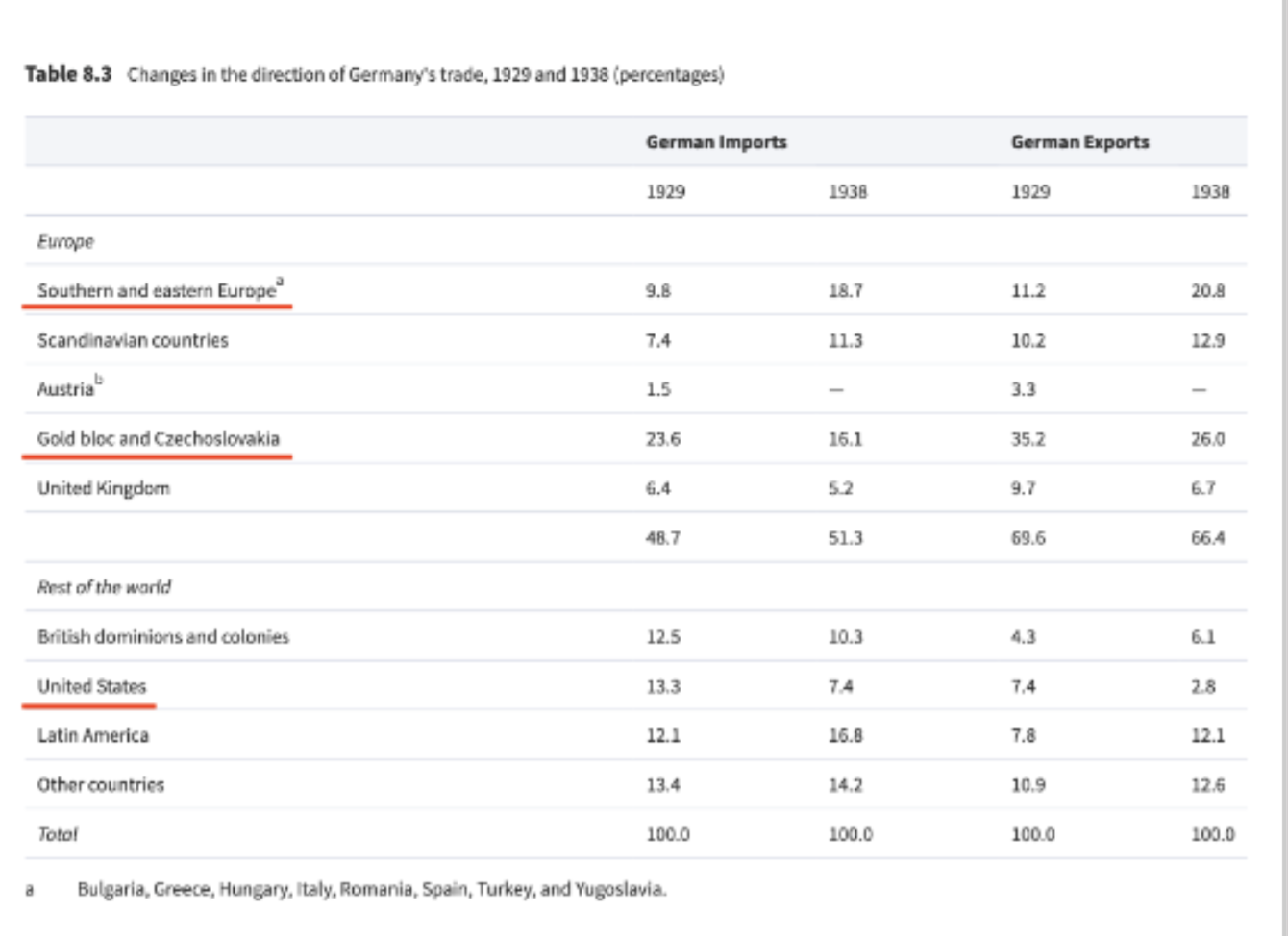
How did the reichsbloc change german trade?
Trade doubled with southern and eastern europe
Latin america and scandinavia gained
Glod bloc and czechoslovakia lost
Us lost
Italy’s recovery from the depression:
1931: Sterling floated and so lira was overvalued
Mussolini tried to deflate the currency by cutting wages, but it was not successful
Capital controls from 1932 to stop gold outflow but gold exports were prohibited in July of 1935 because of Mussolini’s Ethiopia campaign
Clearing agreements with germany due to sanctions they faced because of ethiopia and also with Argentina and Britain
The lira was only on gold formally since italy saw the inroduction of exchange controls, tariffs, and quotas/ clearing
From 1935; Recovery was driven by war spending, sanctions italy faced led to autarky
Autarky
A country trying to produce what it needs itself instead of relying on imports, an aim of economic self sufficiency
Japan’s recovery from the depression
Rejoined gold in 1930, left 1932
Expansionary impulses: yen depreciated by 60% in 1932, and so a cheap yen meant an increase in exports and protected imports
Militarist industrialisation: manucharia occuptaion from 1931-1932, new china campaign in 1937, the empire meant a yen tarde area with an industrial core and primary producing periphery, industry was driven by military demand
Dual economy: Fast growing heavy industry and mining (the zaibatsu) and low wage consumer industry with paesant agriculture
Japan’s empire growth post depression
before 1931: Empire already large
1931-1936: Manucharia and Jehol conquered: The core of the yen bloc
1937-1939: War with China brought new areas under Japanese control
1940-1941: the move into French indochina
territorial expansion and trade grew together
The united states recovery from the great depression and their new deals
March 1933: Bank runs, roosevelt took us off gold, national bank hoiday to reshape macro policy
Monetary and fiscal policy: Gold abandones, fed allowed money supply to increase alongside gold inflow, Glass Steagall act, federal depreciation insurance against bank runs
AAA: Production restricted to raise farm prices, the goal was to go back to 1914 farm purchasing power
NIRA: Firms encouraged to increase wages and spread work by shortening the work week, in exchange, prices grew
Recovery was still incomplete up until world war two
US unemployment policies
Wisconsin unemployment insurance (1932)
Roosevelt sworn in (March 1933)
Works progress administration and social security act (1935)
Unemployment still around 10% in 1941 when the US entered world war two
Soviet Union Recovery from the great depression
Fastest growing economy (1929-1938)
Forced industrialisation: Labor and resources went from argiculture to manufacturing, investment concentrated in modern industries
In the long run, it was unremarkable (1913-1950), only the 1930s stand out
Socialism’s rise in the Soviet union
Feb 1917: Bourgeois revolution
Constitutional monarchy
Provisional government during the war
Radical parties gain more power
October 1917: Boulshevik Coup d’etat
1918-1921: Russian civil war
1922: USSR Established: Formally, multiple independent republics, in reality a single party state: The dictatorship of Bloshevik party
1924-1928: After Lenin’s death, stalin came to power
The stalanist growth strategy
Near isolation from the world economy, relying on russias farm and natural resource wealth
The five year plan (1929) aim for double the industrial output
Collectivisation: Industries were financed from farm surplus, paesants forced into collectivist farms so the state could control surplus
Investment planning: Consumption was cut to increase the investmnet rate, priority towards heavy industry
Output maximisation: Modest plan targets in agricultural and ligh industry, heavy targets in heavy industry
What was the aim of collectivist farms in the Soviet Union?
1928-1933
Aim was to create an optimal farm size for mechanical production and release labour for urban industry
Collectivise because prior peasants would not sell grain as there was little to buy with their earnings
Poor results: Too little investment in agriculture for mechanisation, wealthier paesants resisted by slaughtering livestock and horses
CHAIN: Agricultural capacity per worker decreased, productivity collapses after 1930, famine in ukraine and soutehrn russia, more farm animals
What were some characteristics of stalin’s “1st developmental dictatorship”?
Police state:
State monitored all economic agents
Sabotage of production was a criminal offence
Anyone opposed to super industrialisation was liquidated
Forced labor:
Collectivist farms
People resettled in industrial cities
Those who refused were deported to labor camps
Human cost:
10m deaths
Economic growth was the only idol, everything else was sacrificed

Stalin’s militarisation of the economy
Increased defense spending
War industries had an increased share of total investmnet
USSR became the world’s largest munitions producer
Part of 1930s growth was military output