Epithelial Tissue
 Call Kai
 Learn
 Practice Test
 Spaced Repetition
 Match
 Flashcards
 Knowt Play
1/185

Earn XP
Description and Tags
Objectives: 1. identify all types of epithelia. 2. state the functions and locations of the following types of epithelium: lining epithelium (simple, stratified, pseudostratified, and transitional) and glandular epithelium (exocrine glands). 3. define terminal bar and terminal web. 4. identify and state the functions of kinocilia, sterocilia, and microvilli. 5. state the names and locations of cell junctions
186 Terms
What is tissue made up of?
cells (living component) and extracellular matrix (fluid and fibers/non-living component)
What are four major categories of tissue in the body?
Epithelial, connective, muscle and nerve
What are the groups of tissues assembled into?
organ
What are organs organized into?
organ systems
What are systems organized into?
a body
What are the four characteristics of epithelial tissue?
closely packed with very little intracellular substance in between cells 2. cells sit on a basement membrane 3. polarity in structure (apical-basal/basolateral) 4. avascular (no blood vessels in epithelium)
What is a basement membrane?
platform for epithelial cells to sit on (multilayer membrane with collagen)
If there is no blood vessels in the epithelium, where does it get its nutrients?
diffusion from blood vessels in the connective tissue below
What is the benefit of it being avascular?
It is the first line of defense and pathogens don’t get direct access to vascular system
What does the basement membrane protect the epithelial cells from?
carcinoma metastasis (type of cancer that starts in epithelial cells)
Does epithelial cells have fast or slow turnover?
fast turnover rate (undergoing apoptosis)
What epithelium lining turns over as fast as every five to ten minutes?
GI tract
What are the two classifications of epithelial tissue?
lining epithelium and glandular epithelium
What is lining epithelium?
sheet of cells covering a surface (external or internal)
Which epithelial tissue has a basement membrane?
lining epithelium
What is glandular epithelium?
invagination (cavity or pocket) from surface
What are the 6 functions of epithelium?
protection 2. secretion 3. absorption 4. transport of material on the epithelial surface (cilia) and transcellular transport across epithelium (diffusion and vesicle-mediated) 5. selective permeability 6. sensory cells in taste buds, retina, and hair cells in ear
What ways does epithelial lining and glandular do absorption?
endocytosis or pinocytosis
What does epithelial cells secrete?
mucus, enzymes, hormones
What is the classification and nomenclature of lining epithelial membrane?
number of layers and shape of the superficial cells
What is the classification based on the number of layers?
Simple (one layer) and stratified (multiple layers)
What is the classification based on the shape of the superficial cells?
squamous, cuboidal, columnar
What cells are flat?
squamous
What cells are cube shaped?
cuboidal
What cells are column shaped?
columnar
What are the two types of epithelium?
pseudostratified and transitional epithelium
Simple epithelia
single layer of cells (all cells contact the basement membrane and all cells reach the free surface)
What is simple squamous epithelium?
one layer of squamous cells on basement membrane
What is the special case of simple epithelia in that all cells touch the basement membrane, but not all reach the free surface?
pseudostratified
Stratified Epithelia
only the basal layer of cells touch the basement membrane, not all cells reach the free surface

Transitional Epithelia
type of stratified epithelia where the surface cells can change between squamous and cuboidal
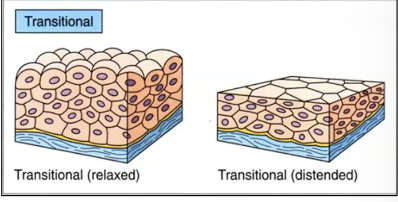
Why do we see the transitional epithelia relaxed and distended?
line the bladder (squamous/squished when bladder is full)
What are the simple squamous epithelium involved in?
passive transport (diffusion) of gases or fluids
What is the shape of the squamous cell’s nuclei?
flat
What are examples of where we see simple squamous epithelium?
lungs or walls of blood vessels
Does the simple squamous epithelium perform one or many roles?
many roles
What is the nucleus shape of simple cuboidal epithelium?
round and centered
Where is simple cuboidal epithelium?
lining of small ducts and tubules (ducts of salivary glands and pancreas, collecting tubules of kidney)
What is the function of the simple cuboidal epithelium?
excretory, secretory, or absorptive
What is the difference between the nucleus in the simple cuboidal vs simple columnar epithelium?
cuboidal are centered and columnar are at the bottom
What is the description of the nuclei in simple columnar epithelium?
elongated and perpendicular to the basement membrane
Where are simple columnar epithelium found?
on absorptive surfaces such as small intestine (with microvilli)
What can simple columnar epithelium have?
microvilli or cilia
What is a goblet cell?
unicellular gland that produces mucus
Where are goblet cells?
in simple columnar epithelium (usually GI tract)
What makes up cilia cells?
microtubules
What is non-ciliated columnar cells, with secretory functions called when present in the fallopian tube?
peg cells
How many cilia can be on one cell?
300
How many layers in stratified epithelium?
2 or more
What is the main function of stratified epithelium?
protection
What are the two types of stratified squamous?
non-keratinizing or keratinizing
What does the non-keratinized stratified squamous do?
strongest protection against abrasion (not to dryness)
What is another name for non-keratinized stratified squamous?
mucus membrane (has mucus producing glands)
Where would you find non-keratinized stratified squamous?
oral cavity, pharynx, esophagus, anal canal, cervix, and vagina
What is the number of layers for non-keratinized stratified squamous?
Variable. Superficial (squamous), intermediate (polygonal), basal (cuboidal)
What is the only type of keratinized stratified squamous epithelium?
epidermis and tongue
What is the process of accumulating cytokeratin called?
keratinisation
What is the benefit of keratinized stratified squamous epithelium?
waterproof and protect against dryness
Where would you find stratified cuboidal epithelium?
lining the duct of sweat gland in skin
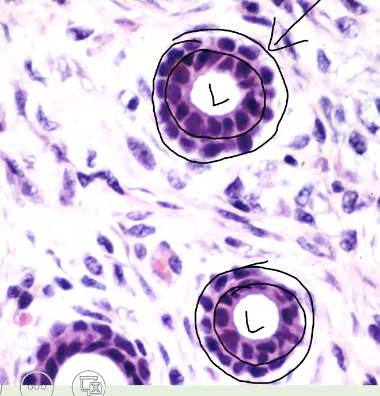
How many layers in stratified cuboidal epithelium?
2 layers of cuboidal epithelium
What is stratified columnar epithelium?
thin, stratified epithelium with only two or three layers of cuboidal (bottom) and one layer columnar (top)
Where would you find stratified columnar epithelium?
lining the large excretory ducts of exocrine glands, such as the salivary glands
What is the function of stratified columnar epithelium?
provide lining of the duct (no absorptive/secretory function)
What is the layers for pseudostratified (columnar) epithelium?
appears multilayers, but is truly 1 layer
Are the cells the same or different height in pseudostratified (columnar) epithelium?
different
What makes pseudostratified epithelium look multilayered?
different height
Where is pseudostratified (columnar) epithelium found?
respiratory tract
What can pseudostratified (columnar) epithelium also have?
kinocilia and goblet cells

What is kinocilia?
motile/movement of contents
What do goblet cells do in pseudostratified (columnar) epithelium?
produce mucus and purify air
What cells are affected by smoking and cause the need to cough up mucus?
Goblet cells in pseudostratified (columnar) epithelium
What is different with pseudostratified (columnar) epithelium with stereocilia?
no basal bodies and non-motile
What does stereocilia do?
absorption only
Where are stereocilia found?
epididymal duct (male reproductive tract) or the inner ear

What do stereocilia do in the male reproductive tract?
absorb water to make semen more concentrated
What is special about the transitional epithelium?
cells at the surface transition between cuboidal and squamous
Where is transitional epithelium found?
urinary system, urothelium (proximal one third of the urethra and urinary bladder)
What are transitional epithelium also called?
umbrella or dome cells
What are all the names of epithelium lining?
Simple squamous, cuboidal, and columnar. Stratified squamous, cuboidal, columnar. Pseudostratified columnar. Transitional epithelium
What structures are present at the surface of epithelial cell’s plasma membrane
apical, lateral, and basal

Is apical surface top or bottom of cell?
top
Is basal top or bottom of cell?
bottom
What is another name for apical surface?
luminal
What are three types of apical surfaces?
microvilli, kinocilia, and stereocilia
What are kinocilia?
true cilia made of mircotubules
What are sterocilia?
not true cilia, not made of microtubules, actually longer versions of microvilli
What are microvilli?
finger-like projections extended toward the lumen. outward folding of membrane
What is the function of microvilli?
increase the surface area for the purpose of better and faster absorption
What does microvilli in small intestine form?
brush border
Microfilaments hold up microvilli. What are they called?
actin
What are the functions of the mircofilaments?
maintain stability, perform contraction and elongation
What makes up the terminal web?
actin filaments
What do actin filaments insert on?
Terminal web
What is the function of terminal web?
provide anchor and base
What are the motile structures with project from the apical surfaces of some epithelial cells?
kinocilia
Where is kinocilia found?
respiratory and female reproductive tracts
Is kinocilia built fast or slow?
slow (takes a lot of energy)
Which is longer: cilia or microvilli?
cilia
What protein do cilia have that allows them to move?
Dynein (ATPase)
What is the function of Dynein?
allows kinocilia to bend