Chapter 4: Market Failures Caused by Externalities and Asymmetric Information
 Call Kai
 Learn
Learn Practice Test
 Spaced Repetition
 Match
Match Flashcards
 Knowt Play
1/18

There's no tags or description
Looks like no tags are added yet.
Name | Mastery | Learn | Test | Matching | Spaced | Call with Kai | Chat |
|---|
No analytics yet
Send a link to your students to track their progress
19 Terms
market failure
the inability of a market to bring about the allocation of resources that best satisfies the wants of society; in particular, the overallocation of or under-allocation of resources to the production of a particular good or service because of externalities or asymmetric information, or because markets fail to provide desired public goods
total surplus
the sum of consumer surplus and producer surplus; a measure of of social welfare, also known as social surplus
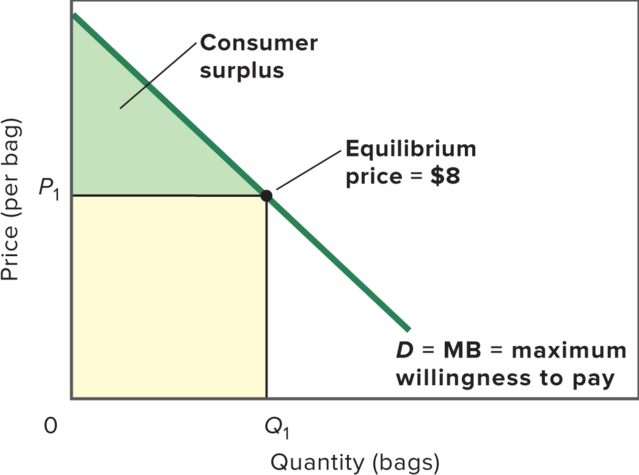
consumer surplus
the difference between the maximum price a consumer is (or consumers are) willing to pay for an additional unit of a product and its market price; the traingular area below the demand curve and above the market price

producer surplus
the difference between the actual price a producer receives and the minimum acceptable price; the triangular area above the supply curve and below the market price
productive efficiency
the production of a good in the least costly way; occurs when production takes place at the ouput level at which per-unit production costs are minimized
allocative efficiency
the apportionment of resournces among firms and industries to obtain the production of the products most wanted by society (consumers), the output of each product at which its marginal cost and marginal benefit are equal, and at which the sum of consumer surplus and producer surplus is maximized
efficiency loss
reductions in combined consumer and producer surplus caused by an under-allocation or over-allocation of resources to the production of a good or service (aka deadweight loss)
deadweight loss
a reduction in the total net benefit that society can obtain from its limited supply of resources. Caused by an under-allocation or over-allocation of resources to the production of a particular good or service (aka efficiency loss)
externality
a cost or benefit from production or consumption that accrues to someone other than the immediate buyers and sellers of the product being produced or consumed
negative externality
a cost imposed without compensation on third parties by the production or consumption of sellers or buyers (also known as external or spillover cost)
Ex: A manufacturer dumps toxic chemicals into a river, killing fish prized by sports fishers
positive externality
a benefit obtained without compensation by third parties from the production or consumption of sellers or buyers (also called external or spillover benefit)
Ex: A beekeeper benefits when a neighboring farmer plants clover
direct controls
government policies that directly constrain activities that generate negative externalities
Ex: maximum emissions limits for factory smokestacks and laws mandating the proper disposal of toxic wastes
Pigovian tax
a tax or charge levied on the production of a product that generates negative externalities; if set correctly, the tax will precisely offset the overallocation (overproduction) generated by the negative externality
Coase theorem
the idea, first stated by economist Ronald Coase, that some externalities can be resolved through private negotiations among the affected parties
optimal reduction of an externality
the reduction of a negative externality such as pollution to the level at which the marginal benefit and marginal cost of reduction (abatement) are equal
asymmetric information
a situation where one party to a market transaction has more information about a product or service than the other. The result may be an under or overallocation of resources
private information
facts known by one party to a market transaction but hidden from others; results in asymmetric information
moral hazard problem
the possibility that individuals or institutions will behave more recklessly after they obtain insurance or similar contracts that shift the financial burden of bad outcomes onto others
Ex: A bank whose deposits are insured against losses may make riskier loans and investments
adverse selection problem
a problem arising when information known to one party to contract or agreement is not known to the other party, causing the latter to incur major costs
Ex: Individuals who have the poorest health are most likely to buy health insurance