Motivation and emotion
 Call Kai
 Learn
 Practice Test
 Spaced Repetition
 Match
 Flashcards
 Knowt Play
1/31

There's no tags or description
Looks like no tags are added yet.
Name | Mastery | Learn | Test | Matching | Spaced | Call with Kai | Chat |
|---|
No analytics yet
Send a link to your students to track their progress
32 Terms
Motivation
Purposeful, goal-directed behaviour
Emotion
Cognitive interpretation of subjective feelings
Behaviour
Reflects neural activity, sensory needs, evolutionary influences and environmental learning
Sensory deprivation
Illustrates that the brain seeks stimulation
Innate releasing mechanisms (IRMs)
Inborn triggers for adaptive responses that support survival, feeding, escape and reproduction
· E.g. kittens react defensively to a threatening cat posture
Environmental influences
· Skinner: consequences shape behaviour and reinforcement increases the likelihood that a behaviour will recur
· Learned taste aversion: food taste becomes associated with subsequent illness which changes later food choice
Regulatory vs non-regulatory behaviour

Homeostasis
Maintaining essential bodily variables within a narrow range
Key neural circuits in motivation
1. Hypothalamus/pituitary
2. Limbic system
3. Frontal lobes
Limbic and frontal regions together
Project to the hypothalamus - linking emotional significance and cognitive control with bodily responses
Hypothalamus
· Links nervous and endocrine systems via pituitary
· Influences hormone release, circadian rhythms, food intake, fear, defence and sexual behaviour
· Different hypothalamic stimulation sites evoke different goal-directed responses
· Communicates with pituitary via neural connections and releasing hormones carried in blood
· Endocrine output is influenced by feedback loops, neural input and experience

Hypothalamic regions
1. Lateral
2. Medial
3. Periventricular
Medial forebrain bundle (MFB)
Connects brainstem/limbic systems with forebrain regions and contributes to motivated behaviours including eating, sex and addiction
Feedback loops
Regulate when neural activity or hormone release starts/stops
· E.g. suckling → tactile input → hypothalamic oxytocin release → milk let-down
· Experience can alter hypothalamic neurons
· Oxytocin-producing cells enlarge during lactation
Limbic system
· Interconnected structures including amygdala, hippocampal formation and cingulate cortex
· Connections to hypothalamus coordinate emotion, memory, motivation and physiological responses
Frontal cortex
· Reasoning, planning and self-control shape whether and how motivated behaviour is expressed
· Orbitofrontal regions participate in food-related decisions
Eating
· Both homeostatic and rewarding
· Hypothalamic signals interact with digestive information, cognitive expectations, learned associations and dopamine-mediated reward

Thinking about food
· Activate reward systems and increase hunger
- Larned taste aversion can reduce consumption
· Amygdala and orbital prefrontal cortex influence food preference
- Amygdala damage can abolish taste-aversion learning
Clinical associations
· Obesity research considers DLPFC-related self-control and dopamine responses
· Anorexia nervosa research links food choices with dorsal striatum and frontostriatal habit circuits
Drinking
Regulatory behaviour associated with hypothalamic homeostatic control
Gonodal hormones
· Developmental gonadal hormones influence differentiation of sex-related neural circuits
· Adult gonadal hormones influence sexual behaviour
- In rats, ovarian hormone changes are linked with changes in hippocampal dendritic spines
Sexual behaviour structures

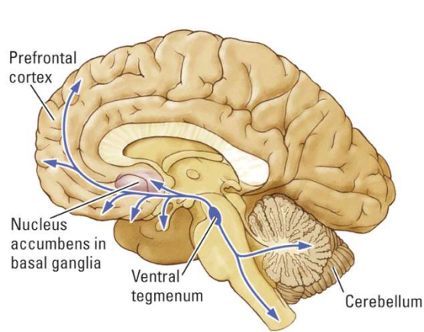
Mesolimbic pathway
Dopaminergic projections begin in the ventral tegmental area (VTA) of midbrain and involve nucleus accumbens, amygdala, hippocampus and medial prefrontal regions
· Linked to reward and pleasure
Olds and Milner (1954)
Rats repeatedly pressed a lever for electrical stimulation of particular brain sites - demonstrating strong reinforcement by brain stimulation
Wanting
Incentive motivation to obtain a reward
Liking
Pleasure/evaluation when receiving it
**Both usually co-occur but can dissociate and involve partly separable systems
Limbic system
Interconnected brain structures involved in emotion, motivation and memory.
· Structures: Amygdala, hippocampus, cingulate cortex and hypothalamus
· Integrates emotional and motivational information to influence behaviour
· Communicates with the prefrontal cortex and hypothalamus to coordinate behavioural and physiological responses

Amygdala
Bilateral groups of nuclei deep in medial temporal lobes involved in fear, anxiety, anger, emotional memories and decisions
· Stimulation evokes fear and aggression
· Connections to hypothalamus and prefrontal cortex link emotion with bodily responses and regulation
Emotion
1. Autonomic responses: heart rate, hypothalamus
2. Subjective feelings: fear, amygdala/frontal regions
3. Cognitions: interpretations in cerebral cortex
James–Lange account
Bodily/autonomic changes occur first and the brain interprets these as emotion
Somatic marker hypothesis
Emotion-related bodily signals guide decisions
· Spinal cord injury may blunt reported emotional intensity
- Higher lesions are described as having greater effect
· Supports a contribution of bodily feedback
Bilateral amygdala damage
Reduced fear, hyperorality, hyperphagia, hypersexuality and memory difficulties