The Visual System
 Call Kai
 Learn
 Practice Test
 Spaced Repetition
 Match
 Flashcards
 Knowt Play
1/33

There's no tags or description
Looks like no tags are added yet.
34 Terms
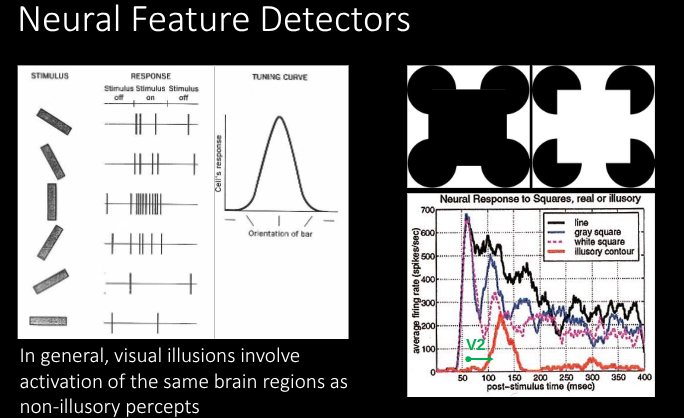
What are neural feature detectors?
Who was patient LM (Zihi, 1983)
Kinetopsia
No impression of motion, difficulty distinguishing moving vs. stationary object
No motion aftereffect, no illusory motion
Can detect movement by hearing and touch
Where does most visual processing occur?
The retina → e.g. encoding of simple features (spots of light, edges, colour)
What is the function of cones in the retina?
Sensitive to different wavelengths of light
Describe the transfer of visual information from streams of action potentials (information encoded by retina) to the brain (via the optic nerve)
Optic nerve travels from each eye to lateral geniculate nucleus (thalamus → receives input from all senses but smell)
Signal travels to primary visual cortex (back of brain)
Info is systematically mapped into a rep of the visual scene
Half of the axons in the optic nerve come from RGCs that code info in the RVF + half codes info in the LVF
Both nerve bundles link to each hemisphere (respectively)
Describe the initial processing region in the visual system
Area V1 → has a topographic visual organisation (adjacent neurons process adjacent portions of the visual field)
Central portion of the VF that corresponds to the input from foveal cells is greatly enlarged → TVO is somewhat distorted
After area V1, how many additional brain areas are thought to be specialised for vision? Where are they located?
30-50 inn the occipital lobe + temporal lobes (Orban, 2004; van Essen, 1992)
How do neurons in the visual cortex selectively respond to bars + edges in specific orientations in space?
Area V1 contains populations of neurons → each ‘tuned’ to respond to edges oriented at each position in the visual field
Some fire when an object is perceived in a vertical orientation
Other neurons fire when an object is perceived in a horizontal orientation
Other neurons fire when objects in a diagonal orientation of 45° are perceived etc
Combine output → pattern of activation codes for varying features of objects
What has a Transcranial Magnetic Stimulation (TMS) been used to show? What does this suggest?
A person can recognise what an object is but not perceive that it's moving
Suggests 1 brain system identifies people/things + another tracks their movements/guides one’s own movements in relation to them
Visual streams project from the occipital cortex to visual areas in other parts of the brain
Describe the organisation of visual processing
Dorsal stream → travels up from occipital love to parietal lobes → identifies objects location + motion (spatial relations)
Dorso-dorsal stream → visually-guided action/reaching
Where/how
Ventral stream → T=travels across the occipital lobe into lower levels of temporal lobes → object’s shape + identity (what)
Ventral-dorsal stream → skilled object use

Ventral and dorsal streams (diagram)

If you damage either the ventral or dorsal streams, is the other impaired? Why or why not?
No → are functionally distinct
What evidence is the of the functional distinctiveness of the dorsal and ventral streams?
Goodale et al. (1991)
DF → CO exposure → damage to lateral occipital cortex (active when recognising objects)
Couldn't recognise by sight, only touch → visual rep of objects (not memory) was damaged
Could guide actions by sight
Couldn't report orientation but could insert the card correctly
Conscious understanding of what she was seeing was greatly impaired BUT ability to use this same info nonconsciously to guide her movements remained intact
Normal activation of regions within dorsal stream during guided movement
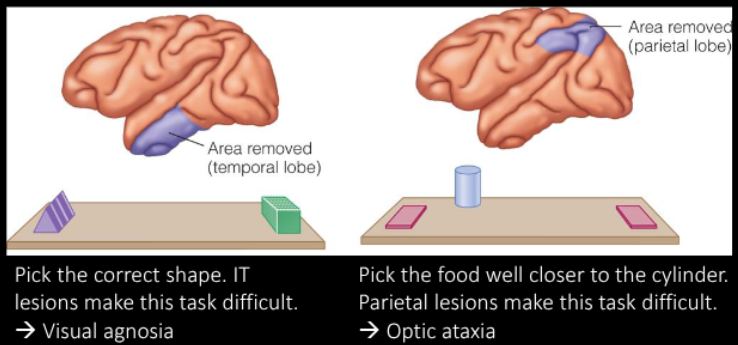
Visual form agnosia = inability to recognise objects by sight
Optic ataxia = difficulty using vision to guide their reaching + grasping movements (damage to parietal section of dorsal stream)
How do the dorsal and ventral streams work together?
Some regions within the dorsal stream are sensitive to properties of an object’s identity
E.g. respond differently to line drawings of the same object in different sizes or viewed from different vantage points (Konen and Kastner, 2008)
The sensitivity of some regions within the dorsal stream to aspects of object identity may allow the dorsal + ventral streams to exchange info → integration of ‘what’ + ‘where/how’ (Farivar, 2009; Konen + Kastner, 2008)
Evidence by fMRIs
What was Farrant and Uddin’s (2015) research into the dorsal and ventral streams? What does it suggest?
Adults showed greater functional connectivity of regions within the ventral network
BUT children showed greater functional connectivity of regions within the dorsal network
Shift from bottom-up attention mechanisms (attributed to the dorsal system) to greater top-down attentional capacities (ventral system) with age
What did Gibson argue about perception and movement?
We must perceive in order to move, but we must move in order to perceive
Perception = process of establishing how the physical world can afford opportunities for action
Affordances = potentials for possible actions by agents acting on the environment
E.g. door handle offers an affordance for how it can be gripped by the hand
We direct attention to relevant objects by the affordances they provide
Perception is direct + doesn’t depend on cognitive processes to interpret the patterns
How is Gibson’s argument supported by researched?
Much of the research role of attention tends to use 2-D images of objects (Eriksen and Eriksen, 1974) → don’t provide rich info in terms of affordances
E.g. Gomez (2018) → studies where PPTs must reach towards real objects reveal that interference from adjacent objects is much stronger than in trials where PPTs reach towards 2-D reps of objects that are flanked by 2-D distractor objects
Real objects produced slower reaction times + elicited greater flanker interference effects compared to both the 2-D + 3-D images
What is involved in tool use? How is this supported by research into chimpanzees?
Needs ‘where/how’ processing to hold/manipulate tool + ‘what’ processing to recognise the tool/know what it’s for
Chimps use tools (some are better than others)
Tool use ability is correlated with grey matter volume in the ventro-dorsal stream (Hopkins, 2019; Mulholland, 2022)

What do cells in V5/MT respond to?
90% respond to particular directions of movement BUT none respond to colour
What does area V4 compute?
The colour of the object taking into account variations in lighting conditions
What is colour constancy?
Cells in V4 continue to respond to the same surface colour if the light source is changed (cells in V1 don’t)
What was Zeki’s (1991) PET study?
Coloured images compared to grey-scale equivalents → area V4 active
Moving dots compared to static dots → area V5/MT active

What are double dissociations?
Lesion studies in humans
Recognizing familiar faces vs. matching unfamiliar faces (face constancy)
Recognizing familiar faces vs. recognizing emotion, age, or sex
Recognizing familiar faces vs. lip-reading
E.g. single-unit recording + ablation studies in monkeys
What was De Renzi’s (1986) research into double dissociations?
Patient failed to recognise his own family but could do so by voice, clothes
E.g. “are you…? [wife’s name] I guess you are my wife because there are no other women at home, but I want to be reassured”
Could match different views of faces and name other objects
Areas in the visual system (diagram)

What is the function of the visual word form area?
Responds to written words more than to consonant strings
Damage → pure alexia (letter-by-letter reading)

What was Hehaene’s (2015) research into the visual word form area?
Response + learning to read

What was Vinckier’s (2007) research into visual word recognition?

In which hemisphere is the visual word form area located?
Left hemisphere
What is the function of the fusiform face area?
Responds to faces more than other types of objects in functional imaging experiments (Kanwisher)
BUT this may be a relative difference between faces + objects rather than an absolute difference
Gauthier (1999) → expert Greeble perception also exhibits various behaviour hallmarks of (holistic) face perception

In which hemisphere is the fusiform face area located?
Right hemisphere
In visual organisation, what is the argument from lack of imagination? What should be asked instead?
“I can’t explain it, so it must be special/innate”
Hard (impossible?) to find stimuli that are just like faces (in terms of processing, difficulty, etc.) but that aren’t faces (can’t be disproven)
Alt q: what is the minimum that must be special/innate?
Which abilities have similar visual and computational demands? What does this suggest?
Word recognition + face recognition
Suggests functional specialisation is an emergent property of interactions between task demands + visual system
What is emergent specialisation?
Visual system needs to do (at least) two very different tasks, which have different computational demands
Object recognition: location-invariant; size-invariant
Object localisation: object-invariant; specific to location, size + shape
Task decomposition
VWFA + FFA
Complementary memory systems