Biogeochemistry Quiz 2
 Call Kai
 Learn
 Practice Test
 Spaced Repetition
 Match
 Flashcards
 Knowt Play
1/62

There's no tags or description
Looks like no tags are added yet.
63 Terms
Primary production
Algae and aquatic plants use sunlight and nutrients to produce organic matter through photosynthesis.
Decomposition
Bacteria break down dead organisms and organic material, recycling nutrients
Stratification
Lakes separate into three distinct thermal layers
Epilimnion: Warm, upper layer.
Metalimnion: Middle transition layer.
Hypolimnion: Cold, deeper layer.
Turnover
Seasonal mixing redistributes oxygen and nutrients throughout the lake.
What do rivers do?
Transport water and materials from land toward lakes, estuaries, and oceans.
They carry:
Dissolved nutrients
Organic carbon
Suspended sediments
Minerals
Pollutants
Estuary
where freshwater from rivers mixes with saltwater from the ocean.
How does fertilizer runoff change the environment
Farmers apply fertilizers to help crops grow.
Rain washes extra fertilizer off fields and into nearby rivers and lakes.
Fertilizers contain nitrogen and phosphorus, which are nutrients.
Too many nutrients cause excessive algae growth (algal blooms).
When algae die and decompose, bacteria consume oxygen.
Result: Eutrophication, which can lead to low oxygen and fish kills.
What does wastewater discharge do to the environment
Wastewater comes from homes, businesses, and industries.
It can contain human waste, food particles, detergents, and other organic material.
When discharged into waterways, it adds nutrients and organic matter.
Bacteria decompose the organic matter, using up dissolved oxygen.
Result: Lower oxygen levels, potentially harming aquatic organisms.
What does deforestation do to the environment
Trees and plants hold soil in place with their roots.
When forests are removed, soil becomes exposed.
Rain washes the loose soil into nearby waterways.
This increases sediment (soil particles) entering rivers and lakes.
Result: Cloudier water, reduced light penetration, and sediment can smother aquatic habitats.
What do dams do to the environment
Dams block or control the natural flow of rivers.
Water backs up behind the dam, creating a reservoir.
Sediment that would normally travel downstream settles behind the dam.
Water released downstream may carry less sediment and have altered flow patterns.
Result: Changes to aquatic habitats, nutrient movement, and downstream ecosystems.
What does industrial pollution do to the environment
Factories and industrial facilities can release pollutants.
These may include heavy metals (mercury, lead), solvents, and other toxic chemicals.
These substances can enter rivers, lakes, and groundwater.
Some toxins accumulate in organisms and become more concentrated up food chains.
Result: Harm to aquatic organisms, reduced biodiversity, and potential contamination of drinking water.
What does Urbanization do to the environment
Urbanization means building more roads, parking lots, buildings, and sidewalks.
These surfaces are impermeable, meaning water cannot easily soak into the ground.
Rainwater flows over these surfaces instead.
It picks up oil, road salt, trash, fertilizers, and other pollutants.
Result: More stormwater runoff, flooding, and pollution entering waterways.
Eutrophication
Occurs when excessive nutrients enter an aquatic ecosystem.
1. Excess nutrients enter the water
2. Algal bloom occurs
3. Algae die and decompose
4. Dissolved oxygen decreases
5. Hypoxia and fish kills
What is hysteresis?
When an ecosystem does not return to its original state even after the original environmental stress is removed. Recovery may require additional intervention.
How does water age influence stream chemistry?
Older water has more time to interact with soil and minerals, increasing solute concentrations.
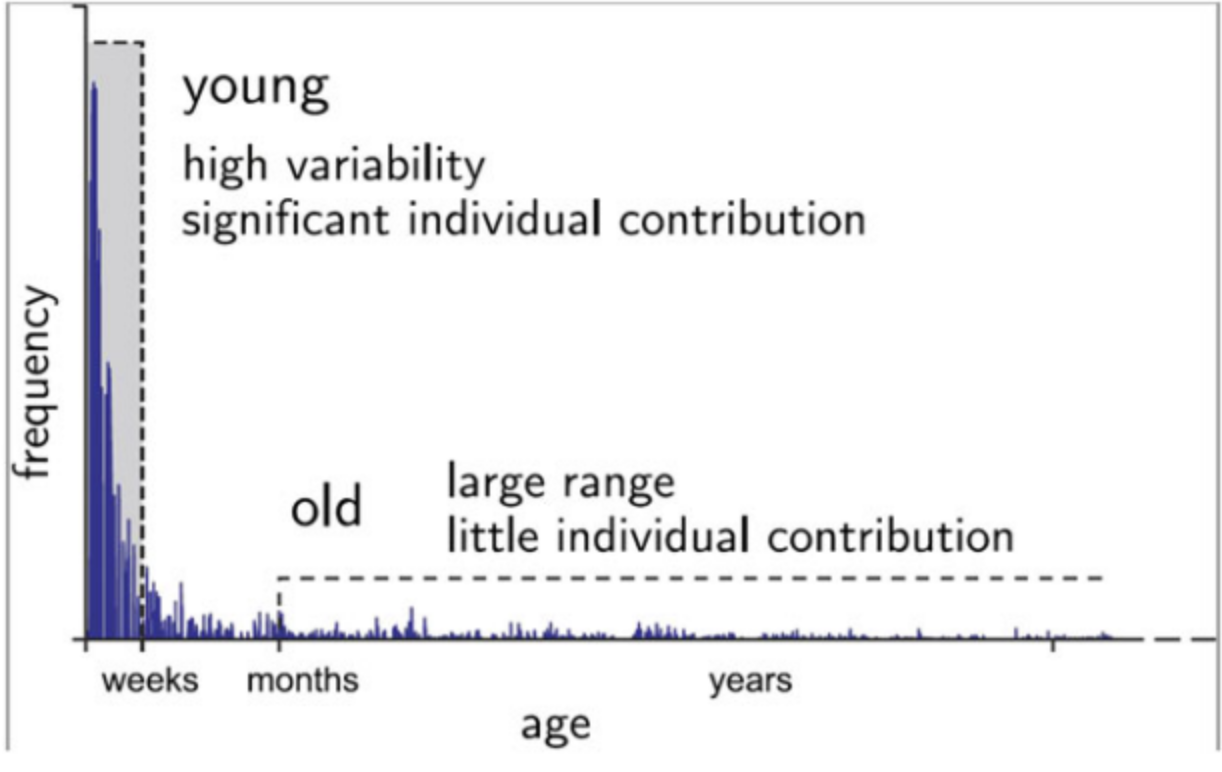
What is this?
Old water is spread super thin across thousands of past days—so no single past rainstorm matters much on its own, even though all those old storms combined provide a massive, steady base of water for the stream.
Young water is concentrated in a few intense, spiky bursts (a few specific recent rainstorms make up a huge chunk of the stream).

What is this?
Young water is volatile: It comes in huge, sudden bursts during storms. Because it changes so fast, it is the main driver of sudden changes in the stream.
Old water is steady: Even though old water spans years, each individual year only contributes a tiny trickle. Together, all those years add up to a steady, reliable background flow.
Q [mm/d] = How much total water is flowing in the stream (the discharge/streamflow).
Q Fraction= How much of the total water is young water

What is this?
Before a storm (Top Left): Flow (Q) is low, young water is near 0%, and silica concentration is high (~2.5 mg/L) because the stream is full of mineral-rich old groundwater.
During a storm (Moving Right and Down): Flow (Q) surges, fresh rainwater (< 13d) floods in (blue line drops down toward 0.4, meaning 40% young water), and that fresh rainwater dilutes the stream, causing silica (Si) to drop down to ~1.7 mg/L.
After the storm (Moving Left and Up): As shown in the tiny inset graph in the bottom-left corner, as streamflow (Q, gray) drops back down in late April/May, the young water slowly drains out and silica (Si, black/red) climbs back up
The vadose zone
The underground layer of soil and rock between the ground surface and the water table (where true groundwater begins).
CPOM
Coarse Particulate Organic Matter
Big chunks of dead stuff, like whole fallen leaves, twigs, and pine needles.
FPOM
Fine Particulate Organic Matter
Crumbs. Bugs and rushing water shred those whole leaves
CPOM is eaten to form FPOM
DOM
Dissolved Organic Matter
Water washes over the leaves and soil (leaching), dissolving organic carbon invisibly into the water
(DOM) acts as a pH buffer because its molecules contain abundant weakly acidic functional groups—primarily carboxylic acids (−COOH) and phenolic hydroxyls (−OH)—that can reversibly bind or release hydrogen ions (H+) when the surrounding water becomes more acidic or more alkaline.
DIC
Dissolved Inorganic Carbon
CO₂(aq) – dissolved carbon dioxide
H₂CO₃ – carbonic acid
HCO₃⁻ – bicarbonate
CO₃²⁻ – carbonate
Autochthonous Carbon
Carbon made inside the water by underwater algae and plants using sunlight.
Allochthonous Carbon
Carbon washed in from outside the water (from the surrounding forest and soil).
R auto
Autotrophic Respiration
Plants and algae breathing out CO2
R hetero
Heterotrophic Respiration
Animals and bacteria breathing out CO2
R photo
Photooxidation
Sunburn for molecules. Harsh sunlight hits the "leaf tea" (DOM) and breaks it down directly into CO2
Pelagic
Open Water (swimming or floating in the middle of the lake/river, like fish and plankton)
Benthic
Bottom of the Water (crawling on or living in the mud/rocks at the bottom, like snails, clams, and mud bacteria)

What is this?
Riverine (Left): Narrow, fast-flowing river water entering the system.
Transition (Middle): Where the river widens and begins to slow down.
Lacustrine (Right): Calm, deep, lake-like water (like behind a dam).
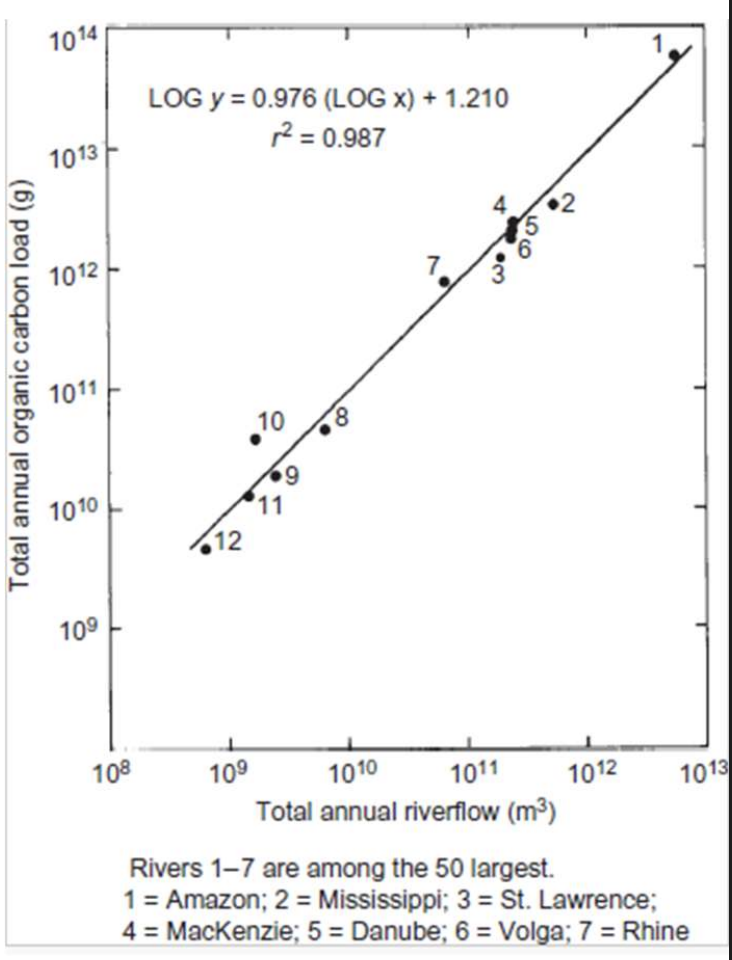
What is this?
Even though rivers flow through completely different climates—from the tropical Amazon (1) to the Arctic MacKenzie (4)—the sheer volume of water (Total annual riverflow) is the #1 factor controlling how much organic carbon a river exports.
Nutrient spiraling
the process of nutrients moving downstream through a stream or river while repeatedly being taken up by organisms, released back into the water, and reused.

What is this?
This graph represents nutrient spiraling
Starts in the Water (×): A dissolved nutrient atom enters the flowing stream water.
Uptake (Ux): As it washes downstream, algae, bacteria, or plants on the bottom grab it (Uptake), pulling it out of the water and into the Sediments.
Stays in the Sediments: It gets used by bottom organisms (eaten by bugs, stored in algae, etc.) while slowly moving or sitting in the mud.
Release / Remineralization (Rx): Eventually, those bottom organisms die, poop, or breathe it back out (Release), sending the nutrient back up into the flowing Water to start the cycle all over again further downstream.
Sw (Water Uptake Length): The distance the nutrient travels in the open water before getting grabbed by the streambed.
SB (Benthic / Sediment Turnover Length): The distance the nutrient travels while trapped in the bottom sediments/organisms before being released back into the wate
S (Total Spiraling Length): The total downstream distance for one full cycle (S = SW + SB).
Aridity
Aridity describes how dry an environment is.
High aridity = very dry conditions, with little water available.
Low aridity = wetter conditions, with more water available.
Precipitation vs PE

What is this?
Y-axis= Annual Primary Production
Insolation= total sunlight hitting the lake. More sunlight = more photosynthesis and growth.
MAWT= Mean Annual Water Temperature. Warmer water speeds up biological activity, so warmer lakes produce much more carbon.
Z avg = average lake depth in meters. Deeper lakes have lower productivity per square meter because algae get mixed down into dark water where sunlight can't reach
Larger surrounding watersheds (or higher watershed-to-lake ratios) wash more nutrients into the lake, boosting algae growth
Oligotrophic
Very low nutrients (Total P and Total N are tiny), so almost no algae can grow
What it looks like: Deep, cold, crystal-clear blue mountain lakes (like Lake Tahoe or Crater Lake). Sunlight reaches way down
Mesotrophic
What it means: Moderate nutrients and moderate algae growth
What it looks like: Clear enough to swim in, with some underwater plants and healthy fish populations, without turning into pea soup
Eutrophic
What it means: Packed with nutrients (phosphorus and nitrogen), fueling massive algae blooms
What it looks like: Warm, shallow, murky green water ("pea soup") where light gets blocked near the surface
Dystrophic
Low nutrients and low algae (like an oligotrophic lake), except it is loaded with Total organic carbon
What it looks like: Dark, root-beer or tea-colored water. Even though there isn't much algae, the dark brown color blocks sunlight
Littoral
The shallow, sunlit shoreline edge where rooted plants can grow
Profundal
The deep, dark open-water zone below where sunlight can reach
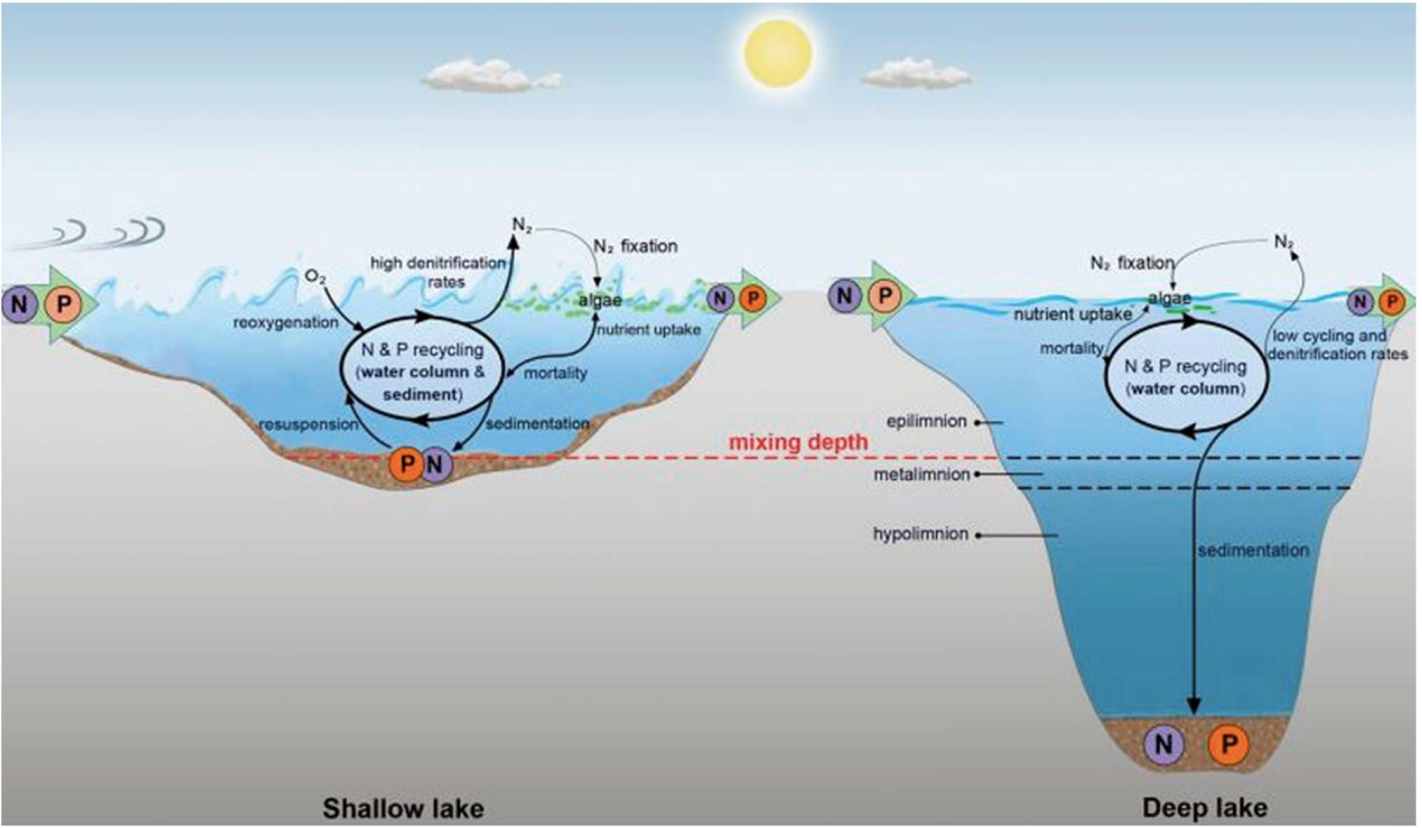
What is this
Deep lake
One-way trap (sedimentation): When algae in the warm top layer die (mortality), they sink past the mixing line all the way into the cold bottom mud (N P).
Stuck at the bottom: Because wind cannot reach down there, those nutrients stay trapped on the deep floor instead of returning to the algae at the top (low cycling and denitrification rates).
Result: Deep lakes have much lower algae growth because their nutrients keep sinking out of reach
Shallow
Wind stirs the mud (resuspension): Whenever algae die and sink (sedimentation), wind immediately kicks those N and P nutrients back up off the bottom.
Fast recycling (N & P recycling): Because the water and mud are constantly mixing (reoxygenation), nutrients stay in the sunlit zone where algae can immediately eat them again (nutrient uptake).
High nitrogen loss (high denitrification rates): Bacteria rapidly convert nitrogen back into N2, which escapes into the air.
Result: Shallow lakes keep recycling their nutrients over and over, making them very productive and prone to algae blooms.

What is this
The top graph represents a fully mixed lake
Temperature (
T): Uniformly cool (~17°C) from top to bottom because wind is stirring the entire lake.Dissolved Oxygen (
DO): Plenty of oxygen (~8–9 ppm) all the way to the bottom.Redox (
pe): High and steady all the way down.Methane & Sulfide: Zero—because oxygen is everywhere.
Bottom graph represents a stratified lake
Epilimnion(0 to ~15 m): Warm (~29°C), wind-mixed surface water.The sharp bend (~15 to 20 m): The metalimnion, where temperature plunges rapidly.
Hypolimnion(20 to 40 m): Cold (~17°C), trapped bottom water cut off from the air.Oxygen (
DO) crashes to ZERO: Above15 m, oxygen is plentiful (~6–7 ppm). Right at15 m, bacteria eating dead sinking algae use up all the oxygen, and because the layer is sealed off from the surface,DOdrops completely to0 ppm.Redox (
pe) plunges: Because oxygen is gone,pedrops sharply around17 m.Toxic/anaerobic gases appear (
CH₄andS(-II)): Below17–20 m, whereDOis zero, anaerobic mud bacteria take over and start producing methane (CH₄) and sulfide (S(-II)), which build up near the bottom.
Cyanobacteria
microscopic, photosynthetic bacteria that live in water. Even though people call them "algae" because they float in lakes and make water look green, biologically they are actually bacteria—not true algae or plants.
What does DOM do to the water
DOM has a yellowish brown color
Because the water is stained dark, it absorbs sunlight near the surface. Both visible light and ultraviolet (UV) rays are blocked from traveling deep down, leaving the deeper water dark.
Underwater plants and algae cannot do photosynthesis without the light in the deep water
Potential evapotranspiration (PET)
The amount of water that could be lost through evaporation and plant transpiration if water availability were unlimited.
Monomictic
A lake that mixes completely from top to bottom once per year.
What pH are the main forms of DIC in?
>4.3- CO2
pH 4.3-8.3- Bicarbonate
pH above 8.3` is carbonate
Lake Whiting
In the summer there is more photosynthesis meaning less CO2 which makes the lake more basic, and there is more CO3 and more CaCO3. The CaCO3 precipitates into the lake as white.
phytolith
tiny particle of silica (silicon dioxide) that plants absorb from the soil and deposit in their tissues.
Good for cell walls (plant structure)
Good for plant defense
Si Cycle
Plants Create a Massive Biogenic Silica Reservoir: Terrestrial plants absorb dissolved silicate from soil water through their roots and deposit it inside their tissues as microscopic, amorphous silica bodies called phytoliths
Soils Act as a Long-Term Silica Bank: When plants die and decompose, their phytoliths accumulate in the topsoil.
Land Controls River Export: Land plants use about as much silica as ocean diatoms, acting as a filter that regulates how much silica enters rivers rather than rock weathering alone.
Human & Climate Impact: Farming, logging, and dams drain soil silica, starving coastal diatoms and skewing climate estimates of CO2 removal via rock weathering.
Dissolved Silica (DSI)
What it is: Silica dissolved in water, primarily in the form of silicic acid
Where it comes from: Released when rainwater chemically weathers silicate rocks on land, or when dead phytoliths and diatom shells dissolve back into water.
Role: It is the only form of silica that plants and algae can actively absorb and use.
Biogenic Silica (BSi)
What it is: Solid, glass-like (amorphous) silica built by living organisms out of absorbed
Examples: Phytoliths inside terrestrial plants and soils, and frustules (shells) built by aquatic diatoms, sponges, and radiolarians.
Role: Acts as the biological storage pool on land and in ocean sediments.

What is this?
Adding both N and P together (+N,P) produces a massive growth spike in every single environment—far greater than adding either nutrient alone.
Carbon Isotopes
C12 is very abundant in OM
Microbes prefer C13
C13 has selective uptake by plants
Photosynthesis has less C13
Decomposed OM has more C13
Sulfate
SO42- (highest oxidation state)
Sulfite
SO2
Sulfide
S2- (Lowest oxidation state)
C/N Molar Ratio
(g carbon/12.011) / (g nitrogen/ 14.007)