parasitology practical
 Call Kai
 Learn
 Practice Test
 Spaced Repetition
 Match
 Flashcards
 Knowt Play
1/21

There's no tags or description
Looks like no tags are added yet.
22 Terms

Identify:
Genus:
Conditions/Diseases:
Vectors:
Leishmania
Genus: Leishmania
Conditions/ Diseases: Leishmaniasis- Multiple species of this genus cause a complex of diseases and fare grouped according to the lesion types (cutaneous,
mucocutaneous, or visceral) they cause
VISCERAL LEISHMANIASIS: L.DONOVANI (“KALA-AZAR”)
Recurrent fever
Loss of appetite
Weakness
Spleen enlargement
Anemia
Vectors: Transmitted by blood-feeding sand flies (Phlebotomus spp.)

Identify:
Genus:
Conditions/Diseases:
Vectors:
Trypanosoma
Genus: Trypanosoma
Vectors: tsetse flies and kissing bugs
Conditions/ Diseases: (2)-African Sleeping Sickness and Chagas Disease
African sleeping sickness
T. brucie gambiense
Fever
Headaches
Joint pain
Swollen lymph nodes
Confusion
Personality changes
Sever circadian rhythm disruption
Chagas Disease
Trypanosoma cruzi
Transmitted by kissing bugs
Fever
Fatigue
body aches
rash, enlarged lymph nodes
Enlarged heart
Heart failure
Enlargement of the esophagus or colon causing severe swallowing or bowel difficulties
Genus:
Conditions/Diseases:
Vectors:
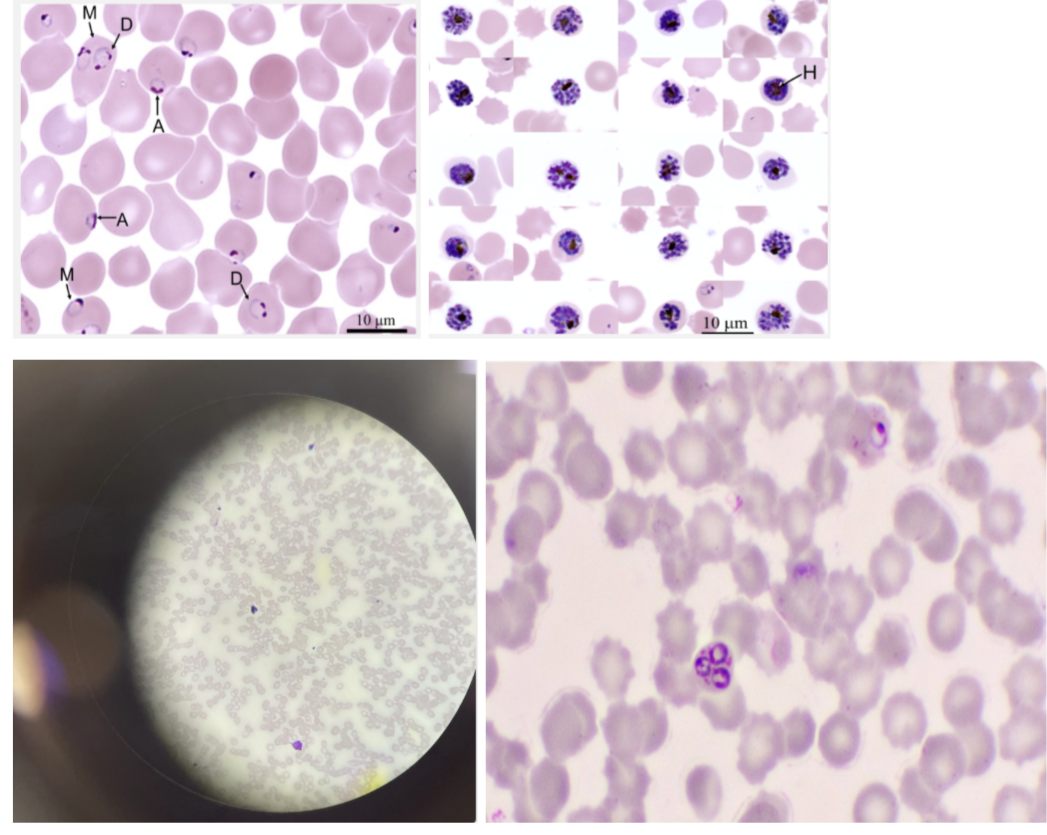
Plasmodium
Genus: Plasmodium
Conditions/ Diseases: Malaria-
cyclic attacks of shaking chills
high fever and sweating
Headaches
Fatigue
muscle/joint pains
Nausea
Vomiting
dizziness
Severe anemia
Jaundice
enlarged spleen or liver
kidney failure
Confusion
seizures or cerebral malaria
Vectors: mosquitoes
they just look like darker stained spots among the blood cells

Genus:
Conditions/Diseases:
Vectors:
Giardia
Genus: Giardia
Conditions/ Diseases: Giardiasis
Diarrhea
Stomach cramps
Nausea
fatigue
Vectors: contaminated water- fecal oral route

Identify:
Genus:
Conditions/Diseases:
Vectors:
Entanomoeba
Genus: Entamoeba
Conditions/ Diseases:
Entamoeba histolytica- amebic dysentery
bloody diarrhea
stomach cramping
Fever
Nausea
Fatigue
Vomiting
Entamoeba Ginigivalis
Swollen, puffy, or enlarged gums
Discolored gums
Gums that bleed easily when brushing or flossing
Tenderness or pain in the gums when touched or while eating
Persistent bad breath (halitosis)
Pyorrhoea or severe tissue destruction
Vectors: fecal-oral route


Phylum:
Class:
Basic Body Structures:
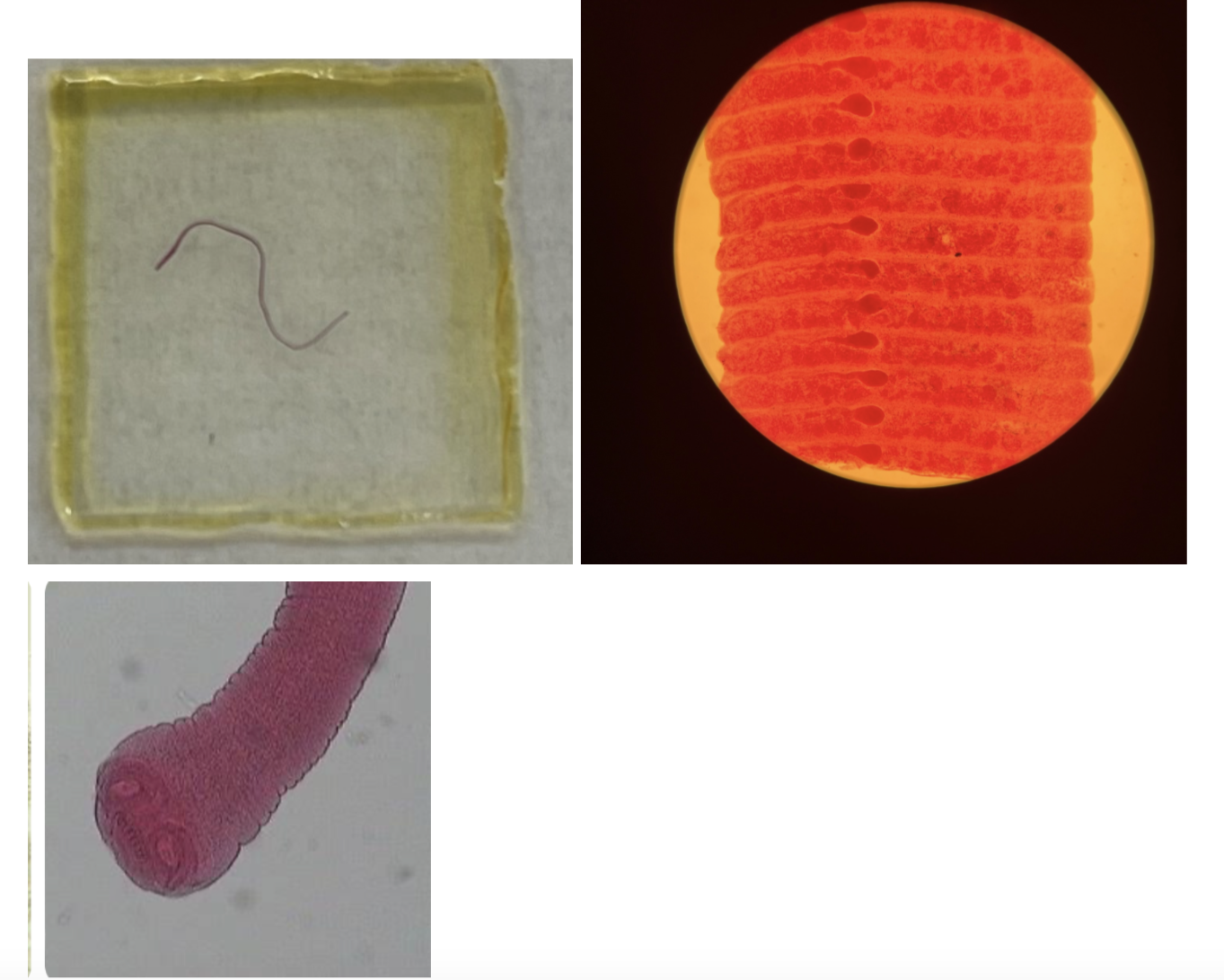
Taenia-tapeworms
Phylum: Platyhelminthes
Class: Cestoda
Basic body structures:
Scolex: The "head" or anterior anchoring organ. Look for circular suckers and, a ring of hooks used to attach to the host's intestinal wall.
Neck: The short, unsegmented, and narrow region directly behind the scolex. This is the growth zone where new body segments are actively generated.
Proglottids: The individual, repeating segments that make up the rest of the worm's body (collectively called the strobila).

Phylum:
Class:
Fasciola
Phylum: Platyhelminthes
Class: Trematodes

Phylum:
Class:
Clonorchis
Phylum: Platyhelminthes
Class: Trematodes

Phylum:
Class:
Basic Body Structures:
Diphyllobothrium
Phylum: Platyhelminthes
Class: Cestoda
Basic Body Structures:
Scolex: The "head" or anterior attachment organ. It features hooks, suckers, or slit-like grooves used to anchor the worm to the host's intestinal wall.
Neck: The narrow, unsegmented region directly behind the scolex.
Proglottids: The individual segments making up the rest of the body.
Phylum:
Class:
Basic Body Structures:
Hymenolepis
Phylum: Platyhelminthes
Class: Cestoda
Basic Body Structures:
Scolex:The scolex is the anterior-most anchoring organ used by the worm to attach to the host's intestinal mucosa.Features a "tetrad" of four muscular suckers. It also features a retractable snout called a rostellum.
Neck: The neck is the short, narrow, and unsegmented region directly behind the scolex
Proglottids: The individual segments making up the rest of the body.

Phylum:
Genus:
Nematoda
Trichinella
Often shown as larvae tightly coiled or encysted within skeletal muscle tissue ("nurse cells").

Phylum:
Genus:
Nematoda
Enterobius
Common Name: Pinworm. Often recognized by a clear, sharply pointed tail on the slide.

Phylum:
Genus:
Latin binomial:
Ascaris lumbricoides
Identification Level: Must know the full species name: Ascaris lumbricoides.
Visual Key: This is the large, whole specimen roundworm you dissected in lab. Look for a distinct, smooth, cylindrical body.

Phylum:
Genus:
Nematoda
Necator and Ancylostoma are hematophagous hookworms with a curved anterior end that feed on blood. Look for a distinct "hooked" anterior end with cutting plates or teeth under the microscope.

Order:
Class:
Group:
Order: Acari
Class: Arachnida
Group: Hard Ticks Ixodidae

Order:
Class:
Group:
Common name:
Order: Acari
Class: Arachnida
Soft Ticks Argasidae

Order:
Class:
Common name:
Mites
Order: Acari
Class: Arachnida

Order:
Latin binomial:
Common Name:
Mites
Order: Acari
Name: Demodex folliculorum

Common Name:
Class:
Order:
Common Name: Fleas
Class: Insecta
Order: Siphonaptera

Common name:
Class:
Order:
Latin binomial:
Common name: Bed Bugs
Class: Insecta
Order:Hemiptera
Latin binomial: Cimex lectularis

Common Name:
Class:
Order:
Family:
Common Name: Assassin Bugs
Class: Insecta
Order: Hemiptera
Family: Reduviidae

Name:
Class:
Order:
Genus:
Tsetse fly (Glossina)
Class: Insecta
Order: Diptera
Genus: Glossina