biol 3140 exam 3 review questions
 Call Kai
 Learn
 Practice Test
 Spaced Repetition
 Match
 Flashcards
 Knowt Play
1/77

There's no tags or description
Looks like no tags are added yet.
78 Terms
Which of the following is not a product of transcription?
A) A new strand of DNA
B) rRNA
C) tRNA
D) mRNA
A) A new strand of DNA
which colonies are streptomycin-resistant and leucine-requiring?
A) 1, 2, 3, and 9
B) 3 and 9
C) 4, 6, and 8
D) 4 and 8
E) 5 and 6
D) 4 and 8

Transformation is the transfer of DNA from a donor to a recipient cell ________.
A) by a bacteriophage
B) as naked DNA in solution
C) by cell-to-cell contact
D) by crossing over
E) by sexual reproduction
B) as naked DNA in solution
Which of the following statements is not true regarding a bacterium that is R+?
A) It possesses a plasmid.
B) R+ can be transferred to a cell of the same species.
C) It is resistant to certain drugs and heavy metals.
D) It is F+.
E) R+ can be transferred to a different species.
D) It is F+.
Synthesis of a repressible is stopped by the ________.
A) allosteric transition
B) substrate binding to the protein repressor
C) corepressor binding to the operator
D) corepressor-repressor complex binding to the operator
E) the end product binding to the promoter
D) corepressor-repressor complex binding to the operator
if base 4 is adenine, what is the base 11' (remember the complimentary configuration of bases in DNA)?
A) Adenine
B) Thymine
C) Cytosine
D) Guanine
E) Uracil
A) Adenine

Codons in mRNA molecule and their corresponding amino acids:
UUU Phenylalanine, UAU tyrosine
UUA leucine, UAA nonsense
GCA alanine, AAU asparagine
AAG lysine, UGC cysteine
GUU valine, UCG, UCU serine
If the sequence of amino acids encoded by a strand of DNA is serine-alanine-lysine-leucine, what is the order of bases in the sense strand of DNA?
A) 3' UGUGCAAAGUUA 5'
B) 3' AGACGTTTCAAT 5'
C) 3' TCTCGTTTGTTA 5'
D) 5' TGTGCTTTCTTA 3'
E) 5' AGAGCTTTGAAT 3'
B) 3' AGACGTTTCAAT 5'
Identify the sequence of amino acids encoded by the following sequence of bases in a strand of DNA (pay attention to the polarity of the DNA here):
3' ATTACGCTTTGC 5'.
A) Leucine-arginine-lysine-alanine
B) Asparagine-arginine-lysine-alanine
C) Asparagine-cysteine-valine-serine
D) Translation would stop at the first codon.
E) The answer cannot be determined based on the information provided.
D) Translation would stop at the first codon.
if enzyme A is a repressible enzyme, compound C would ________.
A) always be in excess
B) bind to enzyme A
C) bind to the corepressor for gene a
D) bind to RNA polymerase
E) bind directly to gene a
C) bind to the corepressor for gene a

he antibiotic chloramphenicol binds the 50S large subunit of a ribosome as shown (the light gray area is the large subunit, while the black shape is the drug). From this information, you can conclude that chloramphenicol prevents ________.
A) transcription in eukaryotes
B) translation in eukaryotes
C) transcription in prokaryotes
D) translation in prokaryotes
E) mRNA-ribosome bindin
D) translation in prokaryotes

An enzyme that catalyzes the cutting and resealing of DNA that is translated from insertion sequences is called ________.
A) RNA polymerase
B) DNA ligase
C) DNA helicase
D) transposase
E) DNA polymerase
D) transposase
which model of the lac operon correctly shows RNA polymerase, lactose, and repressor protein when the structural genes are being transcribed?
A) a
B) b
C) c
D) d
E) e
D) d

Assume the two E. coli strains shown below are allowed to conjugate.
Hfr: pro+, arg+, his+, lys+, met+, ampicillin-sensitive
F-: pro-, arg-, his-, lys-, met-, ampicillin-resistant
What supplements would you add to glucose minimal salts agar to select for a new recombinant cell that is lys+, arg+, amp-resistant?
A) Ampicillin, lysine, arginine
B) Lysine, arginine
C) Ampicillin, proline, histidine, methionine
D) Proline, histidine, methionine
E) Ampicillin, proline, histidine, lysine
C) Ampicillin, proline, histidine, methionine
When two genes from two different people are sequenced and aligned, it is discovered that there are multiple sequence differences in the coding segment DNA level. However, when the proteins formed by the genes have their amino acids sequenced, there is no difference observed between the two. What is the most likely explanation for this observation?
A) The mutations are corrected at the protein level after translation has occurred.
B) The mutations lie at locations where they don't affect protein sequence due to degeneracy of the genetic code.
C) The mutations are repaired at the mRNA level after transcription has occurred, but before translation.
D) Mutations at the DNA level are not reflected in proteins produced.
E) RNA processing removes the different segments from the mRNA molecules of each person prior to translation.
B) The mutations lie at locations where they don't affect protein sequence due to degeneracy of the genetic code.
Transduction requires a(n) ________ to move DNA from one bacterial cell to another.
A) bacteriophage
B) naked DNA molecule
C) F plasmid
D) transposase enzyme
A) bacteriophage
Harmful mutations often occur more frequently than beneficial mutations.
A) True
B) False
A) True
Both base substitution and frameshift mutations can result in the formation of premature stop
codons.
A) True
B) False
A) True
after digestion with the appropriate restriction enzyme(s), what is the smallest piece of DNA
containing the entire ampicillin-resistance (amp) gene?
A) 0.17 kbp
B) 0.25 kbp
C) 1.08 kbp
D) 1.50 kbp
E) 3.00 kbp
D) 1.50 kbp

the enzyme used in step 2 is ________.
A) DNA polymerase
B) DNA ligase
C) RNA polymerase
D) reverse transcriptase
E) spliceosome
D) reverse transcriptase
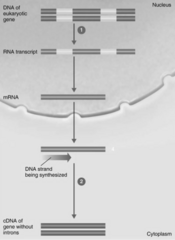
Which of the following is an advantage of using E. coli to make a human gene product?
A) Endotoxin may be in the product.
B) It does not secrete most proteins.
C) Its genes are well known.
D) It cannot process introns.
E) Endotoxin may be in the product, and it does not secrete most proteins.
C) Its genes are well known.
Biotechnology involves the ________.
A) use of microorganisms to make desired products
B) use of animal cells to make vaccines
C) development of disease-resistant crop plants
D) use of microorganisms to make desired products and the use of animal cells to make vaccines
E) use of microorganisms to make desired products, the use of animal cells to make vaccines, and the development of disease-resistant crop plant
E) use of microorganisms to make desired products, the use of animal cells to make vaccines, and the development of disease-resistant crop plant
the bacteria transformed with the recombinant plasmid and plated on media containing ampicillin
and X-gal will ________.
A) form blue, ampicillin-resistant colonies
B) form blue, ampicillin-sensitive colonies
C) form white, ampicillin-resistant colonies
D) form white, ampicillin-sensitive colonies
E) not grow
C) form white, ampicillin-resistant colonies

The most important property of a DNA vector is ________.
A) its ability to replicate within the cell
B) the size of the vector
C) the fact that it contains a marker
D) that it contains an ability to integrate into the chromosome
E) that the inserted genes that lack exons
A) its ability to replicate within the cell
The restriction enzyme EcoRI recognizes the sequence G↓AATTC and cut between G and A to yield sticky ends. Which of the following is true of DNA after it is treated with EcoRI?
A) All of the DNA fragments will have single-stranded regions ending in AA.
B) All of the DNA fragments will have single-stranded regions ending in G.
C) Some of the DNA will have single-stranded regions ending in AA and others will end in G.
D) All of the DNA will have blunt ends.
E) All of the DNA will be circular.
A) All of the DNA fragments will have single-stranded regions ending in AA.
Place the steps of constructing a genomic library in order.
I. Digest phage with restriction enzyme.
II. Lyse cells of interest and precipitate DNA.
III. Introduce constructs via transformation into competent E. coli cells.
IV. Perform ligation reaction with genome fragments and phage.
V. Digest genomic DNA with restriction enzyme.
A) V, IV, I, III. II.
B) I, II, III, IV, V.
C) II, I, III, V, IV.
D) II, V, I, IV, III.
E) IV, II, III, I, V.
D) II, V, I, IV, III.
A population of bacterial cells carrying a desired plasmid is called a ________.
A) library
B) clone
C) vector
D) Southern blot
E) PCR
B) clone
The Human Genome Project, which was completed in 2003, was focused on ________.
A) identifying all of the genes in the human genome
B) determining the nucleotide sequence of the entire human genome
C) determining all of the proteins encoded by the human genome
D) finding a cure for all human genetic disorders
E) cloning all of the genes of the human genome
B) determining the nucleotide sequence of the entire human genome
Which of the following are used to silence specific genes and hold promise for treating cancer or
viral diseases, such as hepatitis B?
A) RNA interference (RNAi)
B) Complementary DNA (cDNA)
C) Reverse transcriptase PCR (rtPCR)
D) Tumor-inducing plasmids (Ti plasmids)
E) DNA fingerprinting
A) RNA interference (RNAi)
the marker genes used for selecting recombinant DNA are:
A) HindIII, BamHI, and EcoRI
B) ampR and lacZ
C) ori
D) ampR and ori
E) lacZ and ori
B) ampR and lacZ

Which of the following methods would be used to introduce the plasmid into E. coli cells shown
in the Figure?
A) Microinjection
B) Transformation
C) Gene guns
D) Ti plasmids and Agrobacterium
B) Transformation
The application of "suicide" genes in genetically modified organisms ________.
A) prevents the growth of the modified organisms in the environment
B) kills the modified organisms before they are released in the environment
C) deletes genes necessary for modified organism's growth
D) provides for resistance of the modified organisms to pesticides
E) provides a means to eliminate non-modified organisms
A) prevents the growth of the modified organisms in the environment
In the Southern blot technique, which of the following is not required?
A) Transfer of DNA to nitrocellulose
B) Addition of a labeled probe to identify the gene of interest
C) Restriction enzyme digestion of DNA
D) Electrophoresis to separate fragments
E) Addition of heat-stable DNA polymerase to amplify DNA
E) Addition of heat-stable DNA polymerase to amplify DNA
Which of the following processes is not required in making cDNA?
A) Reverse transcription
B) RNA processing to remove introns
C) Transcription
D) Translation
D) Translation
PCR can be used to identify an unknown bacterium because ________.
A) the DNA primer is specific to specific target DNA sequences
B) DNA polymerase will replicate any bacterial DNA
C) DNA can be electrophoresed
D) all cells have DNA
E) all cells have RNA
A) the DNA primer is specific to specific target DNA sequences
Restriction enzymes function as:
A) Bacterial endonucleases that splice DNA
B) Bacterial endonucleases that digest phage DNA
C) Animal endonucleases that splice RNA
D) Viral endonucleases that damage host DNA
B) Bacterial endonucleases that digest phage DNA
The study of genetic material taken directly from the environment is ________.
A) bioinformatics
B) proteomics
C) reverse genetics
D) forensic microbiology
E) metagenomics
E) metagenomics
The fact that people continue to be concerned about the safety of DNA technology can be attributed to which of the following?
A) It is impossible to prove something is safe under all conceivable conditions.
B) Science can definitively disprove hypotheses but can only provide supporting evidence for hypotheses.
C) People are suspicious of science, in general.
D) There is mounting scientific evidence that DNA technology is unsafe.
E) Both that it is impossible to prove something is safe under all conditions and that science can only provide supporting evidence for hypotheses.
E) Both that it is impossible to prove something is safe under all conditions and that science can only provide supporting evidence for hypotheses.
The term biotechnology refers exclusively to the use of genetically engineered organisms to produce desired products.
A) True
B) False
B) False
A shuttle vector is a plasmid that is used to move pieces of DNA among organisms such as bacterial, fungal, and plant cells.
A) True
B) False
A) True
Most cells can take up DNA from their surroundings without chemical treatment.
A) True
B) False
B) False
The disadvantage of genomic libraries over cDNA libraries is that genomic libraries contain introns in their DNA collections.
A) True
B) False
A) True
The main function of the "ciliary escalator" is to:
A) Propel inhaled dust and microorganisms away from the mouth, toward the lower respiratory tract
B) Remove microorganisms from the gastrointestinal tract
C) Remove microorganisms from the lower respiratory tract
D) Trap microorganisms in mucus in the upper respiratory tract
E) Trap inhaled dust and microorganisms in mucus and propel it away from the lower respiratory system tract
E) Trap inhaled dust and microorganisms in mucus and propel it away from the lower respiratory system tract
Which of the following exhibits the highest phagocytic activity?
A) Eosinophils
B) Erythrocytes
C) Macrophages
D) Basophils
E) Neutrophils
C) Macrophages
TLRs attach to all of the following except:
A) AMPs
B) Flagellin
C) LPS
D) PAMPs
E) Peptidoglycan
A) AMPs
The activation of the complement protein cascade is the same for the classical pathway,
alternative pathway, and lectin pathway after the activation of ________.
A) C1
B) C2
C) C3
D) C5
E) C6
C) C3
All of the following increase blood vessel permeability except:
A) Kinins
B) Prostaglandins
C) Lysozymes
D) Histamine
E) Leukotrienes
C) Lysozymes
Which of the following statements is true?
A) All three types of interferons have the same effect on the body.
B) Alpha interferon promotes phagocytosis.
C) Gamma interferon causes bactericidal activity by macrophages.
D) Alpha interferon acts against specific viruses.
E) Beta interferon attacks invading viruses.
C) Gamma interferon causes bactericidal activity by macrophages.
Which of the following is found normally in serum?
A) Complement proteins
B) Interferons
C) Histamines
D) Leukocytosis-promoting factors
E) TLRs
A) Complement proteins
Each of the following is an effect of complement activation except:
A) Interference with viral replication
B) Bacterial cell lysis
C) Opsonization
D) Increased phagocytic activity
E) Increased blood vessel permeability
A) Interference with viral replication
The normal microbiota provide protection from infection in each of the following ways except:
A) They produce antibacterial chemicals
B) They compete with pathogens for nutrients
C) They make the chemical environment unsuitable for nonresident bacteria
D) They produce lysozyme
E) They change the pH of the environment
D) They produce lysozyme
Each of the following provides protection from phagocytic digestion except:
A) M protein
B) Capsules
C) Formation of phagolysosomes
D) Leukocidins
E) Biofilms
C) Formation of phagolysosomes
The antimicrobial effects of AMPs include all of the following except:
A) Inhibition of cell wall synthesis
B) Lysis of bacterial cells
C) Destruction of nucleic acids
D) Pore formation in bacterial membranes
E) Inhibition of phagocytosis
E) Inhibition of phagocytosis
The swelling associated with inflammation decreases when the fluid ________.
A) returns to the blood
B) goes into lymph capillaries
C) is excreted in urine
D) is lost as perspiration
E) is transported into macrophages
B) goes into lymph capillaries
All of the following are effects of kinins except:
A) Vasodilation
B) Increased blood vessel permeability
C) Chemotaxis of phagocytic granulocytes
D) Drawing in neutrophils to infected or injure area
E) Production of antibodies
E) Production of antibodies
Which of the following statements is correct?
A) There are at least 30 complement proteins.
B) All of the complement proteins are constantly active in serum.
C) Factors B, D, and P cause cytolysis.
D) Complement activity is antigenic specificity.
E) Complement increases after immunization.
A) There are at least 30 complement proteins.
The alternative pathway for complement activation is initiated by:
A) Lipid-carbohydrate complexes and C3
B) C5—C9
C) Antigen-antibody reactions
D) Factors released from phagocytes
E) Factors released from damaged tissues
A) Lipid-carbohydrate complexes and C3
Activation of C3a results in ________.
A) acute inflammation
B) increased blood vessel permeability
C) opsonization
D) attraction of phagocytes
E) cell lysis
A) acute inflammation
The dermis is composed of connective tissue and serves the primary purpose of providing direct protection from the external environment.
A) True
B) False
B) False
Microorganisms that are members of the normal microbiota are also known to cause disease.
A) True
B) False
A) True
What type of immunity results from recovery from mumps?
A) Innate immunity
B) Naturally acquired active immunity
C) Naturally acquired passive immunity
D) Artificially acquired active immunity
E) Artificially acquired passive immunity
B) Naturally acquired active immunity
Which of the following is the best definition of epitopes?
A) Specific regions on antigens that interact with T-cell receptors
B) Specific regions on antigens that interact with MHC class molecules
C) Specific regions on antigens that interact with haptens
D) Specific regions on antigens that interact with antibodies
E) Specific regions on antigens that interact with perforins
D) Specific regions on antigens that interact with antibodies
Which of the following cells is not an APC?
A) Dendritic cells
B) Macrophages
C) Mature B cells
D) Natural killer cells
E) None of the answers is correct; all of these are APCs.
D) Natural killer cells
When an antibody binds to a toxin, the resulting action is referred to as ________.
A) agglutination
B) opsonization
C) ADCC
D) apoptosis
E) neutralization
E) neutralization
Which of the following recognizes antigens displayed on host cells with MHC II?
A) TC cell
B) B cell
C) TH cell
D) Natural killer cell
E) Basophil
C) TH cell
The antibodies that typically bind to parasitic pathogens are ________.
A) IgG
B) IgM
C) IgA
D) IgD
E) IgE
E) IgE
Large antibodies that agglutinate antigens are ________.
A) IgG
B) IgM
C) IgA
D) IgD
E) IgE
B) IgM
In the Figure, which letter on the graph indicates the highest antibody titer during the patient's
response to a second and distinct/different antigen?
A) a
B) b
C) c
D) d
E) e
E) e

In the Figure, the arrow at time (d) indicates:
A) The time of exposure to the same antigen as at time (a).
B) The secondary response
C) The primary response
D) Exposure to a new antigen
E) The T-cell response
D) Exposure to a new antigen

Which of the following are not lymphocytes?
A) Cytotoxic T cells
B) Helper T cells
C) NK cells
D) M cells
E) B cells
D) M cells
The following events elicit an antibody response. What is the third step?
A) Antigen-digest goes to surface of APC.
B) APC phagocytizes antigen.
C) B cell is activated.
D) TH cell recognizes antigen-digest and MHC II.
E) TH cell produces cytokines.
D) TH cell recognizes antigen-digest and MHC II.
In the Figure, which areas are similar for all IgG antibodies?
A) a and b
B) a and c
C) b and c
D) c and d
E) b and d
D) c and d
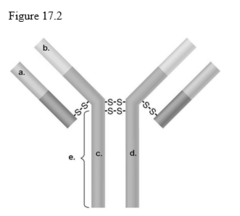
In the Figure, which areas are different for all IgM antibodies?
A) a and b
B) a and c
C) b and c
D) c and d
A) a and b

In the Figure, which areas represent antigen-binding sites?
A) a and b
B) a and c
C) b and c
D) c and d
E) b and d
A) a and b

In the Figure, what portion will typically attach to a host cell?
A) a and c
B) b
C) b and c
D) a and d
E) e
E) e

The presence of which of the following indicates a current infection rather than a previous
infection or vaccination?
A) IgA
B) IgG
C) IgM
D) IgD
E) IgE
C) IgM
thymic selection ________.
A) destroys T cells that do not recognize self-molecules of MHC
B) destroys B cells that make antibodies against self
C) destroys MHC molecules
D) destroys CD4+ cells that attack self
E) activates B cells
A) destroys T cells that do not recognize self-molecules of MHC
Which of the following statements about natural killer cells is false?
A) They destroy virus-infected cells.
B) They destroy tumor cells.
C) They destroy cells lacking MHC I.
D) They are stimulated by an antigen.
E) None of the answers are correct; all of these statements are true.
D) They are stimulated by an antigen.
ADCC is a process that is most effective in destroying ________.
A) eukaryotic pathogens
B) prions
C) extracellular viruses
D) bacterial pathogens
E) bacterial toxins
A) eukaryotic pathogens