PSYC 1002 - Learning and motivation
 Call Kai
 Learn
 Practice Test
 Spaced Repetition
 Match
 Flashcards
 Knowt Play
1/124

There's no tags or description
Looks like no tags are added yet.
125 Terms
what is learning?
Enduring change within an organism brought about by experience that leads to a change in behaviour. 有经验引起的,发生在有机体内部的持久性的变化,并导致行为发生癌变
associative llearning
联结学习
enduring change within an organism brought about by experience of associations that leads to a change in behaviour. (通过体验事物之间的联系,产生持久性的内部变化,并导致行为改变) - building blocks for more complex behaviour and cognition
classical condition / pavlovian conditioning
a form of associative learning in which an organism learns an association between stimuli, so that previously stimulus comes to elicit a conditioned response. 通过建立刺激与刺激之间的联系,使原本不能引起特定反应的刺激逐渐能够引起该反应。
stimulus - stimulus association 刺激与刺激之间的联结
Pacloc’s experiment 巴甫洛夫实验
Pavlov 通过研究狗的 salivation 唾液分泌, 发现动物可以通过学习简历不同刺激之间的联系。
Before condition: food → salivation, bell → no salivation
during condition: bell + food → salivation
after condition: bell → salivation
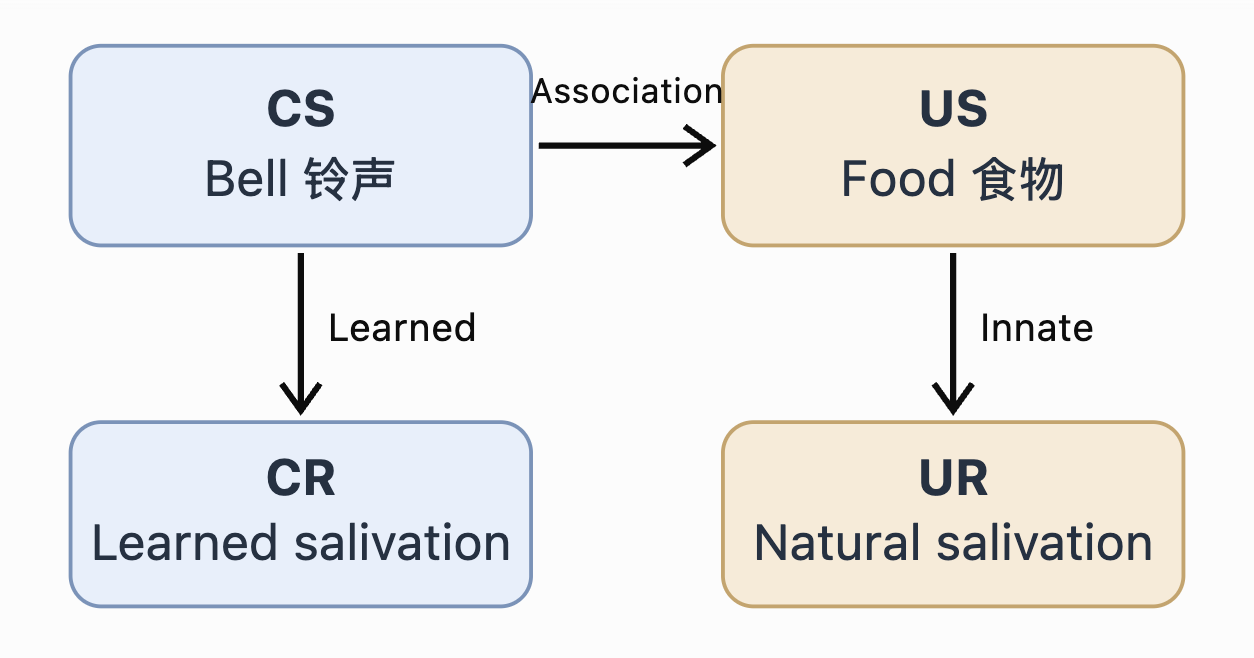
US - unconditioned stimulus
无条件刺激:a stimulus that naturally elicits a response without prior learning. 不需要学习,自然引起反应的刺激
Pavlov’s experiment - food
UR - unconditioned response
无条件反应:an unlearned response elicited by an unconditionaed stimulus 由US引起的,不需要学习的自然反应
Pavlov’s experiment - salivation to food
CS - conditioned stimulus
条件刺激:a previouslt neutral stimulus that comes to elicit a response through conditioning. 原不能引起特定反应,但通过训练后可以引起特定反应的刺激
Pavlov’s experiment - bell
CR - conditioned response
条件反应:a learned response slicited by a conditioned stimulus. 通过学习,由CS引起的反应
Will conditioned response be the same as unconditioned response?
NO - the CR is not always the same as the UR. 当疼痛发生时,动物可能逃跑或者反抗UR,但是当动物学会某个信号代表着疼痛时,单独该信号的出现就可能引起恐惧CR
Pavlov → Stimulus substitution 刺激代替理论
the brain substitutes the CS in place of the US 大脑用CS代替US
does not involve the development of new behaviours: 不涉及性行为的形成

Stimulus substitution
Stimulus substitution 刺激代替理论 Pavlovs
the brain substitutes the CS in place of the US 大脑用CS代替US
does not involve the development of new behaviours: 不涉及性行为的形成
Appetitive conditioning
Types of classical conditioning - 趋向性条件作用
与具有吸引力,令人愉快的刺激建立联结

Aversive conditioning
Types of classical conditioning - 厌恶型条件作用
与令人不愉快的刺激建立联结
Conditioning in advertising
Example of classical conditioning - 广告中的条件作用
Advertising often operates by associating stimuli that elicit positive affective responses with a brand or product. 将产生积极情趣的刺激和品牌建立联结,让消费者对产品本身产生好感 → formed CS to product, without realising the US of positive emotion

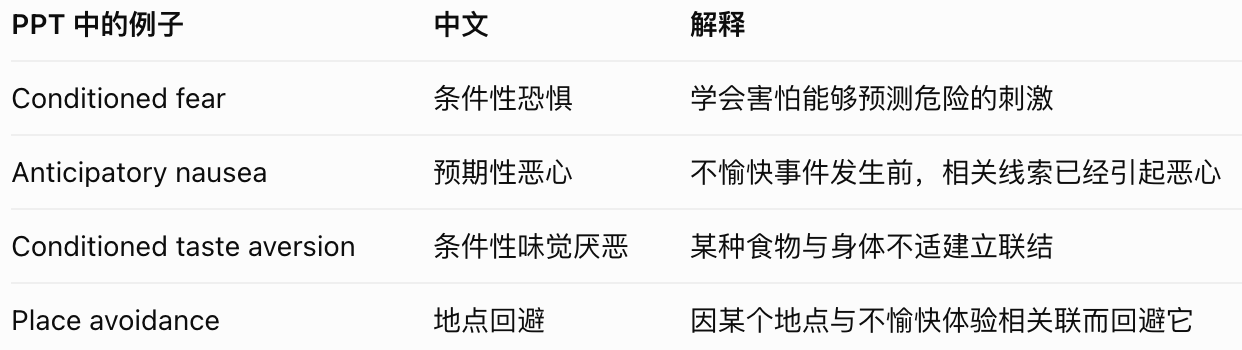
conditioned fear
条件性恐惧 - 学会害怕能够预测危险的刺激
anticipatory nausea
预期性恶心 - 不愉快的是奇怪发生前,相关线索就已经引起恶心
conditioned taste aversion
条件性味觉厌恶 - 某种食物与身体不适建立联结
place avoidance
地点回避 - 某个地点与不愉快的体验相关联而回避
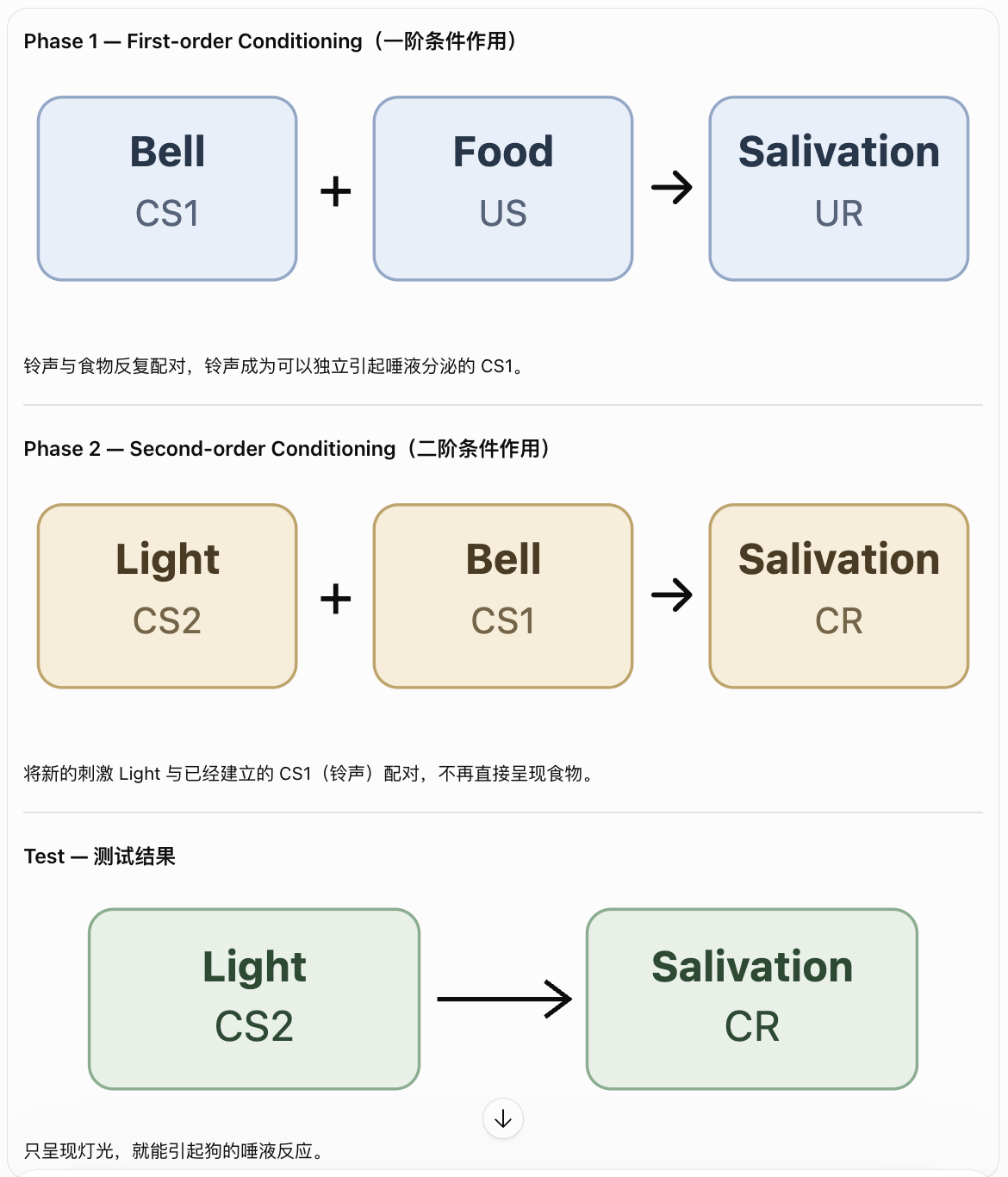
Second-order conditioning
a form of conditioning in which a new stimulus acquires the ability to elicit a conditioned response through association with an already established conditioned stimulus.
(a second stimulus build on CS to have a CR)
新的刺激通过和已经形成的CS建立联结,来引起CR
second-order conditioning (CS2)不需要和US建立联结
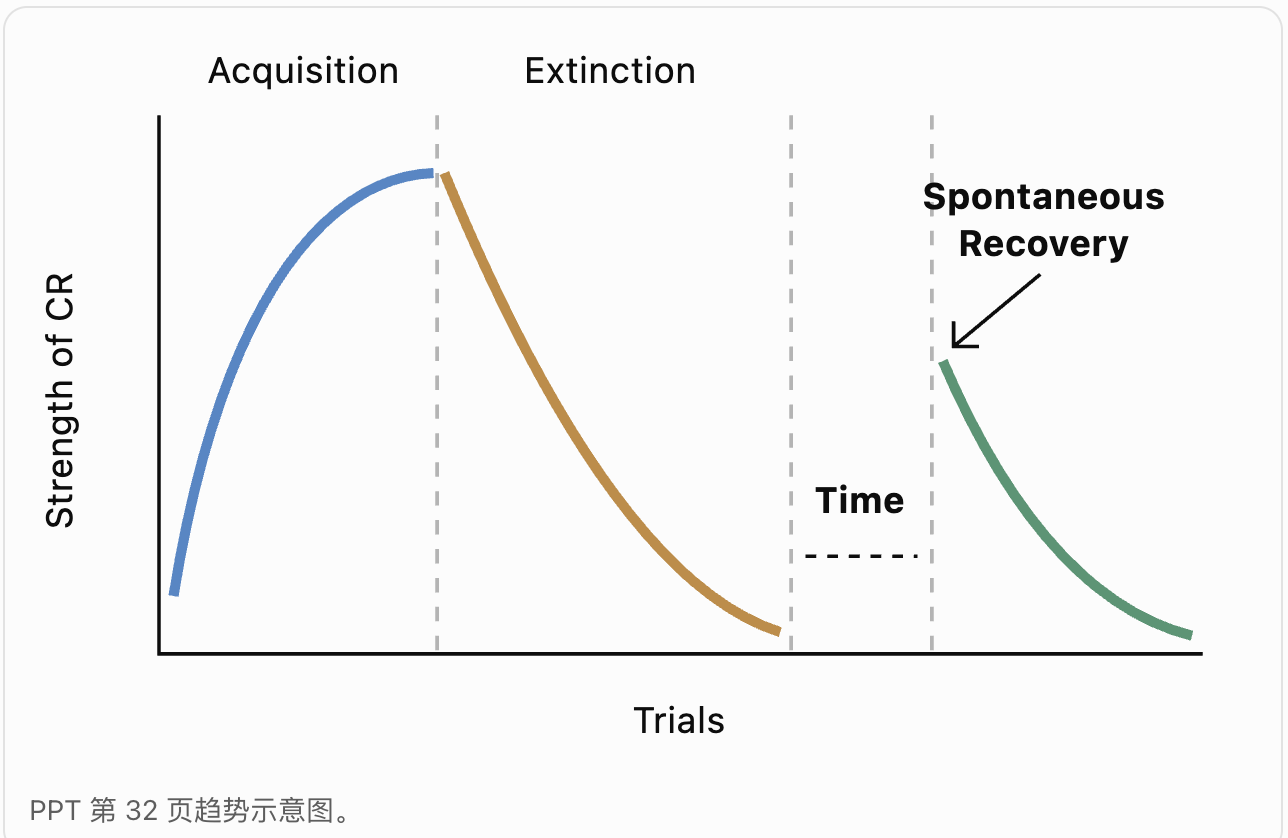
Acquisition
习得 - repeated presentations of the CS with the US result in an increase in the CR (when CS is presented)
不断的将铃声和事物配对,狗听到临时更是的唾液反应就越来越强
Extinction
消退 - repeated presentations of the CS alone following the acquisiiton result in a reduction in the CR (when the CS is presented) 完成习得之后,反复单独呈现 CS,不再呈现 US,导致 CR 逐渐减弱。

exposure therapy
暴露疗法 (apply extinction in reallife) - 通过在安全条件下接触引起恐惧的刺激,而没有原本预期的危险结果,使条件性恐惧反应逐渐减弱。
Does extincition equal to unlearning?
NO - after extinction was done, theyre will be two competing memeories. 所以extinction不是将原本的记忆删除,而是建立了新的学习记忆,与原本的记忆竞争。
(why do conditioned responses return following extinction?)

Spontaneous recovery
自发恢复:the reappearance of an extinguished conditioned response following a period of time 在extinction之后,经过一段时间,原本消退的CR再次出现
(why do conditioned responses return following extinction?)
Renewal
更新效应:the return of an extinguished conditioned response following a change in context. 当context发生改变时,原本消退的CR再次出现
在房间 A 中学会害怕某种声音,在房间 B 中经过消退训练不再害怕该声音,但回到房间 A 时,恐惧反应再次出现。
(why do conditioned responses return following extinction?)

Thorndike’s puzzle box
Thorndike 对 animal intelligence 感兴趣,希望研究都购物是否拥有insight 顿悟, 而不是单纯的认为动物拥有由人类相似的思维方式。
实验过程:将一只猫放进箱子中,在箱子外面防止食物,猫必须完成特定动作才能逃出箱子获得食物。
实验结论:
trial and error learning 尝试不同行为进行学习
progressive immprovement over many trials 表现随着经验增加
no sudden ingiht 没有突然顿悟 没有突然怎么逃出箱子

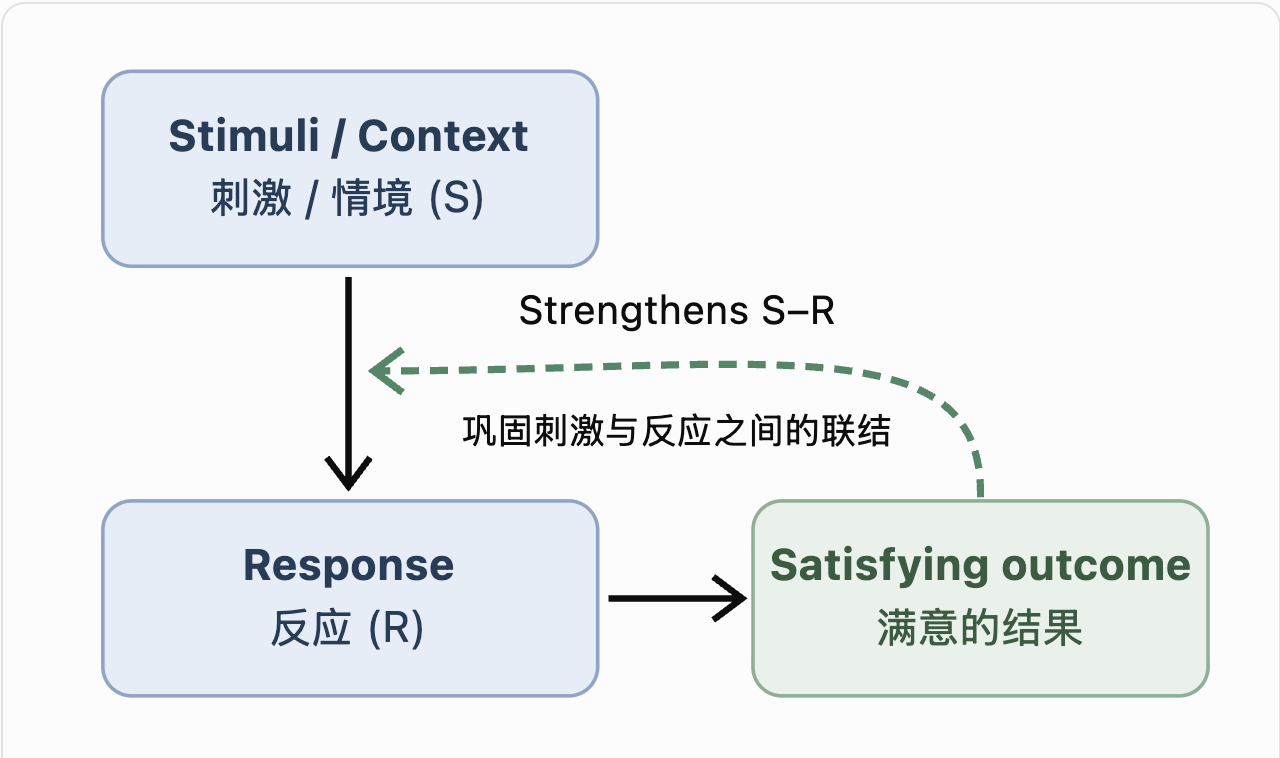
Law of effect - Thorndike
given a particular situation, if an action is met with satisfaction, the prgnism will be more likely to make the same action the next time it find itself in that situation. 在特定情境中,如果某个行为带来了令人满意的结果,那么当有机体再次处于相同情景时,就有可能重复行为。
highlight the Immediate consequences to furture action

behaviourism
scientific study of changes in behaviour
radical behaviourism
强调客观、可观察的解释,避免依赖无法直接观察的解释
reinforces
强化物 - reinforces are events/outcomes/consequences that result in an inrease in a particular behaviour. 强化物是能够使某一特定行为增加的事件、结果或后果。
注意: 判断一个东西是否属于 Reinforcer,不是看它听起来是不是奖励,而是看它是否真的使某个行为增加。
primary reinforces
初级强化物 - Intrinsically valuable,具有内在价值,例如食物
secondary reinforcers
次级强化物 - Acquire their reinforcing properties through experience,通过经验获得强化作用,例如金钱、Clicker
social reinforcement
社会性强化 - 通过社会互动进行强化,例如 Praise(表扬)
behaviour shaping - principle of succcessive approximation
Principle of Successive Approximation(逐步逼近原则) - reinforce behaviours that are closer and closer to a target behaviour. 强化越来越接近目标行为的行为
Principle of successive approximation(逐步逼近原则)。
Reinforce behaviours closer and closer to a target behaviour(强化越来越接近目标的行为)。
Gradually make the conditions of reinforcement more stringent, more precise(逐渐使强化条件更加严格、精确)。
Can generate entirely novel behaviours(能够产生全新的行为)。

Instrumental conditioning
Instrumental Conditioning 工具性条件作用 / Operant conditioning 操作性条件使用 : a form of associative learnig in which behaviour is modified by is consequence. 通过行为后果来改变未来行为的联结学习

Classical conditioning VS instrumental condisioning

reinforcement VS punishment

Positive VS Negative
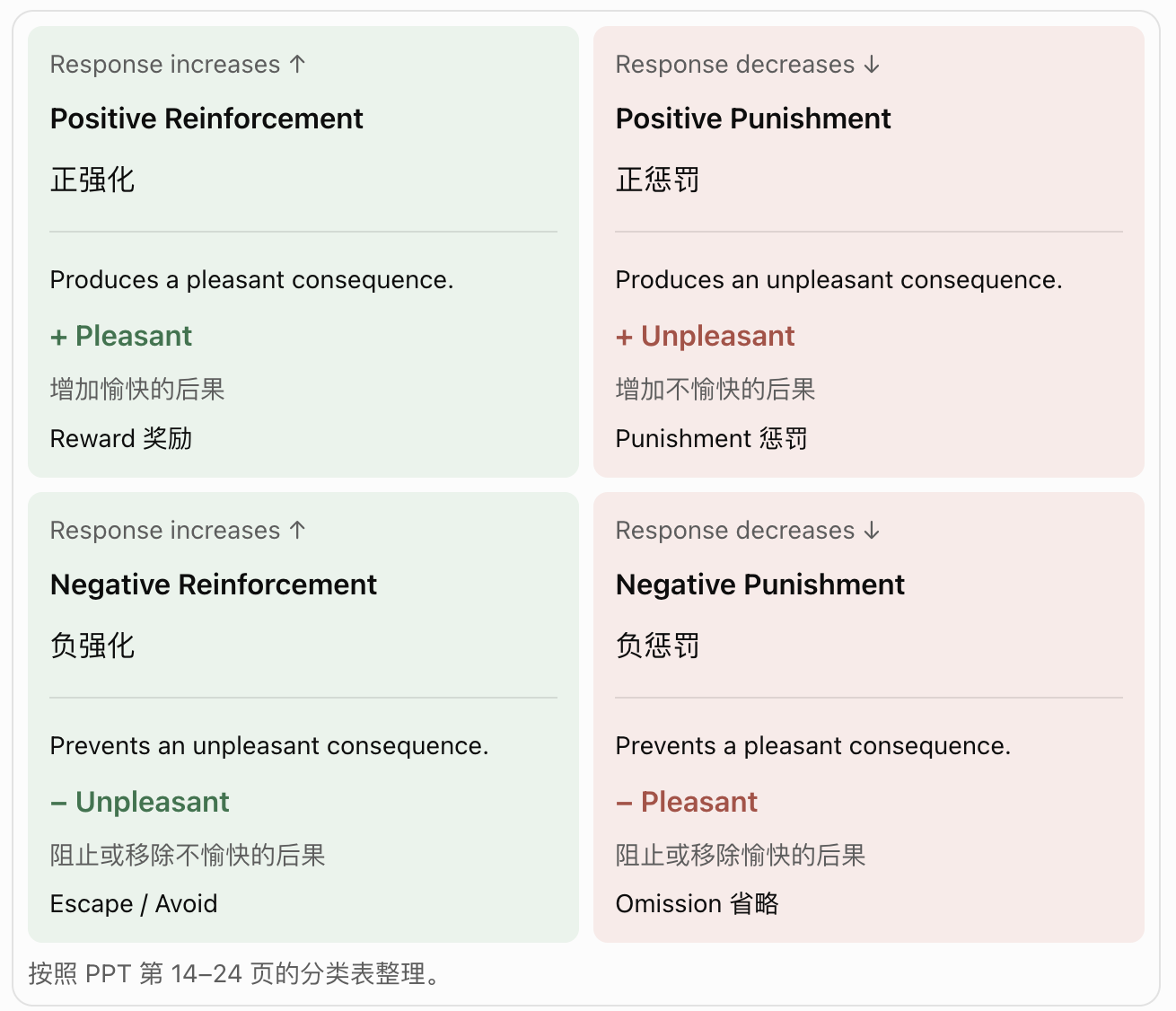
注意:这里的positive 和negative不是好与坏的意思,而是指行为产生了后果,或者是阻止/移除了某个后果

4 different type of instrumental conditioning
positive reinforcement, negative reinforcement, negative punishment, positive punishment
reinforcement
positive reinforcement 正强化 - produces a pleasant consequence (+ pleasant, rewards) 行为产生愉悦后果,使行为增加: 好好学习 → 成绩变好 → 好好学习
negative reinforcement 负强化 - prevents an unpleasant consequence (- unpleasant, escape / avoid) 行为阻止/移除不愉快后果 行为增加: 汽车安全带提示音烦人→ 系安全带 →提示音减少 →系安全带
punishment
positive punishment 正惩罚 - produces an unpleasant conseqence (+unpleasant, punishment) 行为产生不愉快后果,行为减少: 超速→罚款→减少超速
negative punishment 负惩罚 - prevents a pleasant consequence (-pleasant, omission 忽略) 行为阻止或移除愉快后果,行为减少:打人→减少游戏机会→减少打人
Distinguish 4 different instrumental conditioning
第一步:Behaviour increases or decreases?
第二步再判断:Consequence produced or prevented?
schedule of reinforcement - fixed
固定:强化按照固定规律发生
schedule of reinforcement - variable
可变:强化按照变化规律发生
schedule of reinforcement - ratio
比率:based on number of response 取决于行为次数
schedule of reinforcement - interval
时距:based on time period 取决于时间间隔
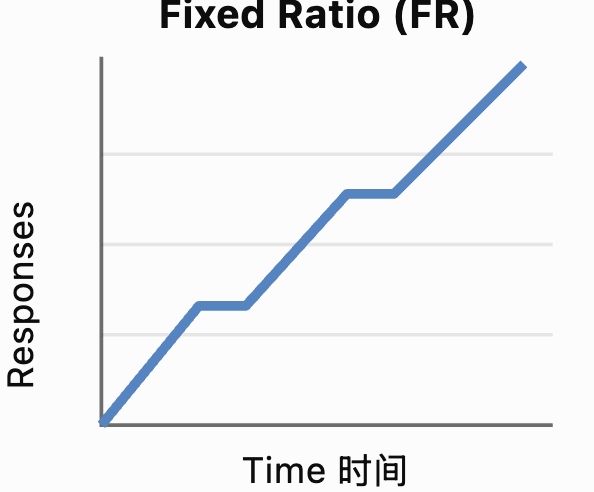
Fixed Ratio(FR)
reinforcer occurs every N responses 完成固定数量的行为之后获得强化
fixed number of responses (固定行为次数)
High response rate,反应率高;强化后可能短暂停顿
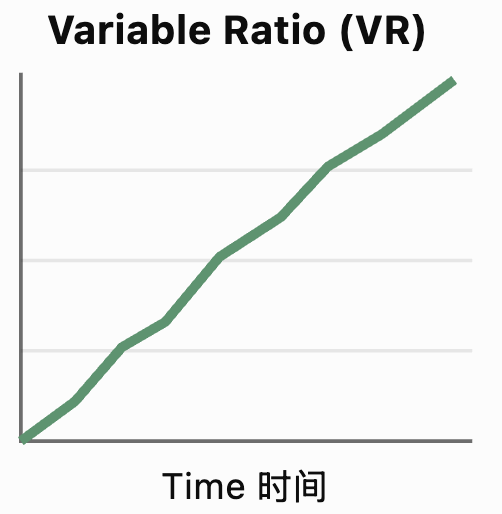
Variable Ratio(VR)
reinforcer occurs on average every N response 平均完成一定数量的行为之后获得强化,但每次实际需要的行为次数不固定
variable number of responses (可变行为次数)
High and relatively steady response rate,高且相对稳定的反应率
Fixed Interval(FI)
reinforcer available after N min/days 经过固定的时间间隔后,强化变得可获得
Fixed period of time (固定时间间隔)
Rapid responding near time for reinforcement,接近强化时间时行为明显增加

Variable Interval(VI)可变时距
reinforcer available on average after N min/day 经过平均一定长度,但实际不固定的时间间隔后,强化变得可获得
variable period of time 可变时间间隔
Steady responding,相对稳定的反应

Thorndike’s law of effect - Stimulus-Response association
satisfying outcomes “stampin” the connection between the stimulus and response
Skinner’s trpartite (ABC) theory
skinner’s tripartite contingency
Antecedent (Sd) : the stimulus controlling behaviour
Behaviour (R): what is the response being reinforced/punished?
Consequence (Sr/Rft): what is the immediate outcome of a behaviour?

Stimulus control
behaviour is controlled by stimuli through previously learned stimulus-response associations. 行为通过过去学习形成的刺激-反应联结,收到特定的刺激控制。
Stimulus control theory
our decision and action are controlled by S-R associations we have learned in the past

discriminative stimulus (Sd)
辨别刺激:a signal that an action will produce a consequence or outcome. 告诉有机体,带当前刺激存在的情况系,执行某种行为会产生什么后果

CS conditioned stimulus VS Sd discriminative stimulus

Generalisation
泛化: the extent to which behaviour transfers to a new stimulus (在某一个情境中学习到的行为也可以迁移到其他相似的情景中)
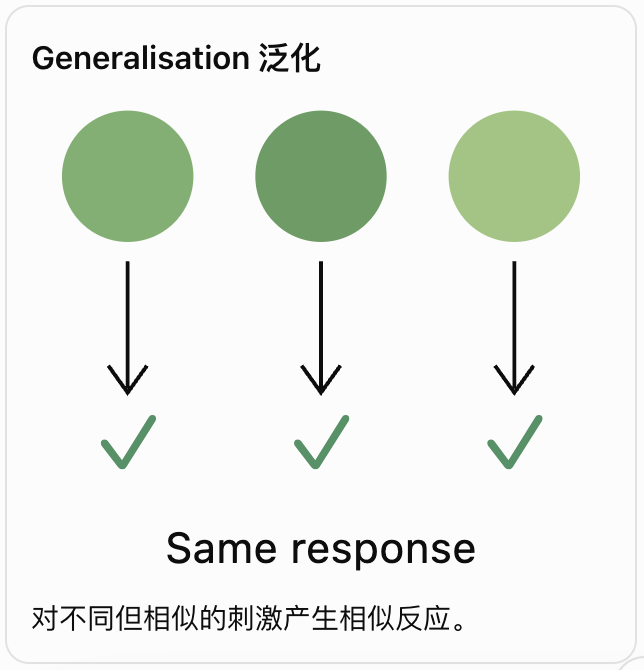
discrimination
辨别:the extent to which behaviour does NOT transfer to a new stimulus

factors effect stimulus control

Experiment - LIttle albert
Aim: test generalisation of learned fear in an infant.
Experimental procedure:
before conditioning: white rat → no learned fear
conditioning: white rat + loud clanging noise → fear/shokc
after conditioning: white rate (CS) → fear (CR)
generalisation → similar stimuli → fear response
Conclusion:
fear can be learned by classical condition
learned fear can generalise to other similar stimuli
generlisation gradient
Note:
S+: the stimulus paired with the reinforcer or US

discrimination learning
discrimination can be learned through training with different schedules of reinforcement.
discrimination learning - classical conditioning example

discrimination learning - instrumental conditioning example
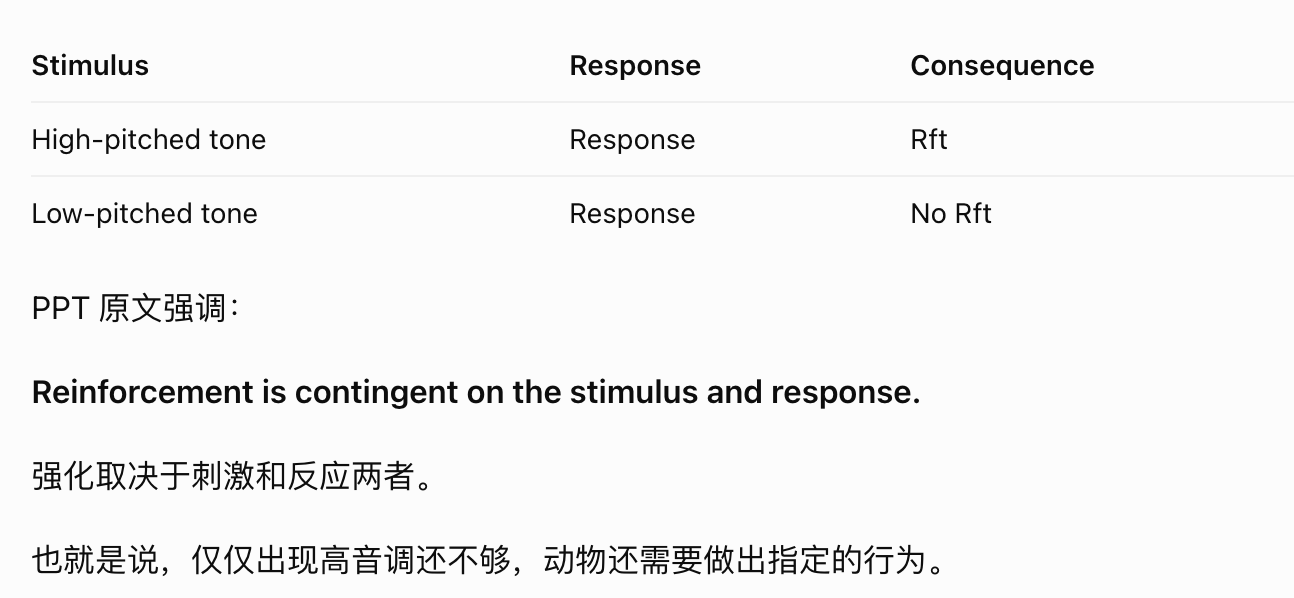
Graph - from generalisation to discrimination

Generalisation in human - 3 element
Term | 中文 | 含义 |
|---|---|---|
Physical attributes | 物理属性 | 根据外观、声音等物理特征进行泛化 |
Semantic similarity | 语义相似性 | 根据事物或词语的含义进行泛化 |
Rules / Analogies | 规则/类比 | 通过规则或类比,将原本不同的事件联系起来 |
Generalisation in human (Experiment: Razran)
research aim: 研究人类的 Generalisation 是更多地基于词语的发音,还是词语的含义。
experimental procedure: 将特定单词(CS)与食物(US)配对,使单词能够引起唾液分泌(CR)。
然后测试学生对以下两类新单词的反应。
Trained CS | Phonologically similar 发音相似 | Semantically similar 语义相似 |
|---|---|---|
Style | Stile | Fashion |
Urn | Earn | Vase |
Freeze | Frieze | Chill |
Surf | Serf | Wave |
这里有两个重要的术语:
Phonological Similarity(语音相似性): 单词的发音相似。
Semantic Similarity(语义相似性): 单词的含义相似。
Results(实验结果):More generalisation to semantically similar words.对语义相似的单词产生了更多的泛化。
Conclusion(实验结论):We generalise on the basis of meaning.人类能够根据含义进行泛化。
social learning
when behaviour changes as a result of observing the behaviour of others. 个体通过观察他人改变自己行为
Acquiring the same behaviour of others through observation:通过观察学会与他人相同的行为。
Acquiring new/altered behaviours through observation of others' actions and their consequences:通过观察他人的行为及其后果,习得新的行为或者改变现有行为。
social learning and direct learning
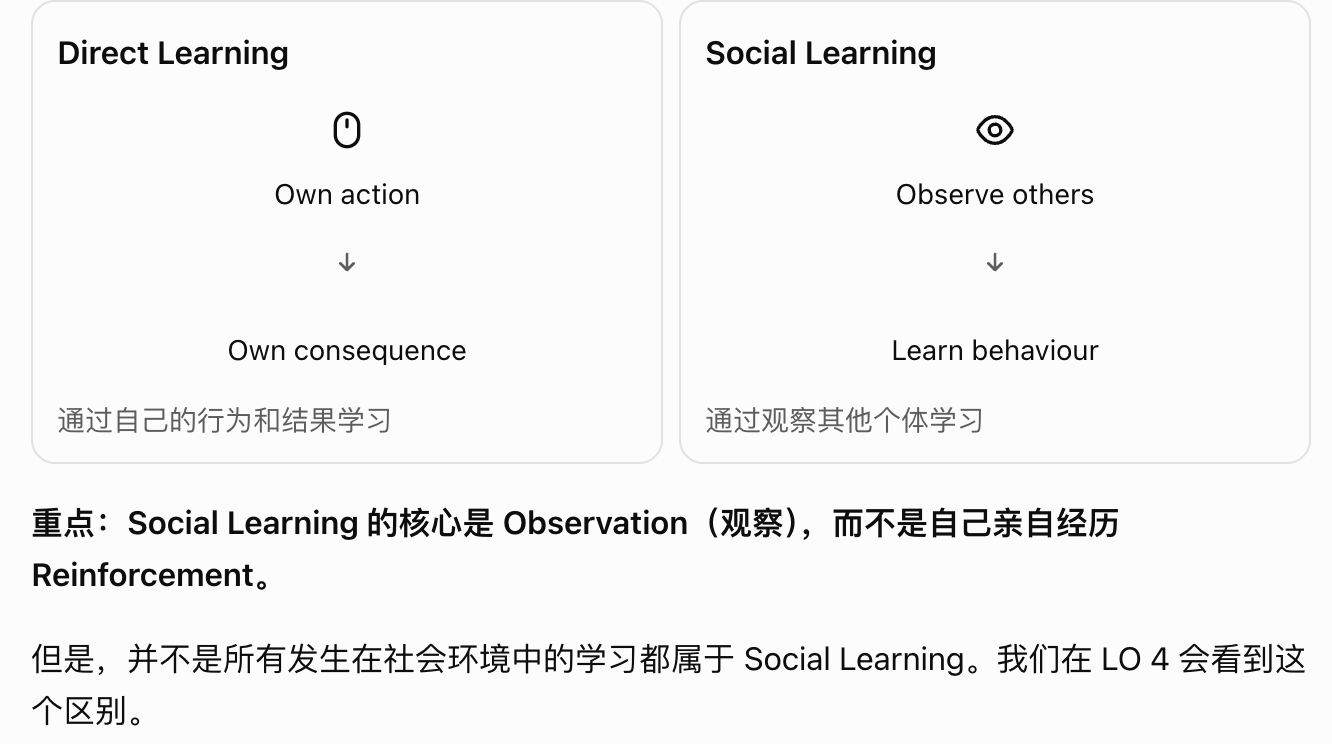
observational conditioning
the behcaiour of others can act as a US that supports classical conditions. 其他个体行为可以作为US,是classical conditioning 发生
例如,原本不害怕蛇的猴子,看到另一只猴子对蛇表现出强烈的恐惧之后,也可能学会害怕蛇。
Experiment - Cook & Mineka
observational fear conditioninng in monkey.
aim: 猴子能否通过观察其他猴子的恐惧反应,学会害怕自己原本不害怕的刺激?
Experimental Procedure
Before Observation: Lab-raised monkeys are not normally afraid of snakes. 实验室饲养的猴子通常并不会自然地害怕蛇。
Observation: The observer monkey watches a wild monkey acting afraid of a snake. 观察者猴子看到另一只猴子对蛇表现出恐惧反应。
After Observation: The observer acquires a fear of snakes.观察者开始害怕蛇,即使它自己并没有经历蛇的攻击。

Cook & Mineka - preparedness for learning
是否所有刺激都同样容易通过观察而引起恐惧学习?
biological preparedness 不等于 innate fear
there is a biological preparedness to learn fear about some stimuli over others.
Asymmetry is specific to aversive (cf. appetitive):这种学习的不对称性主要出现在厌恶性学习,而不是同样体现在趋向性学习中。
May not be innate fear:这不代表猴子出生时就一定害怕蛇或者蜘蛛。
Potentially evolved to learn more quickly about potential threats:这种学习倾向可能通过演化形成,使个体能够更快学会识别潜在威胁。
Innate Fear | Preparedness for Learning |
|---|---|
天生就有恐惧反应 | 更容易习得某种恐惧 |
不需要学习形成恐惧 | 仍然需要学习经验 |
关注是否天生害怕 | 关注学习速度和倾向 |

obervational instrumental learning
Learning can occur by observing others perform an action or behaviour.
Learning can occur by observing the consequences of others performing an action or behaviour (R–Rft).
也就是说,我们既可以通过观察别人的行为学习,也可以通过观察行为产生的结果学习。
emulation
目标模仿:understanding there is a goal but not using the same method to gain sccess to the goal 里街某哥哥行为的目标是什么,但不一定是用相同行为达到目标
imitation
动作模仿:copying behaviour with reference to a goal. replication of the same responses made by the performer 为了达到目标而服之其他个体的行为, 重复是示范者的行为
emulation VS imitation

two-action test

english blue tit - milk bottle example
did the birds learn this response by observing others?
不一定。
鸟可能是因为靠近其他鸟、接触到了牛奶瓶,然后通过自己的 Trial and Error Learning 学会打开瓶盖。
social facilitation
cilitation, 行为变化不是因为观察他人行动,而是因为和其他个体在一次提高了接触目标,刺激或探索机会的可能
definition: goal enhancement, stimulus enhancement, increased motivation to act / explore
Blue tit example:
goal enhancement: 鸟类因为群体活动,更容易接触到原本不容易获得的奶油
stimulus enhancement:鸟跟随其他鸟,更可能接近牛奶瓶
increase motivation to act 、 explore:群体环境让鸟更愿意尝试新的行为

social learning VS social facilitation

social modelling
社会示范: copying the behavioural style of others
bobo doll experiment: Bandura, Ross & Ross
研究儿童如何通过观察成年人的行为,表现出相似的攻击性行为。儿童不仅可以模仿具体动作,也能够模仿 General Styles of Behaviour(一般行为风格)。
novel action and language: 不仅模仿示范者的动作,还有相似风格的新行为或语言.
cognitive aspect of social learning (social modelling)
process of social medelling
understanding 理解他人的动作与意图
application 在合适的情境中运用观察到的知识
memory 学到的信息不一定立即使用
learning can occur without immediate performance
Bandura - reinforcement and modelling (social modelling)
How does reinforcement influence modelling?
model rewarded
model punished
no consequence
Experiment result
positive incentive and no incentive
conclusion
model does not need to be rewarded, but modelling is affect by punishment modelling 不依赖reinforcement,不需要看到示范者得到奖励。同时punishment 可以影响观察者是否表现出模仿行为,但不意味着观察者没有学会该行为
positive incentive is not necessary for modelling
modelling can occur through media, not just in person
Social modelling - application
role models: 儿童可能模仿尊敬或敬仰的人
advertising campaigns:social modelling可以用于减少危险驾驶,吸烟等行为
modelling of punishment:成年人通过打孩子来惩罚不良行为,孩子也可能模仿这种惩罚方式,对其他儿童使用类似行为。注意:即使成年人想通过 Punishment 减少不良行为,自己的惩罚行为也可能成为孩子学习和模仿的对象。
4 factors affect conditioning (classical conditioning and instrumental conditioning)
what effect the strength, speed and efficancy of learning
frequency: number of event pairing
intensity: salience of stimuli / reinforcers
contiguity: how far apart the event occur
contingency: statistical relationship between event
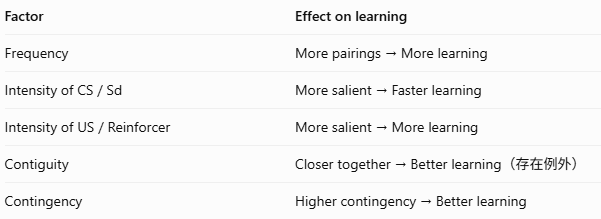
frequency (factor affect conditioning)
number of event pairing 时间之间配对的次数
more paring → more learning
CS 和 US 配对的次数越多,学习程度越高,但每次配对带来的学习增量会逐渐减少,最终达到一个上限。
Graph
negatively accelerating curve: CR increasing in a deccelerating speed
asymptote/ asymptotic level of responding

intensity (factor effect conditioning)
Salience(显著性)指一个刺激有多突出、显眼或容易被注意到。
The salience of the CS / Sd
The salience of the US / Reinforcer
Stimulus | PPT 的结论 |
|---|---|
More salient CS / Sd | Faster learning(学习更快) |
More salient US / Reinforcer | More learning(学习程度更高) |

Contiguity(时间邻近性)(factor effect conditioning)
how far apart the event occur
Inter-stimulus Interval(ISI,刺激间隔):Time between ‘CS on’ and ‘US on’.
ISI Closer together → Better learning.
Exception — Conditioned Taste Aversion 条件性味觉厌恶
Can occur over long delays (hours), and after 1 trial.

Contingency(依存关系)(factor effect conditioning)
statistical relationship between events CS 是否能够有效预测 US 的出现?
What is the probability of the US given the CS?(CS 出现时,US 出现的概率是多少?)
What is the probability that the US occurs anyway?(没有 CS 时,US 仍然出现的概率是多少?)
为了建立正向预测关系,CS 出现时 US 的概率必须高于 CS 不出现时 US 的概率。

Contiguity vs Contingency

learning is…

learning is not …
Maturation(成熟)
随着年龄增长,身体和行为发生的变化。
老师使用了 Learning to Walk(学习走路)的例子,强调身体发育成熟对行为的影响。走路能力也受到练习的影响,因此需要区分发育与经验各自的作用。
Fatigue(疲劳)
一种暂时性的状态(Transient State),可能由以下因素引起:
Emotional strain(情绪压力)
Physical exertion(体力消耗)
Boredom(无聊)
Lack of rest(缺乏休息)
Fatigue 可能导致个体暂时无法执行已经习得的行为,但这并不代表个体失去了之前学习到的知识或能力。

learning & performance
Learning ≠ Performance
Learning(学习)是发生在有机体内部的持久性变化。
Performance(表现)是个体实际表现出来的行为。
Not all changes in behaviour are examples of learning.
No behaviour/performance does not always = no learning.

factor affect performance
Factor | 中文 | 含义 |
|---|---|---|
Opportunity | 机会 | 是否有机会执行已经习得的行为 |
Motivation | 动机 | 是否愿意执行该行为 |
Sensory and Motor Capabilities | 感觉与运动能力 | 身体是否具备执行行为的能力 |
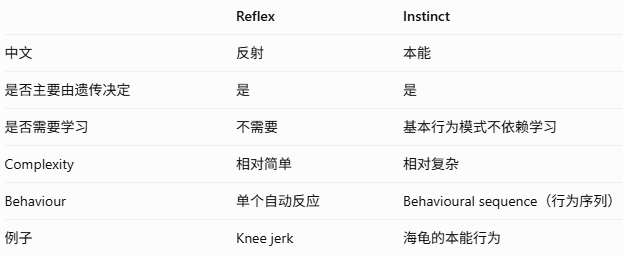
reflex
反射:reflexes are automatic, usually very fast and learning is not required
Eliciting Stimulus(诱发刺激)→ Corresponding Response(相应反应)
Eliciting Stimulus | Corresponding Response |
|---|---|
Food(食物) | Salivation(唾液分泌) |
Airpuff(气流刺激) | Eye blink(眨眼) |
Movement(运动刺激) | Eye turn(眼球转动) |
Knee tap(敲击膝盖) | Knee jerk(膝跳反射) |
Pain(疼痛) | Withdrawal(缩回) |
reflex arc
反射弧
Term | PPT 原文 | 中文 |
|---|---|---|
Sensory (Afferent) Nerves | Detect stimuli | 感觉神经/传入神经,检测刺激 |
Motor (Efferent) Nerves | Stimulate muscles | 运动神经/传出神经,刺激肌肉 |

instinct
本能: instincts are a behavioural sequence which are largely genetically determined (Typical of all members of a species.)
reflex VS instinct
difference between reflexes and instinct is in complexity of behaviour, rather than type of behaviour
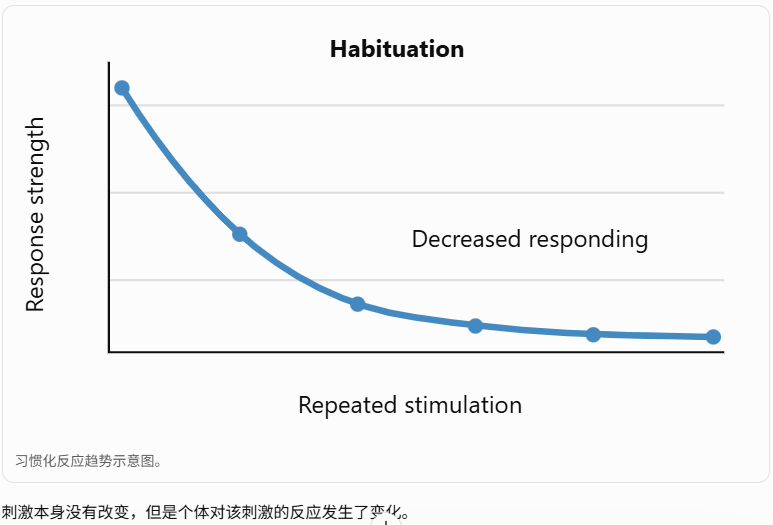
habituation
simplest forms of learning
习惯:decreased responding produced by repeated stimulation
Habituation is NOT…
含义 | PPT 中的老鼠例子 | |
|---|---|---|
Fatigue(疲劳) | 肌肉暂时无法继续执行反应 | 老鼠已经累得跳不起来 |
Sensory Adaptation(感觉适应) | 感觉器官暂时对刺激不敏感 | 老鼠暂时无法正常感知噪音 |
Habituation(习惯化) | 经过重复刺激后,反应减弱 | 老鼠仍然能跳、能听,但不再产生那么强的惊跳反应 |
判断 Habituation 的关键是:感觉能力和运动能力仍然存在,只是对特定刺激的反应减弱了。
dishabituation
The recovery of a habituated response following the presentation of a different stimulus.
呈现一个不同的刺激后,原本已经习惯化的反应重新出现。
例如,老鼠已经习惯了反复出现的声音,在出现一个新的刺激后,再次听到原来的声音时,惊跳反应可能恢复。
Sensitisation
simplest form of learning
敏感化:increased responding produced by repeated stimulation, decrease in the thresholds required to elicit a response.由于刺激反复出现,导致反应逐渐增强。诱发反应所需要的阈值降低。