Plant Tax Lecture Quiz 3 (After Exam 1)
 Call Kai
 Learn
Learn Practice Test
 Spaced Repetition
 Match
Match Flashcards
 Knowt Play
1/38

Earn XP
Description and Tags
lectures 9-11
Name | Mastery | Learn | Test | Matching | Spaced | Call with Kai | Chat |
|---|
No analytics yet
Send a link to your students to track their progress
39 Terms
Alexander von Humboldt
-American expedition 1799-1804
-Met with President Thomas Jefferson in 1804 (6 years before the independence of Mexico)
-“Equinoctial regions of New Continent”
The Heart of the Andes, Frederic Edwin Church, 1859
12,000 people paid an admission fee $0.25
Humboldt’s influence on Darwin
Darwin letter to home:
“I formerly admired Humboldt, I now almost adore him”
Darwin’s sister letter back from home:
“that you had, probably from reading so much Humboldt, got his phraseology”
Humboldt was an early proponent of:
…human-induced climate change (perhaps the first in western civilization)
-Humboldt proposed that the level decrease of Lake Valencia, Venezuela, was due to deforestation
-Humboldt was influenced by scientist around the world (ex: Francisco Jose de Caldas)
Going up in elevation in the tropics is similar to ___
going north in latitude
Which regions in the world are the most diverse in ferns?
-Mesoamerica (Mexico, panama, etc.)
-greater Antilles (Puerto Rico, Jamaica, etc.)
-Guianas (NE south America)
-tropical Andes (Western South America)
-southeastern brazil
-east Asia
-Malesia
-Madagascar

Which regions in the world are the most diverse in gymnosperms?
-east Asia
-Malesia
-west coast of United States
-Mexico

Which regions in the world are the most diverse in angiosperms?
-Mexico
-Malesia
-NW south America
-SE Asia
-east south America
-east Madagascar
-cape code, south Africa

Why are maps of diversity for animals are very similar to maps of diversity of plant richness?
Plants provide ecological services to animals like food and refuge
Natural distributions of Asteraceae, Pinaceae, and Onagraceae (Oenothera and Clarkia)
• Senecio (Asteraceae) is comosmopolitan
• Pinus (Pinaceae) is found in the northern hemisphere
• Oenothera (Onagraceae) is found in the Americas
• Clarkia (Onagraceae) is found in North America
The molecular clock: fossil calibrations
-To understand the origin of Euphyllophyta and Angiosperms, we need to understand
how to add time to phylogenies
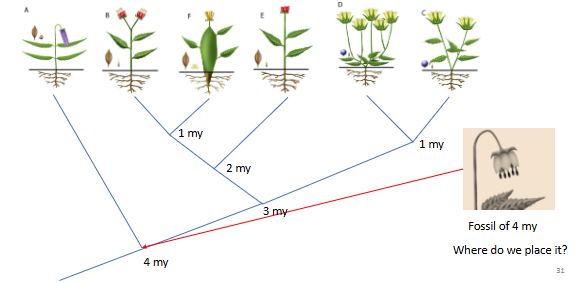
-If you find a fossil that belongs to the group of organisms in your tree and you know its approximate age, you can use the fossil to calibrate your tree
Assuming the fossil corresponds to the mrca of all taxa…
…we can infer the age of the remaining ancestors
Issues with fossils
• Placing the fossil in the phylogenetic tree is problematic
• Multiple fossils can show disagreements in ages
• Interpretation has to be careful, a fossil is a minimum age. There could be older fossils of the same taxa that have not been found, or that simply did not fossilize
Ferns and Angiosperms are more diverse in
tropical and topographic complex landscapes
Gymnosperms dominate what type of ecosystems
temperate ecosystems
Molecular dating adds time to phylogenies which can help us to
reconstruct the history of life on earth
According to the fossil record, Euphyllophyta evolved in
early Devonian
True or false: The history of plant evolution is linked to major atmospheric changes in the the planet
true
The abominable mystery of Darwin
-Poor fossil record means that we don’t have a series of transitional stages between gymnosperm-like plants and angiosperms
-Earliest Angiosperm pollen 140 mya
-Earliest flower fossils 130 mya

Time calibrated phylogeny with 137 fossils:
stem age
crown age

stem vs crown age; what does the red bar represent?
-Long period of time without cladogenesis with extant taxa
-The origin of the flower could have happened anywhere along this internal branch
Cretaceous or Jurassic Origin of the Angiosperms?
-No Confirmed Jurassic Fossils (at least not yet!)
-By the late Cretaceous Angiosperms diversified explosively and became dominant
The Earliest Known “accepted” Angiosperm: Archaefructus
• Early Cretaceous Period—ca. 125 million years ago from China.
• Archaefructus has no modern counterpart.
• Archaefructus was found in the same fossil bed as remains of feathered dinosaurs.
• Fossils of Archaefructus show features of flowers, fruits, leaves, stems, and roots.
• An aquatic habitat may be inferred from nearby fish fossils.
• Location of Yixian, fossil beds in Liaoning Province, China


where do we place Archaefructus?

Additional fossils from China could push back the origin of the Angiosperms
Nanjiganthus : 174 to 207 mya, closer to 174 mya, early Jurassic
-some argue that Nanjiganthus could be a Gymnosperm
*this fossil Archaefructus are most likely offshoots of the Angiosperm lineage
true or false: We have a poor fossil record that documents the intermediate forms between gymnosperms and angiosperms
true
Character mapping: reconstructing hypothetical ancestors
Using mathematical models, one can reconstruct the character states of hypothetical ancestors

Mapping fruit type on to the tree
fresh fruits
dry fruits
The reconstruction of an ancestral flower using extant taxa
-rings of a tree; center = older, around = extant sp.
-bisexual vs unisexual: bisexual more common/dominant in tree of life, unisexual in multiple linages (convergent evolution)
-superior vs inferior: majority superior
-majority two perianth whorls
-most free (>5%) but fused also common, closer to 50-50 split
-actinomorphic vs zygomorphic: more actinomorphic (*)
General plant structure; the shoot bears ___ and ___?
stem and leaf
Stem
-cylindrical organ that bears photosynthetic leaves
-Stem function is transport and support
Leaf
-organ that is generally dorsiventrally flattened usually functions in photosynthesis and transpiration
What are flowers (derived from)?
flower are derived from shoots
flower definition
A flower is a modified, determinate shoot bearing an androecium and a gynoecium (and usually a perianth)
* Determinate means that its development determines the development of an apical meristem – flowers “stop” the growing of a shoot
“Alles ist Blatt” = All is Leaf
every part of the flower is derived from leaves:
• Sepals
• Petals
• Stamens
• Carpels
evidence for “Alles ist Blatt”
-Position of stamens and pistils coincide with that of leaves
-Perianth: Sepals and petals are undifferentiable in Nymphaea. Tepals gradate into stamens!
-“some roses are monsters”: Artificial selection has created flowers in which stamens are petaloid
Carpel – a modified ___
Carpel – a modified folded, leaf bearing ovules
Hypothetical evolutionary stages of the ovary formation, adaxial side below. Note dorsal and ventral veins (black=xylem; white=phloem).

Evolutionary sequence for carpel fusion (apocarpous to syncarpous)
Apocarpous gynoecium: 3 carpels and 3 pistils → Syncarpous gynoecium: 3 carpels and 1 pistils
