Ch 20 high yield
 Call Kai
 Learn
 Practice Test
 Spaced Repetition
 Match
 Flashcards
 Knowt Play
1/7

There's no tags or description
Looks like no tags are added yet.
8 Terms
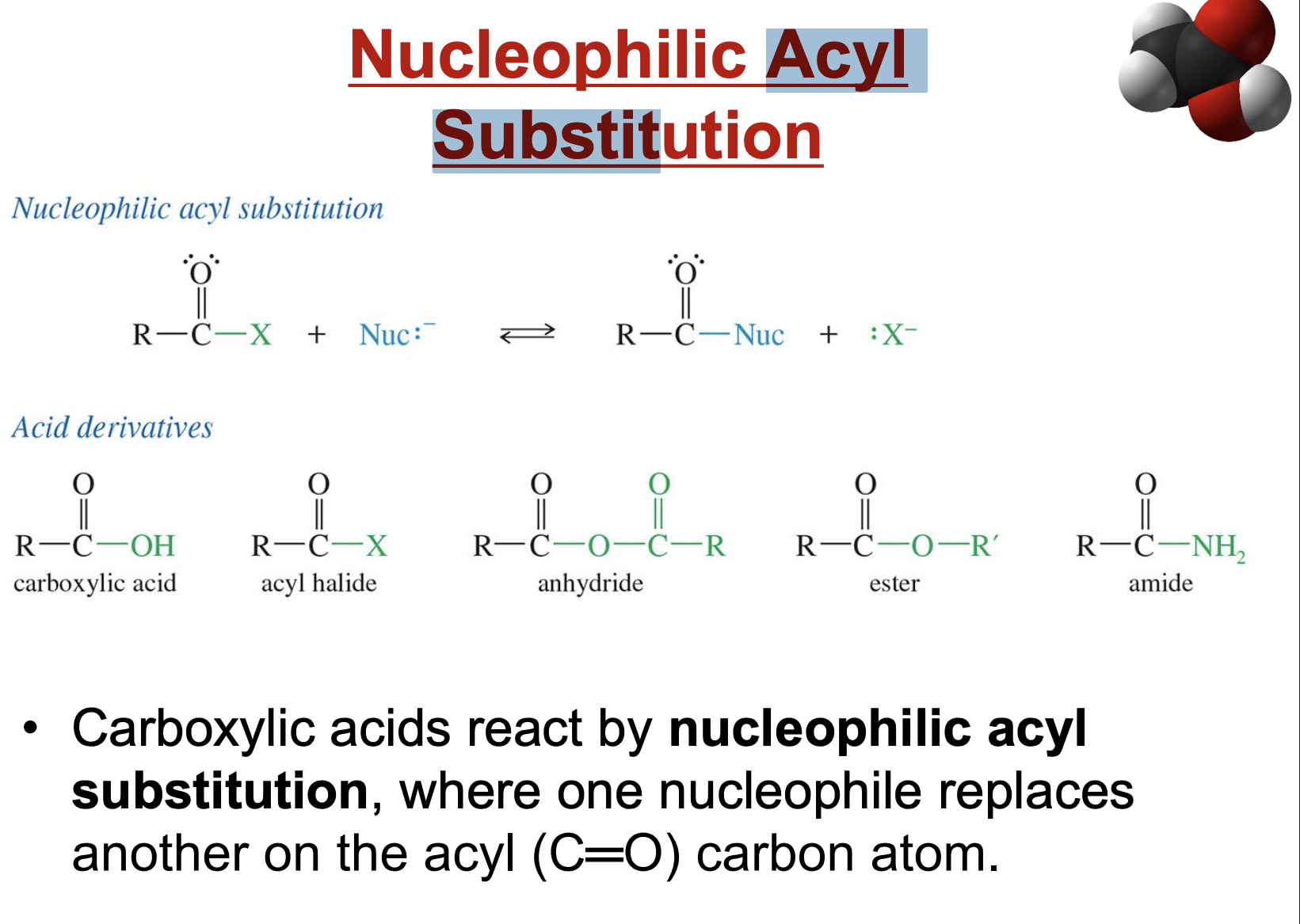
What is nu acyl substitution?
Nucleophilic acyl substitution = a nucleophile attacks the carbonyl carbon, and another group gets replaced. Think of it like a replacement.
There are basically THREE things happening:
A nucleophile attacks the carbonyl carbon.
The C=O temporarily opens up, forming a tetrahedral intermediate.
The carbonyl reforms, and the leaving group gets kicked out.
The important difference from regular nucleophilic addition:
Nucleophilic addition: A nucleophile adds to the carbonyl, and the original group stays.
Nucleophilic acyl substitution: A nucleophile attacks, then another group leaves.
Remember this distinction! You learned nucleophilic addition earlier. Your professor now wants you to understand substitution.
List the following weak acids in order of inc acidity (fr lowest to highest) how to answer
how many w/drawing groups do we have?
how close r they to carboxylic acid?

At pH 4.5, which of the following acids would be most dissociated? How to answer
BASICALLY find strongest acid
if pH > pKa → acid is mostly dissociated
if pH < pKa → acid is mostly protonated
find acid w/ lowest pKa which makes it the strongest acid or the one where the diff btwn the given pH and the pKa is the largest pos #

Reactivity of carboxylic acid derivatives
general order from MOST reactive to LEAST reactive
Most reactive → Least reactive
1 Acid chloride RCOCl
2 Acid anhydride (RCO)₂O
3 Ester RCOOR′
4 Amide RCONH₂

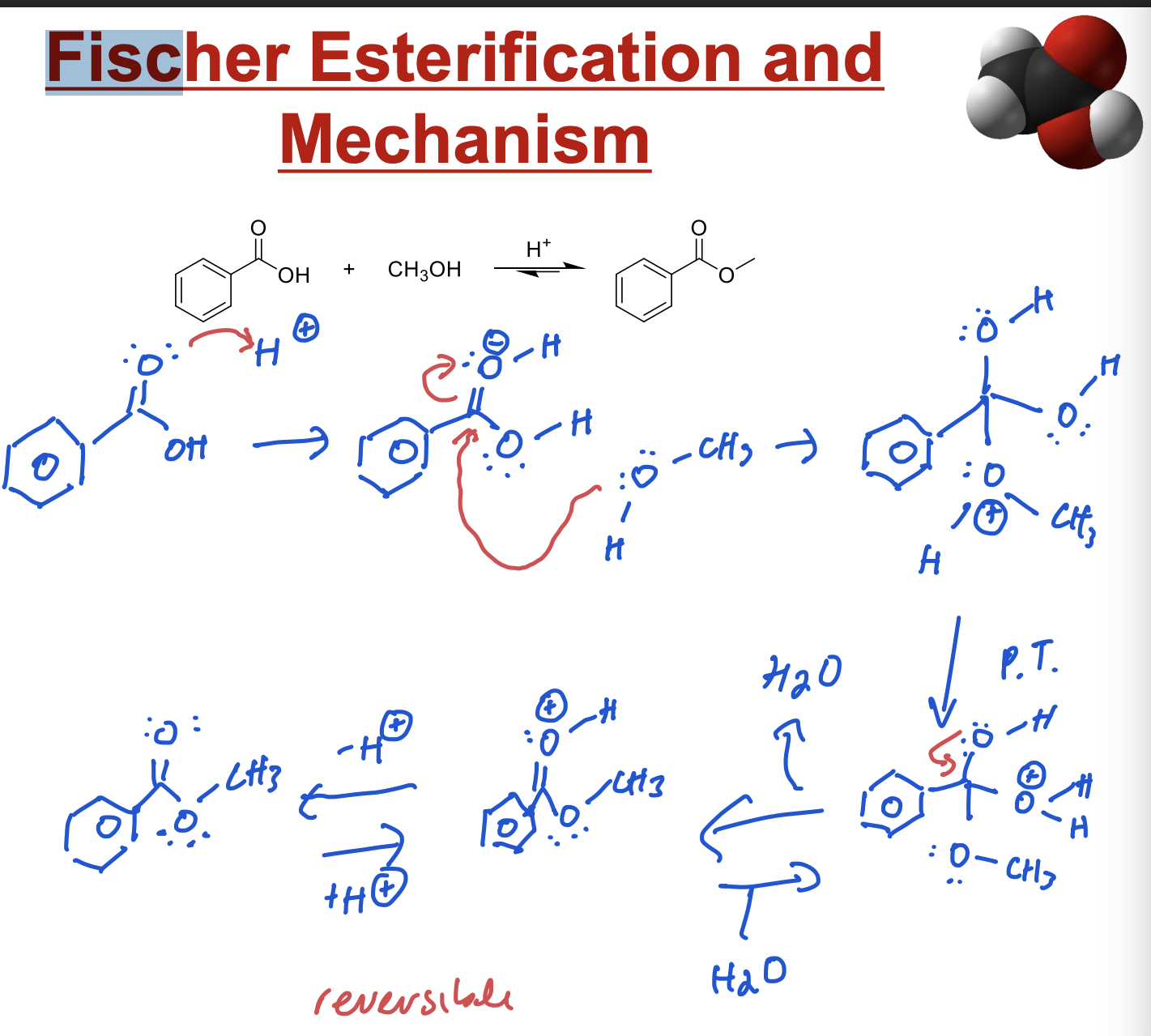
fischer esterification
reaction MAKES AN ESTER fr:
carboxylic acid + alcohol
acid catalyst (H+) and ester
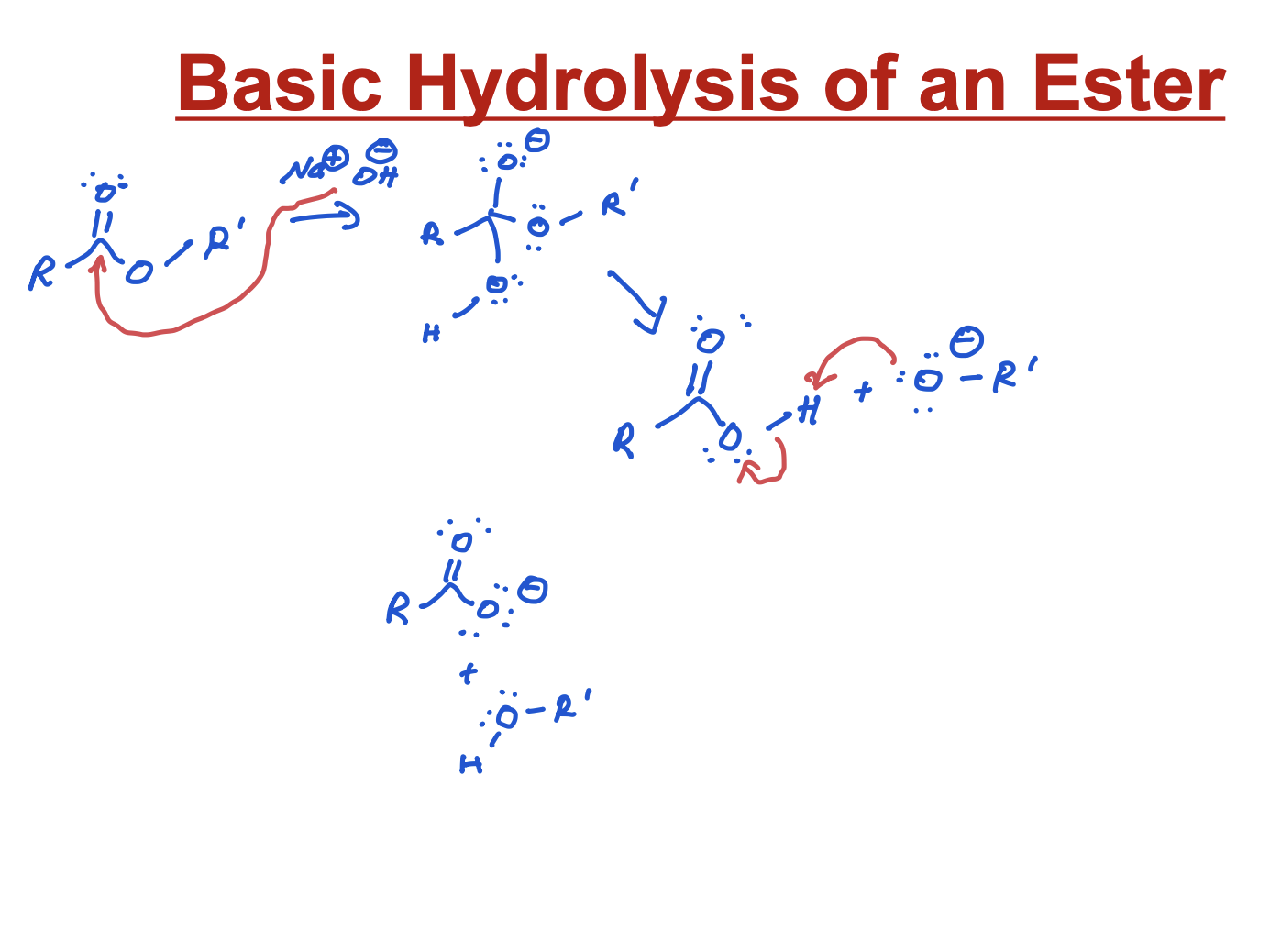
Basic hydrolysis of ester
we're breaking an ester.
overall rxn: Ester + OH- → carboxylate + alcohol
Notice something important:
Under BASIC conditions, the product is a carboxylate ion, not a neutral carboxylic acid.
If you subsequently add H₃O⁺, you can protonate the carboxylate to form the carboxylic acid.
saponification
is the basic hydrolysis of fats and oils
Fats/oils + strong base → soap + glycerol

19, Esterification using diazomethane
another way your professor shows to convert a carboxylic acid into an ester.
The reagent is: CH2N2 (called diazomethane)
The reaction:
RCOOH —CH2N2→ RCOOCH3
What is happening?
The carboxylic acid is converted into a METHYL ester.
You don't need to spend a ton of time on the mechanism right now. Remember:
Starting material: carboxylic acid.
Reagent: diazomethane.
Product: methyl ester.
Nitrogen gas is released.
Your slides note that diazomethane is extremely toxic and explosive. For your exam, focus on recognizing its reaction rather than its preparation or handling.
