Biology Chapter 15 MCQ

0.0(0)
Studied by 0 people
call kaiCall Kai
learnLearn
examPractice Test
spaced repetitionSpaced Repetition
heart puzzleMatch
flashcardsFlashcards
GameKnowt Play
Card Sorting

1/122

flashcard set

Earn XP

Description and Tags

Genes & Proteins MCQ

123 Terms

1
New cards

Where does RNA polymerase bind to initiate transcription in a eukaryotic gene?

The promoter region containing conserved sequences like the TATA box

<p>The promoter region containing conserved sequences like the TATA box</p>
2
New cards

Where does RNA polymerase bind to initiate transcription in a eukaryotic gene?

The promoter region containing conserved sequences like the TATA box

In a eukaryotic gene, RNA polymerase binds to the promoter (a DNA sequence located upstream of the gene) to initiate transcription

  • Transcription factors first: eukaryotic RNA polymerase cannot bind the promoter and start transcription on its own. General transcription factors bind to the promoter first and recruit RNA polymerase

  • TATA box: many eukaryotic promoters contain a TATA box (often TATAAA), which helps transcription factors position RNA polymerase II correctly at the start site

  • Initiation complex: together, the promoter DNA, transcription factors, and RNA polymerase form a transcription initiation complex before the DNA strands unwind and RNA synthesis begins


<p><mark data-color="yellow" style="background-color: yellow; color: inherit;">The promoter region containing conserved sequences like the TATA box</mark></p><p><span>In a eukaryotic gene, RNA polymerase binds to </span>the <strong>promoter</strong> (a DNA sequence located upstream of the gene) to initiate transcription</p><ul><li><p><span><strong>Transcription factors first:</strong> eukaryotic RNA polymerase cannot bind the promoter and start transcription on its own. General transcription factors bind to the promoter first and recruit RNA polymerase</span></p></li><li><p><span><strong>TATA box:</strong> many eukaryotic promoters contain a <strong>TATA box</strong> (often TATAAA), which helps transcription factors position RNA polymerase II correctly at the start site</span></p></li><li><p><span><strong>Initiation complex:</strong> together, the promoter DNA, transcription factors, and RNA polymerase form a transcription initiation complex before the DNA strands unwind and RNA synthesis begins</span></p></li></ul><p></p>
3
New cards

Where does RNA polymerase bind to initiate transcription in a eukaryotic gene?

The promoter region containing conserved sequences like the TATA box

In a eukaryotic gene, RNA polymerase binds to the promoter (a DNA sequence located upstream of the gene) to initiate transcription

  • Transcription factors first: eukaryotic RNA polymerase cannot bind the promoter and start transcription on its own. General transcription factors bind to the promoter first and recruit RNA polymerase

  • TATA box: many eukaryotic promoters contain a TATA box (often TATAAA), which helps transcription factors position RNA polymerase II correctly at the start site

  • Initiation complex: together, the promoter DNA, transcription factors, and RNA polymerase form a transcription initiation complex before the DNA strands unwind and RNA synthesis begins


<p><mark data-color="yellow" style="background-color: yellow; color: inherit;">The promoter region containing conserved sequences like the TATA box</mark></p><p>In a eukaryotic gene, RNA polymerase binds to the <strong>promoter</strong> (a DNA sequence located upstream of the gene) to initiate transcription</p><ul><li><p><strong>Transcription factors first:</strong> eukaryotic RNA polymerase cannot bind the promoter and start transcription on its own. General transcription factors bind to the promoter first and recruit RNA polymerase</p></li><li><p><strong>TATA box:</strong> many eukaryotic promoters contain a <strong>TATA box</strong> (often TATAAA), which helps transcription factors position RNA polymerase II correctly at the start site</p></li><li><p><strong>Initiation complex:</strong> together, the promoter DNA, transcription factors, and RNA polymerase form a transcription initiation complex before the DNA strands unwind and RNA synthesis begins</p></li></ul><p></p>
4
New cards

Where does RNA polymerase bind to initiate transcription in a eukaryotic gene?

The promoter region containing conserved sequences like the TATA box

In a eukaryotic gene, RNA polymerase binds to the promoter (a DNA sequence located upstream of the gene) to initiate transcription

  • Transcription factors first: eukaryotic RNA polymerase cannot bind the promoter and start transcription on its own. General transcription factors bind to the promoter first and recruit RNA polymerase

  • TATA box: many eukaryotic promoters contain a TATA box (often TATAAA), which helps transcription factors position RNA polymerase II correctly at the start site

  • Initiation complex: together, the promoter DNA, transcription factors, and RNA polymerase form a transcription initiation complex before the DNA strands unwind and RNA synthesis begins


<p><mark data-color="yellow" style="background-color: yellow; color: inherit;">The promoter region containing conserved sequences like the TATA box</mark></p><p>In a eukaryotic gene, RNA polymerase binds to the <strong>promoter</strong> (a DNA sequence located upstream of the gene) to initiate transcription</p><ul><li><p><strong>Transcription factors first:</strong> eukaryotic RNA polymerase cannot bind the promoter and start transcription on its own. General transcription factors bind to the promoter first and recruit RNA polymerase</p></li><li><p><strong>TATA box:</strong> many eukaryotic promoters contain a <strong>TATA box</strong> (often TATAAA), which helps transcription factors position RNA polymerase II correctly at the start site</p></li><li><p><strong>Initiation complex:</strong> together, the promoter DNA, transcription factors, and RNA polymerase form a transcription initiation complex before the DNA strands unwind and RNA synthesis begins</p></li></ul><p></p>
5
New cards

Promoter region

A specific sequence of non-coding DNA located upstream of a gene where RNA polymerase and transcription factors bind to initiate transcription. It acts as the genetic "start signal" that tells the cell's machinery where to begin copying DNA into RNA, which DNA strand to use as the template, and which direction to move

  • Initiation starts at promoter region (short DNA sequence upstream) where the RNA polymerase bind and starts

  • Location: the promoter sits immediately upstream (toward the 5' end of the coding strand) of the transcription start site. Because it is a regulatory sequence, the promoter itself is not transcribed into RNA

  • TATA Box: many eukaryotic promoters contain a crucial nucleotide sequence rich in thymine and adenine (commonly TATAAA), located about 25–35 base pairs upstream of the start site. Specific transcription factors recognize and bind to this box first

  • Directionality: the asymmetrical sequence of the promoter determines which of the two DNA strands serves as the template strand and dictates the 5' to 3' direction of RNA synthesis


<p>A specific sequence of non-coding DNA located upstream of a gene where RNA polymerase and transcription factors bind to initiate transcription. It acts as the genetic "start signal" that tells the cell's machinery where to begin copying DNA into RNA, which DNA strand to use as the template, and which direction to move</p><ul><li><p>Initiation starts at promoter region (short DNA sequence upstream) where the RNA polymerase bind and starts </p></li><li><p><span><strong>Location: t</strong>he promoter sits immediately upstream (toward the 5' end of the coding strand) of the transcription start site. Because it is a regulatory sequence, the promoter itself is not transcribed into RNA</span></p></li><li><p><span><strong>TATA Box: </strong>many eukaryotic promoters contain a crucial nucleotide sequence rich in thymine and adenine (commonly </span><code>TATAAA</code><span>), located about 25–35 base pairs upstream of the start site. Specific transcription factors recognize and bind to this box first</span></p></li><li><p><span><strong>Directionality: </strong>the asymmetrical sequence of the promoter determines which of the two DNA strands serves as the template strand and dictates the 5' to 3' direction of RNA synthesis</span></p></li></ul><p></p>
6
New cards

Promoter region

A specific sequence of non-coding DNA located upstream of a gene where RNA polymerase and transcription factors bind to initiate transcription. It acts as the genetic "start signal" that tells the cell's machinery where to begin copying DNA into RNA, which DNA strand to use as the template, and which direction to move

  • Initiation starts at promoter region (short DNA sequence upstream) where the RNA polymerase bind and starts

  • Location: the promoter sits immediately upstream (toward the 5' end of the coding strand) of the transcription start site. Because it is a regulatory sequence, the promoter itself is not transcribed into RNA

  • TATA Box: many eukaryotic promoters contain a crucial nucleotide sequence rich in thymine and adenine (commonly TATAAA), located about 25–35 base pairs upstream of the start site. Specific transcription factors recognize and bind to this box first

  • Directionality: the asymmetrical sequence of the promoter determines which of the two DNA strands serves as the template strand and dictates the 5' to 3' direction of RNA synthesis


<p>A specific sequence of non-coding DNA located upstream of a gene where RNA polymerase and transcription factors bind to initiate transcription. It acts as the genetic "start signal" that tells the cell's machinery where to begin copying DNA into RNA, which DNA strand to use as the template, and which direction to move</p><ul><li><p>Initiation starts at promoter region (short DNA sequence upstream) where the RNA polymerase bind and starts </p></li><li><p><strong>Location: t</strong>he promoter sits immediately upstream (toward the 5' end of the coding strand) of the transcription start site. Because it is a regulatory sequence, the promoter itself is not transcribed into RNA</p></li><li><p><strong>TATA Box: </strong>many eukaryotic promoters contain a crucial nucleotide sequence rich in thymine and adenine (commonly <code>TATAAA</code>), located about 25–35 base pairs upstream of the start site. Specific transcription factors recognize and bind to this box first</p></li><li><p><strong>Directionality: </strong>the asymmetrical sequence of the promoter determines which of the two DNA strands serves as the template strand and dictates the 5' to 3' direction of RNA synthesis</p></li></ul><p></p>
7
New cards

Promoter region

A specific, non-coding sequence of DNA located upstream of a gene where RNA polymerase and transcription factors bind to initiate transcription. It acts as the molecular "start signal" and landing pad that controls when, where, and how much of a gene is copied into mRNA

  • Location: promoters sit directly upstream (toward the 5’ end of the coding strand) of the transcription start site. Because the promoter is a regulatory sequence, it is not transcribed into the final mRNA molecule

  • Directionality: the specific nucleotide order of the promoter tells RNA polymerase which of the two DNA strands to use as the template strand and which direction to move along the DNA

  • TATA Box: many eukaryotic promoters contain a conserved, adenine- and thymine-rich sequence called the TATA box (typically 25–35 base pairs upstream of the start site). Specific proteins recognize and bind to this sequence to help stabilize and position the transcription machinery

  • RNA polymerase requires general transcription factors to bind to the promoter first before it can attach


<p><span>A specific, non-coding sequence of DNA located upstream of a gene where RNA polymerase and transcription factors bind to initiate transcription. It acts as the molecular "start signal" and landing pad that controls when, where, and how much of a gene is copied into mRNA</span></p><ul><li><p><span><strong>Location:</strong> promoters sit directly upstream (toward the 5’ end of the coding strand) of the transcription start site. Because the promoter is a regulatory sequence, it is <strong>not</strong> transcribed into the final mRNA molecule</span></p></li><li><p><span><strong>Directionality: t</strong>he specific nucleotide order of the promoter tells RNA polymerase which of the two DNA strands to use as the template strand and which direction to move along the DNA</span></p></li><li><p><span><strong>TATA Box:</strong> many eukaryotic promoters contain a conserved, adenine- and thymine-rich sequence called the <strong>TATA box</strong> (typically 25–35 base pairs upstream of the start site). Specific proteins recognize and bind to this sequence to help stabilize and position the transcription machinery</span></p></li><li><p>RNA polymerase requires <strong>general transcription factors</strong> to bind to the promoter first before it can attach</p></li></ul><p></p>
8
New cards

Promoter region

A specific regulatory DNA sequence located immediately upstream (toward the 5' end of the coding strand) of a gene. It acts as the recognition and binding site where RNA polymerase and transcription factors attach to initiate transcription

  • Initiates Transcription: the promoter acts as a landing pad that guides RNA polymerase to the exact starting point of a gene, establishing where transcription begins and which DNA strand serves as the template

  • Regulates Gene Expression: because it is a non-coding region, the promoter is not transcribed into RNA itself. Instead, it controls when, where, and how much mRNA (and ultimately protein) is produced from that gene

  • Contains the TATA Box: In eukaryotes, promoters often feature a specific sequence of alternating thymine and adenine nucleotides called the TATA box. General transcription factors recognize and bind to this box first, creating a complex that recruits and stabilizes RNA polymerase


<p><span>A specific <strong>regulatory DNA sequence</strong> located immediately upstream (toward the 5' end of the coding strand) of a gene. It acts as the recognition and binding site where <strong>RNA polymerase</strong> and <strong>transcription factors</strong> attach to initiate transcription</span></p><ul><li><p><span><strong>Initiates Transcription:</strong> the promoter acts as a landing pad that guides RNA polymerase to the exact starting point of a gene, establishing where transcription begins and which DNA strand serves as the template</span></p></li><li><p><span><strong>Regulates Gene Expression:</strong> because it is a non-coding region, the promoter is not transcribed into RNA itself. Instead, it controls when, where, and how much mRNA (and ultimately protein) is produced from that gene</span></p></li><li><p><span><strong>Contains the TATA Box:</strong> In eukaryotes, promoters often feature a specific sequence of alternating thymine and adenine nucleotides called the <strong>TATA box</strong>. General transcription factors recognize and bind to this box first, creating a complex that recruits and stabilizes RNA polymerase</span></p></li></ul><p></p>
9
New cards

Where does RNA polymerase bind to initiate transcription in a eukaryotic gene?

The promoter region containing conserved sequences like the TATA box

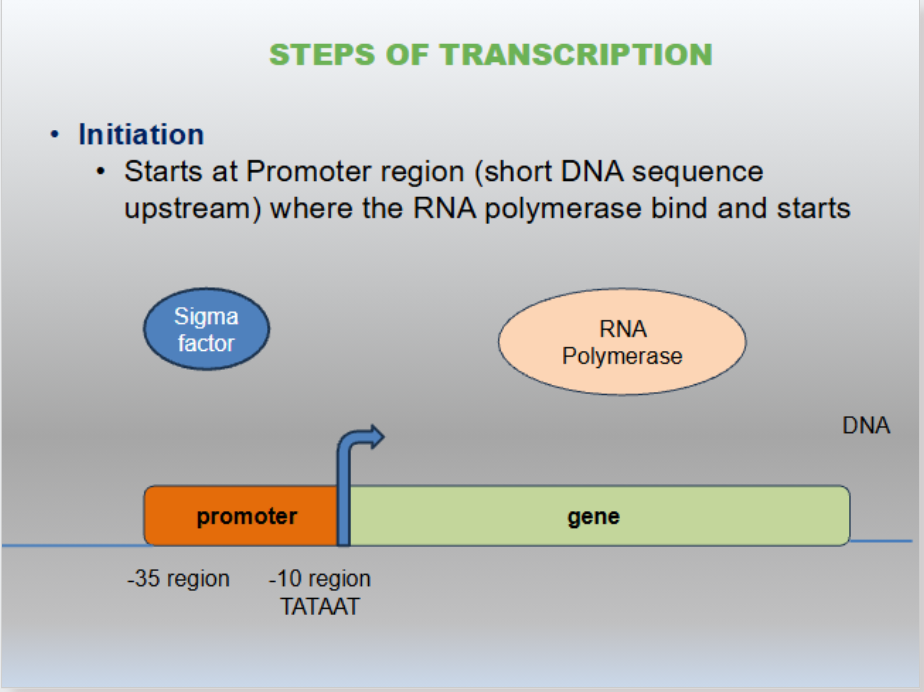
  • A specific regulatory DNA sequence located immediately upstream (toward the 5' end of the coding strand) of a gene. It acts as the recognition and binding site where RNA polymerase and transcription factors attach to initiate transcription

  • Initiation starts at promoter region (short DNA sequence upstream) where the RNA polymerase bind and starts

<p>The promoter region containing conserved sequences like the TATA box</p><ul><li><p>A specific <strong>regulatory DNA sequence</strong> located immediately upstream (toward the 5' end of the coding strand) of a gene. It acts as the recognition and binding site where <strong>RNA polymerase</strong> and <strong>transcription factors</strong> attach to initiate transcription</p></li><li><p>Initiation starts at promoter region (short DNA sequence upstream) where the RNA polymerase bind and starts</p></li></ul><p></p>
10
New cards

Where does RNA polymerase bind to initiate transcription in a eukaryotic gene?

The promoter region containing conserved sequences like the TATA box

  • A specific regulatory DNA sequence located immediately upstream (toward the 5' end of the coding strand) of a gene. It acts as the recognition and binding site where RNA polymerase and transcription factors attach to initiate transcription

  • Initiation starts at promoter region (short DNA sequence upstream) where the RNA polymerase bind and starts


<p>The promoter region containing conserved sequences like the TATA box</p><ul><li><p>A specific <strong>regulatory DNA sequence</strong> located immediately upstream (toward the 5' end of the coding strand) of a gene. It acts as the recognition and binding site where <strong>RNA polymerase</strong> and <strong>transcription factors</strong> attach to initiate transcription</p></li><li><p>Initiation starts at promoter region (short DNA sequence upstream) where the RNA polymerase bind and starts</p></li></ul><p></p>
11
New cards

TATA box

The TATA box is a conserved DNA sequence (rich in adenine and thymine bases) found in the core promoter region of eukaryotic and archaeal genes that helps position RNA polymerase II and transcription factors to initiate transcription

  • Location: typically located about 25–35 base pairs upstream of the transcription start site

  • Sequence: rich in T (thymine) and A (adenine) nucleotides (such as TATAAA or TATAAAA), which pair with two hydrogen bonds rather than three—making local DNA strand separation easier

  • Role in Transcription: acts as a binding site for TATA-binding protein (TBP) and general transcription factors (such as TFIID), which bend the DNA and recruit RNA polymerase II to start making mRNA

  • Prokaryotic Counterpart: bacteria use a similar upstream promoter sequence called the Pribnow box (or -10 box) rather than a TATA box


<p><span>The </span><strong>TATA box</strong> is a conserved DNA sequence (rich in adenine and thymine bases) found in the core promoter region of eukaryotic and archaeal genes that helps position RNA polymerase II and transcription factors to initiate transcription</p><ul><li><p><span><strong>Location:</strong> typically located about 25–35 base pairs upstream of the transcription start site</span></p></li><li><p><span><strong>Sequence:</strong> rich in <strong>T</strong> (thymine) and <strong>A</strong> (adenine) nucleotides (such as </span><code>TATAAA</code><span> or </span><code>TATAAAA</code><span>), which pair with two hydrogen bonds rather than three—making local DNA strand separation easier</span></p></li><li><p><span><strong>Role in Transcription:</strong> acts as a binding site for <strong>TATA-binding protein (TBP)</strong> and general transcription factors (such as TFIID), which bend the DNA and recruit <strong>RNA polymerase II</strong> to start making mRNA</span></p></li><li><p><span><strong>Prokaryotic Counterpart:</strong> bacteria use a similar upstream promoter sequence called the <strong>Pribnow box</strong> (or -10 box) rather than a TATA box</span></p></li></ul><p></p>
12
New cards

TATA box

A conserved DNA sequence (rich in adenine and thymine bases) found in the core promoter region of eukaryotic and archaeal genes that helps position RNA polymerase II and transcription factors to initiate transcription

  • Typically located about 25–35 base pairs upstream of the transcription start site

  • Sequence: rich in T (thymine) and A (adenine) nucleotides (such as TATAAA or TATAAAA), which pair with two hydrogen bonds rather than three—making local DNA strand separation easier

  • Role in Transcription: acts as a binding site for TATA-binding protein (TBP) and general transcription factors (such as TFIID), which bend the DNA and recruit RNA polymerase II to start making mRNA

  • Prokaryotic Counterpart: bacteria use a similar upstream promoter sequence called the Pribnow box (or -10 box) rather than a TATA box


<p>A conserved DNA sequence (rich in adenine and thymine bases) found in the core promoter region of eukaryotic and archaeal genes that helps position RNA polymerase II and transcription factors to initiate transcription</p><ul><li><p><span>Typically located about 25–35 base pairs upstream of the transcription start site</span></p></li><li><p><span><strong>Sequence:</strong> rich in <strong>T</strong> (thymine) and <strong>A</strong> (adenine) nucleotides (such as </span><code>TATAAA</code><span> or </span><code>TATAAAA</code><span>), which pair with two hydrogen bonds rather than three—making local DNA strand separation easier</span></p></li><li><p><span><strong>Role in Transcription:</strong> acts as a binding site for <strong>TATA-binding protein (TBP)</strong> and general transcription factors (such as TFIID), which bend the DNA and recruit <strong>RNA polymerase II</strong> to start making mRNA</span></p></li><li><p><span><strong>Prokaryotic Counterpart:</strong> bacteria use a similar upstream promoter sequence called the <strong>Pribnow box</strong> (or -10 box) rather than a TATA box</span></p></li></ul><p></p>
13
New cards

TATA box

A conserved DNA sequence (rich in adenine and thymine bases) found in the core promoter region of eukaryotic and archaeal genes that helps position RNA polymerase II and transcription factors to initiate transcription

  • Typically located about 25–35 base pairs upstream of the transcription start site

  • Sequence: rich in T (thymine) and A (adenine) nucleotides (such as TATAAA or TATAAAA), which pair with two hydrogen bonds rather than three—making local DNA strand separation easier

  • Role in Transcription: acts as a binding site for TATA-binding protein (TBP) and general transcription factors (such as TFIID), which bend the DNA and recruit RNA polymerase II to start making mRNA

  • Prokaryotic Counterpart: bacteria use a similar upstream promoter sequence called the Pribnow box (or -10 box) rather than a TATA box


<p>A conserved DNA sequence (rich in adenine and thymine bases) found in the core promoter region of eukaryotic and archaeal genes that helps position RNA polymerase II and transcription factors to initiate transcription</p><ul><li><p>Typically located about 25–35 base pairs upstream of the transcription start site</p></li><li><p><strong>Sequence:</strong> rich in <strong>T</strong> (thymine) and <strong>A</strong> (adenine) nucleotides (such as <code>TATAAA</code> or <code>TATAAAA</code>), which pair with two hydrogen bonds rather than three—making local DNA strand separation easier</p></li><li><p><strong>Role in Transcription:</strong> acts as a binding site for <strong>TATA-binding protein (TBP)</strong> and general transcription factors (such as TFIID), which bend the DNA and recruit <strong>RNA polymerase II</strong> to start making mRNA</p></li><li><p><strong>Prokaryotic Counterpart:</strong> bacteria use a similar upstream promoter sequence called the <strong>Pribnow box</strong> (or -10 box) rather than a TATA box</p></li></ul><p></p>
14
New cards

TATA box

A conserved DNA sequence (rich in adenine and thymine bases) found in the core promoter region of eukaryotic and archaeal genes that helps position RNA polymerase II and transcription factors to initiate transcription

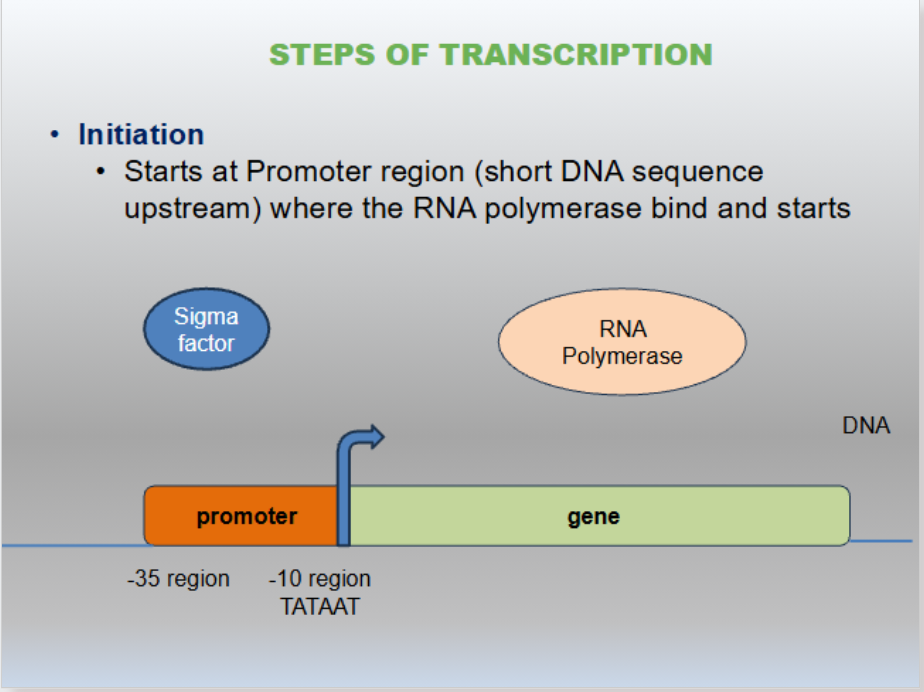
  • Typically located about 25–35 base pairs upstream of the transcription start site

  • Sequence: rich in T (thymine) and A (adenine) nucleotides (such as TATAAA or TATAAAA), which pair with two hydrogen bonds rather than three—making local DNA strand separation easier

  • Role in Transcription: acts as a binding site for TATA-binding protein (TBP) and general transcription factors (such as TFIID), which bend the DNA and recruit RNA polymerase II to start making mRNA

  • Prokaryotic Counterpart: bacteria use a similar upstream promoter sequence called the Pribnow box (or -10 box) rather than a TATA box

<p>A conserved DNA sequence (rich in adenine and thymine bases) found in the core promoter region of eukaryotic and archaeal genes that helps position RNA polymerase II and transcription factors to initiate transcription</p><ul><li><p>Typically located about 25–35 base pairs upstream of the transcription start site</p></li><li><p><strong>Sequence:</strong> rich in <strong>T</strong> (thymine) and <strong>A</strong> (adenine) nucleotides (such as <code>TATAAA</code> or <code>TATAAAA</code>), which pair with two hydrogen bonds rather than three—making local DNA strand separation easier</p></li><li><p><strong>Role in Transcription:</strong> acts as a binding site for <strong>TATA-binding protein (TBP)</strong> and general transcription factors (such as TFIID), which bend the DNA and recruit <strong>RNA polymerase II</strong> to start making mRNA</p></li><li><p><strong>Prokaryotic Counterpart:</strong> bacteria use a similar upstream promoter sequence called the <strong>Pribnow box</strong> (or -10 box) rather than a TATA box</p></li></ul><p></p>
15
New cards

RNA polymerase

A multi-subunit enzyme that synthesizes a complementary RNA strand from a DNA template during the process of transcription. It is the primary enzyme responsible for executing the first step of the central dogma (DNA → RNA)

  • Directionality: RNA polymerase reads the DNA template strand in the 3′ to 5′ direction and synthesizes the new RNA molecule in the 5′ to 3′ direction. It adds free RNA nucleotides exclusively to the free 3′ hydroxyl (-OH) end of the growing strand

  • DNA Unwinding: unlike DNA replication, transcription does not require a separate helicase enzyme. RNA polymerase pries apart the two DNA strands itself to form a localized "transcription bubble" and rewinds the helix behind it as it moves


<p>A multi-subunit enzyme that synthesizes a complementary RNA strand from a DNA template during the process of <strong>transcription</strong>. It is the primary enzyme responsible for executing the first step of the central dogma (DNA → RNA)</p><ul><li><p><span><strong>Directionality:</strong> RNA polymerase reads the DNA template strand in the <strong>3′ to 5′</strong> direction and synthesizes the new RNA molecule in the <strong>5′ to 3′</strong> direction. It adds free RNA nucleotides exclusively to the free 3′ hydroxyl (-OH) end of the growing strand</span></p></li><li><p><span><strong>DNA Unwinding:</strong> unlike DNA replication, transcription does not require a separate helicase enzyme. RNA polymerase pries apart the two DNA strands itself to form a localized "transcription bubble" and rewinds the helix behind it as it moves</span></p></li><li><p><span><strong>Directionality:</strong> RNA polymerase reads the DNA template strand in the <strong>3′ to 5′</strong> direction and synthesizes the new RNA molecule in the <strong>5′ to 3′</strong> direction. It adds free RNA nucleotides exclusively to the free 3′ hydroxyl (-OH) end of the growing strand</span></p></li><li><p><span><strong>DNA Unwinding:</strong> unlike DNA replication, transcription does not require a separate helicase enzyme. RNA polymerase pries apart the two DNA strands itself to form a localized "transcription bubble" and rewinds the helix behind it as it moves</span></p></li></ul><p></p>
16
New cards

RNA polymerase

RNA polymerase is the primary enzyme that synthesizes an RNA molecule from a DNA template during transcription. It reads a single-stranded DNA template in the 3' to 5' direction and builds a complementary RNA strand in the 5' to 3' direction

How RNA polymerase operates across the three stages of transcription:

  • Initiation: RNA polymerase binds to a specific DNA sequence called a promoter. In eukaryotes, proteins called transcription factors must bind to the promoter first (often at the TATA box) before RNA polymerase can attach

  • DNA Unwinding: unlike DNA replication, transcription does not require a separate helicase enzyme. RNA polymerase breaks hydrogen bonds to unwind the DNA double helix itself, creating a small transcription bubble

  • Elongation: the enzyme moves along the template strand, adding complementary RNA nucleotides (pairing Uracil with Adenine instead of Thymine) to the free 3' hydroxyl end of the growing RNA strand

  • Termination: transcription stops when the enzyme reaches a terminator sequence (or a polyadenylation signal in eukaryotes), releasing the newly formed primary RNA transcript


<p>RNA polymerase is the primary enzyme that synthesizes an RNA molecule from a DNA template during transcription. It reads a single-stranded DNA template in the 3' to 5' direction and builds a complementary RNA strand in the 5' to 3' direction</p><p>How RNA polymerase operates across the three stages of transcription:</p><ul><li><p><span><strong>Initiation:</strong> RNA polymerase binds to a specific DNA sequence called a <strong>promoter</strong>. In eukaryotes, proteins called transcription factors must bind to the promoter first (often at the TATA box) before RNA polymerase can attach</span></p></li></ul><ul><li><p><span><strong>DNA Unwinding:</strong> unlike DNA replication, transcription does not require a separate helicase enzyme. RNA polymerase breaks hydrogen bonds to unwind the DNA double helix itself, creating a small <strong>transcription bubble</strong></span></p></li><li><p><span><strong>Elongation:</strong> the enzyme moves along the template strand, adding complementary RNA nucleotides (pairing <strong>Uracil</strong> with Adenine instead of Thymine) to the free <strong>3' hydroxyl end</strong> of the growing RNA strand</span></p></li><li><p><strong>Termination:</strong> transcription stops when the enzyme reaches a terminator sequence (or a polyadenylation signal in eukaryotes), releasing the newly formed primary RNA transcript</p></li></ul><p></p>
17
New cards

RNA polymerase

RNA polymerase is the primary enzyme responsible for transcription, the process of synthesizing a complementary RNA molecule from a DNA template. It is defined as the molecular machine that reads a gene's DNA sequence to build a primary RNA transcript, marking the first step of gene expression

  • Directionality: RNA polymerase reads the DNA template strand in the 3′ to 5′ direction. It builds the new RNA strand in the 5′ to 3′ direction by adding nucleotides to the 3′ end

  • Base Pairing Rules: as it moves along the template, it pairs cytosine (C) with guanine (G) and thymine (T) with adenine (A). However, it pairs adenine (A) on the DNA with uracil (U) instead of thymine


<p><span><strong>RNA polymerase</strong></span> is the primary enzyme responsible for <strong>transcription</strong>, the process of synthesizing a complementary RNA molecule from a DNA template. It is defined as the molecular machine that reads a gene's DNA sequence to build a primary RNA transcript, marking the first step of gene expression</p><ul><li><p><span><strong>Directionality: </strong>RNA polymerase reads the DNA template strand in the <strong>3′ to 5′</strong> direction. It builds the new RNA strand in the <strong>5′ to 3′</strong> direction by adding nucleotides to the 3′ end</span></p></li><li><p><strong>Base Pairing Rules: </strong>as it moves along the template, it pairs cytosine (C) with guanine (G) and thymine (T) with adenine (A). However, it pairs adenine (A) on the DNA with <strong>uracil (U)</strong> instead of thymine</p></li></ul><p></p>
18
New cards

Role of RNA polymerase in transcription

RNA polymerase is the primary enzyme responsible for transcription, the process of synthesizing a complementary RNA molecule from a DNA template. It is defined as the molecular machine that reads a gene's DNA sequence to build a primary RNA transcript, marking the first step of gene expression

  • Directionality: RNA polymerase reads the DNA template strand in the 3′ to 5′ direction. It builds the new RNA strand in the 5′ to 3′ direction by adding nucleotides to the 3′ end

Role in the 3 Stages of Transcription

  • Initiation: RNA polymerase binds to a specific DNA sequence called a promoter (such as the TATA box in eukaryotes) to begin transcription. In eukaryotes, helper proteins called transcription factors must bind to the promoter first to guide RNA polymerase into place

  • Elongation: the enzyme moves down the DNA template, creating a "transcription bubble" and linking RNA nucleotides together via phosphodiester bonds

  • Termination: transcription stops when RNA polymerase reaches a terminator sequence on the DNA. The enzyme detaches and releases the newly formed RNA transcript


<p><span><strong>RNA polymerase</strong></span> is the primary enzyme responsible for <strong>transcription</strong>, the process of synthesizing a complementary RNA molecule from a DNA template. It is defined as the molecular machine that reads a gene's DNA sequence to build a primary RNA transcript, marking the first step of gene expression</p><ul><li><p><strong>Directionality:</strong> RNA polymerase reads the DNA template strand in the <strong>3′ to 5′</strong> direction. It builds the new RNA strand in the <strong>5′ to 3′</strong> direction by adding nucleotides to the 3′ end</p></li></ul><p>Role in the 3 Stages of Transcription</p><ul><li><p><span><strong>Initiation:</strong> RNA polymerase binds to a specific DNA sequence called a <strong>promoter</strong> (such as the TATA box in eukaryotes) to begin transcription. In eukaryotes, helper proteins called <strong>transcription factors</strong> must bind to the promoter first to guide RNA polymerase into place</span></p></li><li><p><span><strong>Elongation:</strong> the enzyme moves down the DNA template, creating a "transcription bubble" and linking RNA nucleotides together via phosphodiester bonds</span></p></li><li><p><span><strong>Termination:</strong> transcription stops when RNA polymerase reaches a <strong>terminator</strong> sequence on the DNA. The enzyme detaches and releases the newly formed RNA transcript</span></p></li></ul><p></p>
19
New cards

Role of RNA polymerase in transcription

RNA polymerase is the primary enzyme responsible for transcription, the process of synthesizing a complementary RNA molecule from a DNA template. It is defined as the molecular machine that reads a gene's DNA sequence to build a primary RNA transcript, marking the first step of gene expression

  • Directionality: RNA polymerase reads the DNA template strand in the 3′ to 5′ direction. It builds the new RNA strand in the 5′ to 3′ direction by adding nucleotides to the 3′ end

Role in the 3 Stages of Transcription

  • Initiation: RNA polymerase binds to a specific DNA sequence called a promoter (such as the TATA box in eukaryotes) to begin transcription. In eukaryotes, helper proteins called transcription factors must bind to the promoter first to guide RNA polymerase into place

  • Elongation: the enzyme moves down the DNA template, creating a "transcription bubble" and linking RNA nucleotides together via phosphodiester bonds

  • Termination: transcription stops when RNA polymerase reaches a terminator sequence on the DNA. The enzyme detaches and releases the newly formed RNA transcript


<p><strong>RNA polymerase</strong> is the primary enzyme responsible for <strong>transcription</strong>, the process of synthesizing a complementary RNA molecule from a DNA template. It is defined as the molecular machine that reads a gene's DNA sequence to build a primary RNA transcript, marking the first step of gene expression</p><ul><li><p><strong>Directionality:</strong> RNA polymerase reads the DNA template strand in the <strong>3′ to 5′</strong> direction. It builds the new RNA strand in the <strong>5′ to 3′</strong> direction by adding nucleotides to the 3′ end</p></li></ul><p>Role in the 3 Stages of Transcription</p><ul><li><p><strong>Initiation:</strong> RNA polymerase binds to a specific DNA sequence called a <strong>promoter</strong> (such as the TATA box in eukaryotes) to begin transcription. In eukaryotes, helper proteins called <strong>transcription factors</strong> must bind to the promoter first to guide RNA polymerase into place</p></li><li><p><strong>Elongation:</strong> the enzyme moves down the DNA template, creating a "transcription bubble" and linking RNA nucleotides together via phosphodiester bonds</p></li><li><p><strong>Termination:</strong> transcription stops when RNA polymerase reaches a <strong>terminator</strong> sequence on the DNA. The enzyme detaches and releases the newly formed RNA transcript</p></li></ul><p></p>
20
New cards

3 stages of transcription

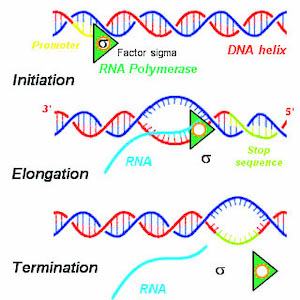
Transcription occurs in three stages: initiation, elongation, and termination, where RNA polymerase copies a DNA gene into an RNA transcript

1. Initiation

  • Promoter binding: RNA polymerase binds to a specific DNA sequence called a promoter at the start of a gene

  • Eukaryotic assist: eukaryotic transcription factors recognize promoter regions (such as the TATA box) and help RNA polymerase form a transcription initiation complex

  • DNA unwinding: RNA polymerase separates the DNA strands to create a transcription bubble and expose the template strand

2. Elongation

  • Directionality: RNA polymerase reads the template (antisense) strand in the 3′ to 5′ direction and synthesizes RNA in the 5′ to 3′ direction

  • Base pairing: free RNA nucleotides pair with complementary DNA bases (A pairs with U in RNA instead of T, while C pairs with G) and link via phosphodiester bonds

  • Re-annealing: as RNA polymerase advances, the newly made RNA peels away and the DNA double helix reforms behind it

3. Termination

  • Stop signal: RNA polymerase reaches a terminator sequence or termination signal in the DNA.

  • Release: the RNA transcript detaches from the DNA template and RNA polymerase releases from the DNA

<p>Transcription occurs in three stages: initiation, elongation, and termination, where RNA polymerase copies a DNA gene into an RNA transcript</p><p>1. Initiation</p><ul><li><p><span><strong>Promoter binding:</strong> RNA polymerase binds to a specific DNA sequence called a <strong>promoter</strong> at the start of a gene</span></p></li><li><p><span><strong>Eukaryotic assist:</strong> eukaryotic <strong>transcription factors</strong> recognize promoter regions (such as the <strong>TATA box</strong>) and help RNA polymerase form a transcription initiation complex</span></p></li><li><p><span><strong>DNA unwinding:</strong> RNA polymerase separates the DNA strands to create a <strong>transcription bubble</strong> and expose the template strand</span></p></li></ul><p>2. Elongation</p><ul><li><p><span><strong>Directionality:</strong> RNA polymerase reads the <strong>template (antisense) strand</strong> in the <strong>3′ to 5′</strong> direction and synthesizes RNA in the <strong>5′ to 3′</strong> direction</span></p></li><li><p><span><strong>Base pairing:</strong> free RNA nucleotides pair with complementary DNA bases (<strong>A</strong> pairs with <strong>U</strong> in RNA instead of <strong>T</strong>, while <strong>C</strong> pairs with <strong>G</strong>) and link via phosphodiester bonds</span></p></li><li><p><span><strong>Re-annealing:</strong> as RNA polymerase advances, the newly made RNA peels away and the DNA double helix reforms behind it</span></p></li></ul><p>3. Termination</p><ul><li><p><span><strong>Stop signal:</strong> RNA polymerase reaches a <strong>terminator</strong> sequence or termination signal in the DNA.</span></p></li><li><p><span><strong>Release:</strong> the RNA transcript detaches from the DNA template and RNA polymerase releases from the DNA</span></p></li></ul><p></p>
21
New cards

3 stages of transcription

Transcription occurs in three stages: initiation, elongation, and termination, where RNA polymerase copies a DNA gene into an RNA transcript

1. Initiation

  • Promoter binding: RNA polymerase binds to a specific DNA sequence called a promoter at the start of a gene

  • Eukaryotic assist: eukaryotic transcription factors recognize promoter regions (such as the TATA box) and help RNA polymerase form a transcription initiation complex

  • DNA unwinding: RNA polymerase separates the DNA strands to create a transcription bubble and expose the template strand

2. Elongation

  • Directionality: RNA polymerase reads the template (antisense) strand in the 3′ to 5′ direction and synthesizes RNA in the 5′ to 3′ direction

  • Base pairing: free RNA nucleotides pair with complementary DNA bases (A pairs with U in RNA instead of T, while C pairs with G) and link via phosphodiester bonds

  • Re-annealing: as RNA polymerase advances, the newly made RNA peels away and the DNA double helix reforms behind it

3. Termination

  • Stop signal: RNA polymerase reaches a terminator sequence or termination signal in the DNA.

  • Release: the RNA transcript detaches from the DNA template and RNA polymerase releases from the DNA


<p>Transcription occurs in three stages: initiation, elongation, and termination, where RNA polymerase copies a DNA gene into an RNA transcript</p><p>1. Initiation</p><ul><li><p><strong>Promoter binding:</strong> RNA polymerase binds to a specific DNA sequence called a <strong>promoter</strong> at the start of a gene</p></li><li><p><strong>Eukaryotic assist:</strong> eukaryotic <strong>transcription factors</strong> recognize promoter regions (such as the <strong>TATA box</strong>) and help RNA polymerase form a transcription initiation complex</p></li><li><p><strong>DNA unwinding:</strong> RNA polymerase separates the DNA strands to create a <strong>transcription bubble</strong> and expose the template strand</p></li></ul><p>2. Elongation</p><ul><li><p><strong>Directionality:</strong> RNA polymerase reads the <strong>template (antisense) strand</strong> in the <strong>3′ to 5′</strong> direction and synthesizes RNA in the <strong>5′ to 3′</strong> direction</p></li><li><p><strong>Base pairing:</strong> free RNA nucleotides pair with complementary DNA bases (<strong>A</strong> pairs with <strong>U</strong> in RNA instead of <strong>T</strong>, while <strong>C</strong> pairs with <strong>G</strong>) and link via phosphodiester bonds</p></li><li><p><strong>Re-annealing:</strong> as RNA polymerase advances, the newly made RNA peels away and the DNA double helix reforms behind it</p></li></ul><p>3. Termination</p><ul><li><p><strong>Stop signal:</strong> RNA polymerase reaches a <strong>terminator</strong> sequence or termination signal in the DNA.</p></li><li><p><strong>Release:</strong> the RNA transcript detaches from the DNA template and RNA polymerase releases from the DNA</p></li></ul><p></p>
22
New cards

In which direction does RNA polymerase synthesize a new RNA strand during transcription?

RNA polymerase synthesizes a new RNA strand in the 5’ to 3’ direction during transcription

  • 5’ to 3’

  • 5’ → 3’


<p><span style="font-family: Calibri, sans-serif; line-height: 115%;"><strong>RNA polymerase synthesizes a new RNA strand in the 5’ to 3’ direction during transcription</strong></span></p><ul><li><p>5’ to 3’</p></li><li><p>5’ → 3’</p></li></ul><p></p>
23
New cards

In which direction does RNA polymerase synthesize a new RNA strand during transcription?

During transcription, RNA polymerase synthesizes a new RNA strand in the 5' to 3' direction (5' →3')

  • RNA polymerase synthesizes a new RNA strand in the 5’ to 3’ direction during transcription

How this process works:

  • Direction of Synthesis: RNA polymerase adds new ribonucleotides exclusively to the free 3' hydroxyl (-OH) group of the growing RNA strand. Because nucleotides are added to the 3' end, the chain elongates from 5' to 3'

  • Direction of Template Reading: because nucleic acid strands pair antiparallel to one another, RNA polymerase reads the DNA template strand in the opposite 3' to 5' direction (3' → 5')

  • Key Distinction: do not confuse the direction the enzyme reads the DNA (3' to 5') with the direction it builds the RNA (5' to 3'). Both DNA polymerase and RNA polymerase synthesize nucleic acids strictly in the 5' to 3' direction


<p><span>During transcription, RNA polymerase synthesizes a new RNA strand in the </span><strong>5' to 3' direction</strong> (5' →3')</p><ul><li><p><span style="line-height: 115%;"><strong>RNA polymerase synthesizes a new RNA strand in the 5’ to 3’ direction during transcription</strong></span></p></li></ul><p>How this process works:</p><ul><li><p><span><strong>Direction of Synthesis:</strong> RNA polymerase adds new ribonucleotides exclusively to the free <strong>3' hydroxyl (-OH) group</strong> of the growing RNA strand. Because nucleotides are added to the 3' end, the chain elongates from 5' to 3'</span></p></li><li><p><span><strong>Direction of Template Reading:</strong> because nucleic acid strands pair antiparallel to one another, RNA polymerase reads the DNA template strand in the opposite <strong>3' to 5' direction</strong> (3' → 5')</span></p></li><li><p><span><strong>Key Distinction:</strong> do not confuse the direction the enzyme <em>reads</em> the DNA (3' to 5') with the direction it <em>builds</em> the RNA (5' to 3'). Both DNA polymerase and RNA polymerase synthesize nucleic acids strictly in the 5' to 3' direction</span></p></li></ul><p></p>
24
New cards

In which direction does RNA polymerase synthesize a new RNA strand during transcription?

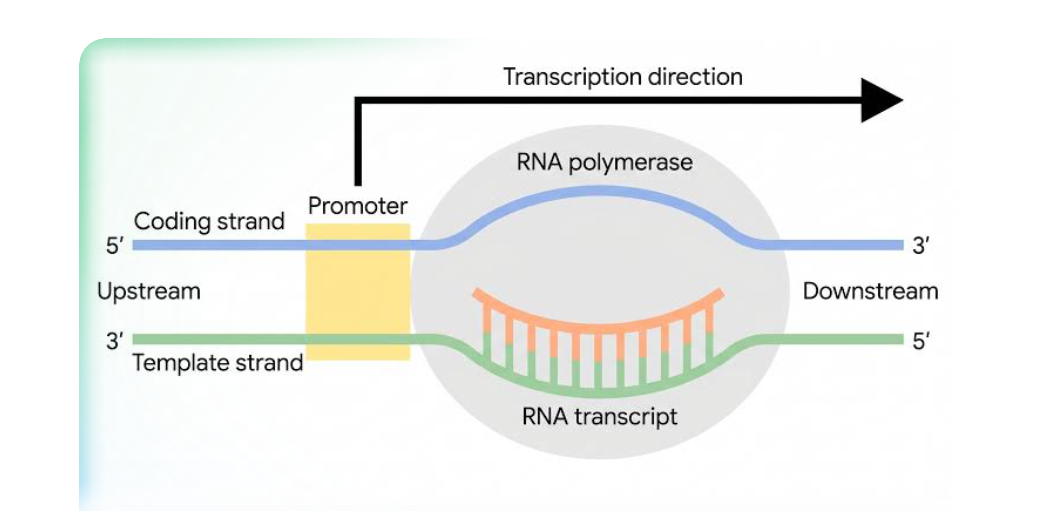
During transcription, RNA polymerase synthesizes a new RNA strand in the 5' to 3' direction (5' →3')

  • RNA polymerase synthesizes a new RNA strand in the 5’ to 3’ direction during transcription

How this process works:

  • Direction of Synthesis: RNA polymerase adds new ribonucleotides exclusively to the free 3' hydroxyl (-OH) group of the growing RNA strand. Because nucleotides are added to the 3' end, the chain elongates from 5' to 3'

  • Direction of Template Reading: because nucleic acid strands pair antiparallel to one another, RNA polymerase reads the DNA template strand in the opposite 3' to 5' direction (3' → 5')

  • Key Distinction: do not confuse the direction the enzyme reads the DNA (3' to 5') with the direction it builds the RNA (5' to 3'). Both DNA polymerase and RNA polymerase synthesize nucleic acids strictly in the 5' to 3' direction

<p>During transcription, RNA polymerase synthesizes a new RNA strand in the <strong>5' to 3' direction</strong> (5' →3')</p><ul><li><p><span style="line-height: 115%;"><strong>RNA polymerase synthesizes a new RNA strand in the 5’ to 3’ direction during transcription</strong></span></p></li></ul><p>How this process works:</p><ul><li><p><strong>Direction of Synthesis:</strong> RNA polymerase adds new ribonucleotides exclusively to the free <strong>3' hydroxyl (-OH) group</strong> of the growing RNA strand. Because nucleotides are added to the 3' end, the chain elongates from 5' to 3'</p></li><li><p><strong>Direction of Template Reading:</strong> because nucleic acid strands pair antiparallel to one another, RNA polymerase reads the DNA template strand in the opposite <strong>3' to 5' direction</strong> (3' → 5')</p></li><li><p><strong>Key Distinction:</strong> do not confuse the direction the enzyme <em>reads</em> the DNA (3' to 5') with the direction it <em>builds</em> the RNA (5' to 3'). Both DNA polymerase and RNA polymerase synthesize nucleic acids strictly in the 5' to 3' direction</p></li></ul><p></p>
25
New cards

In which direction does RNA polymerase synthesize a new RNA strand during transcription?

During transcription, RNA polymerase synthesizes a new RNA strand in the 5' to 3' direction

  • To build the transcript in this orientation, the enzyme moves along the antiparallel DNA template strand, reading it in the opposite 3' to 5' direction

  • Direction of Synthesis: RNA polymerase adds incoming ribonucleotides exclusively to the free hydroxyl (-OH) group on the 3' end of the growing RNA molecule. This chemical requirement forces all nucleic acid synthesis to proceed from 5' to 3'

  • Template Reading vs. Coding Strand: RNA polymerase reads the template (noncoding) strand from 3' to 5'. The resulting RNA sequence is complementary to this template strand and matches the coding (nontemplate) strand, except that uracil (U) replaces thymine (T)


<p><span>During transcription, RNA polymerase synthesizes a new RNA strand in the </span><strong>5' to 3' direction</strong></p><ul><li><p>To build the transcript in this orientation, the enzyme moves along the antiparallel DNA template strand, reading it in the opposite <strong>3' to 5' direction</strong></p></li><li><p><span><strong>Direction of Synthesis:</strong> RNA polymerase adds incoming ribonucleotides exclusively to the free hydroxyl (-OH) group on the 3' end of the growing RNA molecule. This chemical requirement forces all nucleic acid synthesis to proceed from 5' to 3'</span></p></li><li><p><span><strong>Template Reading vs. Coding Strand: </strong>RNA polymerase reads the <strong>template (noncoding) strand</strong> from 3' to 5'. The resulting RNA sequence is complementary to this template strand and matches the <strong>coding (nontemplate) strand</strong>, except that uracil (U) replaces thymine (T)</span></p></li></ul><p></p>
26
New cards

In which direction does RNA polymerase synthesize a new RNA strand during transcription?

During transcription, RNA polymerase synthesizes a new RNA strand in the 5' to 3' direction (5' →3')

  • RNA polymerase synthesizes a new RNA strand in the 5’ to 3’ direction during transcription

  • 5’ to 3’

  • RNA polymerase only synthesizes mRNA in the 5' to 3' direction


<p>During transcription, RNA polymerase synthesizes a new RNA strand in the <strong>5' to 3' direction</strong> (5' →3')</p><ul><li><p><span style="line-height: 115%;"><strong>RNA polymerase synthesizes a new RNA strand in the 5’ to 3’ direction during transcription</strong></span></p></li><li><p><span style="line-height: 115%;"><strong>5’ to 3’</strong></span></p></li><li><p>RNA polymerase only synthesizes mRNA in the 5' to 3' direction</p></li></ul><p></p>
27
New cards

In which direction does RNA polymerase synthesize a new RNA strand during transcription?

During transcription, RNA polymerase synthesizes a new RNA strand in the 5' to 3' direction (5' →3')

  • RNA polymerase synthesizes a new RNA strand in the 5’ to 3’ direction during transcription

  • 5’ to 3’

  • RNA polymerase only synthesizes mRNA in the 5' to 3' direction


<p>During transcription, RNA polymerase synthesizes a new RNA strand in the <strong>5' to 3' direction</strong> (5' →3')</p><ul><li><p><span style="line-height: 115%;"><strong>RNA polymerase synthesizes a new RNA strand in the 5’ to 3’ direction during transcription</strong></span></p></li><li><p><span style="line-height: 115%;"><strong>5’ to 3’</strong></span></p></li><li><p>RNA polymerase only synthesizes mRNA in the 5' to 3' direction</p></li></ul><p></p>
28
New cards

In which direction does RNA polymerase synthesize a new RNA strand during transcription?

During transcription, RNA polymerase synthesizes a new RNA strand in the 5' to 3' direction (5' →3')

  • RNA polymerase synthesizes a new RNA strand in the 5’ to 3’ direction during transcription

  • 5’ to 3’

  • RNA polymerase only synthesizes mRNA in the 5' to 3' direction


<p>During transcription, RNA polymerase synthesizes a new RNA strand in the <strong>5' to 3' direction</strong> (5' →3')</p><ul><li><p><span style="line-height: 115%;"><strong>RNA polymerase synthesizes a new RNA strand in the 5’ to 3’ direction during transcription</strong></span></p></li><li><p><span style="line-height: 115%;"><strong>5’ to 3’</strong></span></p></li><li><p>RNA polymerase only synthesizes mRNA in the 5' to 3' direction</p></li></ul><p></p>
29
New cards

What is the primary function of the 5’ cap added to eukaryotic pre-mRNA?

It protects the mRNA from enzymatic degradation (by RNAse) and assists in ribosome attachment

  • The primary function of the 5' cap (a modified guanine nucleotide) added to eukaryotic pre-mRNA is to protect the transcript from degradation by exonucleases and facilitate ribosome binding to initiate translation

Key Functions of the 5' Cap

  • Protection from Degradation: enzymes in the cytoplasm called ribonucleases (specifically 5' exonucleases) rapidly break down unprotected RNA. The 5' cap blocks these enzymes from digesting the coding sequence

  • Ribosome Recognition: once the mature mRNA reaches the cytoplasm, the small ribosomal subunit and translation initiation factors recognize and bind to the 5' cap. This signals the start site for protein synthesis


<p>It protects the mRNA from enzymatic degradation (by RNAse) and assists in ribosome attachment</p><ul><li><p><span>The primary function of the </span><strong>5' cap</strong> (a modified guanine nucleotide) added to eukaryotic pre-mRNA is to <strong>protect the transcript from degradation</strong> by exonucleases and <strong>facilitate ribosome binding</strong> to initiate translation</p></li></ul><p>Key Functions of the 5' Cap</p><ul><li><p><span><strong>Protection from Degradation:</strong> enzymes in the cytoplasm called ribonucleases (specifically 5' exonucleases) rapidly break down unprotected RNA. The 5' cap blocks these enzymes from digesting the coding sequence</span></p></li><li><p><span><strong>Ribosome Recognition:</strong> once the mature mRNA reaches the cytoplasm, the small ribosomal subunit and translation initiation factors recognize and bind to the 5' cap. This signals the start site for protein synthesis</span></p></li></ul><p></p>
30
New cards

What is the primary function of the 5’ cap added to eukaryotic pre-mRNA?

It protects the mRNA from enzymatic degradation (by RNAse) and assists in ribosome attachment

  • The primary function of the 5' cap (a modified guanine nucleotide) added to eukaryotic pre-mRNA is to protect the transcript from degradation by exonucleases and facilitate ribosome binding to initiate translation

Key Functions of the 5' Cap

  • Protection from Degradation: enzymes in the cytoplasm called ribonucleases (specifically 5' exonucleases) rapidly break down unprotected RNA. The 5' cap blocks these enzymes from digesting the coding sequence

  • Ribosome Recognition: once the mature mRNA reaches the cytoplasm, the small ribosomal subunit and translation initiation factors recognize and bind to the 5' cap. This signals the start site for protein synthesis
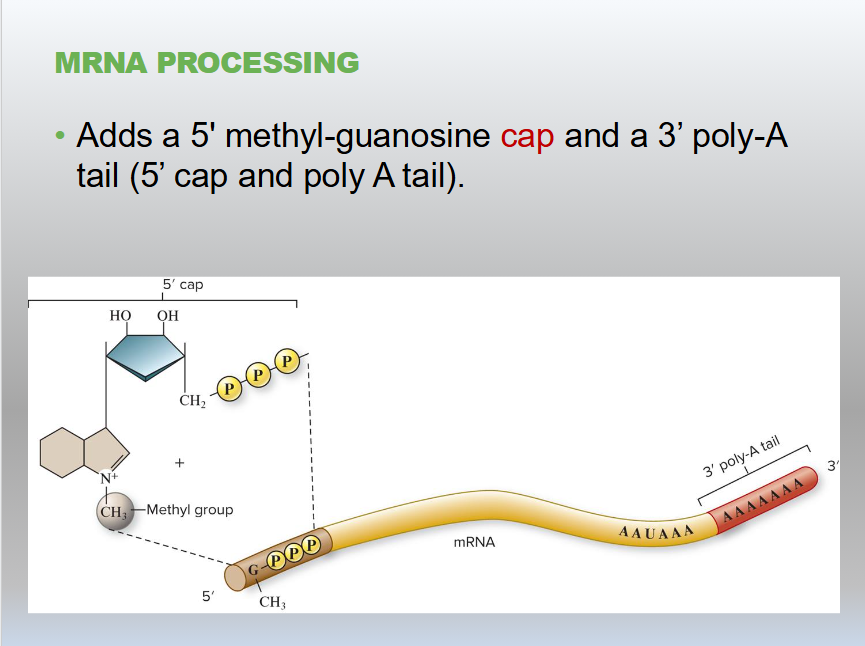

<p>It protects the mRNA from enzymatic degradation (by RNAse) and assists in ribosome attachment</p><ul><li><p>The primary function of the <strong>5' cap</strong> (a modified guanine nucleotide) added to eukaryotic pre-mRNA is to <strong>protect the transcript from degradation</strong> by exonucleases and <strong>facilitate ribosome binding</strong> to initiate translation</p></li></ul><p>Key Functions of the 5' Cap</p><ul><li><p><strong>Protection from Degradation:</strong> enzymes in the cytoplasm called ribonucleases (specifically 5' exonucleases) rapidly break down unprotected RNA. The 5' cap blocks these enzymes from digesting the coding sequence</p></li><li><p><strong>Ribosome Recognition:</strong> once the mature mRNA reaches the cytoplasm, the small ribosomal subunit and translation initiation factors recognize and bind to the 5' cap. This signals the start site for protein synthesis</p></li></ul><p></p>
31
New cards

What is the primary function of the 5’ cap added to eukaryotic pre-mRNA?

It protects the mRNA from enzymatic degradation (by RNAse) and assists in ribosome attachment

  • The primary function of the 5’ cap (a modified guanine nucleotide) added to eukaryotic pre-mRNA is to protect the transcript from degradation by hydrolytic enzymes and facilitate ribosome binding during translation

  • Key Functions of the 5’ Cap

    • Protection from Degradation: the cap shields the 5’ end of the growing mRNA strand from exonucleases (enzymes that break down RNA) as it travels from the nucleus into the cytoplasm

    • Ribosome Recognition: once in the cytoplasm, the 5’ cap acts as an attachment signal that helps the small ribosomal subunit recognize and bind to the mRNA to initiate translation


<p>It protects the mRNA from enzymatic degradation (by RNAse) and assists in ribosome attachment</p><ul><li><p><span>The primary function of the </span>5’ cap (a modified guanine nucleotide) added to eukaryotic pre-mRNA is to protect the transcript from degradation by hydrolytic enzymes and facilitate ribosome binding during translation</p></li><li><p>Key Functions of the 5’ Cap</p><ul><li><p><span><strong>Protection from Degradation:</strong> the cap shields the 5’ end of the growing mRNA strand from <strong>exonucleases</strong> (enzymes that break down RNA) as it travels from the nucleus into the cytoplasm</span></p></li><li><p><span><strong>Ribosome Recognition:</strong> once in the cytoplasm, the 5’ cap acts as an attachment signal that helps the <strong>small ribosomal subunit</strong> recognize and bind to the mRNA to initiate translation</span></p></li></ul></li></ul><p></p>
32
New cards

What is the primary function of the 5’ cap added to eukaryotic pre-mRNA?

It protects the mRNA from enzymatic degradation (by RNAse) and assists in ribosome attachment

  • The primary function of the 5’ cap (a modified guanine nucleotide) added to eukaryotic pre-mRNA is to protect the transcript from degradation by hydrolytic enzymes and facilitate ribosome binding during translation


<p>It protects the mRNA from enzymatic degradation (by RNAse) and assists in ribosome attachment</p><ul><li><p>The primary function of the 5’ cap (a modified guanine nucleotide) added to eukaryotic pre-mRNA is to protect the transcript from degradation by hydrolytic enzymes and facilitate ribosome binding during translation</p></li></ul><p></p>
33
New cards

What role does the 3’ poly-A tail play in eukaryotic messenger RNA?

It facilitates nuclear export and influences transcript stability in the cytoplasm

  • Aids in nuclear export. The tail acts as a recognition signal for transport proteins. This allows the mature mRNA to safely exit the nucleus through nuclear pores and enter the cytoplasm

  • the 3’ poly-A tail is a sequence of roughly 100 to 250 adenine (A) nucleotides added to the 3’ end of eukaryotic pre-mRNA during post-transcriptional modification. It serves three primary functions to ensure the transcript survives and gets translated into a functional protein

  • Enhances Translation Initiation: once in the cytoplasm, poly-A binding proteins attach to the tail and interact with initiation factors at the 5’ cap. This interaction helps recruit ribosomes to the mRNA, increasing the overall efficiency of protein synthesis
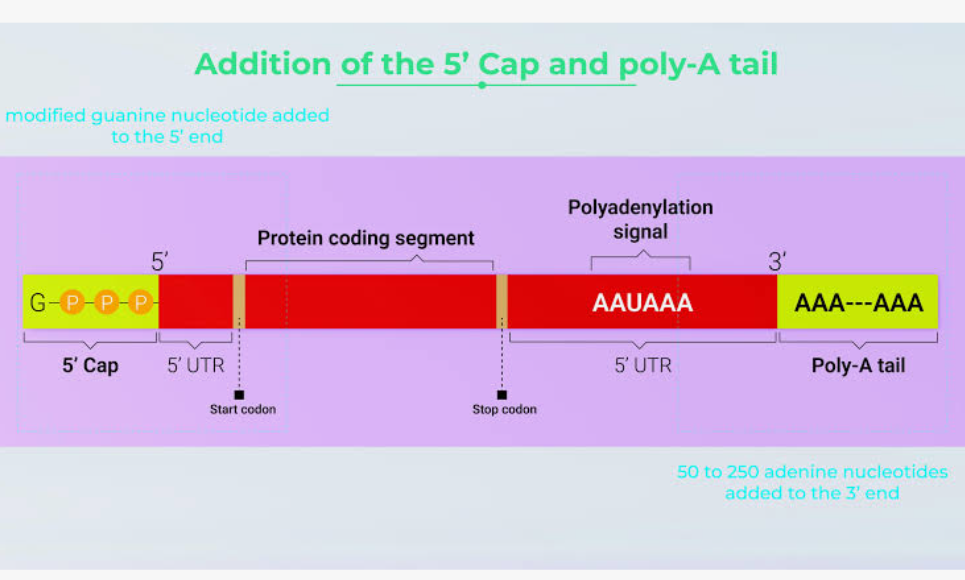

<p>It facilitates nuclear export and influences transcript stability in the cytoplasm</p><ul><li><p>Aids in nuclear export. The tail acts as a recognition signal for transport proteins. This allows the mature mRNA to safely exit the nucleus through nuclear pores and enter the cytoplasm</p></li><li><p><span>the </span>3’ poly-A tail is a sequence of roughly 100 to 250 adenine (A) nucleotides added to the 3’ end of eukaryotic pre-mRNA during post-transcriptional modification. It serves three primary functions to ensure the transcript survives and gets translated into a functional protein</p></li><li><p><span><strong>Enhances Translation Initiation:</strong> once in the cytoplasm, poly-A binding proteins attach to the tail and interact with initiation factors at the 5’ cap. This interaction helps recruit ribosomes to the mRNA, increasing the overall efficiency of protein synthesis</span></p></li></ul><p></p>
34
New cards

What role does the 3’ poly-A tail play in eukaryotic messenger RNA?

It facilitates nuclear export and influences transcript stability in the cytoplasm

  • Aids in nuclear export. The tail acts as a recognition signal for transport proteins. This allows the mature mRNA to safely exit the nucleus through nuclear pores and enter the cytoplasm

  • the 3’ poly-A tail is a sequence of roughly 100 to 250 adenine (A) nucleotides added to the 3’ end of eukaryotic pre-mRNA during post-transcriptional modification. It serves three primary functions to ensure the transcript survives and gets translated into a functional protein

  • Enhances Translation Initiation: once in the cytoplasm, poly-A binding proteins attach to the tail and interact with initiation factors at the 5’ cap. This interaction helps recruit ribosomes to the mRNA, increasing the overall efficiency of protein synthesis


<p>It facilitates nuclear export and influences transcript stability in the cytoplasm</p><ul><li><p>Aids in nuclear export. The tail acts as a recognition signal for transport proteins. This allows the mature mRNA to safely exit the nucleus through nuclear pores and enter the cytoplasm</p></li><li><p>the 3’ poly-A tail is a sequence of roughly 100 to 250 adenine (A) nucleotides added to the 3’ end of eukaryotic pre-mRNA during post-transcriptional modification. It serves three primary functions to ensure the transcript survives and gets translated into a functional protein</p></li><li><p><strong>Enhances Translation Initiation:</strong> once in the cytoplasm, poly-A binding proteins attach to the tail and interact with initiation factors at the 5’ cap. This interaction helps recruit ribosomes to the mRNA, increasing the overall efficiency of protein synthesis</p></li></ul><p></p>
35
New cards

What role does the 3’ poly-A tail play in eukaryotic messenger RNA?

It facilitates nuclear export and influences transcript stability in the cytoplasm

<p>It facilitates nuclear export and influences transcript stability in the cytoplasm</p>
36
New cards

What role does the 3’ poly-A tail play in eukaryotic messenger RNA?

It facilitates nuclear export and influences transcript stability in the cytoplasm

<p>It facilitates nuclear export and influences transcript stability in the cytoplasm</p>
37
New cards

What is the function of the 5’ cap and the 3’ poly-A tail added to eukaryotic pre-mRNA?

The 5' cap and 3' poly-A tail protect eukaryotic pre-mRNA from degradation, help export mature mRNA from the nucleus to the cytoplasm, and assist in initiating translation

  • 5’ methyl-guanosine cap: it protects the mRNA from enzymatic degradation (by RNAse) and assists in ribosome attachment

  • 3’ poly-A tail: it facilitates nuclear export and influences transcript stability in the cytoplasm
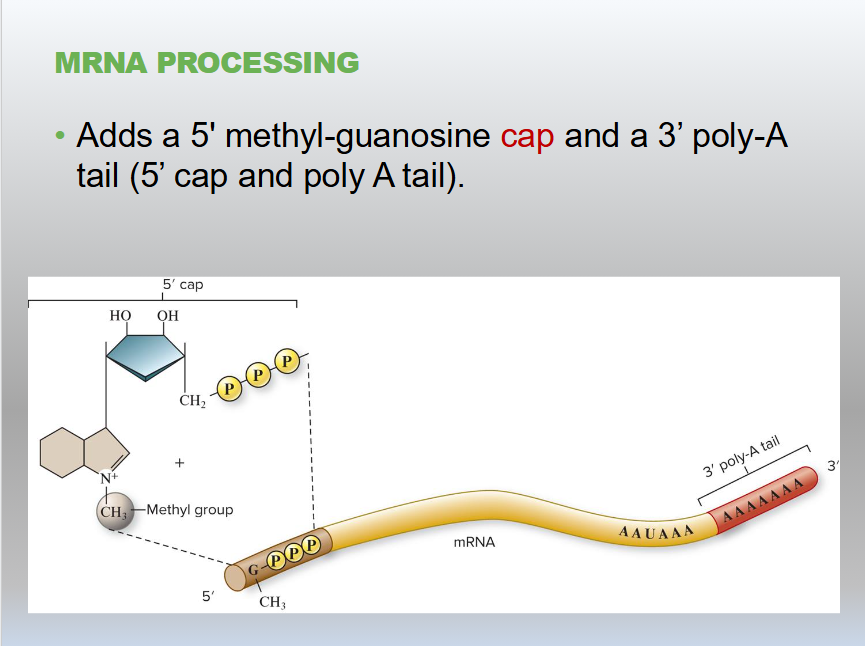

<p>The <strong>5' cap</strong> and <strong>3' poly-A tail</strong> protect eukaryotic pre-mRNA from degradation, help export mature mRNA from the nucleus to the cytoplasm, and assist in initiating translation</p><ul><li><p>5’ methyl-guanosine cap: it protects the mRNA from enzymatic degradation (by RNAse) and assists in ribosome attachment</p></li><li><p>3’ poly-A tail: it facilitates nuclear export and influences transcript stability in the cytoplasm</p></li></ul><p></p>
38
New cards

What is the function of the 5’ cap and the 3’ poly-A tail added to eukaryotic pre-mRNA?

The 5' cap and 3' poly-A tail protect eukaryotic pre-mRNA from degradation, help export mature mRNA from the nucleus to the cytoplasm, and assist in initiating translation

  • 5’ methyl-guanosine cap: it protects the mRNA from enzymatic degradation (by RNAse) and assists in ribosome attachment

  • 3’ poly-A tail: it facilitates nuclear export and influences transcript stability in the cytoplasm


<p>The <strong>5' cap</strong> and <strong>3' poly-A tail</strong> protect eukaryotic pre-mRNA from degradation, help export mature mRNA from the nucleus to the cytoplasm, and assist in initiating translation</p><ul><li><p>5’ methyl-guanosine cap: it protects the mRNA from enzymatic degradation (by RNAse) and assists in ribosome attachment</p></li><li><p>3’ poly-A tail: it facilitates nuclear export and influences transcript stability in the cytoplasm</p></li></ul><p></p>
39
New cards

What is the function of the 5’ cap and the 3’ poly-A tail added to eukaryotic pre-mRNA?

The 5' cap and 3' poly-A tail protect eukaryotic pre-mRNA from degradation, help export mature mRNA from the nucleus to the cytoplasm, and assist in initiating translation

5' methyl-guanosine cap:

  • Structure: a modified guanine nucleotide (7-methylguanosine) added to the 5' end during transcription

  • Protects against breakdown: shields the 5' end from hydrolytic enzymes and exonucleases

  • Initiates translation: serves as a recognition and binding site for ribosomes to attach and start translating the mRNA

  • 5’ methyl-guanosine cap: it protects the mRNA from enzymatic degradation (by RNAse) and assists in ribosome attachment


3’ poly-A tail:

  • Structure: a string of roughly 50–250 adenine nucleotides added to the 3' end after the pre-mRNA is cleaved

  • Increases stability and lifespan: acts as a buffer against exonucleases so the mRNA lasts longer in the cytoplasm before being broken down

  • Aids nuclear export: supports transport of mature mRNA out of the nucleus

  • 3’ poly-A tail: it facilitates nuclear export and influences transcript stability in the cytoplasm


<p>The <strong>5' cap</strong> and <strong>3' poly-A tail</strong> protect eukaryotic pre-mRNA from degradation, help export mature mRNA from the nucleus to the cytoplasm, and assist in initiating translation</p><p><strong>5' methyl-guanosine cap:</strong></p><ul><li><p><strong>Structure:</strong> a modified guanine nucleotide (7-methylguanosine) added to the 5' end during transcription</p></li><li><p><strong>Protects against breakdown:</strong> shields the 5' end from hydrolytic enzymes and exonucleases</p></li><li><p><strong>Initiates translation:</strong> serves as a recognition and binding site for ribosomes to attach and start translating the mRNA</p></li></ul><ul><li><p><strong>5’ methyl-guanosine cap</strong>: it protects the mRNA from enzymatic degradation (by RNAse) and assists in ribosome attachment</p></li></ul><p></p><p>3’ poly-A tail:</p><ul><li><p><strong>Structure:</strong> a string of roughly 50–250 adenine nucleotides added to the 3' end after the pre-mRNA is cleaved</p></li><li><p><strong>Increases stability and lifespan:</strong> acts as a buffer against exonucleases so the mRNA lasts longer in the cytoplasm before being broken down</p></li><li><p><strong>Aids nuclear export:</strong> supports transport of mature mRNA out of the nucleus</p></li><li><p>3’ poly-A tail: it facilitates nuclear export and influences transcript stability in the cytoplasm</p></li></ul><p></p>
40
New cards

What are the non-coding segments of a eukaryotic pre-mRNA that are removed during RNA splicing called?

Introns

The non-coding segments of eukaryotic pre-mRNA removed during RNA splicing are called introns

  • Removal & Joining: a spliceosome (made of snRNPs and proteins) cuts out the introns and joins the remaining coding segments—called exons—together to form mature mRNA

  • Why It Matters: leaving introns in the mRNA can disrupt the reading frame or add unwanted sequences, producing a nonfunctional protein


<p>Introns</p><p>The non-coding segments of eukaryotic pre-mRNA removed during RNA splicing are called introns</p><ul><li><p><strong>Removal &amp; Joining:</strong> a <strong>spliceosome</strong> (made of snRNPs and proteins) cuts out the <strong>introns</strong> and joins the remaining coding segments—called <strong>exons</strong>—together to form mature mRNA</p></li><li><p><strong>Why It Matters:</strong> leaving introns in the mRNA can disrupt the reading frame or add unwanted sequences, producing a nonfunctional protein</p></li></ul><p></p>
41
New cards

What are the non-coding segments of a eukaryotic pre-mRNA that are removed during RNA splicing called?

Introns

The non-coding segments of eukaryotic pre-mRNA removed during RNA splicing are called introns

  • Removal & Joining: a spliceosome (made of snRNPs and proteins) cuts out the introns and joins the remaining coding segments—called exons—together to form mature mRNA

  • Why It Matters: leaving introns in the mRNA can disrupt the reading frame or add unwanted sequences, producing a nonfunctional protein


<p>Introns</p><p>The non-coding segments of eukaryotic pre-mRNA removed during RNA splicing are called introns</p><ul><li><p><strong>Removal &amp; Joining:</strong> a <strong>spliceosome</strong> (made of snRNPs and proteins) cuts out the <strong>introns</strong> and joins the remaining coding segments—called <strong>exons</strong>—together to form mature mRNA</p></li><li><p><strong>Why It Matters:</strong> leaving introns in the mRNA can disrupt the reading frame or add unwanted sequences, producing a nonfunctional protein</p></li></ul><p></p>
42
New cards

Introns

A non-coding nucleotide sequence within a gene that is transcribed into pre-mRNA, but is excised (removed) during RNA splicing before mature mRNA leaves the nucleus for translation

  • Introns vs. Exons: Introns are removed intervening sequences, whereas exons are the expressed sequences joined together to form mature mRNA (and typically code for amino acids)

  • RNA Splicing: In eukaryotic nuclei, spliceosomes (complexes of small nuclear RNAs and proteins) recognize splice sites, cut out introns, and ligate (join) flanking exons together

  • Introns (intervening) must be removed

  • The non-coding segments of eukaryotic pre-mRNA that are removed during RNA splicing


<p>A non-coding nucleotide sequence within a gene that is transcribed into pre-mRNA, but is excised (removed) during RNA splicing before mature mRNA leaves the nucleus for translation</p><ul><li><p><span><strong>Introns vs. Exons:</strong> Introns are removed intervening sequences, whereas <strong>exons</strong> are the expressed sequences joined together to form mature mRNA (and typically code for amino acids)</span></p></li><li><p><span><strong>RNA Splicing:</strong> In eukaryotic nuclei, <strong>spliceosomes</strong> (complexes of small nuclear RNAs and proteins) recognize splice sites, cut out introns, and ligate (join) flanking exons together</span></p></li><li><p>Introns (intervening) must be removed </p></li><li><p>The non-coding segments of eukaryotic pre-mRNA that are removed during RNA splicing </p></li></ul><p></p>
43
New cards

Introns

A non-coding nucleotide sequence within a gene that is transcribed into pre-mRNA, but is excised (removed) during RNA splicing before mature mRNA leaves the nucleus for translation

  • Introns vs. Exons: Introns are removed intervening sequences, whereas exons are the expressed sequences joined together to form mature mRNA (and typically code for amino acids)

  • RNA Splicing: In eukaryotic nuclei, spliceosomes (complexes of small nuclear RNAs and proteins) recognize splice sites, cut out introns, and ligate (join) flanking exons together

  • Introns (intervening) must be removed

  • The non-coding segments of eukaryotic pre-mRNA that are removed during RNA splicing


<p>A non-coding nucleotide sequence within a gene that is transcribed into pre-mRNA, but is excised (removed) during RNA splicing before mature mRNA leaves the nucleus for translation</p><ul><li><p><strong>Introns vs. Exons:</strong> Introns are removed intervening sequences, whereas <strong>exons</strong> are the expressed sequences joined together to form mature mRNA (and typically code for amino acids)</p></li><li><p><strong>RNA Splicing:</strong> In eukaryotic nuclei, <strong>spliceosomes</strong> (complexes of small nuclear RNAs and proteins) recognize splice sites, cut out introns, and ligate (join) flanking exons together</p></li><li><p>Introns (intervening) must be removed </p></li><li><p>The non-coding segments of eukaryotic pre-mRNA that are removed during RNA splicing </p></li></ul><p></p>
44
New cards

Exons

The nucleotide sequences within a eukaryotic gene that remain in the mature messenger RNA (mRNA) after RNA processing and are expressed to code for proteins

  • During transcription, both exons and non-coding introns are copied into pre-mRNA, before introns are removed and exons are joined together

  • Expressed Sequences: exons contain the actual genetic instructions translated into amino acid sequences by ribosomes. You can remember this because exons are expressed and exit the nucleus

  • RNA Splicing: before pre-mRNA leaves the nucleus, an enzyme complex called a spliceosome cuts out non-coding introns and covalently bonds the remaining exons together to form a continuous coding sequence

  • Exons are the coding sequences that are not removed


<p>The nucleotide sequences within a eukaryotic gene that remain in the mature messenger RNA (mRNA) after RNA processing and are expressed to code for proteins</p><ul><li><p>During transcription, both exons and non-coding introns are copied into pre-mRNA, before introns are removed and exons are joined together</p></li></ul><ul><li><p><span><strong>Expressed Sequences:</strong> exons contain the actual genetic instructions translated into amino acid sequences by ribosomes. You can remember this because <strong>ex</strong>ons are <strong>ex</strong>pressed and <strong>ex</strong>it the nucleus</span></p></li><li><p><span><strong>RNA Splicing: b</strong>efore pre-mRNA leaves the nucleus, an enzyme complex called a <strong>spliceosome</strong> cuts out non-coding introns and covalently bonds the remaining exons together to form a continuous coding sequence</span></p></li><li><p>Exons are the coding sequences that are not removed </p></li></ul><p></p>
45
New cards

Exons

The nucleotide sequences within a eukaryotic gene that remain in the mature messenger RNA (mRNA) after RNA processing and are expressed to code for proteins

  • During transcription, both exons and non-coding introns are copied into pre-mRNA, before introns are removed and exons are joined together

  • Expressed Sequences: exons contain the actual genetic instructions translated into amino acid sequences by ribosomes. You can remember this because exons are expressed and exit the nucleus

  • RNA Splicing: before pre-mRNA leaves the nucleus, an enzyme complex called a spliceosome cuts out non-coding introns and covalently bonds the remaining exons together to form a continuous coding sequence

  • Exons are the coding sequences that are not removed


<p>The nucleotide sequences within a eukaryotic gene that remain in the mature messenger RNA (mRNA) after RNA processing and are expressed to code for proteins</p><ul><li><p>During transcription, both exons and non-coding introns are copied into pre-mRNA, before introns are removed and exons are joined together</p></li></ul><ul><li><p><strong>Expressed Sequences:</strong> exons contain the actual genetic instructions translated into amino acid sequences by ribosomes. You can remember this because <strong>ex</strong>ons are <strong>ex</strong>pressed and <strong>ex</strong>it the nucleus</p></li><li><p><strong>RNA Splicing: b</strong>efore pre-mRNA leaves the nucleus, an enzyme complex called a <strong>spliceosome</strong> cuts out non-coding introns and covalently bonds the remaining exons together to form a continuous coding sequence</p></li><li><p>Exons are the coding sequences that are not removed </p></li></ul><p></p>
46
New cards

RNA splicing

A post-transcriptional modification in eukaryotic cells where non-coding regions (introns) are removed from a primary RNA transcript (pre-mRNA) and coding regions (exons) are joined together to form a mature mRNA molecule. This process occurs in the nucleus before the mRNA exits to the cytoplasm for translation

  • Pre-mRNA (Primary Transcript): this is the initial RNA molecule copied directly from DNA. It contains alternating segments of introns and exons

  • Introns vs. Exons: Introns are intervening, non-coding sequences that get cut out and degraded. Exons are the expressed sequences that stay in the final transcript and code for amino acids

  • Spliceosome: this large molecular complex carries out the cutting and pasting. It is made of proteins and small nuclear ribonucleoproteins (snRNPs)

  • Lariat Formation: the spliceosome recognizes short nucleotide sequences at the ends of an intron. It cuts the intron, loops it into a structure called a lariat, releases it, and ligates (joins) the neighboring exons together


<p>A post-transcriptional modification in eukaryotic cells where non-coding regions (<strong>introns</strong>) are removed from a primary RNA transcript (<strong>pre-mRNA</strong>) and coding regions (<strong>exons</strong>) are joined together to form a <strong>mature mRNA</strong> molecule. This process occurs in the nucleus before the mRNA exits to the cytoplasm for translation</p><ul><li><p><span><strong>Pre-mRNA (Primary Transcript):</strong> this is the initial RNA molecule copied directly from DNA. It contains alternating segments of introns and exons</span></p></li><li><p><span><strong>Introns vs. Exons:</strong> Introns are intervening, non-coding sequences that get cut out and degraded. Exons are the expressed sequences that stay in the final transcript and code for amino acids</span></p></li><li><p><span><strong>Spliceosome:</strong> this large molecular complex carries out the cutting and pasting. It is made of proteins and small nuclear ribonucleoproteins (<strong>snRNPs</strong>)</span></p></li><li><p><span><strong>Lariat Formation:</strong> the spliceosome recognizes short nucleotide sequences at the ends of an intron. It cuts the intron, loops it into a structure called a lariat, releases it, and ligates (joins) the neighboring exons together</span></p></li></ul><p></p>
47
New cards

mRNA splicing

A post-transcriptional RNA processing step in eukaryotic cells where non-coding sequences called introns are removed from pre-mRNA and coding sequences called exons are joined together to create a mature mRNA molecule

  • This process occurs in the nucleus before the mature mRNA is exported to the cytoplasm for translation into a protein

  • Pre-mRNA: the initial RNA transcript synthesized directly from a DNA template during transcription. It contains both coding and non-coding regions

  • Introns: Intervening, non-coding nucleotide sequences that do not code for amino acids. They are excised and degraded inside the nucleus

  • Exons: expressed nucleotide sequences that remain in the mature mRNA and code for the polypeptide sequence. (Memory tip: Exons are expressed)

  • Spliceosome: a large molecular complex composed of proteins and small nuclear RNAs (snRNPs). It recognizes specific nucleotide sequences at the intron-exon boundaries, cuts out the introns, and ligates the exons together


<p>A post-transcriptional RNA processing step in eukaryotic cells where non-coding sequences called <strong>introns</strong> are removed from pre-mRNA and coding sequences called <strong>exons</strong> are joined together to create a mature mRNA molecule</p><ul><li><p>This process occurs in the nucleus before the mature mRNA is exported to the cytoplasm for translation into a protein</p></li><li><p><span><strong>Pre-mRNA:</strong> the initial RNA transcript synthesized directly from a DNA template during transcription. It contains both coding and non-coding regions</span></p></li><li><p><span><strong>Introns:</strong> Intervening, non-coding nucleotide sequences that do not code for amino acids. They are excised and degraded inside the nucleus</span></p></li><li><p><span><strong>Exons:</strong> expressed nucleotide sequences that remain in the mature mRNA and code for the polypeptide sequence. <em>(Memory tip: </em><strong><em>Ex</em></strong><em>ons are </em><strong><em>ex</em></strong><em>pressed)</em></span></p></li><li><p><span><strong>Spliceosome:</strong> a large molecular complex composed of proteins and small nuclear RNAs (snRNPs). It recognizes specific nucleotide sequences at the intron-exon boundaries, cuts out the introns, and ligates the exons together</span></p></li></ul><p></p>
48
New cards

mRNA processing

The set of enzymatic modifications that convert a newly transcribed eukaryotic pre-mRNA into a mature mRNA molecule in the nucleus before it exits to the cytoplasm for translation

  • Prokaryotes generally do not perform this processing because transcription and translation occur simultaneously without a nucleus

Three Main Steps

  • 5′ Capping: a modified guanine nucleotide (methylguanosine cap) is added to the 5′ end. It protects the transcript from degradation and helps ribosomes attach during translation

  • 3′ Polyadenylation: a long chain of adenine nucleotides (a poly-A tail) is added to the 3′ end. It increases mRNA stability, aids export from the nucleus, and delays degradation in the cytoplasm

  • RNA Splicing: non-coding sequences (introns) are removed and protein-coding sequences (exons) are joined together, typically by a spliceosome


49
New cards

mRNA processing

The set of enzymatic modifications that convert a newly transcribed eukaryotic pre-mRNA into a mature mRNA molecule in the nucleus before it exits to the cytoplasm for translation

  • Prokaryotes generally do not perform this processing because transcription and translation occur simultaneously without a nucleus

Three Main Steps

  • 5′ Capping: a modified guanine nucleotide (methylguanosine cap) is added to the 5′ end. It protects the transcript from degradation and helps ribosomes attach during translation

  • 3′ Polyadenylation: a long chain of adenine nucleotides (a poly-A tail) is added to the 3′ end. It increases mRNA stability, aids export from the nucleus, and delays degradation in the cytoplasm

  • RNA Splicing: non-coding sequences (introns) are removed and protein-coding sequences (exons) are joined together, typically by a spliceosome


50
New cards

mRNA processing

  • Adds a 5’ cap and a 3’ poly-A tail (5’ methyl-guanosine cap and 3’ poly-A tail)

  • Intron splicing - removal of the non coding introns


<ul><li><p>Adds a 5’ cap and a 3’ poly-A tail (5’ methyl-guanosine cap and 3’ poly-A tail)</p></li><li><p>Intron splicing - removal of the non coding introns </p></li></ul><p></p>
51
New cards

mRNA processing

  • Adds a 5’ cap and a 3’ poly-A tail (5’ methyl-guanosine cap and 3’ poly-A tail)

  • Intron splicing - removal of the non coding introns


<ul><li><p>Adds a 5’ cap and a 3’ poly-A tail (5’ methyl-guanosine cap and 3’ poly-A tail)</p></li><li><p>Intron splicing - removal of the non coding introns </p></li></ul><p></p>
52
New cards

Spliceosomes

A large molecular complex composed of proteins and small RNA molecules found in the nucleus of eukaryotic cells. Its primary job is to carry out RNA splicing, a critical step in eukaryotic RNA processing where non-coding segments are removed from a primary RNA transcript (pre-mRNA) to produce a mature messenger RNA (mRNA) ready for translation

  • a large molecular complex made of proteins and small RNA molecules that edits eukaryotic pre-mRNA inside the nucleus. Its main job is to remove non-coding sequences called introns and join together the coding sequences called exons to create a mature mRNA strand ready for translation

  • mRNA splicing: removal of introns from the RNA

  • The splicing process is catalyzed by protein complex called spliceosome

  • Spliceosomes recognize sequences at the 5' and 3' end of the intron


<p>A large molecular complex composed of proteins and small RNA molecules found in the nucleus of eukaryotic cells. Its primary job is to carry out RNA splicing, a critical step in eukaryotic RNA processing where non-coding segments are removed from a primary RNA transcript (pre-mRNA) to produce a mature messenger RNA (mRNA) ready for translation</p><ul><li><p>a large molecular complex made of proteins and small RNA molecules that edits eukaryotic pre-mRNA inside the nucleus. Its main job is to remove non-coding sequences called <strong>introns</strong> and join together the coding sequences called <strong>exons</strong> to create a mature mRNA strand ready for translation</p></li><li><p>mRNA splicing: removal of introns from the RNA </p></li><li><p><span>The splicing process is catalyzed by protein complex called spliceosome</span></p></li><li><p><span>Spliceosomes recognize sequences at the 5' and 3' end of the intron</span></p></li></ul><p></p>
53
New cards

Spliceosomes

A large molecular complex composed of proteins and small RNA molecules found in the nucleus of eukaryotic cells. Its primary job is to carry out RNA splicing, a critical step in eukaryotic RNA processing where non-coding segments are removed from a primary RNA transcript (pre-mRNA) to produce a mature messenger RNA (mRNA) ready for translation

  • a large molecular complex made of proteins and small RNA molecules that edits eukaryotic pre-mRNA inside the nucleus. Its main job is to remove non-coding sequences called introns and join together the coding sequences called exons to create a mature mRNA strand ready for translation

  • mRNA splicing: removal of introns from the RNA

  • The splicing process is catalyzed by protein complex called spliceosome

  • Spliceosomes recognize sequences at the 5' and 3' end of the intron


<p>A large molecular complex composed of proteins and small RNA molecules found in the nucleus of eukaryotic cells. Its primary job is to carry out RNA splicing, a critical step in eukaryotic RNA processing where non-coding segments are removed from a primary RNA transcript (pre-mRNA) to produce a mature messenger RNA (mRNA) ready for translation</p><ul><li><p>a large molecular complex made of proteins and small RNA molecules that edits eukaryotic pre-mRNA inside the nucleus. Its main job is to remove non-coding sequences called <strong>introns</strong> and join together the coding sequences called <strong>exons</strong> to create a mature mRNA strand ready for translation</p></li><li><p>mRNA splicing: removal of introns from the RNA </p></li><li><p>The splicing process is catalyzed by protein complex called spliceosome</p></li><li><p>Spliceosomes recognize sequences at the 5' and 3' end of the intron</p></li></ul><p></p>
54
New cards

How can a single eukaryotic gene code for multiple different protein isoforms?

Through alternative RNA splicing, where different combinations of exons are joined together

  • a eukaryotic RNA processing mechanism in which a single pre-mRNA transcript is cut and rejoined in different combinations to produce multiple distinct mature mRNA molecules and different proteins from one gene

  • a regulated eukaryotic RNA processing mechanism where a single gene produces multiple different proteins by joining exons from the same pre-mRNA transcript in various combinations. It serves as a primary explanation for how organisms generate vast protein diversity from a relatively small number of genes

  • Pre-mRNA composition: newly transcribed eukaryotic pre-mRNA contains both non-coding regions called introns and coding regions called exons

  • Intron removal and exon selection: a molecular complex called the spliceosome removes the introns and splices the remaining exons together. During alternative splicing, specific exons are selectively included or skipped
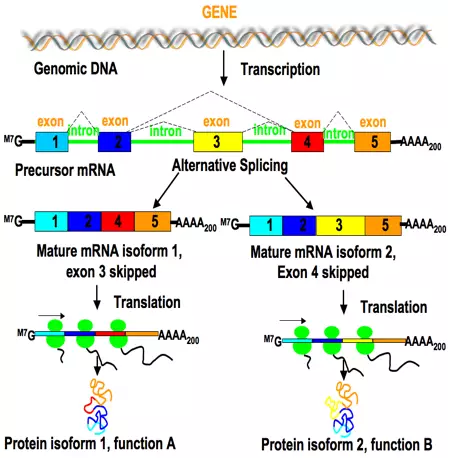

<p>Through alternative RNA splicing, where different combinations of exons are joined together </p><ul><li><p>a eukaryotic RNA processing mechanism in which a single pre-mRNA transcript is cut and rejoined in different combinations to produce multiple distinct mature mRNA molecules and different proteins from one gene</p></li><li><p>a regulated eukaryotic RNA processing mechanism where a single gene produces multiple different proteins by joining exons from the same pre-mRNA transcript in various combinations. It serves as a primary explanation for how organisms generate vast protein diversity from a relatively small number of genes</p></li><li><p><span><strong>Pre-mRNA composition: </strong>newly transcribed eukaryotic pre-mRNA contains both non-coding regions called introns and coding regions called exons</span></p></li><li><p><span><strong>Intron removal and exon selection:</strong> a molecular complex called the spliceosome removes the introns and splices the remaining exons together. During alternative splicing, specific exons are selectively included or skipped</span></p></li></ul><p></p>
55
New cards

How can a single eukaryotic gene code for multiple different protein isoforms?

Through alternative RNA splicing, where different combinations of exons are joined together

  • a eukaryotic RNA processing mechanism in which a single pre-mRNA transcript is cut and rejoined in different combinations to produce multiple distinct mature mRNA molecules and different proteins from one gene

  • a regulated eukaryotic RNA processing mechanism where a single gene produces multiple different proteins by joining exons from the same pre-mRNA transcript in various combinations. It serves as a primary explanation for how organisms generate vast protein diversity from a relatively small number of genes

  • Pre-mRNA composition: newly transcribed eukaryotic pre-mRNA contains both non-coding regions called introns and coding regions called exons

  • Intron removal and exon selection: a molecular complex called the spliceosome removes the introns and splices the remaining exons together. During alternative splicing, specific exons are selectively included or skipped


<p>Through alternative RNA splicing, where different combinations of exons are joined together </p><ul><li><p>a eukaryotic RNA processing mechanism in which a single pre-mRNA transcript is cut and rejoined in different combinations to produce multiple distinct mature mRNA molecules and different proteins from one gene</p></li><li><p>a regulated eukaryotic RNA processing mechanism where a single gene produces multiple different proteins by joining exons from the same pre-mRNA transcript in various combinations. It serves as a primary explanation for how organisms generate vast protein diversity from a relatively small number of genes</p></li><li><p><strong>Pre-mRNA composition: </strong>newly transcribed eukaryotic pre-mRNA contains both non-coding regions called introns and coding regions called exons</p></li><li><p><strong>Intron removal and exon selection:</strong> a molecular complex called the spliceosome removes the introns and splices the remaining exons together. During alternative splicing, specific exons are selectively included or skipped</p></li></ul><p></p>
56
New cards

How can a single eukaryotic gene code for multiple different protein isoforms?

Through alternative RNA splicing, where different combinations of exons are joined together

  • a eukaryotic RNA processing mechanism in which a single pre-mRNA transcript is cut and rejoined in different combinations to produce multiple distinct mature mRNA molecules and different proteins from one gene

  • a regulated eukaryotic RNA processing mechanism where a single gene produces multiple different proteins by joining exons from the same pre-mRNA transcript in various combinations. It serves as a primary explanation for how organisms generate vast protein diversity from a relatively small number of genes

  • Pre-mRNA composition: newly transcribed eukaryotic pre-mRNA contains both non-coding regions called introns and coding regions called exons

  • Intron removal and exon selection: a molecular complex called the spliceosome removes the introns and splices the remaining exons together. During alternative splicing, specific exons are selectively included or skipped


57
New cards

How can a single eukaryotic gene code for multiple different protein isoforms?

Through alternative RNA splicing, where different combinations of exons are joined together

  • a eukaryotic RNA processing mechanism in which a single pre-mRNA transcript is cut and rejoined in different combinations to produce multiple distinct mature mRNA molecules and different proteins from one gene


58
New cards

How can a single eukaryotic gene code for multiple different protein isoforms?

Through alternative RNA splicing, where different combinations of exons are joined together

  • a eukaryotic RNA processing mechanism in which a single pre-mRNA transcript is cut and rejoined in different combinations to produce multiple distinct mature mRNA molecules and different proteins from one gene


59
New cards

Alternative splicing

A regulated eukaryotic RNA processing mechanism where a single gene produces multiple different proteins by joining exons in various combinations. This occurs after transcription when non-coding regions are removed from a pre-mRNA transcript before it leaves the nucleus

  • Pre-mRNA Structure: eukaryotic primary transcripts contain both coding sequences called exons and non-coding intervening sequences called introns

  • Spliceosome Action: a large molecular complex of RNA and proteins called the spliceosome cuts out the introns and splices the remaining exons together

  • Selective Combination: depending on which regulatory proteins are present in a cell, certain exons may be included or skipped. This creates distinct mature mRNA molecules from the exact same initial RNA strand

  • Increased Protein Diversity

  • This process explains how a single eukaryotic gene can code for multiple different protein isoforms: through alternative RNA splicing, where different combinations of exons are joined together


<p>A regulated eukaryotic RNA processing mechanism where a single gene produces multiple different proteins by joining exons in various combinations. This occurs after transcription when non-coding regions are removed from a pre-mRNA transcript before it leaves the nucleus</p><ul><li><p><strong>Pre-mRNA Structure: </strong>eukaryotic primary transcripts contain both coding sequences called <strong>exons</strong> and non-coding intervening sequences called <strong>introns</strong></p></li><li><p><strong>Spliceosome Action:</strong> a large molecular complex of RNA and proteins called the <strong>spliceosome</strong> cuts out the introns and splices the remaining exons together</p></li><li><p><strong>Selective Combination:</strong> depending on which regulatory proteins are present in a cell, certain exons may be included or skipped. This creates distinct mature mRNA molecules from the exact same initial RNA strand</p></li><li><p>Increased Protein Diversity</p></li><li><p>This process explains how a single eukaryotic gene can code for multiple different protein isoforms: through alternative RNA splicing, where different combinations of exons are joined together</p></li></ul><p></p>
60
New cards

Alternative splicing

A regulated eukaryotic RNA processing mechanism where a single gene produces multiple different proteins by joining exons in various combinations. This occurs after transcription when non-coding regions are removed from a pre-mRNA transcript before it leaves the nucleus

  • Pre-mRNA Structure: eukaryotic primary transcripts contain both coding sequences called exons and non-coding intervening sequences called introns

  • Spliceosome Action: a large molecular complex of RNA and proteins called the spliceosome cuts out the introns and splices the remaining exons together

  • Selective Combination: depending on which regulatory proteins are present in a cell, certain exons may be included or skipped. This creates distinct mature mRNA molecules from the exact same initial RNA strand

  • Increased Protein Diversity

  • This process explains how a single eukaryotic gene can code for multiple different protein isoforms: through alternative RNA splicing, where different combinations of exons are joined together


<p>A regulated eukaryotic RNA processing mechanism where a single gene produces multiple different proteins by joining exons in various combinations. This occurs after transcription when non-coding regions are removed from a pre-mRNA transcript before it leaves the nucleus</p><ul><li><p><strong>Pre-mRNA Structure: </strong>eukaryotic primary transcripts contain both coding sequences called <strong>exons</strong> and non-coding intervening sequences called <strong>introns</strong></p></li><li><p><strong>Spliceosome Action:</strong> a large molecular complex of RNA and proteins called the <strong>spliceosome</strong> cuts out the introns and splices the remaining exons together</p></li><li><p><strong>Selective Combination:</strong> depending on which regulatory proteins are present in a cell, certain exons may be included or skipped. This creates distinct mature mRNA molecules from the exact same initial RNA strand</p></li><li><p>Increased Protein Diversity</p></li><li><p>This process explains how a single eukaryotic gene can code for multiple different protein isoforms: through alternative RNA splicing, where different combinations of exons are joined together</p></li></ul><p></p>
61
New cards

How can a single eukaryotic gene code for multiple different protein isoforms?

Through alternative RNA splicing, where different combinations of exons are joined together

  • a eukaryotic RNA processing mechanism in which a single pre-mRNA transcript is cut and rejoined in different combinations to produce multiple distinct mature mRNA molecules and different proteins from one gene

  • This process explains how a single eukaryotic gene can code for multiple different protein isoforms: through alternative RNA splicing, where different combinations of exons are joined together


<p>Through alternative RNA splicing, where different combinations of exons are joined together</p><ul><li><p>a eukaryotic RNA processing mechanism in which a single pre-mRNA transcript is cut and rejoined in different combinations to produce multiple distinct mature mRNA molecules and different proteins from one gene</p></li><li><p>This process explains how a single eukaryotic gene can code for multiple different protein isoforms: through alternative RNA splicing, where different combinations of exons are joined together</p></li></ul><p></p>
62
New cards

Which of the following best describes the “degenerate” (redundant) nature of the genetic code?

Most amino acids are specified by more than one codon
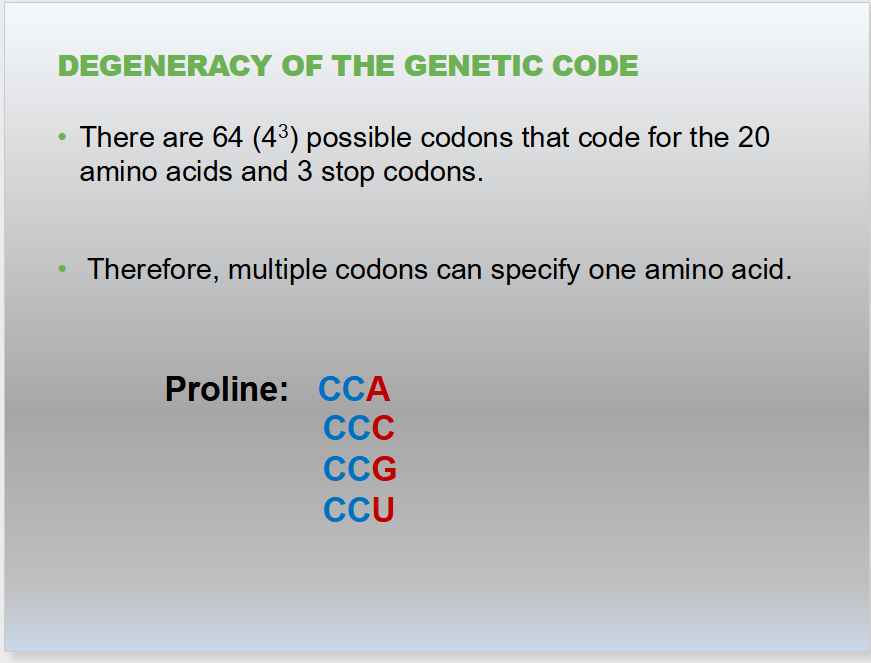
<p>Most amino acids are specified by more than one codon</p>
63
New cards

Which of the following best describes the “degenerate” (redundant) nature of the genetic code?

Most amino acids are specified by more than one codon
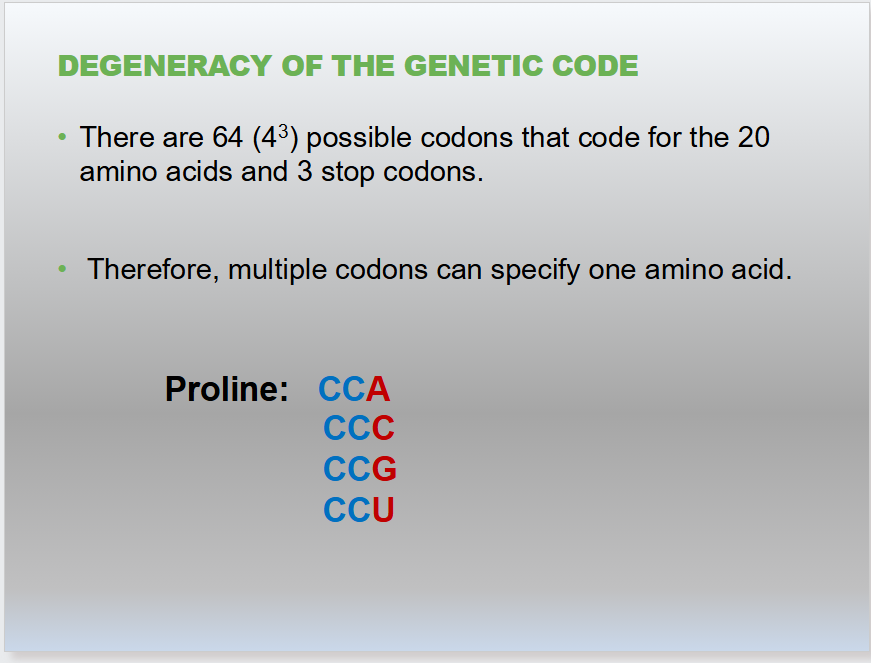
<p>Most amino acids are specified by more than one codon</p>
64
New cards

Which of the following best describes the “degenerate” (redundant) nature of the genetic code?

Most amino acids are specified by more than one codon

The degenerate (redundant) nature of the genetic code means that a single amino acid can be coded for by more than one codon. Because there are 64 possible mRNA codons (triplets of nucleotides) and only 20 standard amino acids, most amino acids have multiple "synonymous" codons

  • Multiple Codons, One Amino Acid: for example, the mRNA codons CCU, CCC, CCA, and CCG all specify the amino acid proline

  • Not Ambiguous: while multiple codons can code for the same amino acid, a single codon never codes for more than one amino acid. For instance, CAU will always code for histidine and nothing else

  • The "Wobble" Position: synonymous codons usually differ only in their third nucleotide base. Flexible base-pairing at this third position allows a single tRNA anticodon to recognize more than one codon


<p>Most amino acids are specified by more than one codon</p><p><span>The </span>degenerate (redundant) nature of the genetic code means that a single amino acid can be coded for by more than one codon. Because there are 64 possible mRNA codons (triplets of nucleotides) and only 20 standard amino acids, most amino acids have multiple "synonymous" codons</p><ul><li><p><span><strong>Multiple Codons, One Amino Acid: </strong>for example, the mRNA codons CCU, CCC, CCA, and CCG all specify the amino acid proline</span></p></li><li><p><span><strong>Not Ambiguous:</strong> while multiple codons can code for the same amino acid, a single codon <em>never</em> codes for more than one amino acid. For instance, CAU will always code for histidine and nothing else</span></p></li><li><p><strong>The "Wobble" Position:</strong> synonymous codons usually differ only in their third nucleotide base. Flexible base-pairing at this third position allows a single tRNA anticodon to recognize more than one codon</p></li></ul><p></p>
65
New cards

Which of the following best describes the “degenerate” (redundant) nature of the genetic code?

Most amino acids are specified by more than one codon

The degenerate (redundant) nature of the genetic code means that a single amino acid can be coded for by more than one codon. Because there are 64 possible mRNA codons (triplets of nucleotides) and only 20 standard amino acids, most amino acids have multiple "synonymous" codons

  • Multiple Codons, One Amino Acid: for example, the mRNA codons CCU, CCC, CCA, and CCG all specify the amino acid proline

  • Not Ambiguous: while multiple codons can code for the same amino acid, a single codon never codes for more than one amino acid. For instance, CAU will always code for histidine and nothing else

  • The "Wobble" Position: synonymous codons usually differ only in their third nucleotide base. Flexible base-pairing at this third position allows a single tRNA anticodon to recognize more than one codon


<p>Most amino acids are specified by more than one codon</p><p>The degenerate (redundant) nature of the genetic code means that a single amino acid can be coded for by more than one codon. Because there are 64 possible mRNA codons (triplets of nucleotides) and only 20 standard amino acids, most amino acids have multiple "synonymous" codons</p><ul><li><p><strong>Multiple Codons, One Amino Acid: </strong>for example, the mRNA codons CCU, CCC, CCA, and CCG all specify the amino acid proline</p></li><li><p><strong>Not Ambiguous:</strong> while multiple codons can code for the same amino acid, a single codon <em>never</em> codes for more than one amino acid. For instance, CAU will always code for histidine and nothing else</p></li><li><p><strong>The "Wobble" Position:</strong> synonymous codons usually differ only in their third nucleotide base. Flexible base-pairing at this third position allows a single tRNA anticodon to recognize more than one codon</p></li></ul><p></p>
66
New cards

Degeneracy of the genetic code

There are 64 (4³) possible codons that code for the 20 amino acids and 3 stop codons

  • Therefore, multiple codons can specify one amino acid

  • Ex; CCA, CCU, CCG, CCC → all code for the amino acid proline

  • Most amino acids are specified by more than one codon


<p><span>There are 64 (4³) possible codons that code for the 20 amino acids and 3 stop codons</span></p><ul><li><p><span>Therefore, multiple codons can specify one amino acid</span></p></li><li><p>Ex; CC<strong>A</strong>, CC<strong>U</strong>, CC<strong>G</strong>, CC<strong>C → all code for the amino acid proline</strong></p></li><li><p>Most amino acids are specified by more than one codon</p></li></ul><p></p>
67
New cards

Degeneracy of the genetic code

There are 64 (4³) possible codons that code for the 20 amino acids and 3 stop codons

  • Therefore, multiple codons can specify one amino acid

  • Ex; CCA, CCU, CCG, CCC → all code for the amino acid proline

  • Most amino acids are specified by more than one codon


<p>There are 64 (4³) possible codons that code for the 20 amino acids and 3 stop codons</p><ul><li><p>Therefore, multiple codons can specify one amino acid</p></li><li><p>Ex; CC<strong>A</strong>, CC<strong>U</strong>, CC<strong>G</strong>, CC<strong>C → all code for the amino acid proline</strong></p></li><li><p>Most amino acids are specified by more than one codon</p></li></ul><p></p>
68
New cards

Which codon serves as the universal start codon for translation, and what amino acid does it encode?

AUG; encodes methionine

<p>AUG; encodes methionine</p>
69
New cards

Which codon serves as the universal start codon for translation, and what amino acid does it encode?

AUG; encodes methionine
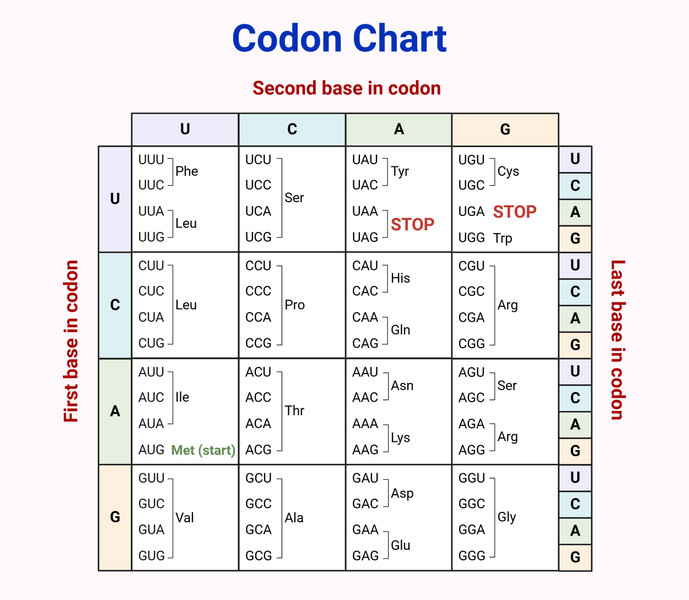
<p>AUG; encodes methionine</p>
70
New cards

Which codon serves as the universal start codon for translation, and what amino acid does it encode?

AUG; encodes methionine

The universal start codon for translation is AUG, and it encodes the amino acid methionine (Met). This mRNA sequence establishes the reading frame for the ribosome to synthesize a polypeptide chain

  • Reading Frame Establishment: the start codon sets the triplet grouping for all subsequent nucleotides in the mRNA strand. Without this specific starting point, the ribosome could shift by one or two bases and produce a completely nonfunctional protein

  • tRNA Pairing: during translation initiation, a specialized initiator tRNA carrying the anticodon 3'-UAC-5' binds directly to the 5'-AUG-3' start codon inside the small ribosomal subunit


71
New cards

Which codon serves as the universal start codon for translation, and what amino acid does it encode?

AUG; encodes methionine

The universal start codon for translation is AUG, and it encodes the amino acid methionine (Met). This mRNA sequence establishes the reading frame for the ribosome to synthesize a polypeptide chain

  • Reading Frame Establishment: the start codon sets the triplet grouping for all subsequent nucleotides in the mRNA strand. Without this specific starting point, the ribosome could shift by one or two bases and produce a completely nonfunctional protein

  • tRNA Pairing: during translation initiation, a specialized initiator tRNA carrying the anticodon 3'-UAC-5' binds directly to the 5'-AUG-3' start codon inside the small ribosomal subunit


<p>AUG; encodes methionine</p><p>The universal start codon for translation is AUG, and it encodes the amino acid methionine (Met). This mRNA sequence establishes the reading frame for the ribosome to synthesize a polypeptide chain</p><ul><li><p><strong>Reading Frame Establishment</strong>: the start codon sets the triplet grouping for all subsequent nucleotides in the mRNA strand. Without this specific starting point, the ribosome could shift by one or two bases and produce a completely nonfunctional protein</p></li><li><p><strong>tRNA Pairing</strong>: during translation initiation, a specialized initiator tRNA carrying the anticodon <strong>3'-UAC-5'</strong> binds directly to the <strong>5'-AUG-3'</strong> start codon inside the small ribosomal subunit</p></li></ul><p></p>
72
New cards

What is the function of the anticodon region of a tRNA molecule?

It forms complementary base pairs with the mRNA codon during translation

<p>It forms complementary base pairs with the mRNA codon during translation </p>
73
New cards

What is the function of the anticodon region of a tRNA molecule?

It forms complementary base pairs with the mRNA codon during translation

<p>It forms complementary base pairs with the mRNA codon during translation </p>
74
New cards

What is the function of the anticodon region of a tRNA molecule?

The primary function of the anticodon region on a transfer RNA (tRNA) molecule is to recognize and base-pair with a complementary codon on a messenger RNA (mRNA) strand during translation

  • Complementary and Antiparallel Pairing: the three-nucleotide anticodon binds to the three-nucleotide mRNA codon via hydrogen bonds following RNA base-pairing rules (A pairs with U, and C pairs with G). Because nucleic acids pair in opposite directions, a 5' to 3' mRNA codon pairs with a 3' to 5' tRNA anticodon

  • Adaptor Role: a tRNA molecule has two functional ends. While the anticodon loop reads the nucleic acid code on mRNA, the opposite 3' acceptor stem carries the corresponding amino acid, bridging the gap between genetic information and protein synthesis

  • If an mRNA strand presents the start codon 5'-AUG-3', the corresponding tRNA molecule must have the complementary anticodon 3'-UAC-5'. Because of this specific match, the tRNA delivers the amino acid methionine to begin the polypeptide chain. (Note: When using an AP Biology codon chart, always look up the mRNA codon, never the tRNA anticodon


<p><span>The primary function of the anticodon region on a transfer RNA (tRNA) molecule is </span>to recognize and base-pair with a complementary codon on a messenger RNA (mRNA) strand during translation</p><ul><li><p><strong>Complementary and Antiparallel Pairing:</strong> the three-nucleotide anticodon binds to the three-nucleotide mRNA codon via hydrogen bonds following RNA base-pairing rules (A pairs with U, and C pairs with G). Because nucleic acids pair in opposite directions, a 5' to 3' mRNA codon pairs with a 3' to 5' tRNA anticodon</p></li><li><p><strong>Adaptor Role:</strong> a tRNA molecule has two functional ends. While the anticodon loop reads the nucleic acid code on mRNA, the opposite 3' acceptor stem carries the corresponding amino acid, bridging the gap between genetic information and protein synthesis</p></li><li><p>If an mRNA strand presents the start codon <strong>5'-AUG-3'</strong>, the corresponding tRNA molecule must have the complementary anticodon <strong>3'-UAC-5'</strong>. Because of this specific match, the tRNA delivers the amino acid <strong>methionine</strong> to begin the polypeptide chain<mark data-color="#fff85b" style="background-color: rgb(255, 248, 91); color: inherit;">. </mark><em><mark data-color="#fff85b" style="background-color: rgb(255, 248, 91); color: inherit;">(Note: When using an AP Biology codon chart, always look up the </mark></em><strong><em><mark data-color="#fff85b" style="background-color: rgb(255, 248, 91); color: inherit;">mRNA codon</mark></em></strong><em><mark data-color="#fff85b" style="background-color: rgb(255, 248, 91); color: inherit;">, never the tRNA anticodon</mark></em></p></li></ul><p></p>
75
New cards

What is the function of the anticodon region of a tRNA molecule?

The primary function of the anticodon region on a transfer RNA (tRNA) molecule is to recognize and base-pair with a complementary codon on a messenger RNA (mRNA) strand during translation

  • Complementary and Antiparallel Pairing: the three-nucleotide anticodon binds to the three-nucleotide mRNA codon via hydrogen bonds following RNA base-pairing rules (A pairs with U, and C pairs with G). Because nucleic acids pair in opposite directions, a 5' to 3' mRNA codon pairs with a 3' to 5' tRNA anticodon

  • Adaptor Role: a tRNA molecule has two functional ends. While the anticodon loop reads the nucleic acid code on mRNA, the opposite 3' acceptor stem carries the corresponding amino acid, bridging the gap between genetic information and protein synthesis

  • If an mRNA strand presents the start codon 5'-AUG-3', the corresponding tRNA molecule must have the complementary anticodon 3'-UAC-5'. Because of this specific match, the tRNA delivers the amino acid methionine to begin the polypeptide chain. When using a codon chart, always look up the mRNA codon, never the tRNA anticodon


<p>The primary function of the anticodon region on a transfer RNA (tRNA) molecule is to recognize and base-pair with a complementary codon on a messenger RNA (mRNA) strand during translation</p><ul><li><p><strong>Complementary and Antiparallel Pairing:</strong> the three-nucleotide anticodon binds to the three-nucleotide mRNA codon via hydrogen bonds following RNA base-pairing rules (A pairs with U, and C pairs with G). Because nucleic acids pair in opposite directions, a 5' to 3' mRNA codon pairs with a 3' to 5' tRNA anticodon</p></li><li><p><strong>Adaptor Role:</strong> a tRNA molecule has two functional ends. While the anticodon loop reads the nucleic acid code on mRNA, the opposite 3' acceptor stem carries the corresponding amino acid, bridging the gap between genetic information and protein synthesis</p></li><li><p>If an mRNA strand presents the start codon <strong>5'-AUG-3'</strong>, the corresponding tRNA molecule must have the complementary anticodon <strong>3'-UAC-5'</strong>. Because of this specific match, the tRNA delivers the amino acid <strong>methionine</strong> to begin the polypeptide chain<mark data-color="#fff85b" style="background-color: rgb(255, 248, 91); color: inherit;">. </mark><em><mark data-color="#fff85b" style="background-color: rgb(255, 248, 91); color: inherit;">When using a codon chart, always look up the </mark></em><strong><em><mark data-color="#fff85b" style="background-color: rgb(255, 248, 91); color: inherit;">mRNA codon</mark></em></strong><em><mark data-color="#fff85b" style="background-color: rgb(255, 248, 91); color: inherit;">, never the tRNA anticodon</mark></em></p></li></ul><p></p>
76
New cards

What is the function of the anticodon region of a tRNA molecule?

It forms complementary base pairs with the mRNA codon during translation

The primary function of the anticodon region on a transfer RNA (tRNA) molecule is to recognize and base-pair with a complementary codon on a messenger RNA (mRNA) strand during translation

  • Complementary and Antiparallel Pairing: the three-nucleotide anticodon binds to the three-nucleotide mRNA codon via hydrogen bonds following RNA base-pairing rules (A pairs with U, and C pairs with G). Because nucleic acids pair in opposite directions, a 5' to 3' mRNA codon pairs with a 3' to 5' tRNA anticodon

  • When using a codon chart, always look up the mRNA codon, never the tRNA anticodon


<p>It forms complementary base pairs with the mRNA codon during translation</p><p>The primary function of the anticodon region on a transfer RNA (tRNA) molecule is to recognize and base-pair with a complementary codon on a messenger RNA (mRNA) strand during translation</p><ul><li><p><strong>Complementary and Antiparallel Pairing:</strong> the three-nucleotide anticodon binds to the three-nucleotide mRNA codon via hydrogen bonds following RNA base-pairing rules (A pairs with U, and C pairs with G). Because nucleic acids pair in opposite directions, a 5' to 3' mRNA codon pairs with a 3' to 5' tRNA anticodon</p></li><li><p><mark data-color="#fff85b" style="background-color: rgb(255, 248, 91); color: inherit;">When using a codon chart, always look up the </mark><strong><mark data-color="#fff85b" style="background-color: rgb(255, 248, 91); color: inherit;">mRNA codon</mark></strong><mark data-color="#fff85b" style="background-color: rgb(255, 248, 91); color: inherit;">, never the tRNA anticodon</mark></p></li></ul><p></p>
77
New cards

Which enzyme is responsible for attaching the correct amino acid to its corresponding tRNA molecule?

Aminoacyl-tRNA synthetase

78
New cards

Which enzyme is responsible for attaching the correct amino acid to its corresponding tRNA molecule?

Aminoacyl-tRNA synthetase

  • The enzyme responsible for attaching the correct amino acid to its corresponding tRNA molecule is aminoacyl-tRNA synthetase. This process is known as tRNA charging or aminoacylation, and it is a critical step in ensuring accuracy during protein synthesis

  • Specificity: there are 20 different aminoacyl-tRNA synthetases, one for each of the 20 standard amino acids. Each enzyme has an active site that recognizes both a specific amino acid and the corresponding tRNA molecule


<p>Aminoacyl-tRNA synthetase</p><ul><li><p><span>The enzyme responsible for attaching the correct amino acid to its corresponding tRNA molecule is </span><strong>aminoacyl-tRNA synthetase</strong>. This process is known as tRNA charging or aminoacylation, and it is a critical step in ensuring accuracy during protein synthesis</p></li><li><p><strong>Specificity:</strong> there are 20 different aminoacyl-tRNA synthetases, one for each of the 20 standard amino acids. Each enzyme has an active site that recognizes both a specific amino acid and the corresponding tRNA molecule</p></li></ul><p></p>
79
New cards

Which enzyme is responsible for attaching the correct amino acid to its corresponding tRNA molecule?

Aminoacyl-tRNA synthetase

  • The enzyme responsible for attaching the correct amino acid to its corresponding tRNA molecule is aminoacyl-tRNA synthetase. This process is known as tRNA charging or aminoacylation, and it is a critical step in ensuring accuracy during protein synthesis

  • Specificity: there are 20 different aminoacyl-tRNA synthetases, one for each of the 20 standard amino acids. Each enzyme has an active site that recognizes both a specific amino acid and the corresponding tRNA molecule


<p>Aminoacyl-tRNA synthetase</p><ul><li><p>The enzyme responsible for attaching the correct amino acid to its corresponding tRNA molecule is <strong>aminoacyl-tRNA synthetase</strong>. This process is known as tRNA charging or aminoacylation, and it is a critical step in ensuring accuracy during protein synthesis</p></li><li><p><strong>Specificity:</strong> there are 20 different aminoacyl-tRNA synthetases, one for each of the 20 standard amino acids. Each enzyme has an active site that recognizes both a specific amino acid and the corresponding tRNA molecule</p></li></ul><p></p>
80
New cards

Which enzyme is responsible for attaching the correct amino acid to its corresponding tRNA molecule?

Aminoacyl-tRNA synthetase

  • The enzyme responsible for attaching the correct amino acid to its corresponding tRNA molecule is aminoacyl-tRNA synthetase. This process is known as tRNA charging or aminoacylation, and it is a critical step in ensuring accuracy during protein synthesis

  • Specificity: there are 20 different aminoacyl-tRNA synthetases, one for each of the 20 standard amino acids. Each enzyme has an active site that recognizes both a specific amino acid and the corresponding tRNA molecule


<p>Aminoacyl-tRNA synthetase</p><ul><li><p>The enzyme responsible for attaching the correct amino acid to its corresponding tRNA molecule is <strong>aminoacyl-tRNA synthetase</strong>. This process is known as tRNA charging or aminoacylation, and it is a critical step in ensuring accuracy during protein synthesis</p></li><li><p><strong>Specificity:</strong> there are 20 different aminoacyl-tRNA synthetases, one for each of the 20 standard amino acids. Each enzyme has an active site that recognizes both a specific amino acid and the corresponding tRNA molecule</p></li></ul><p></p>
81
New cards

Aminoacyl-tRNA synthetase

An essential family of enzymes that attaches a specific amino acid to its corresponding transfer RNA (tRNA) molecule in the cytoplasm before translation begins. This process is known as tRNA charging or amino acid activation

How It Works

  • Specificity: there are 20 different aminoacyl-tRNA synthetases, one for each of the 20 standard amino acids. The active site of each enzyme recognizes both a specific amino acid and the matching tRNA molecules

  • Energy Requirement: linking an amino acid to a tRNA is an endergonic (energy-requiring) process. The enzyme uses energy from ATP hydrolysis to form a covalent bond between the amino acid and the 3' attachment site of the tRNA

  • Charged tRNA: once the amino acid is attached, the resulting molecule is called an aminoacyl-tRNA (or "charged" tRNA). It is now ready to travel to the ribosome and deliver its amino acid to a growing polypeptide chain


<p>An essential family of enzymes that attaches a specific amino acid to its corresponding transfer RNA (tRNA) molecule in the cytoplasm before translation begins. This process is known as tRNA charging or amino acid activation</p><p>How It Works</p><ul><li><p><span><strong>Specificity:</strong> there are <strong>20 different aminoacyl-tRNA synthetases</strong>, one for each of the 20 standard amino acids. The active site of each enzyme recognizes both a specific amino acid and the matching tRNA molecules</span></p></li><li><p><span><strong>Energy Requirement:</strong> linking an amino acid to a tRNA is an endergonic (energy-requiring) process. The enzyme uses energy from <strong>ATP hydrolysis</strong> to form a covalent bond between the amino acid and the 3' attachment site of the tRNA</span></p></li><li><p><span><strong>Charged tRNA:</strong> once the amino acid is attached, the resulting molecule is called an <strong>aminoacyl-tRNA</strong> (or "charged" tRNA). It is now ready to travel to the ribosome and deliver its amino acid to a growing polypeptide chain</span></p></li></ul><p></p>
82
New cards

Aminoacyl-tRNA synthetase

An essential family of enzymes that attaches a specific amino acid to its corresponding transfer RNA (tRNA) molecule in the cytoplasm before translation begins. This process is known as tRNA charging or amino acid activation

How It Works

  • Specificity: there are 20 different aminoacyl-tRNA synthetases, one for each of the 20 standard amino acids. The active site of each enzyme recognizes both a specific amino acid and the matching tRNA molecules

  • Energy Requirement: linking an amino acid to a tRNA is an endergonic (energy-requiring) process. The enzyme uses energy from ATP hydrolysis to form a covalent bond between the amino acid and the 3' attachment site of the tRNA

  • Charged tRNA: once the amino acid is attached, the resulting molecule is called an aminoacyl-tRNA (or "charged" tRNA). It is now ready to travel to the ribosome and deliver its amino acid to a growing polypeptide chain


<p>An essential family of enzymes that attaches a specific amino acid to its corresponding transfer RNA (tRNA) molecule in the cytoplasm before translation begins. This process is known as tRNA charging or amino acid activation</p><p>How It Works</p><ul><li><p><strong>Specificity:</strong> there are <strong>20 different aminoacyl-tRNA synthetases</strong>, one for each of the 20 standard amino acids. The active site of each enzyme recognizes both a specific amino acid and the matching tRNA molecules</p></li><li><p><strong>Energy Requirement:</strong> linking an amino acid to a tRNA is an endergonic (energy-requiring) process. The enzyme uses energy from <strong>ATP hydrolysis</strong> to form a covalent bond between the amino acid and the 3' attachment site of the tRNA</p></li><li><p><strong>Charged tRNA:</strong> once the amino acid is attached, the resulting molecule is called an <strong>aminoacyl-tRNA</strong> (or "charged" tRNA). It is now ready to travel to the ribosome and deliver its amino acid to a growing polypeptide chain</p></li></ul><p></p>
83
New cards

Aminoacyl-tRNA synthetase

An aminoacyl-tRNA synthetase is an enzyme that attaches a specific amino acid to its corresponding transfer RNA (tRNA) molecule before translation begins. This process is known as tRNA charging or amino acid activation, and it ensures that the genetic code is accurately translated into proteins

  • Specificity: there are 20 different aminoacyl-tRNA synthetases, one for each of the 20 standard amino acids. Each enzyme has a unique active site that recognizes only one specific amino acid and the matching tRNA molecule(s)

  • Energy Requirement: attaching an amino acid to a tRNA is an endergonic (energy-requiring) process. The enzyme uses energy from ATP (hydrolyzing it to AMP and pyrophosphate) to form a high-energy covalent bond between the amino acid and the 3' end of the tRNA

  • Charged tRNA: once the amino acid is attached, the resulting molecule is called an aminoacyl-tRNA or a charged tRNA. This charged molecule is now ready to travel to the ribosome and deliver its amino acid during translation

  • Accuracy Checkpoint: ribosomes only check the match between the mRNA codon and the tRNA anticodon, not the amino acid itself. Therefore, aminoacyl-tRNA synthetases serve as a critical quality-control step to prevent wrong amino acids from being built into a polypeptide


<p><span>An </span>aminoacyl-tRNA synthetase is an enzyme that attaches a specific amino acid to its corresponding transfer RNA (tRNA) molecule before translation begins. This process is known as tRNA charging or amino acid activation, and it ensures that the genetic code is accurately translated into proteins</p><ul><li><p><span><strong>Specificity:</strong> there are <strong>20 different aminoacyl-tRNA synthetases</strong>, one for each of the 20 standard amino acids. Each enzyme has a unique active site that recognizes only one specific amino acid and the matching tRNA molecule(s)</span></p></li><li><p><span><strong>Energy Requirement:</strong> attaching an amino acid to a tRNA is an endergonic (energy-requiring) process. The enzyme uses energy from <strong>ATP</strong> (hydrolyzing it to AMP and pyrophosphate) to form a high-energy covalent bond between the amino acid and the 3' end of the tRNA</span></p></li><li><p><span><strong>Charged tRNA:</strong> once the amino acid is attached, the resulting molecule is called an <strong>aminoacyl-tRNA</strong> or a <strong>charged tRNA</strong>. This charged molecule is now ready to travel to the ribosome and deliver its amino acid during translation</span></p></li><li><p><span><strong>Accuracy Checkpoint:</strong> ribosomes only check the match between the mRNA codon and the tRNA anticodon, not the amino acid itself. Therefore, aminoacyl-tRNA synthetases serve as a critical quality-control step to prevent wrong amino acids from being built into a polypeptide</span></p></li></ul><p></p>
84
New cards

Aminoacyl-tRNA synthetase

An aminoacyl-tRNA synthetase is an enzyme that attaches a specific amino acid to its corresponding transfer RNA (tRNA) molecule before translation begins. This process is known as tRNA charging or amino acid activation, and it ensures that the genetic code is accurately translated into proteins

  • Specificity: there are 20 different aminoacyl-tRNA synthetases, one for each of the 20 standard amino acids. Each enzyme has a unique active site that recognizes only one specific amino acid and the matching tRNA molecule(s)

  • Energy Requirement: attaching an amino acid to a tRNA is an endergonic (energy-requiring) process. The enzyme uses energy from ATP (hydrolyzing it to AMP and pyrophosphate) to form a high-energy covalent bond between the amino acid and the 3' end of the tRNA

  • Charged tRNA: once the amino acid is attached, the resulting molecule is called an aminoacyl-tRNA or a charged tRNA. This charged molecule is now ready to travel to the ribosome and deliver its amino acid during translation

  • Accuracy Checkpoint: ribosomes only check the match between the mRNA codon and the tRNA anticodon, not the amino acid itself. Therefore, aminoacyl-tRNA synthetases serve as a critical quality-control step to prevent wrong amino acids from being built into a polypeptide


<p>An aminoacyl-tRNA synthetase is an enzyme that attaches a specific amino acid to its corresponding transfer RNA (tRNA) molecule before translation begins. This process is known as tRNA charging or amino acid activation, and it ensures that the genetic code is accurately translated into proteins</p><ul><li><p><strong>Specificity:</strong> there are <strong>20 different aminoacyl-tRNA synthetases</strong>, one for each of the 20 standard amino acids. Each enzyme has a unique active site that recognizes only one specific amino acid and the matching tRNA molecule(s)</p></li><li><p><strong>Energy Requirement:</strong> attaching an amino acid to a tRNA is an endergonic (energy-requiring) process. The enzyme uses energy from <strong>ATP</strong> (hydrolyzing it to AMP and pyrophosphate) to form a high-energy covalent bond between the amino acid and the 3' end of the tRNA</p></li><li><p><strong>Charged tRNA:</strong> once the amino acid is attached, the resulting molecule is called an <strong>aminoacyl-tRNA</strong> or a <strong>charged tRNA</strong>. This charged molecule is now ready to travel to the ribosome and deliver its amino acid during translation</p></li><li><p><strong>Accuracy Checkpoint:</strong> ribosomes only check the match between the mRNA codon and the tRNA anticodon, not the amino acid itself. Therefore, aminoacyl-tRNA synthetases serve as a critical quality-control step to prevent wrong amino acids from being built into a polypeptide</p></li></ul><p></p>
85
New cards

tRNA charging

tRNA charging (also known as aminoacylation or amino acid activation) is the cellular process of attaching a specific amino acid to its corresponding transfer RNA (tRNA) molecule. This energy-requiring step takes place in the cytoplasm and prepares the tRNA to deliver its amino acid to the ribosome during translation

  • Aminoacyl-tRNA synthetase: this is the specific family of enzymes responsible for catalyzing the reaction. There are 20 different synthetases, and each one recognizes a single amino acid and its matching tRNA molecule(s)

  • Two-step process: first, the enzyme binds the amino acid and ATP to create a high-energy intermediate, releasing inorganic pyrophosphate. Second, the enzyme transfers the amino acid to the 3' acceptor stem of the correct tRNA and releases AMP

  • Aminoacyl-tRNA: this is the resulting "charged" tRNA molecule that is ready to enter the ribosome and base-pair its anticodon with a complementary mRNA codon

  • Translational accuracy: the ribosome only checks the match between the mRNA codon and the tRNA anticodon, not the amino acid itself. Therefore, the specificity of aminoacyl-tRNA synthetase is critical for ensuring the genetic code is translated accurately


<p><span>tRNA charging</span> (also known as aminoacylation or amino acid activation) is the cellular process of attaching a specific amino acid to its corresponding transfer RNA (tRNA) molecule. This energy-requiring step takes place in the cytoplasm and prepares the tRNA to deliver its amino acid to the ribosome during translation</p><ul><li><p><strong>Aminoacyl-tRNA synthetase: </strong>this is the specific family of enzymes responsible for catalyzing the reaction. There are 20 different synthetases, and each one recognizes a single amino acid and its matching tRNA molecule(s)</p></li></ul><ul><li><p><span><strong>Two-step process:</strong> first, the enzyme binds the amino acid and ATP to create a high-energy intermediate, releasing inorganic pyrophosphate. Second, the enzyme transfers the amino acid to the 3' acceptor stem of the correct tRNA and releases AMP</span></p></li><li><p><span><strong>Aminoacyl-tRNA:</strong> this is the resulting "charged" tRNA molecule that is ready to enter the ribosome and base-pair its anticodon with a complementary mRNA codon</span></p></li></ul><ul><li><p><span><strong>Translational accuracy:</strong> the ribosome only checks the match between the mRNA codon and the tRNA anticodon, not the amino acid itself. Therefore, the specificity of aminoacyl-tRNA synthetase is critical for ensuring the genetic code is translated accurately</span></p></li></ul><p></p>
86
New cards

tRNA charging

tRNA charging (also called aminoacylation or amino acid activation) is the process of covalently attaching a specific amino acid to its corresponding transfer RNA (tRNA) molecule in the cytoplasm before translation begins. Once attached, the molecule is called an aminoacyl-tRNA (or "charged" tRNA) and is ready to deliver its amino acid to the ribosome

  • Location: the reaction takes place in the cytoplasm (cytosol)

  • Enzyme: the process is catalyzed by a family of highly specific enzymes called aminoacyl-tRNA synthetases. There are 20 different synthetases—one for each of the 20 amino acids—and each recognizes a specific amino acid along with all of its compatible tRNAs

  • Energy Requirement: charging requires cellular energy from ATP


<p><span>tRNA charging</span> (also called aminoacylation or amino acid activation) is the process of covalently attaching a specific amino acid to its corresponding transfer RNA (tRNA) molecule in the cytoplasm before translation begins. Once attached, the molecule is called an aminoacyl-tRNA (or "charged" tRNA) and is ready to deliver its amino acid to the ribosome</p><ul><li><p><span>Location: the reaction takes place in the cytoplasm (cytosol)</span></p></li><li><p><span>Enzyme: the process is catalyzed by a family of highly specific enzymes called aminoacyl-tRNA synthetases. There are 20 different synthetases—one for each of the 20 amino acids—and each recognizes a specific amino acid along with all of its compatible tRNAs</span></p></li><li><p><span>Energy Requirement: charging requires cellular energy from ATP</span></p></li></ul><p></p>
87
New cards

During translation elongation, where does the incoming aminoacyl-tRNA initially bind on the ribosome?

The A (aminoacyl) site

  • During translation elongation, the incoming aminoacyl-tRNA initially binds to the A site (aminoacyl site) of the ribosome. Here, its anticodon base-pairs with the complementary codon on the mRNA strand

  • A site (Aminoacyl site): this is the entry point where each new incoming charged tRNA binds to the ribosome

  • An incoming aminoacyl-tRNA first binds to the A site (aminoacyl or acceptor site) of the ribosome during the elongation phase of translation


<p>The A (aminoacyl) site </p><ul><li><p><span>During translation elongation, the incoming aminoacyl-tRNA initially binds to the </span><strong>A site (aminoacyl site)</strong> of the ribosome. Here, its anticodon base-pairs with the complementary codon on the mRNA strand</p></li><li><p><strong>A site (Aminoacyl site):</strong> this is the entry point where each new incoming charged tRNA binds to the ribosome</p></li><li><p><span>An incoming aminoacyl-tRNA first binds to the </span><span style="background-color: rgb(243, 245, 246);"><strong>A site</strong> (<strong>aminoacyl or acceptor site</strong>) of the ribosome during the elongation phase of translation </span><br></p></li></ul><p></p>
88
New cards

During translation elongation, where does the incoming aminoacyl-tRNA initially bind on the ribosome?

The A (aminoacyl) site

  • During translation elongation, the incoming aminoacyl-tRNA initially binds to the A site (aminoacyl site) of the ribosome. Here, its anticodon base-pairs with the complementary codon on the mRNA strand


<p>The A (aminoacyl) site </p><ul><li><p>During translation elongation, the incoming aminoacyl-tRNA initially binds to the <strong>A site (aminoacyl site)</strong> of the ribosome. Here, its anticodon base-pairs with the complementary codon on the mRNA strand</p></li></ul><p></p>
89
New cards

During translation elongation, where does the incoming aminoacyl-tRNA initially bind on the ribosome?

The A (aminoacyl) site

  • During translation elongation, the incoming aminoacyl-tRNA initially binds to the A site (aminoacyl site) of the ribosome. Here, its anticodon base-pairs with the complementary codon on the mRNA strand

  • A site (Aminoacyl site): this is the entry point where each new incoming charged tRNA binds to the ribosome

  • An incoming aminoacyl-tRNA first binds to the A site (aminoacyl or acceptor site) of the ribosome during the elongation phase of translation


<p>The A (aminoacyl) site </p><ul><li><p>During translation elongation, the incoming aminoacyl-tRNA initially binds to the <strong>A site (aminoacyl site)</strong> of the ribosome. Here, its anticodon base-pairs with the complementary codon on the mRNA strand</p></li><li><p><strong>A site (Aminoacyl site):</strong> this is the entry point where each new incoming charged tRNA binds to the ribosome</p></li><li><p>An incoming aminoacyl-tRNA first binds to the <span style="background-color: rgb(243, 245, 246);"><strong>A site</strong> (<strong>aminoacyl or acceptor site</strong>) of the ribosome during the elongation phase of translation </span></p></li></ul><p></p>
90
New cards

Aminoacyl-tRNA

An aminoacyl-tRNA (also called a charged tRNA) is a transfer RNA molecule that is chemically bonded to its specific, matching amino acid. Its main job is to carry that amino acid to the ribosome during translation so it can be added to a growing polypeptide chain

  • How it is made (tRNA Charging): an enzyme called aminoacyl-tRNA synthetase attaches the correct amino acid to the 3′ end of the tRNA in the cytosol before translation begins. There are 20 different synthetases in human cells, one for each standard amino acid

  • Energy requirement: charging a tRNA requires energy from the hydrolysis of one ATP molecule. This creates a high-energy ester bond that will later help power peptide bond formation at the ribosome

  • Structure and function: one end of the molecule holds the anticodon loop, which pairs with a complementary mRNA codon. The opposite 3′ acceptor end carries the attached amino acid

  • Role in the ribosome: during elongation, an incoming aminoacyl-tRNA enters the A (aminoacyl) site of the ribosome. Once its amino acid is linked to the growing protein chain, the uncharged tRNA moves to the P and E sites before exiting

  • Accuracy checkpoint: synthetase enzymes ensure the genetic code is read properly by matching the right amino acid to the right anticodon


<p><span>An </span><strong>aminoacyl-tRNA</strong> (also called a <strong>charged tRNA</strong>) is a transfer RNA molecule that is chemically bonded to its specific, matching amino acid. Its main job is to carry that amino acid to the ribosome during translation so it can be added to a growing polypeptide chain</p><ul><li><p><span><strong>How it is made (tRNA Charging):</strong> an enzyme called <strong>aminoacyl-tRNA synthetase</strong> attaches the correct amino acid to the 3′ end of the tRNA in the cytosol before translation begins. There are 20 different synthetases in human cells, one for each standard amino acid</span></p></li><li><p><span><strong>Energy requirement:</strong> charging a tRNA requires energy from the hydrolysis of <strong>one ATP molecule</strong>. This creates a high-energy ester bond that will later help power peptide bond formation at the ribosome</span></p></li><li><p><span><strong>Structure and function:</strong> one end of the molecule holds the <strong>anticodon</strong> loop, which pairs with a complementary mRNA codon. The opposite 3′ acceptor end carries the attached amino acid</span></p></li><li><p><span><strong>Role in the ribosome:</strong> during elongation, an incoming aminoacyl-tRNA enters the <strong>A (aminoacyl) site</strong> of the ribosome. Once its amino acid is linked to the growing protein chain, the uncharged tRNA moves to the P and E sites before exiting</span></p></li><li><p><strong>Accuracy checkpoint:</strong> synthetase enzymes ensure the genetic code is read properly by matching the right amino acid to the right anticodon</p></li></ul><p></p>
91
New cards

Aminoacyl-tRNA

An aminoacyl-tRNA (also called a charged tRNA) is a transfer RNA molecule that is chemically bonded to its specific, matching amino acid. Its main job is to carry that amino acid to the ribosome during translation so it can be added to a growing polypeptide chain

  • How it is made (tRNA Charging): an enzyme called aminoacyl-tRNA synthetase attaches the correct amino acid to the 3′ end of the tRNA in the cytosol before translation begins. There are 20 different synthetases in human cells, one for each standard amino acid

  • Energy requirement: charging a tRNA requires energy from the hydrolysis of one ATP molecule. This creates a high-energy ester bond that will later help power peptide bond formation at the ribosome

  • Structure and function: one end of the molecule holds the anticodon loop, which pairs with a complementary mRNA codon. The opposite 3′ acceptor end carries the attached amino acid

  • Role in the ribosome: during elongation, an incoming aminoacyl-tRNA enters the A (aminoacyl) site of the ribosome. Once its amino acid is linked to the growing protein chain, the uncharged tRNA moves to the P and E sites before exiting

  • Accuracy checkpoint: synthetase enzymes ensure the genetic code is read properly by matching the right amino acid to the right anticodon
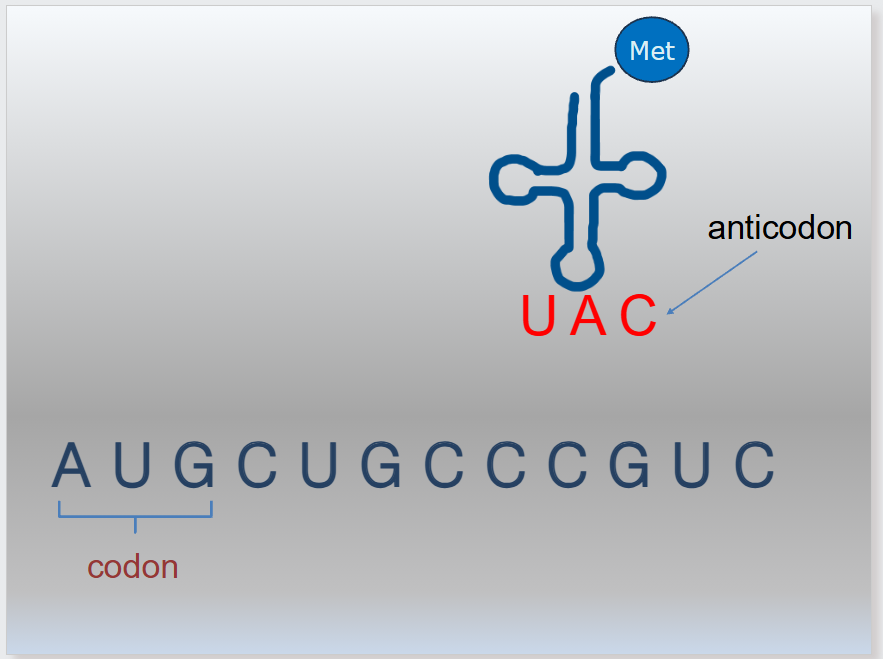

<p>An <strong>aminoacyl-tRNA</strong> (also called a <strong>charged tRNA</strong>) is a transfer RNA molecule that is chemically bonded to its specific, matching amino acid. Its main job is to carry that amino acid to the ribosome during translation so it can be added to a growing polypeptide chain</p><ul><li><p><strong>How it is made (tRNA Charging):</strong> an enzyme called <strong>aminoacyl-tRNA synthetase</strong> attaches the correct amino acid to the 3′ end of the tRNA in the cytosol before translation begins. There are 20 different synthetases in human cells, one for each standard amino acid</p></li><li><p><strong>Energy requirement:</strong> charging a tRNA requires energy from the hydrolysis of <strong>one ATP molecule</strong>. This creates a high-energy ester bond that will later help power peptide bond formation at the ribosome</p></li><li><p><strong>Structure and function:</strong> one end of the molecule holds the <strong>anticodon</strong> loop, which pairs with a complementary mRNA codon. The opposite 3′ acceptor end carries the attached amino acid</p></li><li><p><strong>Role in the ribosome:</strong> during elongation, an incoming aminoacyl-tRNA enters the <strong>A (aminoacyl) site</strong> of the ribosome. Once its amino acid is linked to the growing protein chain, the uncharged tRNA moves to the P and E sites before exiting</p></li><li><p><strong>Accuracy checkpoint:</strong> synthetase enzymes ensure the genetic code is read properly by matching the right amino acid to the right anticodon</p></li></ul><p></p>
92
New cards

Aminoacyl-tRNA

An aminoacyl-tRNA (also called a charged tRNA) is a transfer RNA molecule that is chemically bonded to its specific, corresponding amino acid. Its main job is to carry that amino acid to the ribosome so it can be added to a growing polypeptide chain during protein synthesis

  • An aminoacyl-tRNA (also called a charged tRNA) is a transfer RNA molecule that is chemically bonded to its specific, matching amino acid. Its main job is to carry that amino acid to the ribosome during translation so it can be added to a growing polypeptide chain

Before translation begins at the ribosome, tRNAs must be loaded with the right amino acid in the cytoplasm

  • The Enzyme: a specialized enzyme called aminoacyl-tRNA synthetase attaches the amino acid to the 3′ end of the matching tRNA. There are 20 different versions of this enzyme, with at least one dedicated to each of the 20 amino acids

  • Energy Requirement: the charging process requires energy from ATP. Hydrolyzing ATP creates a high-energy ester bond between the amino acid and the tRNA

  • Accuracy Checkpoint: these enzymes ensure the right amino acid matches the tRNA's anticodon before it ever reaches the ribosome. This step is vital for accurately translating the genetic code
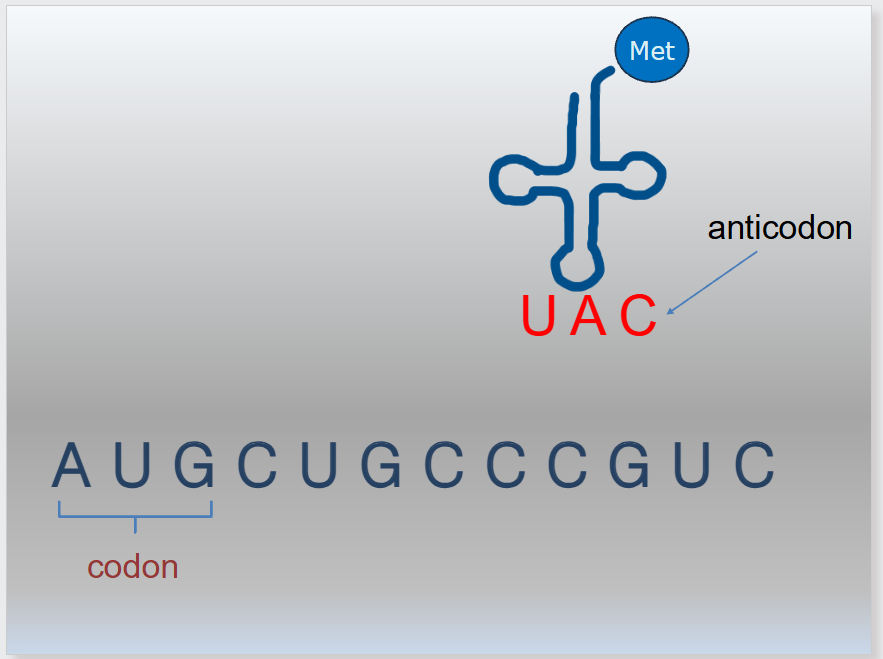

<p>An aminoacyl-tRNA (also called a charged tRNA) is a transfer RNA molecule that is chemically bonded to its specific, corresponding amino acid. Its main job is to carry that amino acid to the ribosome so it can be added to a growing polypeptide chain during protein synthesis</p><ul><li><p>An <strong>aminoacyl-tRNA</strong> (also called a <strong>charged tRNA</strong>) is a transfer RNA molecule that is chemically bonded to its specific, matching amino acid. Its main job is to carry that amino acid to the ribosome during translation so it can be added to a growing polypeptide chain</p></li></ul><p>Before translation begins at the ribosome, tRNAs must be loaded with the right amino acid in the cytoplasm</p><ul><li><p><strong>The Enzyme:</strong> a specialized enzyme called <strong>aminoacyl-tRNA synthetase</strong> attaches the amino acid to the 3′ end of the matching tRNA. There are 20 different versions of this enzyme, with at least one dedicated to each of the 20 amino acids</p></li><li><p><strong>Energy Requirement:</strong> the charging process requires energy from <strong>ATP</strong>. Hydrolyzing ATP creates a high-energy ester bond between the amino acid and the tRNA</p></li><li><p><strong>Accuracy Checkpoint:</strong> these enzymes ensure the right amino acid matches the tRNA's anticodon before it ever reaches the ribosome. This step is vital for accurately translating the genetic code</p></li></ul><p></p>
93
New cards

During translation elongation, where does the incoming aminoacyl-tRNA initially bind on the ribosome?

The A (aminoacyl) site

  • During translation elongation, the incoming aminoacyl-tRNA initially binds to the A site (aminoacyl site) of the ribosome. Here, its anticodon base-pairs with the complementary codon on the mRNA strand

  • A site (Aminoacyl site): this is the entry point where each new incoming charged tRNA binds to the ribosome

  • An incoming aminoacyl-tRNA first binds to the A site (aminoacyl or acceptor site) of the ribosome during the elongation phase of translation


94
New cards

Ribosome sites

Assembled ribosomes contain three distinct tRNA-binding sites—the A site, P site, and E site—which coordinate the steps of mRNA translation into a polypeptide chain. In addition to these internal catalytic sites, biology also distinguishes between two cellular locations where ribosomes operate: free in the cytosol and bound to the rough endoplasmic reticulum

  • A site (aminoacyl or acceptor site): accepts the incoming charged tRNA carrying the next amino acid specified by the mRNA codon

  • P sites (peptidyl site): holds the tRNA attached to the growing polypeptide chain while rRNA catalyzes a new peptide bond

  • E site (exit site): holds the now-empty tRNA briefly before releasing it back into the cytoplasm to be recharged


<p><span>Assembled ribosomes contain three distinct tRNA-binding sites—the </span>A site, P site, and E site—which coordinate the steps of mRNA translation into a polypeptide chain. In addition to these internal catalytic sites, biology also distinguishes between two cellular locations where ribosomes operate: free in the cytosol and bound to the rough endoplasmic reticulum</p><ul><li><p><strong>A site (aminoacyl or acceptor site): </strong>accepts the incoming charged tRNA carrying the next amino acid specified by the mRNA codon</p></li><li><p><strong>P sites (peptidyl site):</strong> holds the tRNA attached to the growing polypeptide chain while rRNA catalyzes a new peptide bond</p></li><li><p><strong>E site (exit site)</strong>: holds the now-empty tRNA briefly before releasing it back into the cytoplasm to be recharged </p></li></ul><p></p>
95
New cards

Ribosome sites

Assembled ribosomes contain three distinct tRNA-binding sites—the A site, P site, and E site—which coordinate the steps of mRNA translation into a polypeptide chain. In addition to these internal catalytic sites, biology also distinguishes between two cellular locations where ribosomes operate: free in the cytosol and bound to the rough endoplasmic reticulum

  • A site (aminoacyl or acceptor site): accepts the incoming charged tRNA carrying the next amino acid specified by the mRNA codon

  • P sites (peptidyl site): holds the tRNA attached to the growing polypeptide chain while rRNA catalyzes a new peptide bond

  • E site (exit site): holds the now-empty tRNA briefly before releasing it back into the cytoplasm to be recharged
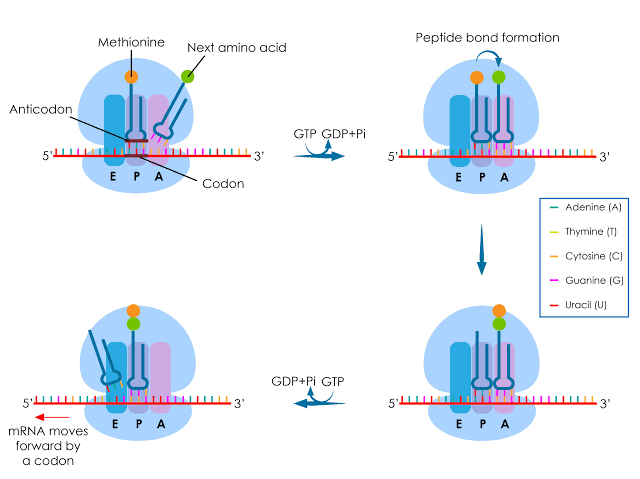

<p>Assembled ribosomes contain three distinct tRNA-binding sites—the A site, P site, and E site—which coordinate the steps of mRNA translation into a polypeptide chain. In addition to these internal catalytic sites, biology also distinguishes between two cellular locations where ribosomes operate: free in the cytosol and bound to the rough endoplasmic reticulum</p><ul><li><p><strong>A site (aminoacyl or acceptor site): </strong>accepts the incoming charged tRNA carrying the next amino acid specified by the mRNA codon</p></li><li><p><strong>P sites (peptidyl site):</strong> holds the tRNA attached to the growing polypeptide chain while rRNA catalyzes a new peptide bond</p></li><li><p><strong>E site (exit site)</strong>: holds the now-empty tRNA briefly before releasing it back into the cytoplasm to be recharged</p></li></ul><p></p>
96
New cards

P site of ribosome

The P site (peptidyl-tRNA binding site) is the middle binding pocket on a ribosome that holds the transfer RNA (tRNA) attached to the growing polypeptide chain during protein synthesis (translation)

Key Functions in Translation

  • Initiation entry: the initiator tRNA carrying methionine (Met) is the only tRNA that binds directly to the P site at the start codon (AUG). Every subsequent tRNA enters through the A site first

  • Polypeptide anchoring: during elongation, the P site holds the tRNA linked to the chain of amino acids built so far

  • Peptide bond transfer: the ribosome catalyzes a peptide bond between the amino acid on the A-site tRNA and the polypeptide on the P-site tRNA. As a result, the entire growing chain transfers over to the tRNA in the A site

  • Translocation: after peptide bond formation, the ribosome shifts one codon forward along the mRNA. The tRNA carrying the newly lengthened polypeptide moves from the A site into the P site, while the now-empty tRNA moves from the P site to the E site
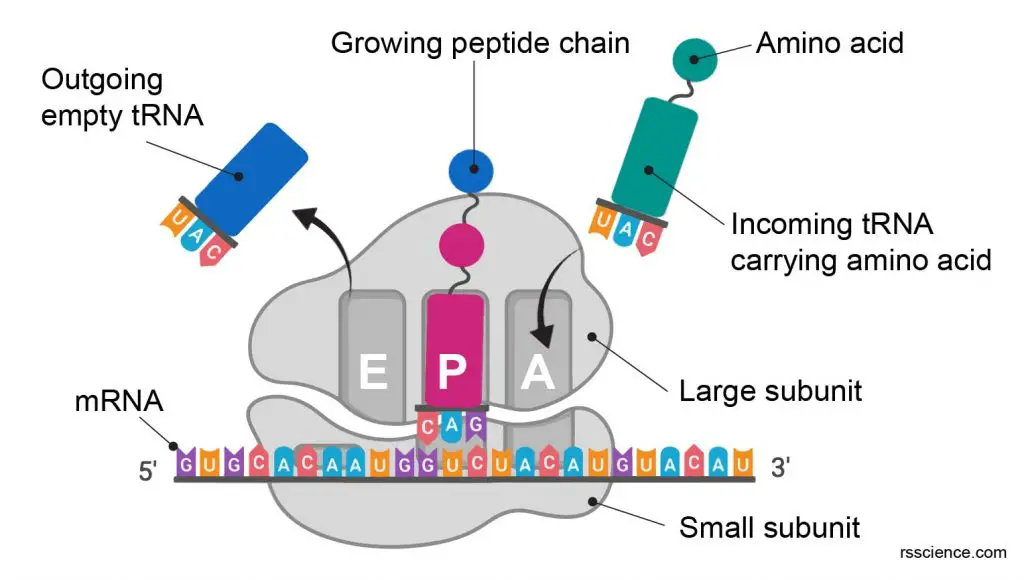

<p><span>The <strong>P site (peptidyl-tRNA binding site)</strong> is the middle binding pocket on a ribosome that holds the transfer RNA (tRNA) attached to the <strong>growing polypeptide chain</strong> during protein synthesis (translation)</span></p><p>Key Functions in Translation</p><ul><li><p><span><strong>Initiation entry:</strong> the initiator tRNA carrying methionine (Met) is the only tRNA that binds directly to the P site at the start codon (AUG). Every subsequent tRNA enters through the A site first</span></p></li><li><p><span><strong>Polypeptide anchoring:</strong> during elongation, the P site holds the tRNA linked to the chain of amino acids built so far</span></p></li><li><p><span><strong>Peptide bond transfer: </strong>the ribosome catalyzes a peptide bond between the amino acid on the A-site tRNA and the polypeptide on the P-site tRNA. As a result, the entire growing chain transfers over to the tRNA in the A site</span></p></li><li><p><span><strong>Translocation:</strong> after peptide bond formation, the ribosome shifts one codon forward along the mRNA. The tRNA carrying the newly lengthened polypeptide moves from the A site into the P site, while the now-empty tRNA moves from the P site to the E site</span></p></li></ul><p></p>
97
New cards

P site on ribosome

The P site (peptidyl-tRNA binding site) is the middle binding pocket of a ribosome that holds the tRNA carrying the growing polypeptide chain during protein synthesis (translation)

  • Initiation entry: during translation initiation, the initiator tRNA (carrying methionine) is the only tRNA that binds directly to the P site rather than entering through the A site first

  • Polypeptide anchoring: throughout elongation, the P site securely holds the tRNA attached to the growing chain of amino acids

  • Peptide bond transfer: when a new aminoacyl-tRNA arrives in the adjacent A site, the large ribosomal subunit catalyzes a peptide bond. The growing polypeptide chain in the P site is transferred and attached to the new amino acid in the A site

  • Translocation: as the ribosome shifts one codon down the mRNA (5' to 3'), the now-empty tRNA in the P site moves into the E site to exit, while the tRNA in the A site (now holding the extended polypeptide) shifts into the P site
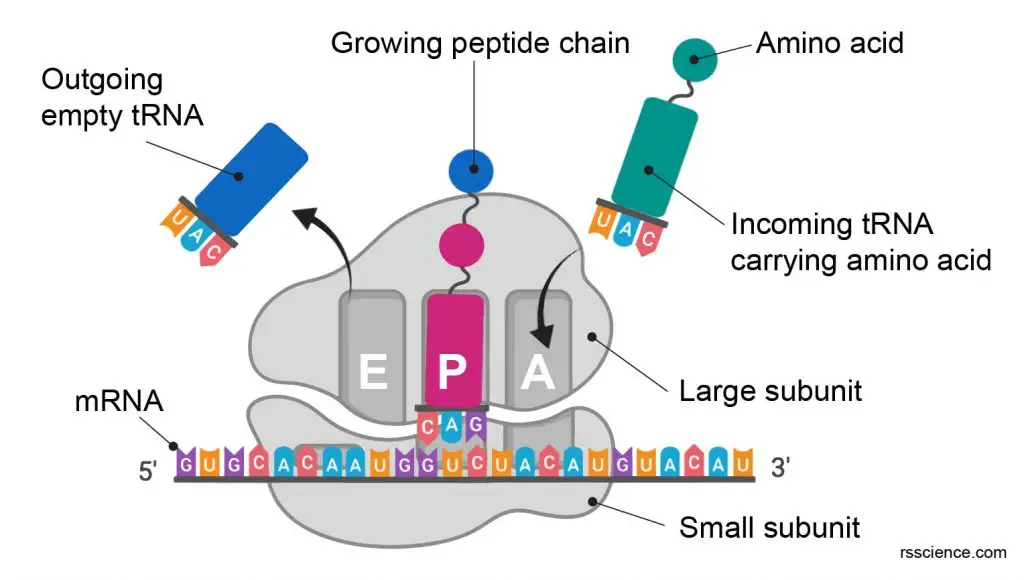

<p>The P site (peptidyl-tRNA binding site) is the middle binding pocket of a ribosome that holds the tRNA carrying the growing polypeptide chain during protein synthesis (translation)</p><ul><li><p><strong>Initiation entry:</strong> during translation initiation, the initiator tRNA (carrying methionine) is the only tRNA that binds directly to the P site rather than entering through the A site first</p></li><li><p><strong>Polypeptide anchoring:</strong> throughout elongation, the P site securely holds the tRNA attached to the growing chain of amino acids</p></li><li><p><strong>Peptide bond transfer:</strong> when a new aminoacyl-tRNA arrives in the adjacent A site, the large ribosomal subunit catalyzes a peptide bond. The growing polypeptide chain in the P site is transferred and attached to the new amino acid in the A site</p></li><li><p><strong>Translocation:</strong> as the ribosome shifts one codon down the mRNA (5' to 3'), the now-empty tRNA in the P site moves into the E site to exit, while the tRNA in the A site (now holding the extended polypeptide) shifts into the P site</p></li></ul><p></p>
98
New cards

E site on ribosome

The E site (exit site) is the third and final tRNA-binding site on the large ribosomal subunit where discharged (uncharged) tRNA molecules briefly bind before leaving the ribosome during translation

  • Location: the E site is primarily formed by ribosomal RNA (rRNA) in the large ribosomal subunit

  • Function in Accuracy: binding of the deacylated tRNA in the E site helps maintain the reading frame on the mRNA and coordinates the release of the spent tRNA as a new tRNA enters the A site

  • E site (Exit site): receives the empty, uncharged tRNA from the P site after it transfers its polypeptide chain. The tRNA is then released into the cytoplasm to be recharged with a new amino acid by aminoacyl-tRNA synthetase


<p><span>The </span>E site (exit site) is the third and final tRNA-binding site on the large ribosomal subunit where discharged (uncharged) tRNA molecules briefly bind before leaving the ribosome during translation</p><ul><li><p><span><strong>Location:</strong> the E site is primarily formed by ribosomal RNA (rRNA) in the <strong>large ribosomal subunit</strong></span></p></li><li><p><span><strong>Function in Accuracy:</strong> binding of the deacylated tRNA in the E site helps maintain the reading frame on the mRNA and coordinates the release of the spent tRNA as a new tRNA enters the A site</span></p></li><li><p><strong>E site (Exit site):</strong> receives the empty, uncharged tRNA from the P site after it transfers its polypeptide chain. The tRNA is then released into the cytoplasm to be recharged with a new amino acid by aminoacyl-tRNA synthetase</p></li></ul><p></p>
99
New cards

E site on ribosome

The E site (exit site) is the third and final tRNA-binding site on the large ribosomal subunit where discharged (uncharged) tRNA molecules briefly bind before leaving the ribosome during translation

  • Location: the E site is primarily formed by ribosomal RNA (rRNA) in the large ribosomal subunit

  • Function in Accuracy: binding of the deacylated tRNA in the E site helps maintain the reading frame on the mRNA and coordinates the release of the spent tRNA as a new tRNA enters the A site

  • E site (Exit site): receives the empty, uncharged tRNA from the P site after it transfers its polypeptide chain. The tRNA is then released into the cytoplasm to be recharged with a new amino acid by aminoacyl-tRNA synthetase


<p>The E site (exit site) is the third and final tRNA-binding site on the large ribosomal subunit where discharged (uncharged) tRNA molecules briefly bind before leaving the ribosome during translation</p><ul><li><p><strong>Location:</strong> the E site is primarily formed by ribosomal RNA (rRNA) in the <strong>large ribosomal subunit</strong></p></li><li><p><strong>Function in Accuracy:</strong> binding of the deacylated tRNA in the E site helps maintain the reading frame on the mRNA and coordinates the release of the spent tRNA as a new tRNA enters the A site</p></li><li><p><strong>E site (Exit site):</strong> receives the empty, uncharged tRNA from the P site after it transfers its polypeptide chain. The tRNA is then released into the cytoplasm to be recharged with a new amino acid by aminoacyl-tRNA synthetase</p></li></ul><p></p>
100
New cards

Sites on ribosome during translation

During the elongation phase of protein synthesis, the ribosome moves along the mRNA strand in the 5' to 3' direction. Transfer RNA (tRNA) molecules pass through three binding sites on the large ribosomal subunit in a specific sequence (A → P → E):

  • A Site (Aminoacyl site): an incoming charged tRNA carrying a specific amino acid enters here and pairs its anticodon with the exposed mRNA codon

  • P Site (Peptidyl site): the tRNA holding the growing polypeptide chain sits here while the ribosome catalyzes a peptide bond to attach the new amino acid from the A site

  • E Site (Exit site): once the tRNA in the P site transfers its polypeptide chain to the incoming amino acid, the ribosome shifts forward by one codon. This translocation pushes the now-empty (deacylated) tRNA into the E site, where it dissociates from the mRNA and exits into the cytoplasm to be recharged with another amino acid
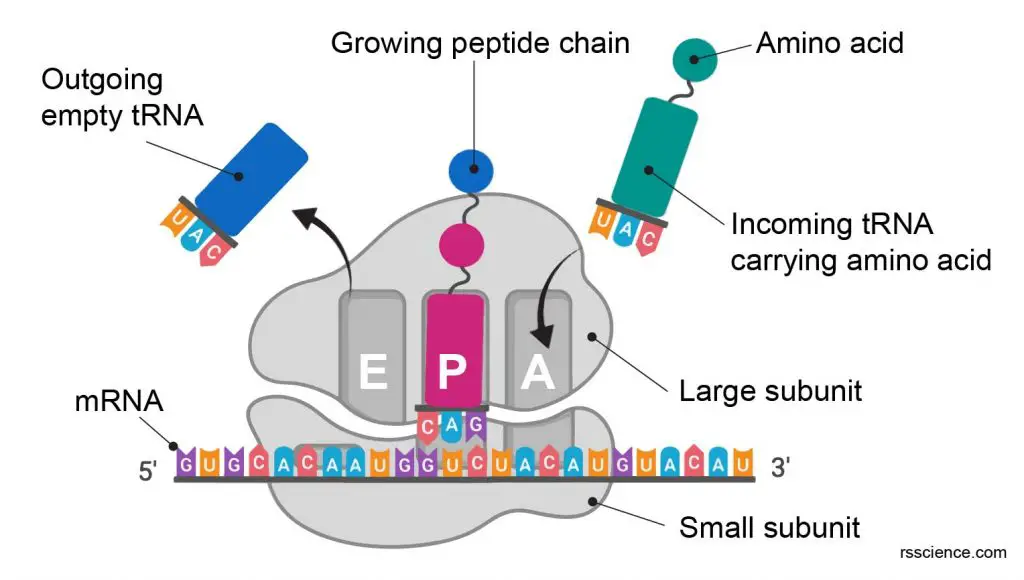

<p>During the elongation phase of protein synthesis, the ribosome moves along the mRNA strand in the 5' to 3' direction. Transfer RNA (tRNA) molecules pass through three binding sites on the large ribosomal subunit in a specific sequence (<strong>A → P → E</strong>):</p><ul><li><p><span><strong>A Site (Aminoacyl site):</strong> an incoming charged tRNA carrying a specific amino acid enters here and pairs its anticodon with the exposed mRNA codon</span></p></li><li><p><span><strong>P Site (Peptidyl site):</strong> the tRNA holding the growing polypeptide chain sits here while the ribosome catalyzes a peptide bond to attach the new amino acid from the A site</span></p></li><li><p><span><strong>E Site (Exit site):</strong> once the tRNA in the P site transfers its polypeptide chain to the incoming amino acid, the ribosome shifts forward by one codon. This translocation pushes the now-empty (deacylated) tRNA into the E site, where it dissociates from the mRNA and exits into the cytoplasm to be recharged with another amino acid</span></p></li></ul><p></p>



