ACT Math Formulas 26-27
 Note
Note Call Kai
 Learn
Learn Practice Test
 Spaced Repetition
 Match
Match Flashcards
 Knowt Play
1/86

There's no tags or description
Looks like no tags are added yet.
Name | Mastery | Learn | Test | Matching | Spaced | Call with Kai | Chat |
|---|
No analytics yet
Send a link to your students to track their progress
87 Terms
tan(x)
sinx/cosx
secθ
1/cosθ
cscθ
1/sinθ
cotθ
1/tanθ
Law of Sines Formula
sin(A)/a = sin(B)/b = sin(C)/c
Law of Sines
• a, b, c: Lengths of the sides of the triangle.
• A, B, C: Angles opposite to sides a, b, and c.
• R: Radius of the triangle's circumcircle (the circle that passes through all three vertices)

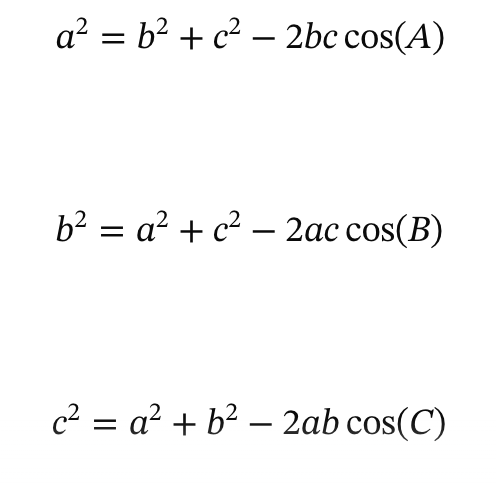
Law of Cosines
Standard Form of a Trig Function
y = Asin(B(x - C)) + D
• A (Amplitude): Controls the vertical stretch or height from the center line (|A|).
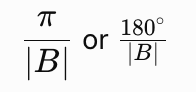
• B (Frequency factor): Used to find the period using the formula \(\frac{2\pi }{B}\) (or \(\frac{360^{\circ }}{B}\)).
• C (Phase shift): Horizontal shift to the left or right (note the minus sign in (x - C)).
• D (Vertical shift): Moves the graph up or down, which also sets the sinusoidal axis (midline
Two Functions of a Trig Function
y=sin(x) and y=3*sin(x)
Period (Trig Functions)
the distance between two peaks or two troughs of the curve in question
Amplitude (Trig Functions)
“A,” how far above and below the “midline” the curve goes
Phase Shift/Horizontal Shift (Trig Functions)
Caused by C and B (graph on calculator), changing C shifts whole graph to right or left, increasing B makes the period smaller (a compressed curve when graphed), and vice versa
Y Shift/Vertical Shift (Trig Functions)
Represented by D in the equation, if D has a value of 0, then the “midline” of the trig function will occur at y=0
y=sin(Bx)

y=cos(Bx)

y=tan(Bx)
Maximum and Minimum Values of Sinx and Cosx
Max: 1, Min: -1
Maximum and Minimum Values of Tanx, Cscx, Secx, and Cotx
No maximum, no minimum, (exept Cscx and Secx cannot equal 0)
Circle Formula
(h,k)=center, r=radius

Ellipse Formula (Horizontal)

Ellipse Formula (Vertical)

A and B on Ellipse

Hyperbola Formula (Horizontal)

Hyperbola Formula (Vertical)

Vertices of Horizontal Hyperbola

Vertices Vertical Hyperbola

Number in front of () in Hyperbola…
Tells how stretched or compressed (horizontally or vertically) a hyperbola is
A and B in Hyperbola
B: Draw a box, B is where diagonal asymptotes cross (height from center)
A: Distance from center of Hyperbola to two vertices
An arrangement where order does NOT matter (Key words: combinations, pairs, trios, groups)
An arrangement where order DOES matter (Key words: unique, different, distinct, arrange, permutations, order)
Anatomy of Combinatoric Notation
n: total # of items
k: # of items chosen

Factorial Notation
Shown by an exclamation point (!), where x is an integer, is calculated by multiplying all integers between x and 1 together
Ex: 8! = 8×7×6×5×4×3×2×1
Factorial Term
(n+1)!=(n+1)*n!
Because of definition of Factorial → n!=n*(n-1)*n(n-2)*…
Intersection
∩ = where the sets overlap ONLY
Union
∪ = and/or, BOTH sets
(x,y) (Unit Circle)
(cosθ, sinθ)
Vertex of a Parabola

Difference of Squares

Trapezoid Area Formula

Circle Circumference and Area

Arc Length and Sector Area

Cylinder Volume

Sphere Volume and Surface Area

Cone Volume

Mean Formula
