Intro to psych - Week 5
 Call Kai
 Learn
Learn Practice Test
 Spaced Repetition
 Match
Match Flashcards
 Knowt Play
1/24

Earn XP
Description and Tags
Learning
Name | Mastery | Learn | Test | Matching | Spaced | Call with Kai | Chat |
|---|
No analytics yet
Send a link to your students to track their progress
25 Terms
What is learning?
How we adapt to changes in the environment
Any relatively permanent change in behaviour or mental processes brought by experience or practice
Different from maturation (genetically controlled changes)
Maturation = Muscle development, bone growth etc
What behaviours aren’t learned?
Reflexes: Unlearned, involuntary responses to a specific stimulus/environment
E.g. touching a hot stove and pulling away
Fixed actions patterns (aka ‘instincts’): Motivated, complex behaviours that have strong innate basis, triggered by broad events
E.g. baby crying for attention when they’re hungry, uncomfortable
Something that just happens, and is built in due to evolution
How do we learn through association (Classic conditioning)
3 key elements:
Before classical conditioning:
Unconditioned stimulus: A naturally occurring stimulus that leads to —>
Unconditioned response: An involuntary unlearned response
During classical conditioning:
Acquisition: Repeated pairing of neutral stimulus and the unconditioned stimulus
After conditioning:
Conditioned stimulus: Formerly a neutral stimulus (NS) that becomes able to produce a learned response by being paired with an unconditioned stimulus
Conditioned response (CR): learned, reflex-like response to a conditioned stimulus; also called a conditioned reflex

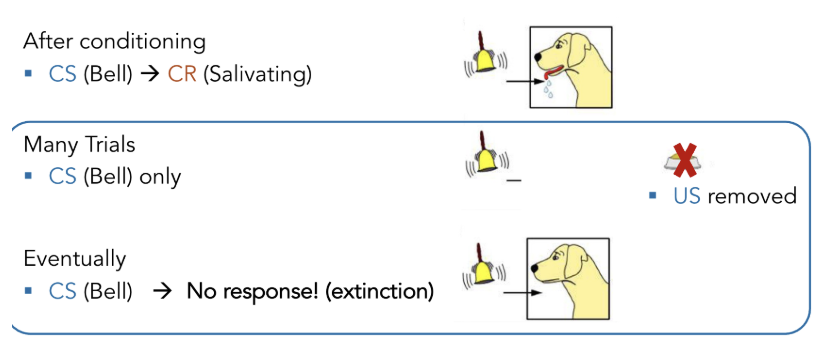
Extinction
Disappearance or weakening of a learned response following the removal or absence of the unconditioned stimulus or the removal of a reinforcer
Spontaneous recovery
Reappearance of a learned response after extinction has occurred
Learning is relatively permanent change in behaviour
Stimulus generalisation
Tendency to respond to a stimulus that is similar to the original conditioned stimulus with the conditioned response
Stimulus discrimination:
the learned ability to respond only to a specific stimulus while ignoring similar, alternative cues
Exposure therapy
Can help eliminate fear
Involves directly confronting the anxiety/fear-provoking stimulus paired with an attractive stimulus and without the aversive outcome
Allows extinction to occur
Biological constraints
Conditioned taste aversion: Development of a nausea or aversive response to a particular taste because that taste was followed by a nausea reaction.
Occurs after only one association
E.g. me eating truffle pasta and vomiting, then associating truffle with nausea and feeling that way even before eating it
Biological preparedness: Tendency for animals to learn certain associations, such as taste and nausea, with only one or few pairings due to the survival value of learning
Not all pairings are equal
E.g. spoiled milk being associated with nausea
Thorndicke’s law of effect
If a voluntary response is followed by a pleasurable consequence, it tends to be repeated
If a voluntary response is followed by an unpleasurable consequence, it will tend to not be repeated
Operant conditioning
Process by which a voluntary behaviour becomes more probable or less probable depending on the pleasant or unpleasant consequences
Premack Principle
Using a preferred activity to reinforce a less preferred activity
E.g. force them to do homework before allowing them to go to the playground
Punishment
Event or object following a response which DECREASES that the response will occur again
E.g. taking away your phone because you didn’t do your homework
Helps temporarily remove behaviour, but behaviour eventually returns
Teaches us what NOT to do, but does not teach us what to do
(Psychologist suggest reinforcement instead of punishment)
How to use punishment effectively?

Types of reinforcers
Primary reinforces: Naturally rewarding, serve to fulfill basic biological need
E.g. food, water, sleep, pleasure, affection
Secondary reinforcers: Any reinforcer that has no inherent value, but becomes reinforcing after being paired with primary reinforcers
E.g. money, praise, good grades
Schedules of reinforcement
Continuous reinforcement:
Reinforcement of each and every correct response
Helps distinguish correct and incorrect responses → Rapid learning
Extinction occurs rapidly when reinforcement is discontinued
Shaping
Process of reinforcing small steps as they become closer and closer to the desired behaviour, until the desired behaviour is learned
Partial reinforcement
Learning response that is reinforced after some, but not all
Learning happens less rapidly
Correct responses tends to be very resistant to extinction, efficient way to maintain behaviour
Fixed interval schedule
reinforcement based on time elapsed since last reinforcement; independent no. of reinforces
Variable interval schedule
Interval time that must pass before reinforcement becomes possible is different for each trial or number of event
Fixed ratio schedule
Number of reinforcements required for each event is not always the same
Variable ratio schedule
The number of responses for reinforcement is different for each trial or event
Latent learning
Learning that isn’t done through reinforcement, but is not observable until there is reason to demonstrate it
Learned helplessness
Tendency to fail to act to escape from a situation because of a history of repeated failures from the past
Related to depression
HOWEVER if helplessness can be learned, it can also be unlearned
Observational learning
Learning that does not come from direct experience, but by watching others - social models - and the consequences of their behaviour
Can be desirable/prosocial or undesirable and antisocial
Challenges the operant + classical conditioning that learning does not have to be done through experience
Elements of observational learning
Attention : To learn anything through observation, the learner must first pay attention to the model
Memory/Retention: The learner must also be able to retain the memory of what was done
Imitation: The learner must be capable of reproducing, or imitating, the actions of the model
Desire: The learner must have the motivation to perform the action
Influenced by consequences observed – vicarious reinforcement or vicarious punishment