[LEC] Digestive System
 Call Kai
 Learn
 Practice Test
 Spaced Repetition
 Match
 Flashcards
 Knowt Play
1/48

There's no tags or description
Looks like no tags are added yet.
49 Terms
What are the alimentary canals four layers superficial to deep?
Mucosa → submucosa → muscularis → serosa or adventitia

Mucosa [Layers Of The Alimentary Canal]
Mostly simple columnar epithelium with goblet cells
Excluding the stratified squamous epithelium in the esophagus and rectum; areas of higher friction

Submucosa [Layers Of The Alimentary Canal]
Loose connective tissue that aids in the absorption of nutrients and fluids
Highly vascularized and innervated by autonomic fibers

Muscularis [Layers Of The Alimentary Canal]
Two thick layers of smooth muscle
Inner layer is circular muscle
Outer layer is longitudinal muscle
Performs the mechanical actions of the alimentary canal
The muscle of the inner and outer layers run in opposite directions
inner circular muscles can contract and squeeze in segments, decreasing the size of the lumen
outer longitudinal muscles contract to shorten the length of the lumen
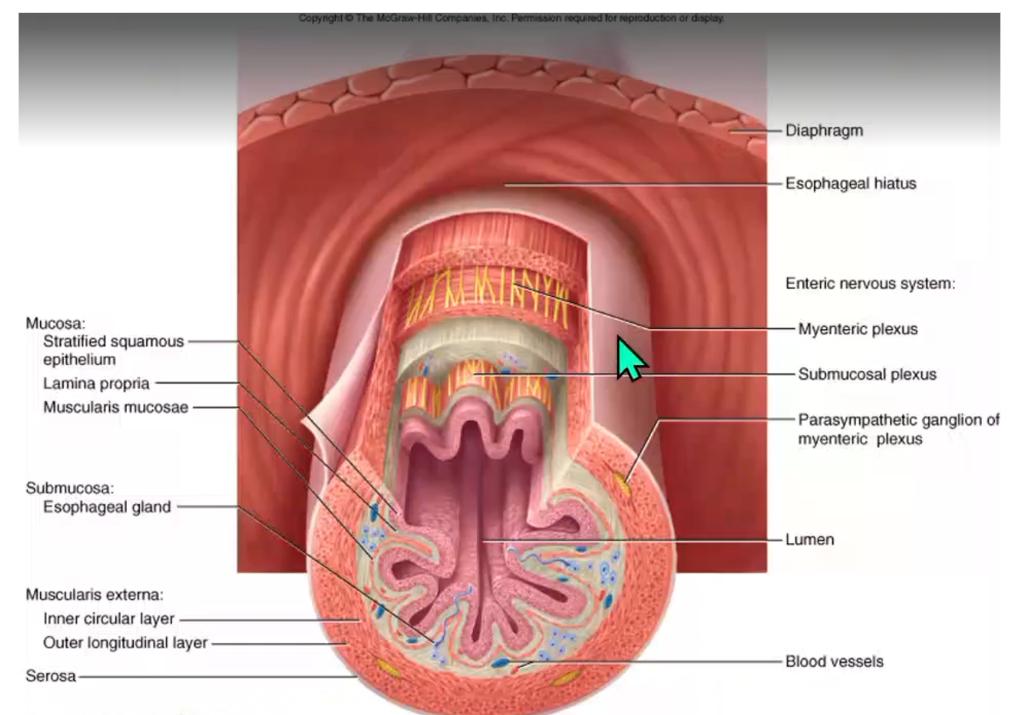
Serosa or adventitia [Layers Of The Alimentary Canal]
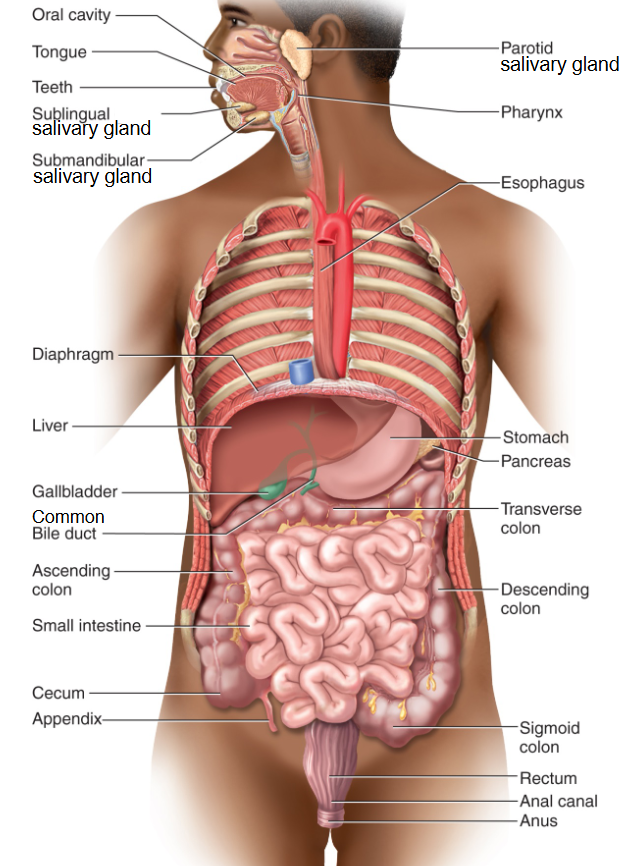
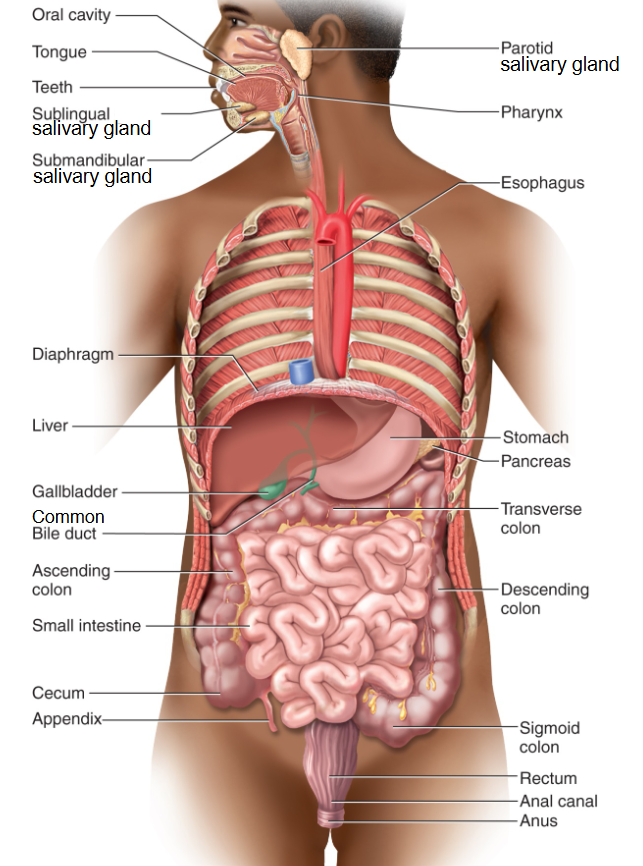
Portion of the alimentary canal superior to the diaphragm
What are some accessory organs of the digestive system?
Salivary glands
Liver
Gall bladder
Pancreas
What are the general functions of the digestive system?
Ingestion - tasting and taking food into the mouth
Mastication - food is chewed and broken down by saliva in the mouth
Deglutition - swallowing food
Digestion - conversion of complex organic compounds (food) into simpler organic compounds (nutrients)
Absorption - movement of nutrients from the alimentary canal into the blood
Defecation - elimination of waste products from the alimentary canal
What are the two types of digestion?
Mechanical - physically breaking the food into smaller pieces; begins in the mouth as food is chewed
the alimentary canal uses its smooth muscle to mix and propel food with digestive enzymes, which are secreted by mucosa
Chemical - involves breaking down the food into simpler nutrients that can be used by cells; begins in the mouth with saliva, and is completed by various chemicals and enzymes
Catabolism is the decomposition of larger organic compounds into smaller organic compounds
What are the three requirements for enzymes to function?
Correct pH
Correct temperature
Correct substrate
Carbohydrate digestion
Is mostly performed by amylase and disaccharidases. There is salivary amylase and pancreatic amylase
Amylase - converts starch into various oligosaccharides and disaccharides, which includes:
maltose
sucrose
lactose
Oligo - small or short
Di - two monomers or building blocks
Poly - many monomers or building blocks
Saccharide - sugar
Cellulose [Carbohydrate Digestion]
Indigestible polysaccharide produced by plants; fiber
Starch [Carbohydrate Digestion]
Digestible polysaccharide produced by plants; fiber
Glycogen [Carbohydrate Digestion]
Digestible polysaccharide produced by animals
Comprised of a long chain of about 3000 glucose monomers
What is the function of disaccharidases? [Carbohydrate Digestion]
Disaccharidases are enzymes that convert disaccharides into monosaccharides
Sucrase - enzyme that cleaves sucrose into glucose and fructose
Lactase - enzyme that cleaves lactose into glucose and galactose
Maltase - enzyme that cleaves maltose into several bits of glucose
Proteins
Class of nitrogenous organic compounds
Consist of large molecules composed of one or more long chains of amino acids totaling 100 amino acids or more
An essential part of all living organisms
Make up structural components of muscle, hair, and collagen
Make up structural components of antibodies
Make up structural components of enzymes
Protein digestion
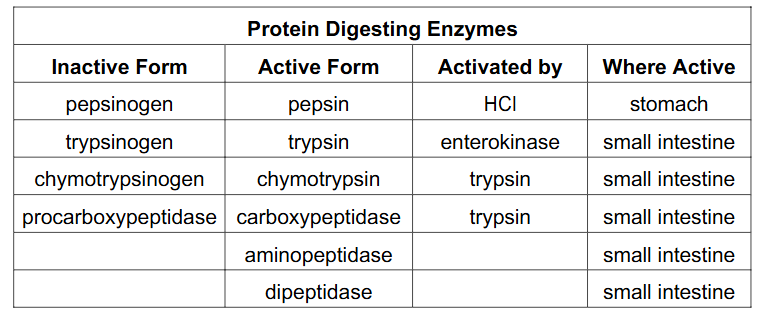
Is mostly performed by proteases or peptidases, or enzymes that digest proteins
These enzymes occur in an inactive form, which prevents digestion of the stomach and small intenstine
Pepsin [Protein Digestion]
A type of stomach enzyme produced in an inactive form
Has an optimal pH level of 1.5 to 3.5
Removes a few amino acids from protein molecules
Mostly converts proteins into polypeptides
Poly - many
Peptide - short chains of amino acid monomers linked by peptide bonds
Trypsin [Protein Digestion]
A type of pancreatic enzyme produced in an inactive form
Hydrolyzes polypeptides into even shorter oligopeptides
Poly - many
Oligo - small or short
Peptide - short chains of amino acid monomers linked by peptide bonds
Chymotrypsin [Protein Digestion]
A type of pancreatic enzyme produced in an inactive form
Hydrolyzes polypeptides into even shorter oligopeptides
Poly - many
Oligo - small or short
Peptide - short chains of amino acid monomers linked by peptide bonds
Carboxypeptidase [Protein Digestion]
A type of pancreatic enzyme produced in an inactive form
Takes apart oligopeptides one amino acid at a time from the -COOH end of the molecule
Oligo - small or short
Peptide - short chains of amino acid monomers linked by peptide bonds
Aminopeptidase [Protein Digestion]
A type of pancreatic enzyme produced in an inactive form
Takes apart oligopeptides one amino acid at a time from the -NH2 end of the molecule
Oligo - small or short
Peptide - short chains of amino acid monomers linked by peptide bonds
Dipeptidase [Protein Digestion]
A type of pancreatic enzyme produced in an inactive form
Splits dipeptides down the middle, and releases the last two free amino acids
Di - two monomers or building blocks
Peptide - short chains of amino acid monomers linked by peptide bonds
Name brush-border enzymes
Carboxypeptidase - Takes apart oligopeptides one amino acid at a time from the -COOH end of the molecule
Enterokinase - converts inactive trypsinogen into the active trypsin

STUDY PICTURE
*
Lipid digestion
Is mostly performed by bile salts and lipases
Lipases - enzymes that digest lipids, and includes:
lingual lipase
gastric lipase
pancreatic lipase
Lingual lipase [Lipid Digestion]
A type of lipase that is activated by acid in the stomach
Digests up to 10% of ingested fat
Gastric lipase [Lipid Digestion]
A type of lipase that is activated by acid in the stomach
Digests up to 15% of ingested fat
Pancreatic lipase [Lipid Digestion]
A type of lipase that performs most fat digestion
Secreted into the small intestine
Converts triglycerides into free fatty acids and glycerol
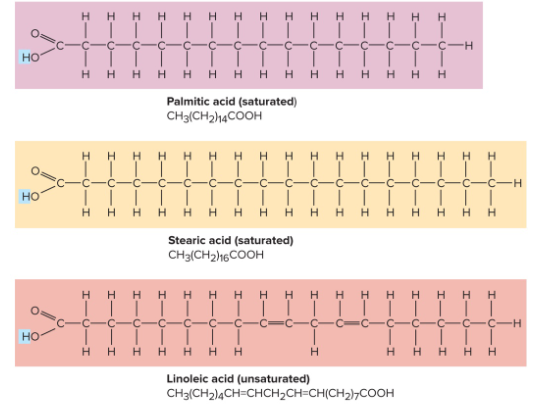
Triglyceride
A three-carbon alcohol (glycerol) linked to three fatty acids
Fatty acid
A chain of 4 to 24 carbon atoms
A carboxyl group at one end
A methyl group at another end

Saturated fatty acid
Has as much hydrogen as it can possibly carry
Has only single covalent bonds between the carbon atoms
They are saturated or full because they can not possibly hold more hydrogen atoms

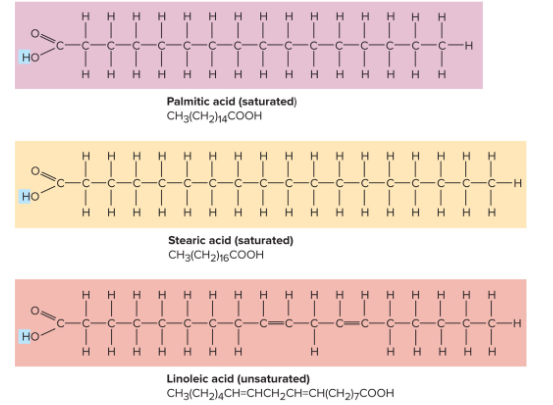
Unsaturated fatty acid
Some carbon atoms are joined by double covalent bonds
Each carbon could potentially share on pair of electrons with another hydrogen atom instead of the adjacent carbon; unsaturated because it could hold more
Nucleic acid digestion
Is mostly performed by nucleases and nucleotidases
Nucleotidases - convert nucleotides to 5-carbon sugar, phosphate, and nitrogen bases
ribonuclease - converts RNA into one of five nucleotides
deoxyribonuclease - converts DNA into one of five nucleotides
How does the autonomic nervous system affect the alimentary canal and digestion?
Sympathetic response - decreased digestive activity and efficiency
Parasympathetic response - increased digestive activity and efficiency
Bolus
Refers to food mixed with saliva in the mouth when swallowed
Chyme
Refers to food in the stomach, specifically the large intestine
When food particles are sufficiently reduced in size and composition, they are absorbed by the intestinal wall and transported to the bloodstream
Feces
Waste products
All of the nutrients have been absorbed from the chyme
Consists of mostly fiber and other indigestible material

Palate
The roof of the mouth which aids in chewing
Hard palate - palatine process of the maxilla plus the palatine bone
Soft palate - striated muscle
Uvula


Tongue
Consists of striated muscle
Helps manipulate food during mastication to produce bolus
Contains the taste buds
Contains the intrinsic salivary glands
Dentition
Teeth
Deciduous teeth - emerge in predictable order during 6 to 30 months of age; 20 in number
Permanent teeth - emerge between the ages of 6 to 25 years old; 32 in number
Sit in sockets of the alveolar process of the mandible and maxilla
Are lined by periodontal ligaments


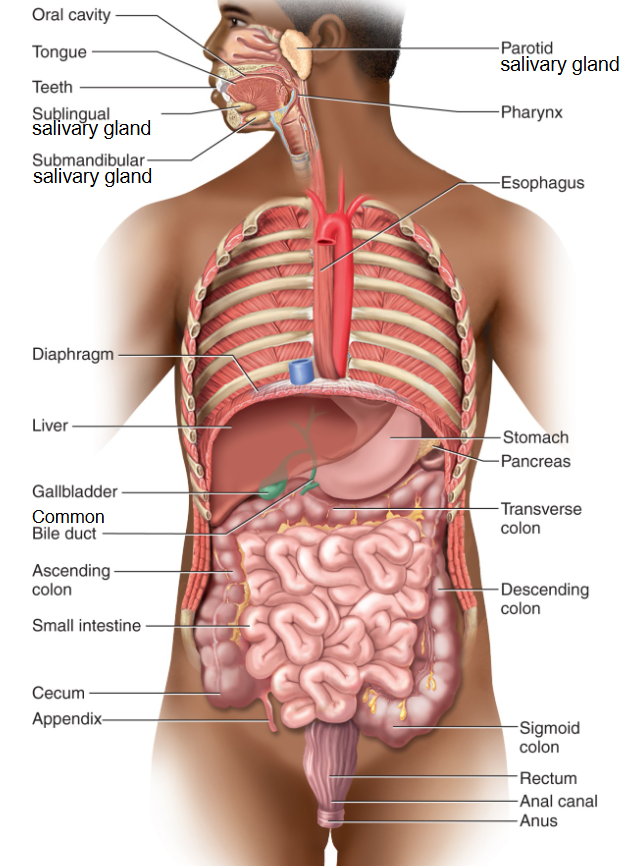
What do the extrinsic salivary glands produce?
Consists of the parotid, submandibular, and sublingual salivary glands. Produces saliva that contains:
Mucus - binds and lubricates food bolus
Electrolytes
Sodium (Na+)
Potassium (K+)
Chlorine (Cl-)
Phosphate
Bicarbonate
Lysozyme - antibacterial enzyme
Immunoglobulin A - antibacterial antibody
Salivary amylase - enzyme that begins starch digestion in the mouth


What do the intrinsic salivary glands produce?
Exist within the tongue. They secrete lingual lipase
An enzyme that begins fat digestion in the stomach and is activated by hydrochloric acid from the stomach
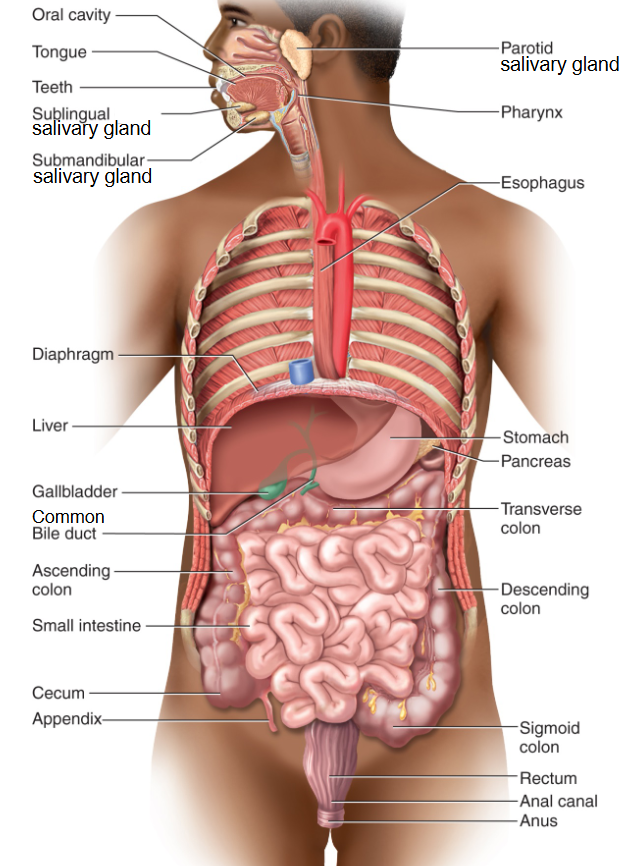
Esophagus
Food tube
Functions to propel bolus from the pharynx to the stomach via peristalsis


Stomach
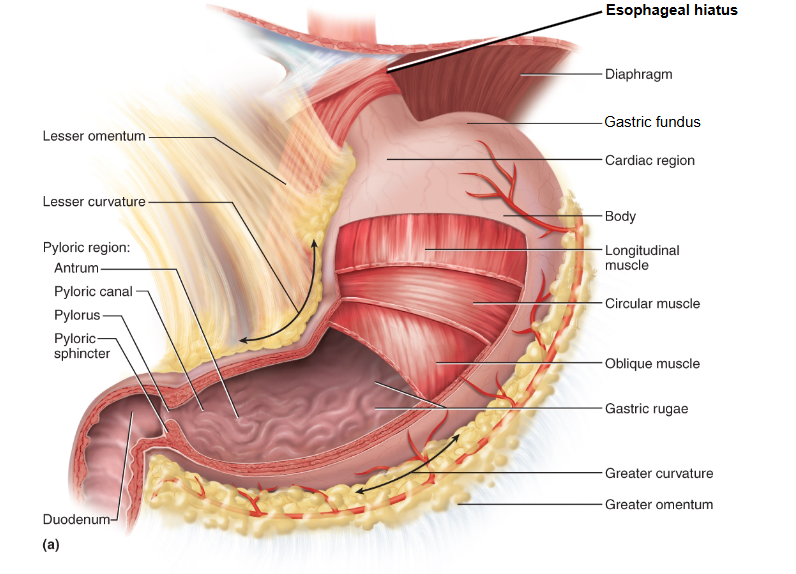
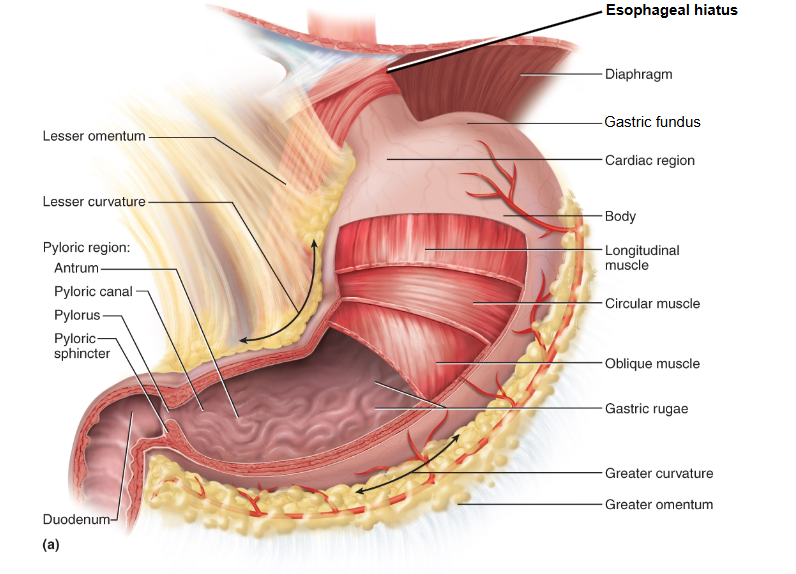
J-shaped bag made up of three layers of muscle that has four regions, which includes the:
Cardiac region - surrounds the cardiac sphincter; where the esophagus joins the stomach
Fundus - domed bulge lateral to the cardiac region that collects gas
Body - main part containing gastric cells and gastric glands
Pylorus - narrow distal area containing the pyloric sphincter

Gastric rugae [Structures Of The Stomach]
Collapsible folds in the inner stomach lining that allow for expansion and contraction

Gastric glands [Structures Of The Stomach]
Secrete gastric juice, including:
Mucous - an alkaline substance that prevents self-digestion which is secreted by mucous cells
Pepsinogen - an inactive form of pepsin which is secreted by chief cells
Gastric lipase - an acidic lipase which is secreted by the gastric chief cells in the mucosa of the gastric fundus
has an optimal pH level of 3 to 6


Hydrochloric acid (HCl)
Secreted by parietal cells
Kills ingested pathogens
Is responsible for the acidic environment of the stomach
Activates lingual lipase
Converts ingested ferric ions to ferrous ions, which are a form of iron needed for hemoglobin
Converts pepsinogen into pepsin; begins the digestion of proteins

Intrinsic factor
A glycoprotein secreted by parietal cells
Required for the absorption of vitamin B12 in the ileum of the small intestine
Vitamin B12 is required for hemoglobin synthesis
Enteroendocrine cells
Cells that secrete hormones that affect digestive organs
Gastrin - helps regulate stomach secretions
Cholecystekinin (CCK) - stimulates the release of pancreatic juices and bile into the duodenum
Serotonin - stimulates gastric motility
Histamine - stimulates hydrochloric acid (HCl) secretion
Somatostatin - inhibits gastric secretion and motility, which delays the emptying of the stomach