Marketing Research and Analytics
 Call Kai
 Learn
 Practice Test
 Spaced Repetition
 Match
 Flashcards
 Knowt Play
1/28

Earn XP
Description and Tags
Vocabulary flashcards covering the core concepts, research methodologies, analytics models, and ethical considerations in marketing research.
29 Terms
Marketing Research
The systematic collection, recording, and analysis of data to reduce uncertainty in decision making and assist managers in making informed choices regarding segmentation, positioning, product, pricing, promotion, and distribution.
Marketing Research Process
A sequential five-step framework used to investigate marketing problems, comprising: 1) Define Research Problem and Objectives, 2) Design the Research Plan, 3) Collect Data, 4) Analyze Data and Develop Insights, and 5) Determine Action Plan.

Secondary Data
Pieces of information that have been collected prior to the start of the focal research project, originating from either internal company records or external third-party sources.
Primary Data
Data collected directly by researchers to address the specific research questions or objectives of the focal project currently being investigated.
Internal Secondary Data
Secondary information generated within a firm's day-to-day operations, including sales invoices, customer purchase histories, and existing company reports.
Data Mining
The use of advanced statistical analysis tools to uncover previously unknown patterns, correlations, and relationships within large volumes of data to predict behaviour and reduce customer churn.
Big Data
Extremely large and complex data sets that exceed the capacity of conventional data management software to capture, store, manage, and analyze.
Five Vs of Big Data
The five defining characteristics of big data: Volume (large quantities), Variety (many data forms), Velocity (high speed of generation and processing), Veracity (degree of trustworthiness or data doubt), and Value (converting data insights into economic benefit).

Syndicated Data
External secondary data collected and standardized by commercial market research companies (such as Nielsen or Léger Marketing) and sold to multiple subscribing firms.
Scanner Data
Quantitative data obtained from optical readings of Universal Product Codes (UPC) at retail checkout counters to track point-of-sale volume and pricing dynamics.
Panel Data
Information gathered over an extended period from an ongoing, recruited sample of consumers who systematically record their purchases and shopping behaviours.
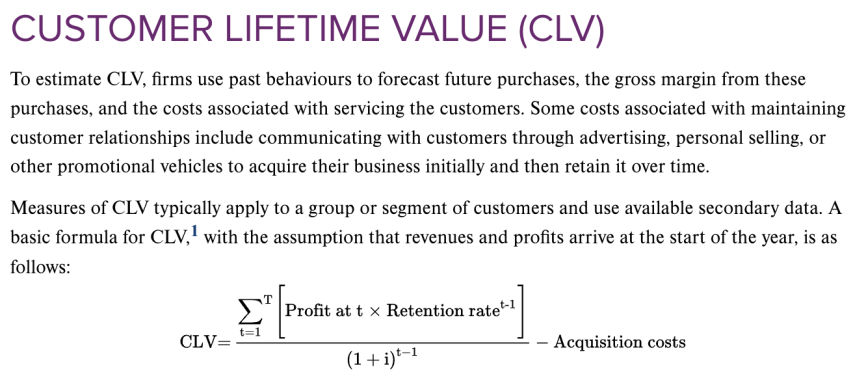
Customer Lifetime Value (CLV)
A quantitative metric forecasting the net economic value of a customer over their relationship with a firm, calculated using past purchases, gross margin, retention rates, and acquisition costs via: CLV=∑t=1T(1+i)t−1Profit at t×Retention ratet−1−Acquisition costs
Qualitative Research
Exploratory research methods—such as observation, focus groups, and in-depth interviews—designed to gather non-numerical, in-depth insights into consumer attitudes, motivations, and perceptions.
Observation Research
A qualitative research approach where researchers monitor and record consumer habits and movements directly or via tracking technologies, sensors, or heat maps.
In-Depth Interview
A qualitative data-gathering method in which a trained interviewer conducts a detailed, one-on-one session with a respondent, using probing questions to uncover underlying motivations and beliefs.
Focus Group
A qualitative research method that gathers a small group of participants to engage in an open discussion about a specific topic, guided by a trained moderator.
Quantitative Research
Structured research approaches that gather numerical data from large samples to test hypotheses, model statistical relationships, and quantify consumer patterns.
Survey
A systematic quantitative data collection method that gathers information from a targeted sample of respondents using structured or unstructured questionnaires.
Unstructured Questions
Open-ended survey questions that allow respondents to answer freely in their own words, capturing qualitative feedback without predefined answer choices.
Structured Questions
Closed-ended survey questions that provide respondents with a predetermined set of discrete response options or rating scales.
Double-Barreled Question
A questionnaire design error in which a single question asks about two separate topics or issues at once while only allowing a single response.
Leading Question
A flawed questionnaire item phrased in a manner that nudges or steers the respondent toward answering in a specific direction.
Experimental Research
A quantitative research approach that manipulates one or more independent variables to determine causal effects on dependent outcomes such as demand, sales, or profitability.
Marketing Analytics
The systematic use of advanced statistical and mathematical technologies and models to extract actionable insights from big data stored in warehouses to guide marketing strategy.
Descriptive Analytics
A branch of analytics that organizes and summarizes historical past data to describe what has previously occurred in the business or market.
Predictive Analytics
An analytics discipline that applies statistical algorithms and historical trends to forecast future customer behaviours, churn, or market trends.
Prescriptive Analytics
Advanced analytics tools and optimization models that evaluate different alternatives to recommend the most effective course of managerial action.
Active Analytics
A real-time analytics methodology that leverages artificial intelligence and Internet-of-Things (IoT) device data to generate instant marketing insights and reactions.
Customer Churn
The rate or metric representing the loss of customers who stop purchasing products or discontinue subscriptions with a firm over a given period.