Midterm 1 Flashcards (Lecture Material)
 Call Kai
 Learn
Learn Practice Test
 Spaced Repetition
 Match
Match Flashcards
 Knowt Play
1/144

Earn XP
Description and Tags
Pharmacodynamics 1* & 2*, Pharmokinetics 1 & 2, Autonomic Pharmacology, Drug Discovery*, Antimicrobial Pharmacology*, Anticancer Pharmacology, Anesthesia 1 & 2
Name | Mastery | Learn | Test | Matching | Spaced | Call with Kai | Chat |
|---|
No analytics yet
Send a link to your students to track their progress
145 Terms
pharmacology
the study of substances that interact with living systems through chemical processes
medical pharmacology
the study of substances used to prevent, diagnose and treat disease
toxicology
a branch of pharmacology - the study of undesirable effects of chemicals on living systems and ecosystems
which substances are toxic?
ALL substances can, under certain circumstances be toxic
what are the orgins of pharmacology?
2500 BC: early written records from China, Greece, Egypt and India list many types of ‘remedies’
described either beneficial or toxic effects of many plant and animal materials
many of these were of unknown efficacy (did not have actual proof or records of the mechanisms that proved that a drug actually worked to treat a disease)
pharmacogenomics
the study of how an individual’s unique genetic makeup affects their body’s response to specific drugs. It combines pharmacology (the study of drugs) and genomics (the study of genes) to understand why people react differently to the exact same medications helping to predict whether a drug will work effectively or cause adverse side effects based on a person’s DNA
what is complete decoding of genomes and has this led to?
scientists have successfully mapped out the entire sequence of DNA (the complete genetic code) for various species which has allowed for modern drug discovert and personalized medicine by:
allowing researchers to identify the exact proteins and receptors that cause diseases, enabling the creation of drugs designed to fit those specific molecular targets
helps researchers pinpoint how and why people have different interactions with substances
allows scientists to study complex biological pathways and test therapies using model organisms
gene therapy
experimental technique that treats or prevents diseases by introducing, altering or replacing genetic material inside a patient’s cells (often using a modified harmless virus as a delivery vehicle to fix the root cause of a genetic disorder rather than just managing its symptoms)
knockout mice
genetically engineered laboratory mice in which researchers have deactivated a specific gene by disrupting its sequence. By observing how these mice behave or react to drugs without that particular gene, scientists can figure out what the gene normally does and test how a potential drug interacts with that specific biological target
what does a “new” drug compound require?
the discovery of a new drug target (completely novel target, can not just be a modification or mimic of an already existing drug)
identifying the specific biological molecule, cellular structure or disease process in the body that a new medication will interact with to create a therapeutic effect
what is a typical example of a drug target?
a specific protein, receptor, enzyme or gene pathway that is driving a disease
who usually is involved in the development of a new drug
public sector institutions: universities and research institutes
discover a new target a drug could interact with
private corporations, industrial laboratories (big-pharma)
develops the drug; develops the actual chemical compound that interacts with that target
optimization of a class of new drugs is expensive
(once a target is identified and mapped out, pharmaceutical companies can use techniques like rational drug design or high-throughput screening to build molecules (like agonists or antagonists) that lock onto that specific target to alter its function
what are the five progressions of the development and regulation of a new drug and the average years it takes
In vitro studies (2 years) - to determine the lead compound (mix of biological products, chemical synthesis and optimization)
animal testing (2 years) - to ensure/determine efficacy, selectivity and mechanism
clinical testing (4 years) - safe? does it work in patients? does it work on a large scale?
NDA: new drug application (1 year)
Marketing/Monitoring
when does a patent for a drug expire? what happens if a patent is not created or renewed
20 years
with no patents, generics can be made
what are the differences in purpose and aim of animal testing and clinical testing?
animal: efficacy, selectivity, mechanism
clinical: drug metabolism, safety assessment
drug (according to the general principles of pharmacology)
any substance that brings a change in biological function through chemical actions
ligand
any molecule (eg. drugs, hormones or neurotransmitters) that selectively binds to a specific target molecule (usually a receptor) to trigger a biological response or change cell function
a structural or functional term rather than a medical one
substance
any chemical matter or material that can interact with living systems through chemical processes (eg. water, drugs)
types of ligands
endogenous ligands, agonists, antagonists
agonist
an activator of a biochemical pathway; binds to a receptor and mimics the natural ligand, activating a biochemical pathway (mimics endogenous signaling
can be either natural (produced by the body) or synthetic
endogenous ligands (aka natural ligands)
natural (naturally in the body) molecules produced inside the body (such as hormones or neurotransmitters) that normally bind to receptors
(endogenous = originating from within an organism)
antagonist
inhibitor of a biological pathway (blocks endogenous signaling); binds to a receptor but block or inhibit the action of natural ligands
can be either natural (produced by the body) or synthetic
what are the two types of way to categorize antagonists?define.
competitive or noncompetitive
& irreversible and reversible
competitive antagonists: binds to the same site as the natural ligand and inhibits natural action of the ligand or other agonists
noncompetitive antagonist: binds to a different sitr on the receptor and inhibits function (does not directly interfere with the natural ligand) - binds to an allosteric (different) sit of the receptor
irreversible antagonist: covalently modifies receptors
reversible antagonist: binds via weaker forces (like electrostatic or hydrogen bonds) that easily break allowing the drug to unbind (most fall into this category
note: can be both competitive and irreversible or noncompetitive and irreversible (same as reversible)
what is an agonist dose-response curve?
a graph that visually maps out the relationship between the concentration (or dose) of an agonist drug and the magnitude of the biological effect it produces in the body
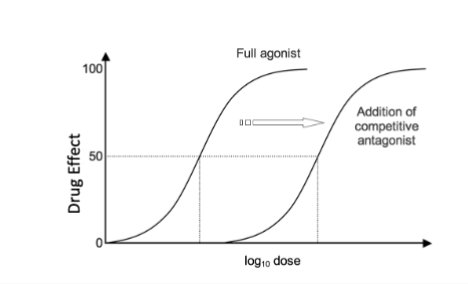
what usually happens to the affect of an agonist when a competitive antagonist is introduced
full effect still possible but more is needed
blocks the effect of endogenous ligands or other agonists and causes a shift in the agonist dose-response curve to the right
because the antagonist and agonist compete for the exact same spot you need a higher concentration (dose) of the agonist to beat the antagonist to achieve the same level of response (the max possible effect Emax is still possible though)
how does a noncompetitive antagonist affect the function of a agonist?
full biological effect is not possible even with increased agonists since the antagonist blocks the agonist’s action by binding to an allosteric site on the receptor and altering its shape
the agonist dose-response curve flattens flattens out (can not reach as high of a response)
describe full, partial and inverse agonists
full: binds to the receptor and maximally activates the biochemical pathway producing a 100% biological response (mimicking or fully driving the natural signal)
partial: binds to the receptor but only triggers a sub-maximal response, even if all the receptors are completely occupied (a lot of agonists available)
inverse: binds to the receptor and reduces the receptor’s activity (some receptors have constitutive activity; they buzz slightly on their own) below baseline producing an opposite pharmacological effect
how can a partial agonist be a blocker
it can act as a competitive blocker against a full agonist if it is present?
compare and contrast an inverse agonist and a neutral antagonist
neutral antagonist: has zero intrinsic effect and just sits on the receptor to block agonists or endogenous ligands, keeping the baseline signaling right at zero or its normal resting state (if constitutive activity)
inverse agonist (sometimes also called a non-neutrl antagonist): actively binds to the receptor and drives the baseline activity below zero (reducing cinsitutive activity)
what is a neutral antagonist?
binds to the receptor without changing its baseline activity level (zero effect on its own) its sole job is to block natural ligands or agonists from binding, keeping activity right at baseline
what is the defining characteristic of agonists and antagonists?
agonists have intrinsic efficacy (ability to activate biochemical pathway) while antagonists have zero intrinsic efficacy: can bind but can not activate)
what is orthosteric binding?
binds to the primary active site (where the natural ligand usually goes)
what are the characteristics to consider to ensure a drug can interact with a receptor
it must have the appropriate size, electrical charge, shape and atomic composition
beyond characteristics that allow a drug to interact with a receptor what are additional considerations to design for?
having the necessary properties to be transported to the site of action from the administered location
must be able to eventually be inactivated or excreted from the body so that its effects are appropriate in duration (we don’t want the affects forever)
which route of drug administration has the most rapid onset?
intravenous (IV)
list out the common routes of drug administration

what is the difference between intramuscular (IM) and subcutaneous (SC) drug administration?
IM is injected directly into the depth of a skeletal muscle (eg. deltoid in the arm or the gluteus maximus) and can transport large volumes of medication but can be painful depending on the specific properties of the drug formation
SC injects medication into the layer or fat and tissue directly between the skin and the muscle (subcutis layer) and can accomodate smaller volumes of medication compared to IM and can also be painful like IM. usually absorbed more slowly than IM because there are fewer blood vessels than muscle
compare and contrast oral (OR) and parenteral rectal drug administration (PR)
oral:
most convient for patients
has a significant first-pass effect, meaning mucg of the drug can be metabolized and inactivated by the liver before it ever reaches systemic circulation
parenteral rectal (PR)
delivering medication into the rectum where it is absorbed through the rich network of blood vessels in the rectal mucosa directly into the systemic circulation (The drug dissolves in the rectal fluids and crosses the mucosal lining into the hemorrhoidal veins)
Because the lower and middle rectal veins drain directly into the systemic circulation (inferior vena cava) rather than traveling through the portal system to the liver first, it avoids a significant portion of the hepatic first-pass metabolism that oral drugs endure. This allows more of the active drug to reach the bloodstream intact.
what is a characteristic of inhalation?
often very rapid onset
what is transdermal drug administration?
involves applying a drug formation to the skin (often as a patch) for systematic absorption
characterized by very slow absorption
successfully avoids the first-pass effect, meaning the drug enters systemic circulation directly without being heavily metabolized by the liver first
provides a prolonged duration of action, making it ideal for steady long-term drug delivery
why is it important to pick the correct form of a drug (organic vs inorganic)
important factor for how the body handles the drug (eg. pH differences)
what is an important factor for drug administration
drug size varies
rational drug design and why is it significant
defined as the ability to predict the molecular structure of a drug on the basis of its biological receptor site
significant because until recently drugs were developed through random testing of chemicals or modification of existing molecules
now receptor binding sits are being studied increasingly through computer programs designed to fit 3D structure of receptor site
what are various ways that drug action is terminated
dissociation of drug from receptor (but not always immediate, action may persist after drug association)
if covalent bond is involved: effect may persist until drug-receptor complex destroyed and new receptors synthesized - desensitization mechanisms
what determines the quantitative relations between dose/concentration and effect
receptors (largely)
receptors affinity for a drug determines the concentration of drug required
total number of receptors can limit the maximal effect a drug produces
regulatory G-protein coupled receptors (GPCRs)
a particular receptor that has a 7-transmembrane structure and has an internal G-protein that is activated
responsible for mediating the actions of natural chemical signals in the body
act as sensors that detect molecules outside the cell and translate that detection into active intracellular responses
best characterized drug receptors (scientists know most about it so they are common targets)
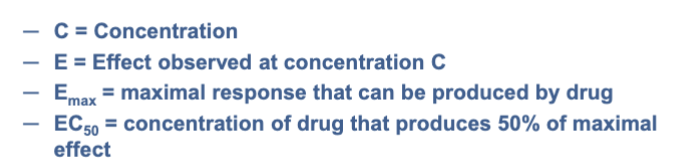
what do the following terms mean on a concentration-effect curve; C, E, Emax, EC50

what scale are drug does typically reported on?
log scale
pharmacologic potency
the concentration (EC50) of a drug required to produce 50% of that drug’s maximal effect
based on the relative position of their dose-response curves along the dose axis (typically x-axis)
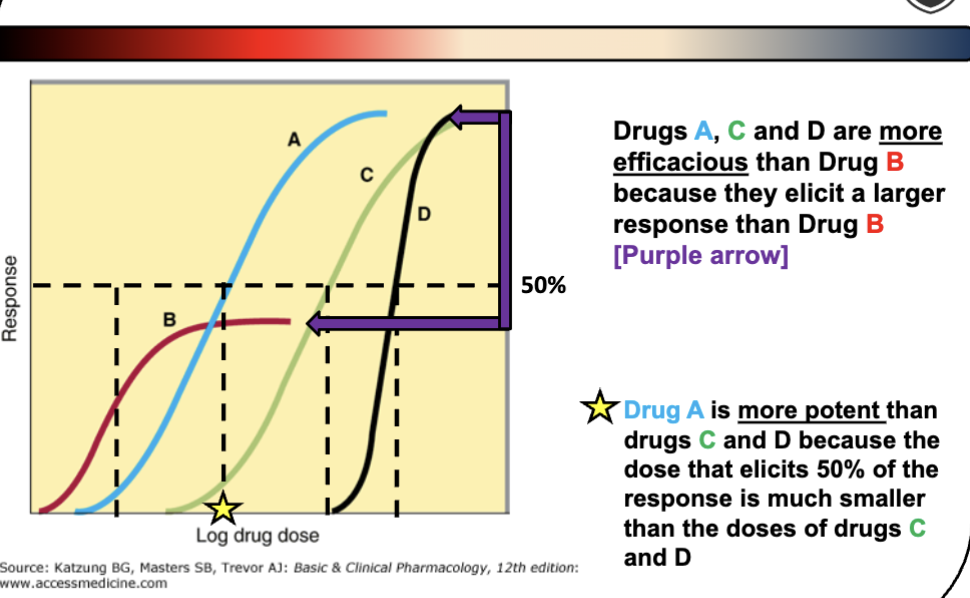
maximal efficacy
based on the relative position of their dose-response curves along the response axis (typically y-axis)

how does EC50 and Emax change when a competitive antagonist and non-competitive antagonist is administered
comp: Emax the same, EC50 increases
non-comp: Emax decreases (shifts downward), EC50 remains the same
EC50 vs ED50
EC50 is the dose required for an individual to experience 50% of the maximal effect while ED50 is the dose for 50% of the population to obtain the therapeutic effect

IC50
the half maximal inhibitory concentration
a measure of the potency of a substance (how little of the drug needed) that inhibits a specific biological or biochemical function by 50%
cells die off more quickly = higher drug potency
less cells die off = lower efficacy
what is Bmax
the maximum binding capacity (maximum number of binding sites in a system)
what is the difference between EC50 and Kd
Kd: The concentration of a drug required to occupy 50% of the total receptors B_{max} in a tissue. (physical contact based)
EC50: The concentration of a drug required to produce 50% of the drug's maximal biological effect (e.g., maximum heart rate increase, maximum blood vessel dilation) (drug response based)
why do spare receptors occur?
occurs when the maximal drug response (Emax) is obtained at less than maximal occupation of the receptors (Bmax)
occurs when:
duration of the activation of the effector may be much greater than the duration of the drug-receptor interaction
the actual number of receptors may exceed the number of effector molecules available
TD50 and LD50
TD50: the dose at which 50% of individuals exhibit a toxic side-effect
LD50: the dose at which 50% of individuals exhibit a lethal effect (die)
what is a common example of a drug that has high therapeutic index and a drug with low therapeutic index
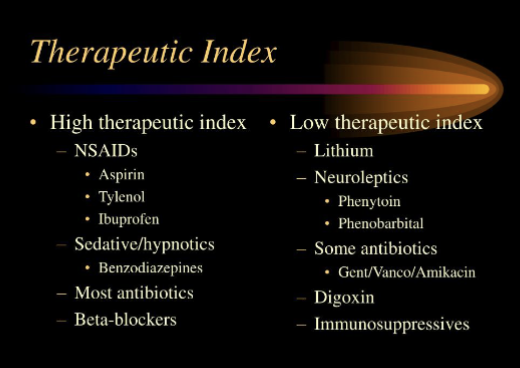
*just need to know NSAIDs and Lithium
what variation does transmembrane drug signalling mechanisms create?
variation in effect time after a drug is no longer present on a receptor
variation in drug response after prolonged or repeated administration
variation in selective actions of chemically similar drugs
describe the 5 transmembrane signaling mechanism introduced in pharmacodynamics
a lipid-soluble chemical signal crosses the plasma membrane and acts on an intracellular receptor (enzyme or regulator of gene transcription)
the signal binds to the extracellular domain of a transmembrane protein, therby activating an enzymatic activity of its cytoplasmic domain
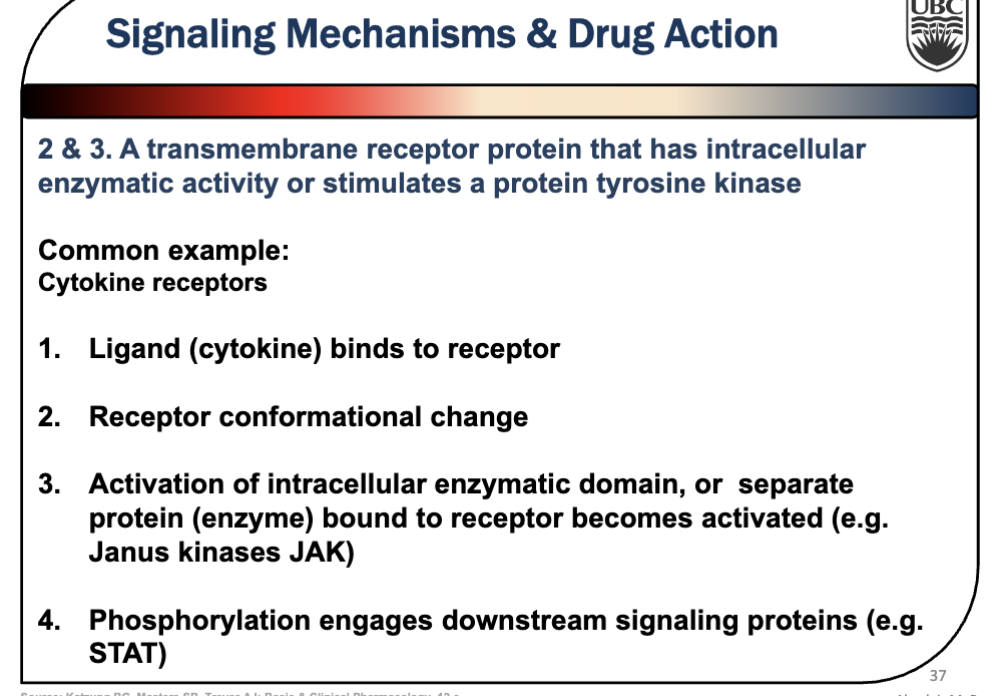
the signal binds to the extracellular domain of a transmembrane receptor bound to a separate protein tyrosine kinase, which activates it
the signal binds to and directly regulates the opening of an ion channel
the signal binds to a cell-surface receptor linked to an effector enzyme by a G protein (A, C, substrates; B, D, products; R, receptor; G, G protein; E, effector
[enzyme or ion channel]; Y, tyrosine; P, phosphate.)

what is the signaling mechanism for most steroids (lipid-soluble ligand)
lipid-soluble ligand crosses the membrane and acts on a intracellular receptor
receptors stimulate the transcription of genes through binding to DNA sequences
effects occur after a ‘lag’ period (as takes time to synthesize new proteins) and effects can persist for hours-days (slow turnover of proteins)

A cytokine binds to its transmembrane receptor. Describe the complete signaling mechanism from ligand binding to cellular response. Include the receptor conformational change, the role of JAK and STAT proteins, the phosphorylation events that occur, how cytokine receptors differ from receptor tyrosine kinases, and the final effect on the cell.
Cytokine binds the extracellular receptor domain.
Receptor dimerizes or undergoes a conformational change.
Associated JAK (Janus kinase) proteins become activated by cross-phosphorylation.
Activated JAKs phosphorylate tyrosine residues on the receptor.
STAT proteins bind these phosphorylated tyrosines.
JAK phosphorylates STAT proteins.
Phosphorylated STATs dissociate and dimerize.
STAT dimers translocate to the nucleus.
STATs bind DNA and alter gene transcription.
Result: changes in cell proliferation, differentiation, immune function, or other cytokine-mediated responses.
Key distinction: Cytokine receptors lack intrinsic tyrosine kinase activity and signal through associated JAK kinases, whereas receptor tyrosine kinases possess their own kinase activity.
what are the 5 things that receptors talk to?
Type | Receptor Talks To | Classic Example |
|---|---|---|
1 | DNA/transcription machinery | Steroids |
2 | Own kinase domain | Insulin |
3 | JAK kinase | Cytokines |
4 | Ion channel | Nicotinic ACh |
5 | G protein | β-adrenergic |
Compare the 5 major receptor signaling mechanisms. For each mechanism, identify:
Receptor location
What the receptor directly activates
Key examples
How cytokine receptors differ from receptor tyrosine kinases
Back:
Type 1: Intracellular receptor
Receptor inside cell
Drug crosses membrane
Alters gene transcription
Examples: steroids, thyroid hormone, vitamin D
Type 2: Receptor with intrinsic enzyme activity (RTK)
Transmembrane receptor
Receptor itself is tyrosine kinase
Examples: insulin, EGF, PDGF
Type 3: Cytokine receptor (JAK-STAT)
Transmembrane receptor
No intrinsic kinase activity
Activates associated JAK kinase
JAK phosphorylates STAT
STAT enters nucleus
Examples: interleukins, interferons, EPO, growth hormone
Type 4: Ligand-gated ion channel
Receptor is ion channel
Ligand binding opens channel
Examples: nicotinic ACh, GABA-A
Type 5: GPCR
Receptor activates G protein
Produces second messengers (cAMP, IP3, DAG)
Examples: adrenergic, muscarinic, histamine receptors
Key distinction:
Type 2 = receptor is the kinase.
Type 3 = receptor activates a separate kinase (JAK).
A great mnemonic is:
"Inside, Self, Sidekick, Channel, G"
Inside cell receptor
Self-enzyme receptor
Sidekick kinase (JAK)
Channel
G protein
describe signaling mechanism 1: corssing the membrane and acting intracellularly


describe signaling mechanisms and drug action 2 and 3: binding to a transmembrane receptor
describe signaling mechanism and drug action 4: a ligand-gated transmembrane ion channel


describe mechanisms and drug action 5: transmembrane receptor protein that stimulates a GTP-binding signal transducer protein that modulates a intracellular second messenger


describe the common intracellular second messenger: phosphorylation

what is the average time for testing medication (clinical research)
8.3 years (faster by 3 years is accelerated approval)
what is the median cost to bring a new drug to market and overall likelihood of approval from phase 1 onward
1.1 billion and 8%
general process of Bio-Pharma
discovery and development
pre-clinical research
clinical research
FDA Drug Review/Approval
explain translational assays in the context of drug discovery
are experimental test, model or biomarker used during pre-clinical development that can bridge the gap between bench science (in vitro or animals) and human clinical outcomes (yield data that directly predicts how a drug canidate will behave in human clinical trials)
Anatomical Therapeutic Chemical (ATC)
a classification system (tool) used globally to classify active pharmaceutical ingredients - it organizes drugs according to the organ system ot body part they act on as well as their therapeutic, pharmacological and chemical properties
describe the Level 1 classification system in the ATC
represents the broad organ system or body tract where the drug acts. There are 14 main groups plus an unclassified group (U)
biologics in drug discovery
large, complex molecules produced in living systems using recombinant DNA technology
small molecules in drug discovery
low-molecular-weight, chemically synthesized organic compounds (simple, well-defined chemical structures)
L in ATC and small molecule vs biologics description
cancer
therapeutic area: antineoplastic and immunomodulating agents
moderate number of small molecules (142) but it heavily dominates biologic approvals (67)
N in ATC and small molecule vs biologics description
nervous system
dominated by small molecules and leads all categories in small molecule approvals (239 drugs)
but only 1 biologic approval
in terms of drug discovery what are the two major classes of pharmaceutical drugs
biologics
large, highly complex molecules (proteins, antibodies, nucleic acids) produced using living cellular systems
usually delivered via injection or infusion bc stomach acid and enzymes destroy them
generally too large and polar to cross cell membranes easily (typically acting on extracellular targets or cell-surface receptors)
small molecules
low molecular weight, chemically synthesized organic compounds with simple, well-defined structures
typically formulated as pills or capsules because they are orally bioavailable and stable in the digestive tract
tiny size allows them to easily cross cell membranes and slip through tight biological barriers like blood-brain barrier
what is the trend of approved drugs (2000-2024) and why?
use of biologics trends up while use of small molecules in drug development trend down (even though there are still more small molecule approved drugs than biologics)
The growth in biologics happens because modern drug discovery has massively shifted investment toward oncology, immunology, and targeted gene therapies—areas where biologics (like monoclonal antibodies) excel because they can be engineered to precisely target complex tumor markers and immune pathways. Meanwhile, small-molecule drug discovery has faced higher hurdles as researchers run out of "easy" traditional targets, even though older small molecules still hold a massive historical volume lead in areas like the nervous system and cardiovascular health.
Which biologic sub-category experienced a massive, exponential surge in FDA approvals from 2014 to 2024, and what therapeutic area is it exclusively tied to?
mAb/ADC (Monoclonal Antibodies / Antibody-Drug Conjugates), which is exclusively tied to Cancer.
Based on the 2000–2024 approval trends, which biologic sub-category dominates overall volume compared to peptides, proteins/enzymes, and siRNA/ASO?
mAb/ADCs z9mAb/ADC » Peptides ~ proteins > GenMed)
in 2026 which treatment modality represents the largest group?
small molecules (then biologics, then others)
what are the common targets for small molecules (thus NS) vs biologics (thus cancer)
small molecules:
enzymes, GPCRs, ion channels
biologics:
catalytic receptors, nuclear hormone receptors, endogenous peptides
describe Probability of Success (POS)—the likelihood that a drug candidate entering Phase I clinical trials will successfully make it all the way to commercial launch for all terapeutic areas, pain and oncology

why is there a huge unmet medical need for chronic pain medication
pain relies heavily on subjective patient-reported outcomes making clinical trials difficult to standardize
search for non-addictive alternatives admit opioid epidemic
What are the four sequential physiological steps involved in how pain signals travel from an injury site to the brain, as outlined in the pain pathway?
Transduction (at the injury site)
Conduction (along the peripheral nerve)
Transmission/Modulation (at the spinal cord and Dorsal Root Ganglion)
Perception (in the brain)
What is the high-level mechanism of pain signaling from the peripheral terminal to the spinal cord?
Peripheral Transduction: Noxious stimuli are detected by receptors at the peripheral nerve terminal, creating an initial electrical signal.
Conduction: This signal triggers an action potential that travels down the axon through the dorsal root ganglion.
Transmission: The signal reaches the spinal cord, where it triggers the release of neurotransmitters to pass the pain message along to the next neuron.
xenon’s extreme genetics
a human genetics-driven strategy used to identify and validate high-confidence drug targets by studying individuals at the extreme ends of a phenotypic distribution
By leveraging these extreme human genetic variations, companies establish high target confidence because human DNA itself proves that modulating these specific channels or genes directly alters the disease state.
describe extreme genetic pain phenotypes
extreme human genetics reveal how natural mutations at opposing ends of the phenotypic spectrum can completely alter pain processing. These human models provide high target confidence for drug discovery by showing that altering a specific gene directly translates to a clinical pain state
What is the role of the SCN9A gene and its mutations in extreme human pain phenotypes?
SCN9A is the gene that encodes the Na_v1.7 sodium channel involved in peripheral pain signaling. Loss-of-function mutations cause complete insensitivity to pain (Congenital Insensitivity to Pain), while gain-of-function mutations cause severe hyper-excitable pain disorders (such as Primary Erythromelalgia and Paroxysmal Extreme Pain Disorder).
How do opposite types of genetic mutations in the same pain-signaling gene affect human pain phenotypes?
Mutations that increase the activity or function of the gene lead to chronic or episodic pain disorders (hypersensitivity), whereas mutations that decrease or shut down its function result in a complete lack or reduction of pain.
How do different sodium channel subtypes functionally compare during the progression of an action potential?
Channels act sequentially: some manage baseline stimulus response, Na_v1.7 acts near the threshold where it can experience "failed initiations" or drive the initial upstroke, and Na_v1.8/Na_v1.6 drive the rapid peak of the action potential.
Understanding the precise roles of different sodium channel subtypes during an action potential is foundational for rational drug design and target validation in drug discovery
How long did it take to transition a Na_v1.8 inhibitor from initial Phase 1 clinical trials to FDA approval, and what milestone does it represent in drug discovery?
It took approximately 18 years (from 2007 with Abbott/Icagen to the 2025 FDA approval of Vertex's Na_v1.8 inhibitor, VX-548 / Journavx), marking the approval of the first new class of pain medication in 25 years despite pain's historically low probability of success ~6%
what are HIT IDs and how does AI accelerate the discovery of them?
Hit Identification (Hit ID) is the critical first stage of the drug discovery process where researchers identify initial chemical compounds ("hits") that show measurable biological activity or the ability to bind against a specific disease target of interest. These compounds serve as the starting points for further optimization, testing, and development into clinical drug candidates.
Artificial intelligence drastically streamlines and speeds up Hit ID by replacing or augmenting slow, manual laboratory screening with computational power
how does AI help with drug discovery
accelerates target identification
What is the significance of platforms like Latent Labs (e.g., Latent-Y) in modern drug discovery and therapeutic design?
They act as autonomous AI design agents that compress weeks of expert manual work into hours by executing end-to-end drug design campaigns (from text prompts and literature review to lab-ready sequences). This enables a single researcher to run parallel campaigns across multiple targets with high success rates and strong binding affinities without human intervention.
What does "Zero Shot" mean in the context of platforms like Latent Labs designing molecular binders and modulators?
It refers to the AI's ability to successfully design functional biological binders for a target directly from a text prompt or research paper on the very first try, without requiring any prior target-specific fine-tuning or iterative wet-lab training data.
what is the impact of AI on time to identify target IDs and HIT IDs
target: months to days
HIT: years to weeks