Potential questions
 Call Kai
 Learn
 Practice Test
 Spaced Repetition
 Match
 Flashcards
 Knowt Play
1/53

There's no tags or description
Looks like no tags are added yet.
54 Terms
Spontaneous ovulators are controlled by endogenous processes, what does this mean within the context of reproduction?
What is the difference between spontaneous and induced ovulators?
Most female animals are spontaneous ovulators, meaning that ovulation results from an endogenous process (circadian rhythm) synchronized to some external process (e.g. seasonality) or to a biological clock.
We see this in whales, fish, moose, humans, etc.
In contrast, induced ovulators ovulate in direct response to sexual stimulation, irrespective of calendar date or environmental cues.
Rabbits and hares.
What is the relationship between physiology and photoperiod in many male Passerines?
as photoperiod extends throughout the spring, Plasma Gonadotropin releasing hormone levels rise, which in turn increases testicular mass
method of HPG axis within men
evidence that gonads respond to changes in photoperiods for many seasonal breeders
Explain the HPG axis
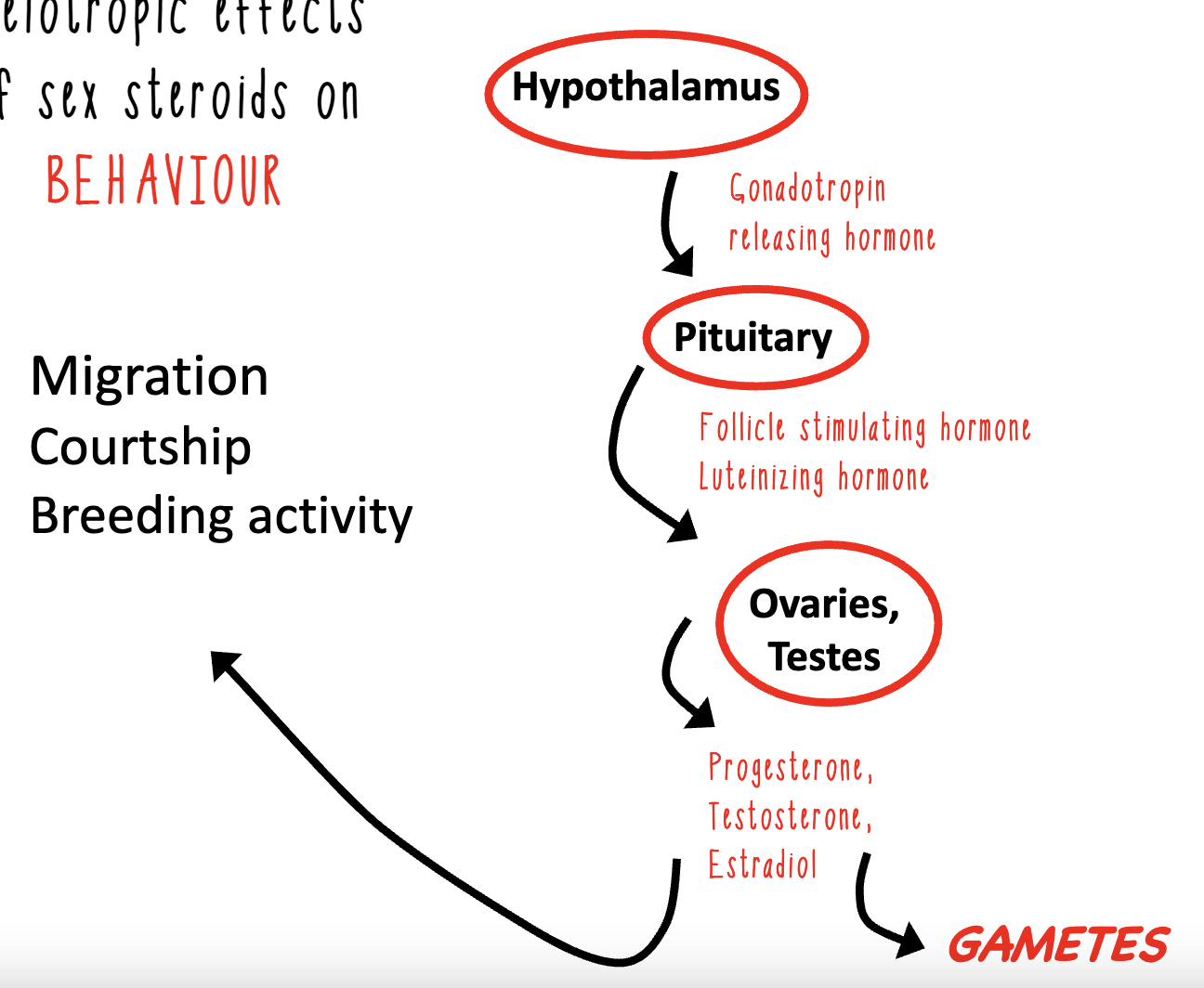
Explain the HPG axis and the integration of photoperiodic cues
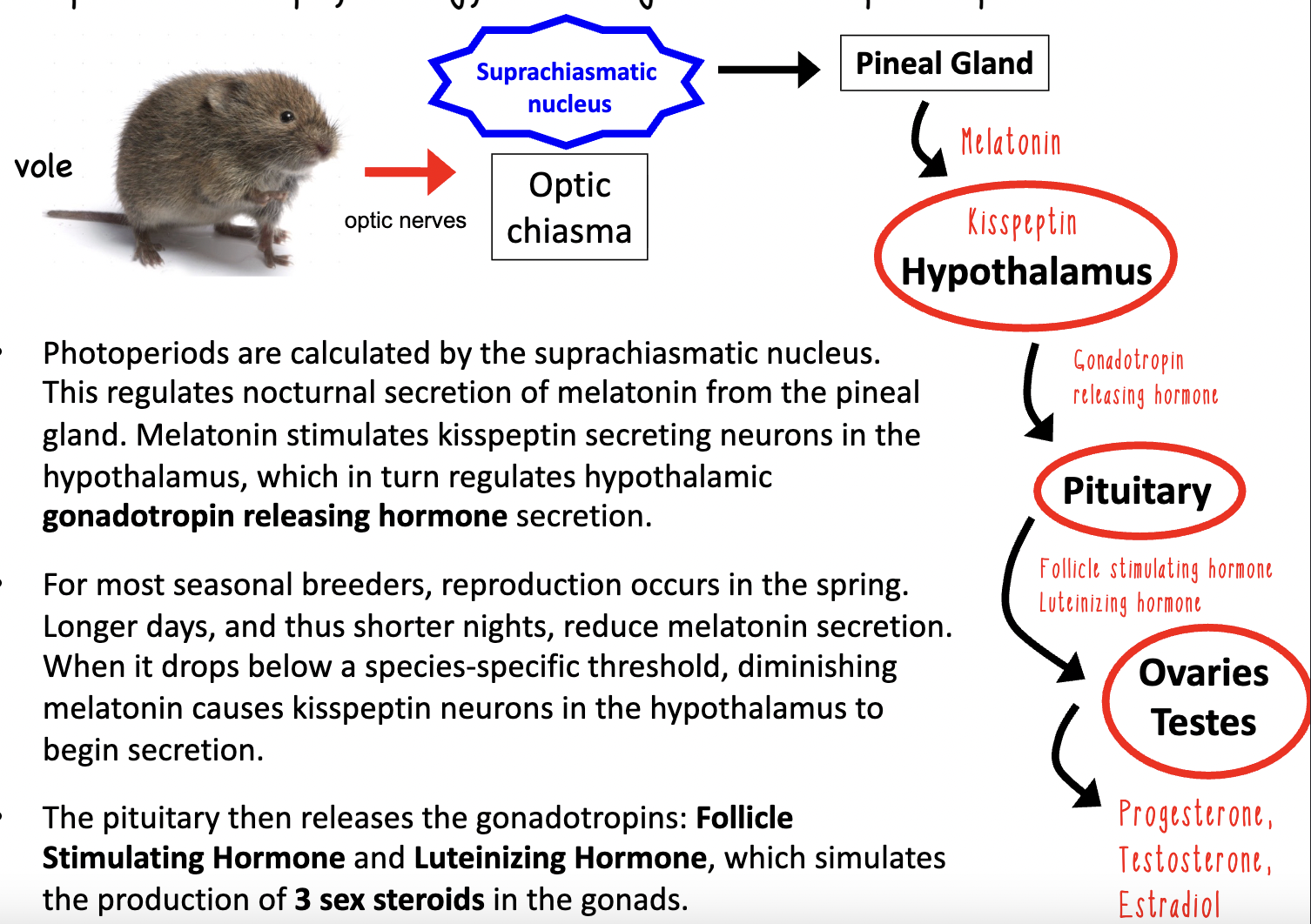
How does the integration of photoperiodic cues differ when animals are experimentally blinded?
blinding halts the HPG axis
If experimentally blinded, some seasonally breeding mammals won’t up-regulate their HPG axes.
No reproductive development occurs, or it occurs at unpredictable times (maladaptive)
however, this differs in birds whose eyes, pinneal gland, and melatonin are not required for regulation of HPG axis
Presence of encephalic photoreceptors detect photoperiodic cues independently from the eyes, which can regulate hypothalamic ‘kisspeptin-like’ secretion and gonadotropin releasing hormone secretion directly.
Thin skulls of the birds can also let light in
Explain the HPG axis in induced ovulators
In only a few animals - hares, rabbits, camels, alpacas, llamas - physical stimulation of stretch receptors at the cervix sends impulses via afferent neurons to the brainstem.
This stimulates norepinepherine release, which simulates an HPG cascade to bring about a surge of Luteinizing hormones, leading to ovulation

Compare/contrast the 2 methods of successive steps of reproduction
rigidly linked
mating, fertilization, and embryonic development all occur without interruption or delay (most animals)
decoupled
may be either via sperm storage or embryonic diapause
sperm storage seen in blue crabs, where females can mate only when moulting, but can store sperm and fertilize eggs her when she deems conditions to be most appropriate
embryonic diapause seen in mammals, programmed slow development. Two forms - Obligate or Facultative
What is the difference between obligate and facultative embryonic diapause?
Obligate diapause happens automatically in every generation or gestation regardless of current conditions, while facultative diapause happens only when triggered by specific environmental or physiological cues
Facultative diapause
seen in silk moths
diapause hormones are secreted into eggs by mother, so that they may hatch in better suited months
Obligate diapause
seen in fur seals
development of new embryo is delayed at blastocyst stage, only to be released after 100 days
Illustrate a timeline of the days of the human menstrual cycle (follicle development)

Illustrate a timeline of the days of the human menstrual cycle (hormonal patterns)

Explain ovary development (diploid germ cell → primordial follicle → primary follicle → CL.)
the fetal ovary contains diploid germ cells, which undergo rapid mitosis, and subsequent meiosis
however, it is halted after the first stage
the subsequent primordial follicles are encased by a layer of somatic cells, and are held statically until sexual maturity, when kisspeptin neurons become active at puberty
at maturity, each month ~1000 primordial follicles begin growing in whcih those somatic surrounding cells differentiate into Granulosa cells and the outer marigins differentiate into Theca cells
FSH and LH secretion causes ~20 primordial follicles to be developed into primary follicles, of which only 1 will be ovulated, while the rest are broken down and reabsorbed
What are some different forms of ovulation amongst animals?
Estrous
Menstrual cycle
Egg laying
Track the hormonal patterns during follicle development within the menstrual cycle

How does the ending of the luteal phase differ if fertilization does occur? If it doesn't occur?
Fertilization does not occur;
hormones return to baseline levels
P4 crashes
endometrium breaks down and is shed; menstruation
low P4 signals Kisspeptin neurons to begin a new cycle
CL degenerates as it needs LH to survive
Fertilization does occur
part of the newly developing placenta secretes chorionic gonadotropin
this sustains the CL so that is can secrete P4 throughout pregnancy
fetus develops
What is the role of the theca/granulosa layers of a primordial follicle?
theca cells
where LH stimulates progesterone production and conversion to testosterone
granulosa cells
where FSH stimulates conversion of T to E2 via aromatase
… at maturity each month ~1000 PF begin growing, those surrounding somatic cells differentiate into Granulosa cells, and the outer margin of those cells differentiate into Theca cells…

What happens during the LH surge?
occurs at the end of the Follicular stage
reactivates meiosis 1 in the oocyte
increases P4 and E2 secretion from granulosa cells
releases inhibin to shut-down FSH secretion
releases enzymes to break down follicle membrane and ovarian epithelium
ruptures and releases oocyte
LH transforms ruptured follicle into the CL
What are the phases of endometrial development?
Follicular phase
Menstrual phase
sloughing of endometrium
Proliferative phase
rapid thickening of endometrium
Luteal phase
Secretory phase
maturation of endometrium
What are the steps which the sperm follow during fertilization?
One sperm is able to force itself through the granulosa layer of the follicle and binds to species specific receptors at the vitelline membrane
Upon binding, an acrosomal reaction occurs which dissolves the glycoprotein matrix of the zona pellucida
Sperm then moves in and fuses to the oocyte membrane
Causes changes in the membrane polarity and a cortical reaction, which ensures that only 1 set of haploid chromosomes are delivered to the oocyte during fertilization
Describe the blastocyst stage of the zygote
Following the fertilization from the sperm of the zygote, it is divided up tot he blastocyst stage, which has 2 cell lines:
Embryoblast: forms the embryo
Trophoblast: forms the Chorion
Describe the process of delivery, what feedback loop is this?
Oxytocin positive feedback loop
labour/delivery is facilitated by oxytocin levels
As the baby reaches a certain size, it begins to physically stretch the uterus, thus initiating mechano/stretch receptors, sending a signal to the hypothalamus.
Oxytocin is released from the posterior pituitary, which releases prostaglandins
Prostaglandinds cause rhythmic contractions of myometrium, which pushes the fetus out, as well as further stimulating the stretch receptors (which sends out for the further release of oxytocin)
Once there are no more stretch receptors being activated (ie the baby has been delivered) the + feedback loop ends
What parts of the brain control milk production and ejection, how do these mechanisms work?
Milk production is dictated via the anterior pituitary’s release of prolactin, which stimulates alveolar epithelial cells, where milk is produced
Milk ejection is dictated via the posterior pituitary’s release of prostaglandin, which stimulates milk ejection from the alveolar cells via myoepithelial cell contractions
Offspring cries create auditory stimulation of the thalamus, which then stimulates the hypothalamus → posterior pituitary
What is the nature of oxytocin release during pregnancy/post partum?
Spikes during childbirth; positive feedback loop
After delivery animals must provide milk for their offspring, and the production of milk occurs in a constant rhythm
Rhythmic pulses of oxytocin highs and prolactin lows (and vice versa)
Metabolism of lactating mothers is considerably higher than baseline, which increases thyroid hormone levels. This signals the release of prolactin, which is a controlled response.
Oxytocin release is induced via tactile/auditory stimuli, and is thus inducible.
How does the trophoblast become the placenta?
Maternal transfer of nutrients and oxygen, removal of fetal CO2 and metabolic by-products
Maternal and fetal blood vessels meet in the placenta, but transfers occur without their blood co-mingling
Trophoblast eventually replaces the CL as the main endocrine structure at the start of the 2nd trimester, takes over the production of P4 and E2 to sustain pregnancy all the way to delivery
What role does E2 play in the uterus?
Stimulates the synthesis of connexins in the myometrial smooth muscles, which provides electrical connectivity between cells so that coordinated contractions can be generated
Stimulates the production of oxytocin receptors in uterine myometrium
E2 from the uterus is supplied to the uterus throughout pregnancy
What is hormonal pleiotropy? How is this related to parental behaviours?
Hormonal pleiotropy occurs when a single hormone affects multiple traits or biological systems at once.
Thus, both hormones prolactin and oxytocin induce parental behaviours and production of milk
What are the 3 modes of development? Compare and contrast
Ovoparity:
Females lay eggs that develop and hatch in the external environment
Birds, reptiles, fishes, etc.
Ovoviviparity
Females develop eggs which are retained, incubated, and hatched internally then delivered as free-swimming offspring
Some sharks, seahorses, and pipefishes
Viviparity
Placental-like connection to the maternal circulation, delivered as free-living offspring
Describe the avian reproductive tract
Follicle recruitment (in mammals; folliculogenesis) involves vitellogenesis
Production of the main protein of the yolk; vitellogenin
Birds only have 1 functional ovary, the other acts as an endocrine gland
2 main components:
Ovary
Oviduct
What is the role of the avian ovary?
Follicle development, vitellogenesis (5-14 days)
HPG stimulation of ovarian follicles produces lots of E2, and individuals follicles are recruited daily in a hierarchical pattern
Lots of this E2 then travels from ovary to the liver, where it prompts the production of 2 important yolk precursors, which are sent into circulation and taken up by developing follicles
Vitellogenin
VLDLy
Avian ovaries contain previtellogenic follicles (analogous to mammalian primordial follicle)
Capillaries covering the ovaries, however during LH spike the follicle ruptures along a seam (stigma) which has few capillaries
What causes a blood stain in my egg yolk? Can we still eat this?
Mature ovarian follicles are covered with capillaries, needed to transfer VTG, VLDLy, and other nutrients
At ovulation and LH spike, the follicle ruptures along a seam in the follicle membrane (stigma), which has few if any capillaries
But sometimes capillaries at the margin of the stigma rupture during ovulation, which then stain the yolk with drops of blood
Move down the avian oviduct, explaining each step
Infundibulum: envelops the ovary and captures the mature, ovulated follicles (analogous to the fallopian tube). Where fertilization occurs
Magnum: yolk is covered with albumin, whose production is driven by E2. Spiral ridges in the inner walls causes the yolk to spin as it travels down the magnum, which creates twists of proteins/albumen fibres in front of and behind the yolk (this is the Chalazae)
Isthmus: egg shell membranes are deposited around the albumin layer, which binds the yolk and albumin together, and allows the transfer of gases between the egg and the external environment when laid.
Shell gland (uterus): a thin albumin layer is deposited around the yolk, driven by E2, thus plumping the egg up. Next, a concentrated CaCO3 solution is secreted around the egg, which leaves fine pores between the crystals, thus allowing for efficient gas exchange and protection from bacteria. A protein cuticle is secreted/enveloping the entire egg
Vagina/cloaca: uterine contractions are initiated by stretch receptors, leading to release of oxytocin analog; Arginine Vasotocin, and prostaglandin. Egg flips so can be delivered wide end first. + feedback continues until egg is laid
I see weird white lines around my egg, what is this?
In the magnum portion of the oviduct, the spiral ridges of the inner walls causes the yolk to spin as it travels down. This creates twists of protein/albumen fibres in front of and behind the yolk
This is known as the Chalazae
I see a weird white disc on my egg yolk! Can I eat this?
This is the blastodisk, which is the nucleus.
When fertilized, it divides into the blastoderm, which gives rise to the embryo. Idk eat it if you want
What is the pre-laying exodus experienced in some birds?
An example of a decoupled reproductive strategy, in which seabirds reunite with their mates after the long non-breeding season
The HPG axis is already active before her arrival, the females mate, then do on a PLE, in which she forages at sea, and completes egg formation
She will then fertilize the egg when she is ready, and lay
Why is the thermal difference between egg and environment so crucial?
An egg is almost always laid into an environment colder than its mother’s body
Thermal difference causes the yolk to contact, which creates an air pocket at the blunt end of the egg, providing essential oxygen to the chick before it breaks out of the shell.
What is the difference between determinant vs. indeterminate layers?
Determinant: females will typically not lay additional eggs when any lost or removed from the nest
Indeterminant: species will lay additional eggs if any are removed
What hormone propagates the delivery positive feedback loop in mammals? In birds?
Mammals: oxytocin
Birds: arginine vasotocin
What are 3 kinds of parental care? What is an example from each?
Bi-parental: kittiwakes
One parent works in shifts to protect eggs and chicks on the nest while the other forages at sea, they then swap duties.
Breed annually
Communal: meerkats
One pair, the Alpha breeders, produce all the offspring. All others are subordinate helpers, either babysitters or foragers (individual role depends on the morning’s endocrinological profiles, high prolactin in the morning= babysitter, high cortisol in the morning= forager)
Breed throughout the year
Paternal only: sunfishes
Female spawns then leaves for mating opportunities
Males fast when tending the nest, and work nonstop to defend the offspring until they are free-living
What is a main physiological trade-off?
Tradeoff between current reproduction and survival
Mediated by prolactin and glucocorticoid hormones (corticosterone and cortisol)
What is the difference between Type I and Type II binding
The effects of glucocorticoids depend on the relative volumes secreted, and therefore what type of binding is undergone
Baseline stress levels experience type I binding at receptors with a high affinity for cortisol/corticosterone. Stress induced experiences see type II binding, which have a lower affinity for CORT.
Type I binding receptors are present in baseline situations
Have a high affinity for CORT
Type II binding receptors are activated in high stress situations
Type I receptors are basically all filled up, therefore need more
How are the roles of subordinate helpers delineated in meerkat communities?
Cooperative care system, in that one pair (the Alpha breeders) produce all the offspring. All others are subordinate helpers, and either take on the role of babysitter or foragers
The roles that the subordinates adopt on any given day is determined by their morning endocrinological profiles
Babysitters: early day had high prolactin, low cortisol
Late day had low prolactin, high cortisol
Foragers: early day high cortisol, low cortisol late in the day
Constant, low prolactin throughout the day
The next morning, roles will again be determined by hormonal state
What were the experimental findings of prolactin in fish?
“Hormone of paternity”: prolactin
3 groups
Group 1: prolactin action blocked
Group 2: cortisol increased
Group 3: control
When cortisol increased, reduction of offspring survival
Suggests no observable effects of cortisol on defensive behaviour, but does lead to a premature energy exhaustion that reduced offspring survival
Reduced prolactin was deleterious to both parental behaviour and offspring survival
Why do humans, orcas, belugas, and short-finned pilot whale females outlive their fertility?
The Grandmother Hypothesis
The root of long, post-menopausal life-span lies not in cooperation, but in conflict and competition
By caring for a daughter’s post-weaned offspring, a grandmother increases the survivorship of her grandchildren, and allows her daughter to breed again quickly.
When a female stops breeding, she bolsters her fitness by helping to raise/teach her descendants (especially her male offspring)
Male offspring without grandmothers have lower survival than those with grandmothers
How do matrilineal orca pods organize themselves?
All male and female orcas stay with their mothers for their entire lives, so each time the mother breeds she increases her relatedness to those around her within the pod (good for evolutionary fitness)
Eventually, shifting from breeding to allo-care fosters inclusive fitness and is a response to competition for limited resources
Why do matriarch orcas preferentially give her male offspring more food?
Because they will eventually sire offspring who will get raised by other families in other pods, thus increasing her fitness with little effort
Males also have faster growth rates, and shorter lifespans
Why do elephants not live for long post menopause?
Female elephants remain with their mothers for life, while the males emigrate when they approach maturity.
Because males leave, elephant matriarchs don’t accumulate as many close relatives as orca pods do, so it is therefore advantageous for the matriarch to reproduce for as long as possible.
Additionally, predation on young elephants is common, which reduces a matriarch’s overall relatedness to the herd.
Both these reasons explain why the long post-reproductive lifespans is not selected for in elephants
Why has post-menopausal longevity evolved in humans?
Historically, females join a new family group when they get married (emigration), and similar to the structure of orcas, by having children early and often a female will increase her relatedness to her new group.
However, there are limitations to the # of offspring which is beneficial, as too many can introduce competition (also seen in orcas)
At some point, caring for your existing descendants rather than producing new ones becomes an adaptive way to minimize conflict and bolster inclusive fitness
In humans, the main grandmother effect is linked to food resources
By aiding the provisioning of grandchildren at a time when competition in the group is high, her female offspring can invest more time and energy into having more kids and other intensive aspects of parenting
Is modernization the sole reason for the increase in post-reproductive lifespan in humans?
No! Anthropological data from present-day hunter-gatherer societies, which do not have access to modern technologies, shows that a long-post-reproductive lifespan is indeed part of their biology
How do chimps and humans differ in their post-reproductive lifespans? Why?
Chimps:
Young female chimps emigrate from their birth families to join her mates. She then breeds early and often to increase her relatedness to the new troop
Chimps do not have long post reproductive lifespans
Humans:
See above
Why?
Chimps are very promiscuous, and when her male offspring mate, it becomes difficult for her to determine who her grandchildren are
This makes infanticide common
Because of these reasons, the Grandmother Effect is untenable, and so there is no selection for post-reproductive longevity in chimps
What is excitation-contraction coupling?
An AP is sent to the muscle, and reaches the pre-synaptic terminus, causing voltage gated Ca++ channels to open, thus allowing acetylcholine to rapidly exit
Acetylcholine binds to the ligand-gated Na+ channels, thus creating a graded depolarization. May become AP if threshold achieved
AP spreads across muscle
AP reaches the Dihydropyridine receptor, and allows Ca++ ions to exit the sarcoplasmic reticulum into the cytoplasm
Ca++ floods the sarcomeres
Ca++ binds to Troponin, which leads to a conformation shift, thus exposing a binding site for the Myosin head on the actin filament, which allows for a contraction.
What is the difference between Actin and Myosin? What do they work to do? Where are they found?
Both are found within sarcomeres, and work to generate mechanical force and movement in muscle and non-muscle cells
Actin is the thin filament which contains the Ca2+ binding site, which is important for muscle contraction
Myosin is the thick filament which contains the Actin and ATP binding sites, and control muscular motor.
What is the sliding filament theory
Sarcomere is defined as the distances between the two Z discs (and actin and myosin, the two proteins required to enact a muscular stretch)
When there is a motor neuron stimulus, there is an interaction between the myosin and actin
Myosin is conformationally changed when bound to ATP, this leads to a contraction
What are the two kinds of muscles fibres, and how do they differ?
Tonic fibres (smooth muscle)
Autonomic nervous control, and do not produce APs
Rare, slow, not very powerful
Twitch fibres (skeletal muscle)
Motor neurons, respond to neuron APs and give rise to a muscle ‘twitch’= contraction
Most common kind of muscle. Has 3 fibre types:
Slow oxidative
Fast oxidative-glycolytic
Fast glycolytic
How do fish muscles differ from human muscles?
Difference in medium between water and air led to 2 discrete muscle types within fish:
Red muscle (aerobic)
Analogous to slow oxidative
White muscle (anaerobic)
Analogous to fast glycolytic