5.3 How Enzymes Work: Catalytic Mechanisms
 Call Kai
 Learn
 Practice Test
 Spaced Repetition
 Match
 Flashcards
 Knowt Play
1/12

There's no tags or description
Looks like no tags are added yet.
13 Terms
How Enzymes Lower Activation Energy to Increase the Reaction rate
Enzymes increase reaction rate (lower ΔG‡) by:
→ Participating in the Rxn (directly or thru cofactors)
general acid/base catalysis = adding or removing a proton from the substrate via AA side chains of the enzyme
nucleophilic/covalent catalysis = forms covalent bond b/w substrate & enzyme as an intermediate
metal ion catalysis = metal ions of metalloenzymes can accept protons, binding/orientation of substrate, or stabilize TS
→ Proximity & Orientation: enzymes active sites line up the substrates or the Nuc & electrophile
results in entropy reduction
→ Desolvation: substrate binding to the enzyme removes water for rxn to occur (done BEFORE rxn to decrease the required energy for the rxn)
→ Stabilization of the Transition state: enzymes make it easier to achieve TS
“Preferential binding”: enzyme increases rxn rate by binding the TS better than the substrate
Participating in the Reaction: pH Sensitivity of Enzymes in Catalysis
pH sensitivity in catalysis is related to:
Acid/base reactions
ex. His needs specific pH to maintain its protonation state
Nucleophilic reactions
ex. Cys is a better Nuc when deprotonated
Denaturation: enzyme could denature bc of pH change

→ enzymes operate maximally (most effective) at different pH’s
Participating in the Reaction: Acid/Base catalysis
General acid/base catalysis = adding or removing a proton from the substrate via AA side chains of the enzyme
proton transfer/donation to/from specific side chains in the enzyme’s active site is FASTER than transfer to/from solvent (H2O), THUS results in rate enhancement
NOT the same as specific acid-base catalysis, where H+ or OH- is the catalyst
→ enzyme’s residue side chain acting as:
general acid = donates H to substrate
general base = takes/accepts H from substrate
note: His residue can act as an acid & base
process:
w/o catalysis: unstable (charged) & intermediate breaks down to from reactants
lone pair on OH’s O attack amide bond @ carbonyl
form protonated oxygen & negative oxygen to connect reactants
proton transfers to & from water or a weak general acid, then general base stabilizes the intermediate → accelerates the rxn
potion on O+ transfers to general base
general acid transfers H to N → form protonated N
O- form carbonyl & N group is released

Participating in the Reaction: Acid/Base catalysis - ex. RNase
RNase: carries out hydrolytic rxn of RNA → breaks down RNA into pieces
an acid/base catalyst (enzyme participates in rxn to increase rxn rate)
Christians folding study
His residue of RNase’s active site acts as a general acid & base
uses H2O
breaks RNA at the phosphate connecting sugars
Mechanism of RNase (KNOW)
step 1: His 12 acts as a general base & His 119 as a general acid to promote nucleophilic attack & bond cleavage
His 12 acts as a general base: takes c2’s H
His 119 acts as a general acid: donates H to c6’s oxygen of the sugar leaving
bottom sugar group is released with an OH group at c6
H2O acts as a Nuc: attacks phosphate attached to c3 of top sugar

step 2: His 12 acts as a general acid & His 119 as a vernal base to promote hydrolysis
His 12 donates H to c2’s oxygen
His 119 takes H from the H2O attacking the phosphate

result:
His residues of RNases active site return to original protonation state
RNase ALWAYS generates a 3’ phosphate group: top sugar group has an OH from water attached to the phosphate
c2’s oxygen is pronated again
→ proximity & orientation aspect of the mechanism: His’s are aligned well, THUS H’s barely have to move
Participating in the Reaction: Covalent Catalysis
nucleophilic/covalent catalysis = forms covalent bond b/w substrate & enzyme as an intermediate
enzyme participates directly in enzymatic rxn by forming a transient covalent bond b/w enzyme & substrate
Nuc in enzyme becomes covalently attached
alters the pathway of the rxn: intermediates ARENT the same as the uncatalyzed rxns
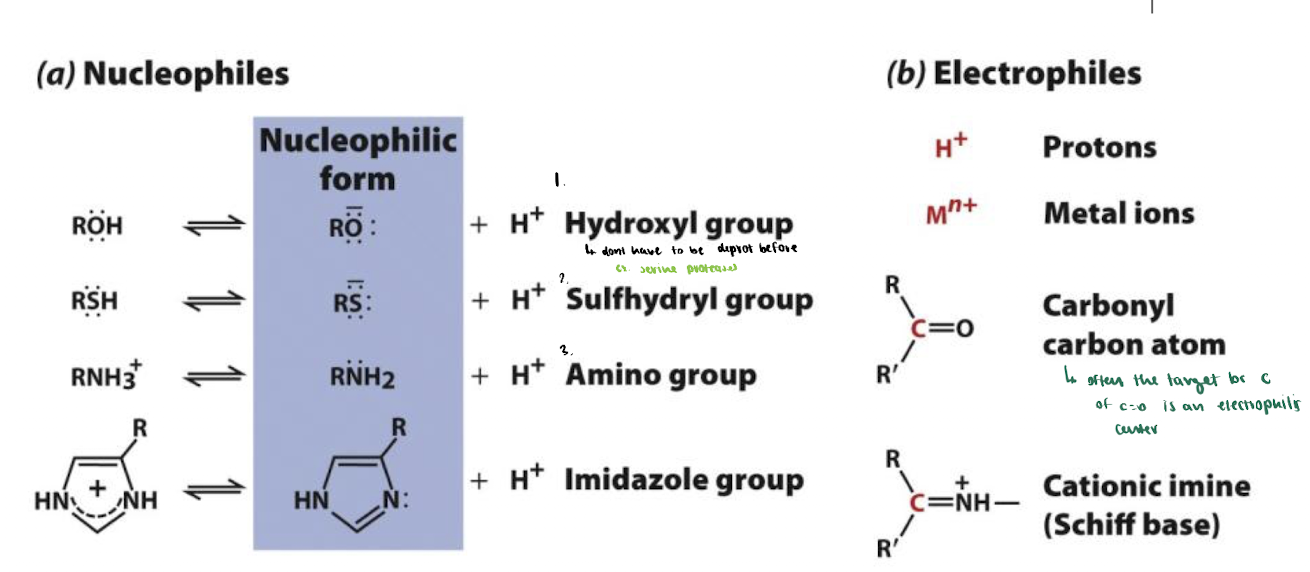
→ Nucleophiles:
hydroxyl group: ROH → RO-
sulfhydryl group: RSH → RS-
amino group: RNH3+ → RNH2
imidazole group: His+ → His (deprot. N)
→ Electrophiles:
protons: H+
metal ions: M^n+
carbonyl carbon atom
often the target bc c of C=O is an electrophilic centre
cationic imine (schiff base): RR’C=NH+
Participating in the Reaction: ex. Reaction Mech involving covalent & general acid-base catalysis
→ this rxn mech involves covalent & general acid-base catalysis
enzymes participates directly in the rxn using its Asp 102, His 57, and Ser 195 side chains in the active site
forms a tetrahedral intermediate from the substrate
mech: general base catalysis & nucleophilic attack to form tetrahedral intermediate
Enzyme-substrate complex:
Asp 102’s O is h-bonded to His’s N1
His 57 acts as a general base: His 57’s N3 takes H from Sea 195’s OH group
Ser 195’s O- acts as a Nuc and attacks substrates carbonyl C
form tetrahedral intermediate in enzyme’s actie site

Participating in the Reaction: Metal Ion catalysis
→ metal ions can participate in catalysis in 3 primary ways:
binding/orientation of substrate (not rly part of catalytic process)
stabilization of TS
ex. metal ion ca stabilize (-) on Oxygen
serving as reduction/oxidation centres
ex. metal ion is ox-reduc rxns
Participating in the Reaction: Metal Ion catalysis - ex. Carbonic anhydrase
carbonic anhydrase is a metalloenzyme (can participate directly in rxns to increase rxn rate)
contains Zn2+ in active site that binds to intermed in rxn pathway
3 His residues coordinate the Zn2+ in active site → increase nucleophelicity of OH- attached to zinc
→ carbonic anhydrase is a lyase (addition rxn) that is important in RBC’s to convert carbonic acid → bicarbonate + H+
mechanism occurring in metalloenzymes active site:

Proximity & Orientation → Entropy Reduction
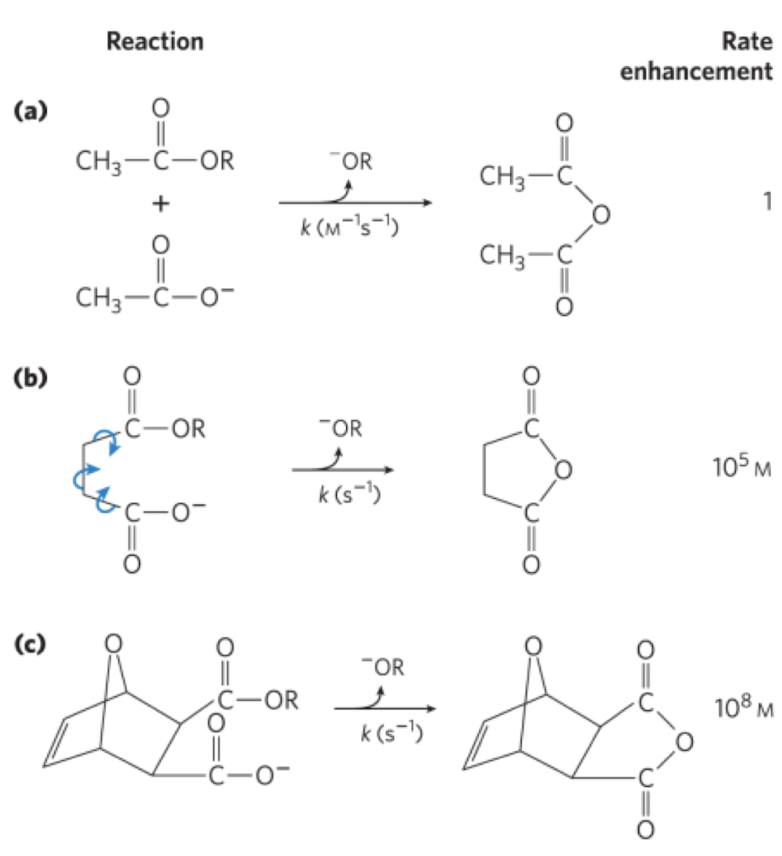
Proximity & Orientation: want things to be near each/other & in the right orinetation for reaction to proceed
analogous to substrate binding
when 2 reactive groups are spatially constrained (near e/o) → increased rxn rate
when 2 groups are constrained in space & orientation → even greater increase in rxn rate
even further enhancement
→ in an enzymes active site: 2 substrates or the substrate & active site groups are bound close together + in the correct orientation
THUS, active site of enzyme ensures proximity & orientation that increases rxn rate
Proximity & Orientation: ex. PEP carboxykinase
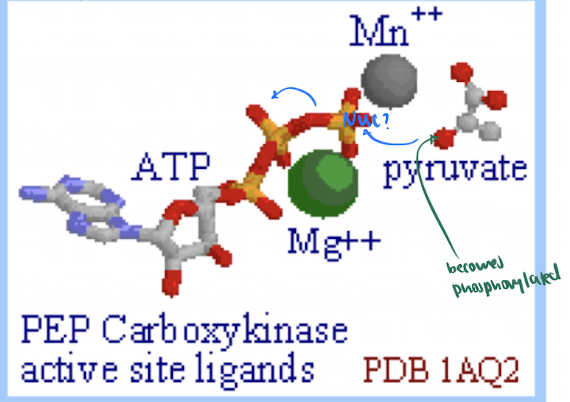
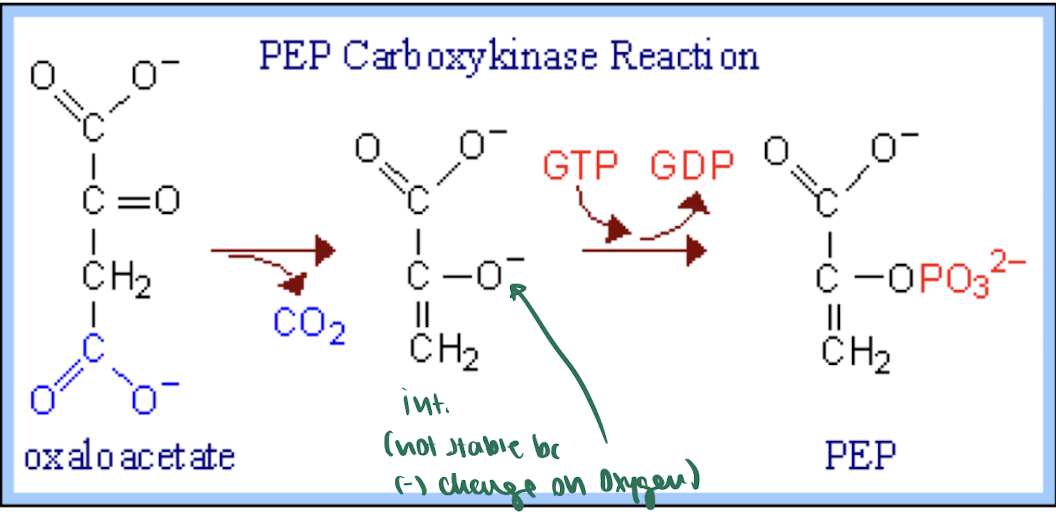
PEP carboxykinase: enzyme containing Mn2+ & MG2+ in its active site
metal ions in the active site stabilize the (-) charges on the triphosphate group in its rxn
→ PEPCK’s active site brings the ATP (or GTP) & oxygens pyruvate close together, so the pyruvate’s O can become phosphorylated in the 2nd step of the rxn → allows rxn to proceed rapidly
assisted by metal ion cofactors (stabilize negative charges)
Desolvation & Induced Fit
Desolvation: substrate binding to the enzyme removes water for rxn to occur
why: water forms a shell around many small molecules → prevents reactive groups from reacting
substrate bindings removes many of these waters
→ should remove water BEFORE rxn, bc If done at the same time as the rxn it requires MORE energu
How:
Induced fit = enzymes often change shape upon substrate binding
brings catalytic group into orientation & can be used to exclude water from active site
Desolvation & Induced Fit: ex. Hexokinase
hexokinase:
a phosphotransferase
→ induced fit of HK: HK’s 2 domains change shape when glucose & ATP bind → brings substrates into right geometry & prevents water from hydrolyzing phosphoanhydride (excludes water)

→ Substrates of HK:
beta-D-glucose: C6 OH group is phosphorylated- its the reactive group
beta-D-xylose: space where c6 should be allows water to be present, THUS if xylose is bound at HK’s active site water is present → leads to phosphorylation of water (hydrolysis)
result: water & ATP react to have hydrolysis of ATP
→ ONLY want rxn to proceed is glucose is bound at active site

→ HK Mechanism at active site:
uses non-covalent catalysis, THUS substrates react directly w e/o
enzyme (HK) provides Asp residue as a general base
phosphate of ATP acts as electrophile (has enhanced electrophility)
glucoses c6 -OH group acts as Nuc: O attacks ATP’s phosphate
leaving group is ADP
reactive groups: C6-OH
glucose’s c6-OH groups O attacks 3rd Phosphate of ATP
phosphorylates glucose @ c6 + releases ADP
Asp in HK’s active site acts as a general base: pulls proton off c6-OH group as the rxn proceeds


note: solved with crystallography

Stabilization of the Transition State (TS)
Stabilization of the Transition state: enzymes make it easier to achieve TS
“Preferential binding”: enzyme increases rxn rate by binding the TS better than the substrate
→ differences in activation energies for catalyzed vs uncatalyzed rxns (binding energy) is ENHANCED by strong interaction with the TS, NOT the substrate

reminder: Binding energy = diff in activation energies for catalyzed vs uncatalyzed rxns
ΔGB = ΔΔG‡cat
