Inhaled Anesthetics
 Call Kai
 Learn
 Practice Test
 Spaced Repetition
 Match
 Flashcards
 Knowt Play
1/157

There's no tags or description
Looks like no tags are added yet.
158 Terms
Ethers structure & gases
Ether bridge = C-O-C
Desflurane
Isoflurane
Sevoflurane
Enflurane
Methoxyflurane
Ether
Alkanes
Halothane
Chloroform
Isoflurane Structure
5 Fluorine atoms + 1 Chlorine
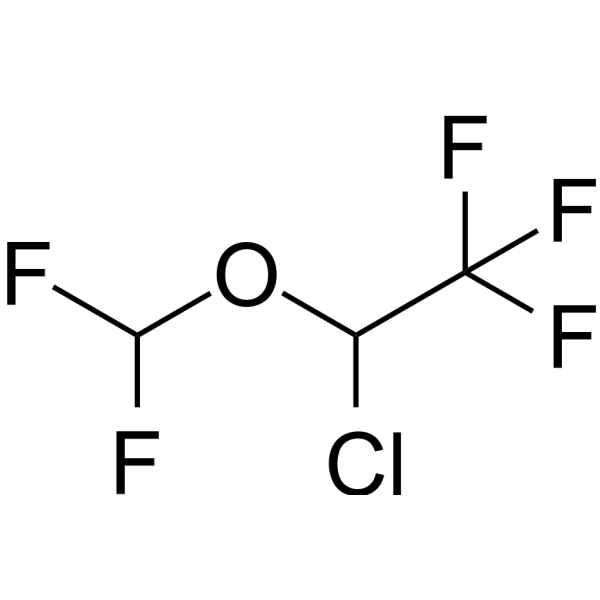
Desflurane Structure
6 Fluorine atoms

Sevoflurane Structure
7 fluorine atoms

Agents with Chiral Carbons
Desflurane and Isoflurane
Desflurane IUPAC Name
difluoromethyl 1,2,2,2- tetrafluroethyl ether
Desflurane Full Fluorination effects
Reduced potency = ^ MAC
^ Vapor pressure = requires heated vaporizer
^ resistance to biotransformation (lower metabolism) = makes immune mediated hepatitis unlikely
Sevoflurane IUPAC name
fluoromethyl 2,2,2-trifluoro-1-trifluoromethyl ethyl ether
Sevoflurane potency
3x more potent than Des I
Isoflurane IUPAC Name
1-chloro 2,2,2-trifluoroethyl difluoromethyl ether
Isoflurane chemical structure effects
Heavy chlorine atom ^ potency and ^Blood and tissue solubility
2x more potent than sevo, 5x as des
Halothane IUPAC name
2-bromo-2-chloro-1,1,1 trifluorethane
Vapor Pressure
Pressure exerted by a vapor in equilibrium with its liquid or solid phase inside a closed container
Directly proportional to temperature
^Temp = ^VP
Evaporation
Process where compound transitions from liquid state to gaseous state at a temperature below its boiling point.
VP < P atm
No bubbles can form
Boiling Point
Occurs when VP = Patm
Requires an open container
^Patm = ^ boiling point
reduced Patm = reduced BP (High altitude)
Partial Pressure
Fractional amount of pressure that a single gas exerts within a gas mixture. Dalton’s law of PPs says that the total gas pressure in a container is equal to the sum of the PPs exerted by each gas
Depth of anesthesia is determined by ____ of an agent, and NOT the volumes percent
Partial pressure
Vaporizer dial sets vol%
Partial pressure Equation
Vol% x Total gas pressure = PP of that gas
Stability
Ability to resist breakdown or metabolism. CO2 absorbent and liver transform VAs into toxic compounds. Soda lime dehydrated = compound A. Des and Iso (D>I) form CO in desiccated soda lime
Sevo VP
157
Des VP
669
Iso VP
238
N2O VP
38,770
Sevo BP
59
Des BP
22
Iso BP
49
N2O BP
-88
Only agent not stable in hydrated CO2 absorber
Sevo
Only agent stable in dehydrated CO2 absorber
N2O
Solubility
tendency of a solute to dissolve in a solvent: ability of an agent to dissolve into the blood and tissues
Like dissolves like: polar will be more soluble in hydrophilic solvent/ non-polar solute more soluble in lipophilic solvent
Blood:gas partition coefficient
describes relative solubility of an inhaled anesthetic in the blood vs alveolar gas when the PPs between the 2 compartments are equal
Blood Gas Partition Coefficient Equation
λ = anesthetic dissolved in blood/ anesthetic inside the alveoli
High BG Solubility
More likely to be taken into the blood. Less agent available to exert PP in alveoli and brain
Low BG Solubility
Less likely to be taken into the blood. More agent available to exert PP in the alveoli and brain
Desflurane BG Partition Coefficient
0.42
N2O BG Partition Coefficient
0.46
Sevo BG Partition Coefficient
0.65
Iso BG Partition Coefficient
1.64
FI
Concentration of anesthetic exiting the vaporizer. Vol %
VA travels along concentration gradient from vaporizer to alveoli of pt
FA
PP of the anesthetic inside the alveoli. Surrogate measure of PP of anesthetic in the brain. Alveolus ~ Blood ~ Brain
FA Functions as 2 things:
Rate of anesthetic delivery from machine to alveoli
Rate of anesthetic transfer from alveoli to blood (uptake)
Factors of Rate of anesthetic delivery from machine to alveoli:
setting on the vaporizer
time constant of the delivery system
anatomic dead space
alveolar ventilation
volume of the FRC
Factors of rate of anesthetic transfer from alveoli to blood (uptake)
BG Solubility
Cardiac Output
Pa-Pv difference
Speed of induction is a function of VA’s ____
Solubility
Low Solubility= less uptake in the blood = ^rate of rise = faster FA/FI equilibration = faster onset (N2O and Des)
High Solubility = more uptake in blood = reduced rate of rise = slower FA/FI equilibration = slower onset (Iso, Sevo)
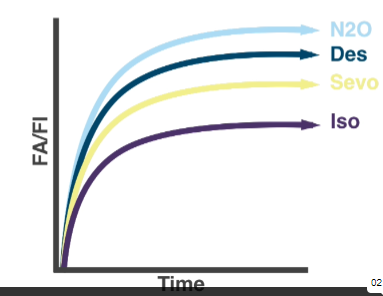
FA/FI curve
Illustrates the speed at which FA will approximate FI. Allows us to appreciate the speed at which alveolar PP equilibrates with the PP leaving the vaporizer
Plateau of FA/FI Curve
Steady state when amount of agent washed into alveoli is equivalent to the agent removed from the alveoli via uptake
Agent with the fastest rate of rise on FA/FI Curve
Nitrous Oxide
2 Things that Increase FA/FI (pushes curve up)
Increased Wash in
Reduced Uptake
Factors that ^ wash in
High FGF
High alveolar ventilation
Low FRC
Low time constant
Low anatomic dead space
Factors that Reduce Uptake
Low BG solubility
Low CO
Low Pa-Pv difference
VRG organs
Heart, brain, liver, kidneys, endocrine glands
VRG % body mass and % CO
10% body mass
75% CO
Muscle % body mass and % CO
50% body mass
20% CO
Fat % body mass and % CO
20% Body mass
5% CO
Vessel-poor group % body mass and % CO
20% body mass
<1% CO
Determinants of Tissue Uptake
Tissue: blood solubility
Tissue blood flow
PP difference between arterial blood and tissue
Determinants of Delivery to Alveoli
setting on vaporizer
FGF
Time constant of delivery system
Anatomic dead space
alveolar ventilation
FRC
Inhaled anesthetics eliminated from body in 3 ways
Elimination from alveoli (primary)
Hepatic biotransformation
Percutaneous loss
Hepatic Biotransformation %: N2O
0.0004%
Hepatic Biotransformation %: Desflurane
0.02%
Hepatic Biotransformation %: Iso
0.2%
Hepatic Biotransformation %: Sevo
2%
Hepatic Biotransformation %: Halothane
20%
Hepatic Biotransformation % Acronym for least to most
DISH
Hepatic enzyme responsible for VA metabolism
CYP2E1
Metabolite of Halothane, Des, Iso
Trifluoroacetic acid (TFA)
High TFA in liver
Immune-mediated hepatic dysfunction (halothane hepatitis)
Metabolite of Sevo
NO TFA
Liberation of inorganic fluoride ions
Fluoride induced High Output renal failure
Signs of High Output Renal Failure
Polyuria
Hypernatremia
Hyperosmolarity
^Plasma Crt
Inability to concentrate urine
FDA Guideline for min FGF w/ Sevo:
FGF of 1 L/min for up to 2 MAC hrs and 2 L/min after 2 MAC hrs
MAC-hr
One x the minimum alveolar concentration that prevents movement in response to a noxious stimulus in 50% of population administered for 1 hr
2% sevo (1MAC) for 1 hr = 1 MAC-hr
1% Sevo for 2 hrs = 1 MAC-hr
Concentration Effect
The higher the concentration of inhaled agent delivered to the alveolus (FA) = the faster the onset of action (over pressuring). Likely only relevant for N2O
Higher solubility agents more greatly affected
Concentrating Effect
N2O is ~34x more soluble in blood than Nitrogen: when N2O is introduced, volume of N2O going into blood is higher than amount of Nitrogen re-entering the alveolus. Causes shrink of alveolus and causes an ^ in FA. Explains why N2O achieves the fastest rate of FA/FI despite Des being less soluble
Augmented Gas Inflow Effect
Temporary Phenomenon where the subsequent breath after the concentrating effect shrinks alveolar size causes an increase inflow of gas with agent to replace the lost volume: alveolar volume quickly restored
Ventilation Effect
Explains how changes in alveolar ventilation can affect the rate of rise of FA/FI. Greater the alveolar ventilation, greater rise of FA/FI
Second Gas Effect
Describes the consequences of the concentration effect when a second gas is co-administered.
when N2O and a 2nd gas are introduced, the rapid uptake of N2O causes shrinkage of the alveolus
This augments ^tracheal inflow which ^the concentration of the 2nd gas
Alveolar concentration of the 2nd gas is higher than if administered alone
Second gas effect produces a more meaningful benefit with agents of _____
Higher BG solubility: Iso > Sevo > Des
Diffusion Hypoxia
When N2O is shut off, it will transfer to the alveoli for elimination in 1-5 mins: can temporarily dilute the alveolar O2 and CO2 concentration = hypoxia and hypocarbia (reducing stimulus to breathe)
Best way to mitigate diffusion Hypoxia after N2O discontinued
Increase FiO2 for 3-5 mins after d/c N2O
What happens to FA/FI in R-to-L shunt?
Causes more De-O2 blood to bypass the lungs = wont pick up O2 or anesthetic gas = dilutes non-shunt fraction when it mixes in the left heart = reduction in PAO2
Produces a slower rate of rise and reduction in PP of agent in arterial blood
Which agents are more affected by R-to-L shunt?
Gases with lower BG Solubility: slows speed of induction with VA= takes longer for FA to equilibrate with FI
Desflurane affected the most (Iso the least)
Examples of R-to-L shunts
Tetralogy of Fallot
PFO
Tricuspid Atresia
Ebstein’s anomoly
Truncus arteriosis
Transposition of the great arteries
Eisenmenger’s Syndrome
How is anesthetic onset of VAs affected by R-to-L shunt?
FA/FI of an agent with lower solubility will be more affected than an agent with higher solubility.
How is anesthetic onset of IV agents affected by R-to-L shunt?
produces a faster IV induction: blood bypasses lungs and travels to brain first
How is Anesthetic onset affected by L-to-R shunt?
VA: NO effect on uptake or induction time
IV agents: slower IV induction because recirculating to lungs
Compliant Airspaces
Volume Increases, Pressure Unchanged
Fast equilibrium btwn Space and Blood: Pulmonary blebs, air bubbles in blood, gas bubble in eye
Slow equilibrium: bowel, pneumoperitoneum
Non-Compliant Airspace
pressure increases, volume unchanged
Middle ear, brain during intracranial procedures
SF6 Bubble Rules
Stop N2O at least 15 mins before bubble placed
Avoid N2O for 7-10 days after
How does N2O affect Anesthetic Equipment
^Vol and Pressure in ETT cuff, LMA cuff, balloon tipped PAC
N2O irreversibly inhibits ____
B12: inhibits methionine synthesis which is required for folate metabolism and myelin production
SEs of Vitamin B12 Inhibition
reduced DNA synthesis
Neuropathy
Immunocompromised
Megaloblastic anemia
homocysteine accumulation
teratogenicity
Spontaneous abortion in 1st and 2nd trimester
Pts at risk for ^B12 inhibition (pre-existing B12 deficiency)
Alcoholism
Pernicious anemia
Vegan
Recreational use of N2O
MAC
Minimum alveolar concentration: concentration of inhaled anesthetic that prevents the nociceptive withdrawal reflex following a supramaximal painful stimulus in 50% of the population
MAC is measure of ___
Potency (ED50)
Higher the MAC = lower potency
Lower MAC = higher potency
Iso MAC
1.2
Sevo MAC
2.0
Des MAC
6.6
N2O MAC
104
Triad of Anesthetic Action
amnesia (lowest MAC fraction)
loss of consciousness
Immobility (highest MAC fraction)