Lecture 7 - Electrical properties of excitable cells: Capacitance & Conductance
 Call Kai
 Learn
 Practice Test
 Spaced Repetition
 Match
 Flashcards
 Knowt Play
1/6

There's no tags or description
Looks like no tags are added yet.
7 Terms
How do structural elements determine electrical properties of cell membranes?
the lipid bilayer is impermeable to ions via simple diffusion, so it behaves like insulator
the ECF and ICF are highly conductive for ions
two conductors that are separated by insulator form electrical capacitor which has ability to separate charge
membrane has capacity to hold charge
ion channels give membrane electrical conductance
Capacitance occurs due to the ability of the cell to membrane to separate charge
Determining capacitance?
C = capacitance
q = electric charge in coulombs
V = change in electrical potential
measured in Farads (F)
1F capacitor can store one Coulomb of charge per 1 Volt difference between the conductors
cell membrane have high capacitance of 10^-6F/cm²

Calculating total capacitance…

How much charge (in Coulombs) must be separated across the membrane of a 50 μm diameter glial cell in order to produce a membrane potential of -90 mV?

part 2 of question

How can you determine how many ions move?
To convert the amount of electrical charge into the mol of K+ ions that had to move out of the cell to establish Vm in glial cells, use Faraday’s constant
F = 96 485 coulombs/mol
use avogadro’s number to determine how many ions it is
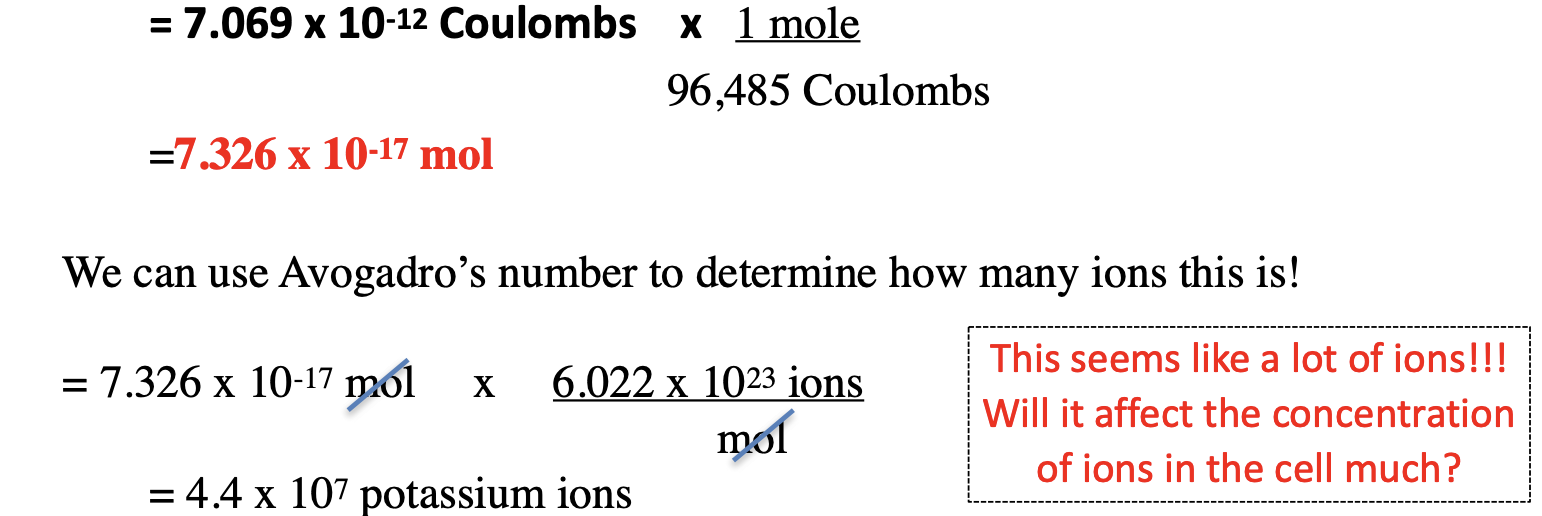
7.326 x 10⁻¹⁷ mol of potassium ions have to move out of glial cells to establish EK=Vm of -90mV. Does this efflux significantly lower the K+ content of the cell? (Does ion flux significantly change ion concentrations in cells?)
final answer = 0.001%
For every 1 million K+ ions in glial cells, roughly 10 K+ ions are needed to establish Vm = Ek=-90mV
no, ion movement that occurs to establish a membrane potential does not significantly change the ion concentration inside the cell
