WEAX 201 - Lesson 7: Geostropic Wind
 Call Kai
 Learn
Learn Practice Test
 Spaced Repetition
 Match
Match Flashcards
 Knowt Play
1/33

There's no tags or description
Looks like no tags are added yet.
Name | Mastery | Learn | Test | Matching | Spaced | Call with Kai | Chat |
|---|
No analytics yet
Send a link to your students to track their progress
34 Terms
what is beneficial about weather maps?
obtain weather observations at…
obtain weather observations at same time
only (…) variations affect wind
horizontal pressure
station pressure must be reduced to ()
MSL
what are isobars?
contours (lines of constant pressure)
when isobars are close together, it leads to (). which then leads to ()
stronger pressure
more wind
(When lines are packed tightly together, the pressure change is steep, generating a powerful push (pressure gradient force) that accelerates the air into strong winds. Wide gaps between lines mean a gentle change and light breezes)
what causes pressure gradients?
temperature differences
(uneven heating of the earth’s surface by the sun creating areas of warm, less dense air (low pressure) and cool, denser air (high pressure)
how do you identify lows and highs on a weather map?
look for the labeled pressure center letters, H or L
how do you identify a trough on a weather map and what is it?
() area of relatively () atmospheric pressure shaped like a () or ()
elongated area of relatively low atmospheric pressure shaped like a U or V

how do you identify a ridge on a weather map and what is it?
() area of relatively () atmospheric pressure or high geopotential height
an upside-down () or a () like hump
elongated area of relatively high atmospheric pressure or high geopotential height
an upside-down U or a hill like hump

what is an isopleth?
line on a map that connects () sharing an () value of a specific atmospheric or meteorological measurement
line on a map that connects points sharing an equal value of a specific atmospheric or meteorological measurement
what is an isotherm?
line on a map that connects () or represents conditions of () or () temperature
line on a map that connects points or represents conditions of equal or constant temperature.
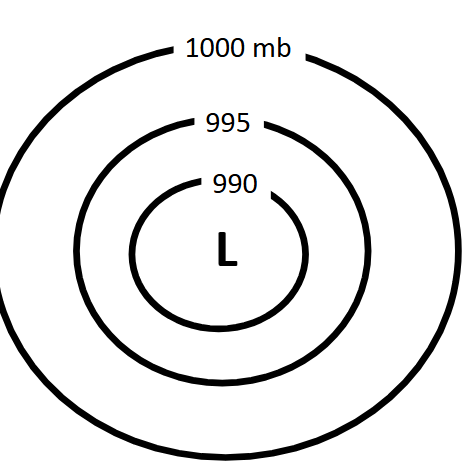
what does a low pressure system or cyclone look like?
isobars surround the center - the numbers on the lines get () as you move toward the middle
() packed lines so pressure change is () and winds are ()
isobars surround the center - the numbers on the lines get lower as you move toward the middle
tightly packed lines so pressure change is rapid and winds are strong
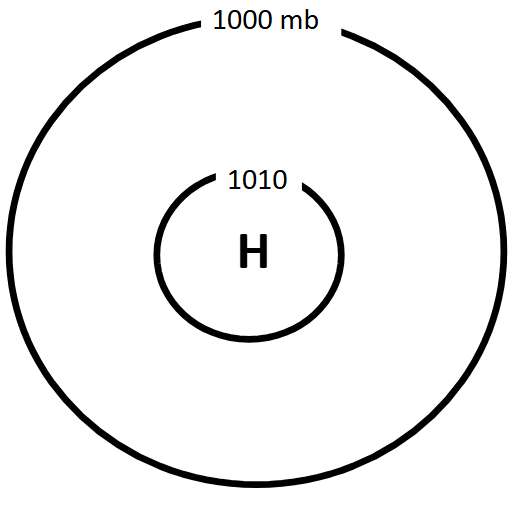
what does a high pressure system or anticyclone look like?
isobars surround the center - the numbers on the lines get () as you move toward the middle
lines are () so pressure change is () and winds are ()
isobars surround the center - the numbers on the lines get higher as you move toward the middle
lines are far apart so pressure change is gradual and winds are light
the distribution of atmospheric pressure is mapped using…
isobars (lines of equal air pressure)
what does wind originate from?
pressure gradient force, caused by spatial differences in heating
air begins accelerating toward () - (PGF is () to pressure gradient)
lower pressure
perpendicular
how does airflow move in relation to the rotation of earth?
toward the () in the northern hemisphere
toward the () in the southern hemisphere
toward the right in the northern hemisphere
toward the left in the southern hemisphere
what is the coriolis effect?
an apparent force, produced by (…)
its strength depends on the () and ()
an apparent force, produced by earth’s rotation
its strength depends on the wind speed and latitude
coriolis deflection changes (), not () because it is strictly a () force
wind direction, not speed
perpendicular
the () the air moves, the () the coriolis effect
faster, stronger
how is the coriolis effect in terms of the equator, latitude, and poles?
() effect at equator for () movements
increasing with () bc as you move towards () latitudes, () occurs which creates higher effect
strongest at () bc it is completely () to the surface
zero effect at equator for horizontal movements
increasing with latitude bc as you move towards higher latitudes, deflection occurs which creates higher effect
strongest at poles bc it is completely perpendicular to the surface
acts () to () of wind vector in the () hemisphere ( () in () hemisphere)
acts 90 degrees to right of wind vector in the northern hemisphere (left in southern hemisphere)
primarily influences (…) motions that are greater than 100 miles
large-scale motions
what is geostrophic balance?
state where the (…) pulling air toward () pressure is completely offset by the () force deflecting it due to earth’s rotation
state where the horizontal PGF pulling air toward low pressure is completely offset by the coriolis force deflecting it due to earth’s rotation
what is geostrophic wind?
results from balance between the () and the ()
above () AGL, wind is approx geostrophic
is () to isobars and upper-air contours
results from balance between the pressure gradient force and the coriolis effect
above 3000 AGL, wind is approx geostrophic
is parallel to isobars and upper-air contours
for geostrophic wind, when standing with your back to the wind (face downwind), low pressure is located on the () in the N hemisphere and low pressure is located on the () in the S hemisphere
left, right
the () together the isobars or height contour lines, the () is the airflow
closer, stronger

how do you predict the wind direction?
note ur in N hemisphere
in N.H low NEEDS to be on ur left
with the lines you could either go NE or SW, but u need to choose the one where the L will be on ur LEFT
that is NE, but NE is the direction the wind is going but since wind is always where it is coming from it would be a SW wind
what direction is an cyclonic flow? N & S hemisphere
CCW in N hemisphere
CW in S hemisphere
what direction is an anticyclonic flow? N & S hemisphere
CW in N hemisphere
CCW in S hemisphere
what is zonal flow?
when isobars are oriented () to ()
() - (+)
() - (-)
when isobars are oriented west to east
westerly (+)
easterly (-)
prevailing wind in (…) is normally zonal
cold air ()
warm air ()
mid-latitudes
cold air north
warm air south
what is meridional flow?
when isobars are mainly oriented () to ()
() - (+)
() - (-)
when isobars are mainly oriented north to south
southerly (+)
northerly (-)
prevailing wind meridional over AZ in ()/()
brings () air ()
july/august
moist, northward