SECTION 1: Organization of Nervous System
 Call Kai
 Learn
Learn Practice Test
 Spaced Repetition
 Match
Match Flashcards
 Knowt Play
1/9

There's no tags or description
Looks like no tags are added yet.
Name | Mastery | Learn | Test | Matching | Spaced | Call with Kai | Chat |
|---|
No analytics yet
Send a link to your students to track their progress
10 Terms
What is the nervous system? general definition
The Nervous system is the body’s control and communication system, it controls both voluntary and involuntary processes.
The functions of the nervous system can be simplified into three steps: what are they and explain them briefly
Sensory Input: detect change inside or outside the body and send signals to the Central nervous system.
Integration: the brain and spinal cord process and combine the information to decide what it means.
Motor output: the central nervous system sends signals through motor nerves to muscles or effectors to produce a response.

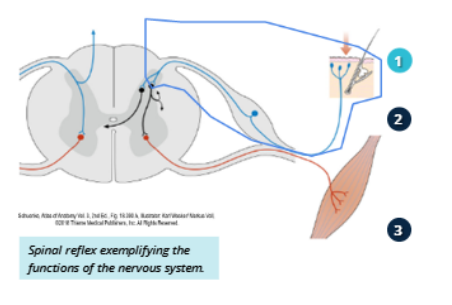
Sensory Input
Sensory Input allows us to gather vital sensory information about our external environment (e.g. touch, temperature, sound) and internal environment (e.g. distension of the urinary bladder).
Sensory nerves detect this information and send signals through the body to other nerve cells so the body can respond.

Integration
Integration is the process of being able to put together all of the incoming sensory signals in order to create a complete picture of the environment.
Integration incorporates multiple simultaneous signals.
For example, the brain is able to integrate different sound signals from each ear to determine the location of a sound’s source. Integration occurs in the brain or spinal cord.

Motor Input
Once sensory input has been integrated, the nervous system functions to produce an appropriate response by sending motor output signals through motor nerves.
These nerves communicate signals from the brain and spinal cord to the skeletal, cardiac, or smooth muscle of the body, causing them to contract or relax.
Central Nervous System (CNS)
The central nervous system (C N S) is made up of the brain and spinal cord. The CNS is commonly referred to as the ‘control center’ of the body.
Where all signals come to and from and where they are integrated, and where information can be stored.
Peripheral Nervous System (P N S)
The peripheral nervous system (P N S) is composed of all the nerves outside of the brain and spinal cord. These include the cranial nerves, spinal nerves, the autonomic nervous system and the special sense organs. Bring signals to and from CNS.
Overview of the Nervous System and their functions
CNS
Spinal Cord:
Brain:
PNS
Motor (Efferent): Relays information from CNS to target cells
▪ Can be voluntary or involuntary (heart)
• Autonomic: controls involuntary responses/movement
○ Parasympathetic: Rest and digest
○ Sympathetic: Fight or flight (very active during exercise)
○ (ex. When information in sent to the heart it travels through two efferent neuron signal transduction pathway from the CNS to the heart where sympathetic division is active it will send signals to target- heart causing increased heart rate during exercise- however if the parasympathetic division is active it will slow the heart rate down, therefore being more active at rest)
• Somatic: Controls voluntary movement (ex. signal from CNS through efferent neurons down spinal cord to skeletal muscle)
Sensory (Afferent): Relays information to CNS through sensory neurons. (spinal cord -> brain) ▪ Sight, smell, touch, pain

Briefly explain one similarity of efferent and afferent neurons.
Efferent and afferent neurons are part of the PNS and function to carry electrical signals.
Briefly explain one difference between efferent and afferent neurons.
Efferent neurons are part of the motor division and carry signals away from the C N S.
Afferent neurons are part of the sensory division and carry signals to the C N S.