Lecture 18 - Genome Editing
 Call Kai
 Learn
 Practice Test
 Spaced Repetition
 Match
 Flashcards
 Knowt Play
1/85

There's no tags or description
Looks like no tags are added yet.
86 Terms
Genome editing
allow scientists to alter an organism's DNA
Knocking in
Inserting a new gene into a DNA sequence
e.g. introducing a functional copy of a gene during gene therapy
Knocking out
Deleting a gene or functionally inactivating it
e.g. by nonsense and frameshift mutations
Knockdown
The gene is still present in the genome but its expression is tuned down
e.g. reducing expression of a gene that produces unwanted effects but is essential for cell viability

Applications of genome editing
Gene therapy
drug development
development of animal models for diseases
metabolic engineering
sustainable fuel production and research
more resilient food or cash crops

Non-homologous end joining (NHEJ)
An error-prone pathway used to repair double-stranded breaks in DNA
inserting random nucleotides

Homology directed repair (HDR)
A DNA repair pathway that uses a donor template to insert a desired sequence into DNA
The donor template is flanked by homology arms, which allows for precise insertion of a DNA sequence

Zinc-finger nucleases (ZFN)
A genome editing technique using a DNA-binding domain + the FokI endonuclease

How ZFNs work
Zinc fingers bind the targeted region of DNA while bringing FokI
FokI creates a double-stranded break that induces NHEJ or HDR
“Knocking in and knocking out genes”

TALENs
Transcription activator-like effector nucleases
a genome editing technique using a DNA binding domain + FokI endonuclease

TALEN DNA binding domain
Contains tandem repeats about 34 AA long
can be edited to change the target sequence
“Knocking in and knocking out genes”
TALEN advantage: ease of design
Easier to design because TALENs require changing only 2 residues, as opposed to 4 in ZFNs
TALEN advantage: specificity
Higher specificity of binding because TALENs can bind 18 or more bp while ZFNs bind only 9–12 bp
TALEN advantage: off-target effects
Fewer off-target mutations, since TALENs are more specific than ZFNs
ZFN advantage
ZFNs are 3× smaller than TALENs, allowing easier delivery into the host cell and easier expression
important because viral vectors have limited cargo sizes

Cre-lox recombination
A genome editing technique using Cre recombinase + loxP recognition sites

What determines the outcome of Cre-lox recombination
The orientation and direction of the loxP sites determines how the genetic material is rearranged

Cre-lox inversion
Occurs when loxP sites are on the same strand of DNA and in opposite orientations

Cre-lox deletion
Occurs when loxP sites are facing the same direction

Product of Cre-lox deletion
The segment between the loxP sites is excised as a circular DNA molecule, leaving a single loxP site in the chromosome

Cre-lox translocation
Occurs when loxP sites are on different DNA strands

Red recombination
A genome editing technique using the Exo, Beta and Gam proteins
“gene knock in and knock out”

Exo (Red recombination)
An exonuclease that digests one strand of DNA, creating single-stranded overhangs

Beta (Red recombination)
Binds the single-stranded overhangs and anneals them to a complementary strand from donor DNA
once bound to both, it facilitates recombination
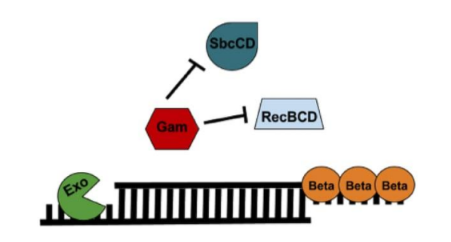
Gam (Red recombination)
Prevents nucleases from degrading the donor DNA
CRISPR
Clustered Regularly Interspaced Short Palindromic Repeats

Origin of CRISPR
Derived from the bacterial immune system

How the natural CRISPR system works
Viral DNA is integrated into the bacterial genome upon infection
bacteria insert spacers into CRISPR regions of their genome, allowing them to recognize viral DNA and defend against future infections

Editing capability of CRISPR-Cas9
Can be used to “knock in, knock out, and knock down genes”

Cas9
An endonuclease that induces double-stranded breaks
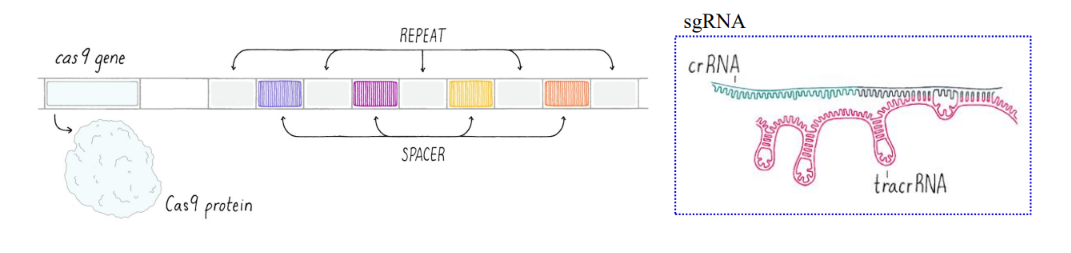
Protospacer adjacent motif (PAM)
A short DNA sequence downstream of the target sequence
required for Cas9 function
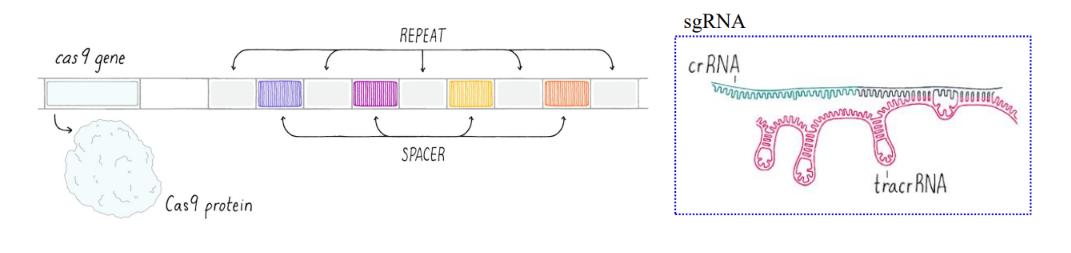
crRNA
CRISPR RNA, complementary to the target sequence

tracrRNA
Trans-activating CRISPR RNA, the binding scaffold for Cas9

Single guide RNA (sgRNA)
The crRNA + tracrRNA complex that guides Cas9 to the target sequence

Gene insertion with CRISPR-Cas9 + Red recombinase
Cas9 cuts near the PAM site to induce a double-stranded break
Red recombinase allows homologous recombination between the editing cassette's homology arms and the genome
so the sequence between the homology arms is inserted into genome
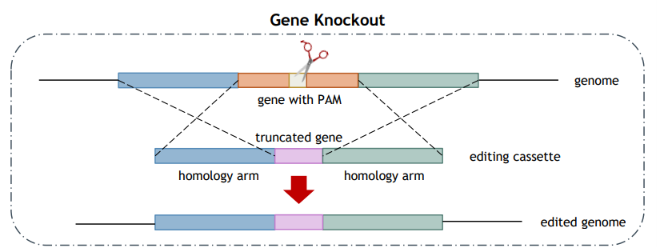
Gene knockout with CRISPR-Cas9 + Red recombinase
Cas9 cuts near a PAM site within the target gene
the editing cassette contains a non-functional (truncated) version of the gene
Red recombinase-mediated homologous recombination replaces the target gene with the truncated one

Catechol
A key intermediate in the microbial degradation of aromatic compounds, including lignin-derived molecules
Versatile aromatic building block

Catechol as a precursor
Serves as a precursor for industrial chemicals, pharmaceuticals, pesticides and polymers

Catechol as a platform chemical
A valuable platform chemical for biocatalysis and metabolic engineering
enabling biosynthesis of value-added compounds through engineered microbial pathways

Picolinic acid (PA)
A naturally occurring metal-chelating metabolite
strong affinity for zinc and other divalent metal ions

Properties of picolinic acid
Exhibits antimicrobial, immunomodulatory, and neuroactive properties

Uses of picolinic acid
Pharmaceutical research
metal-ion complexation
precursor for synthesizing pyridine-based compounds

de novo PA biosynthesis pathway
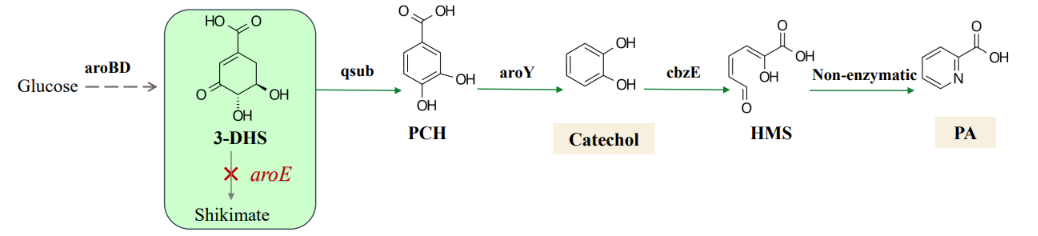
Glucose → (aroBD) 3-DHS → (qsuB) PCH → (aroY) catechol → (cbzE) HMS → (non-enzymatic) picolinic acid

Core precursor of the PA pathway
3-dehydro-shikimate (3-DHS)

Features of the shortcut PA pathway
A de novo route in E. coli using only three key enzymes within a single pathway
starting from glucose as an inexpensive, renewable carbon source

Problem: Metabolic leak in the PA pathway
The endogenous aroE gene converts 3-DHS into shikimate
draining the precursor pool
Solution to the aroE leak
Knock out aroE to eliminate this competitive pathway
redirect all flux toward high-yield PA production

pCas plasmid contents
Cas9 endonuclease
Red recombinase genes Beta and Gam under an arabinose-inducible promoter
kanamycin-resistance gene

pTargetF plasmid contents
gRNA that guides Cas9 where to cut in the genome
spectinomycin-resistance gene

Five steps of pTargetF construction
Design primers and N20
PCR
restriction enzyme digestion
ligation
transformation

Step 1 of pTargetF construction
Identify the gene sequence
locate a suitable 20-nucleotide (N20) sequence near the cleavage site (PAM sequence (NGG) downstream of the N20)
design forward and reverse primers

Primer optimization guidelines (Step 1 of pTargetF construction)
Choose 25–30 nucleotides upstream of the start/stop codon
%GC approximately 45%
annealing temperature from 55 °C to 60 °C for PCR efficiency
Software tools for design
SnapGene, ApE, and ChopChop
Step 2 of pTargetF construction
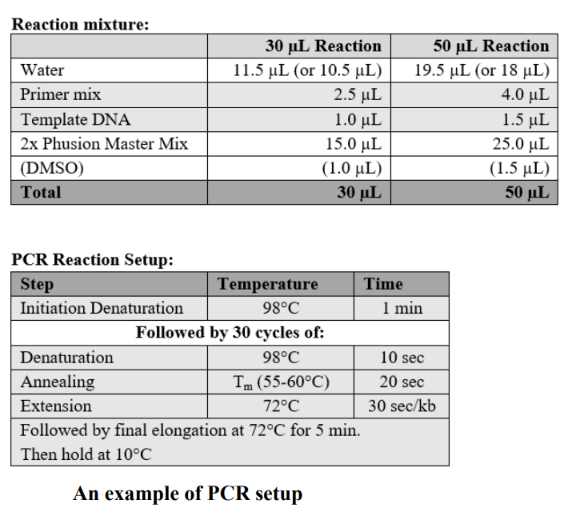
PCR to amplify the N20 sequence using the designed primers
cycling through denaturation, primer annealing and extension
Step 3 of pTargetF construction
Digest the pTargetF plasmid and PCR-amplified N20 fragment with restriction enzymes
such as SpeI and XhoI

Purpose of restriction digestion here
linearizes the pTargetF backbone
generates compatible cohesive ends on both the vector and the insert
Restriction enzymes used for pTargetF
XhoI and SpeI
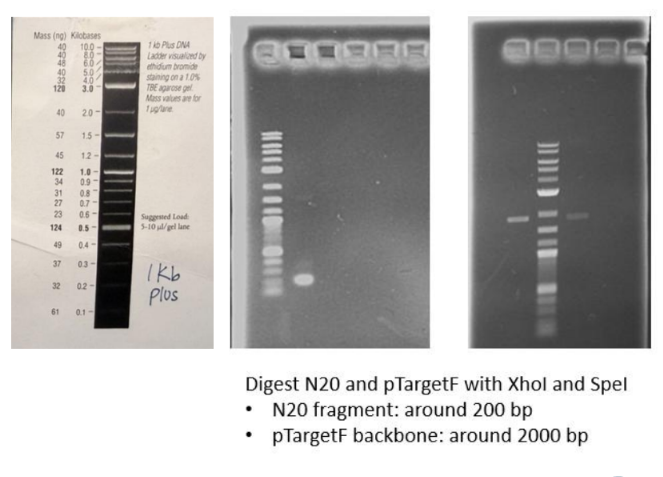
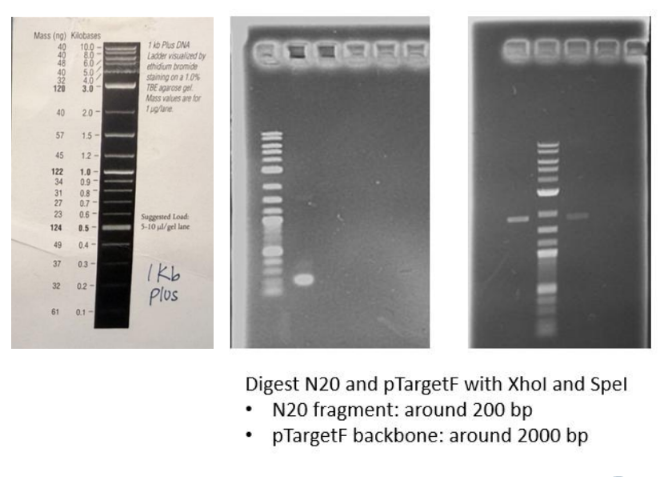
giving an N20 fragment around 200 bp and a pTargetF backbone around 2000 bp on the gel

Expected band sizes after digestion
~200 bp for the N20 fragment and about ~2 kb for the pTargetF backbone
analyzed by agarose gel electrophoresis
Step 4 of pTargetF construction (ligation)
digested N20 insert is ligated into the linearized pTargetF backbone with DNA ligase
forms phosphodiester bonds between vector and insert to generate a recombinant plasmid

Step 4 of pTargetF construction (transformation)
The ligation mixture is introduced into competent XL1-Blue cells by heat shock transformation

Screening transformants
Transformants are selected on antibiotic plates
individual colonies are screened by colony PCR to confirm insertion of the N20 sequence

Genome editing step 1
Transform pCas into the host cell

Genome editing step 2
Prepare the pCas-containing host as electrocompetent cells

Genome editing step 3
Induce λ-Red recombinase expression with arabinose

Genome editing step 4
Construct the homologous fragment

How the homologous fragment is built (Genome editing step 4)
PCR-amplify the upstream and downstream homology arms
downstream fragment carrying an overhang complementary to the upstream fragment
fuse them into one w/ second round of PCR
Why the fused fragment is nonfunctional (Genome editing step 4)
The final fragment lacks the middle portion of the target gene, creating a nonfunctional version

Genome editing step 5
Co-transform pTargetF and the homologous donor fragment into the induced, electrocompetent pCas-containing host

Verifying the knockout (Genome editing step 5)
Colony PCR on selected colonies, compared against wild type on a gel
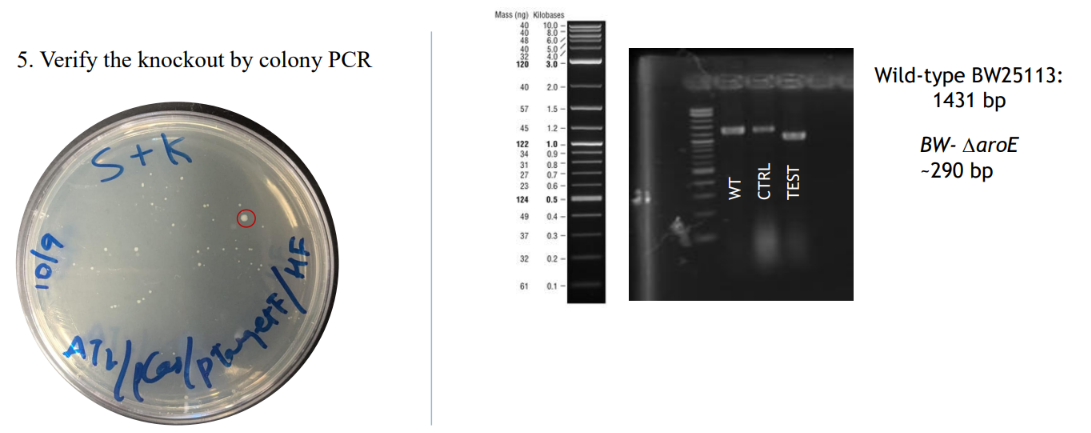
Colony PCR band sizes in the aroE knockout (Genome editing step 5)
Wild-type BW25113 gives 1431 bp while BW ΔaroE gives about 290 bp

Genome editing step 6: Curing pTargetF
Add IPTG, which induces the gRNA that cleaves pTargetF and thereby cures it

How pTargetF curing is confirmed
No growth on spectinomycin indicates pTargetF has been cured

Genome editing step 7: Curing pCas
Incubate at 37 °C, since pCas is temperature-sensitive
Validation goal for the PA project
Validate the quantity of 3-DHS produced after….
single deletion of aroE from wild-type E. coli BW25113
multi-gene knockouts

Multi-gene knockout strain for 3-DHS
BW ΔpykA ΔpykF ΔptsG ΔaroE
designed for metabolic flux
precursor preservation
control of carbon uptake

Precedent study (anthranilic acid)
The lab previously redirected carbon flux toward anthranilic acid by knocking out trpD
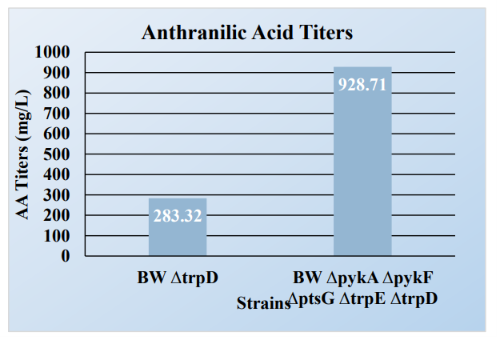
AA titer from single deletion
Single deletion of trpD from wild-type E. coli BW25113 successfully redirected flux, yielding 283.32 mg/L of anthranilic acid

AA titer from multi-gene knockout
BW ΔpykA ΔpykF ΔptsG ΔtrpE ΔtrpD yielded 928.71 mg/L of anthranilic acid — a 3.3× increase
Experimental error: fragment length
The homologous fragment should be at least 1 kb
Experimental error: N20 uniqueness
The N20 sequence must be UNIQUE in the genome
use CHOPCHOP to find unique and efficient N20 sequences

Experimental error: PAM position
The PAM site is on the RIGHT SIDE of the target sequence
Experimental error: incubation temperature
Incubate transformants at 30 °C when using kanamycin plates, since pCas is temperature-sensitive
Experimental error: reagent freshness
Use FRESH rather than frozen pTargetF, homologous fragment, and competent cells
Experimental error: recovery time
Allow transformants to recover for >1 hour before plating
Advantages of CRISPR-Cas9
Precise genome editing (most of the time)
cheap
simple compared to other techniques like ZFN and TALENs
Disadvantage of CRISPR-Cas9
It requires a PAM to function
regions of the genome lacking PAM sequences cannot be edited with CRISPR-Cas9