Week 11 PALS
 Call Kai
 Learn
 Practice Test
 Spaced Repetition
 Match
 Flashcards
 Knowt Play
1/86

There's no tags or description
Looks like no tags are added yet.
87 Terms
Signs and symptoms of croup?
Viral
Slow onset
Wants to sit up
Barking cough
No Dueling
steaple sign
Low grade fever 101-102
what is the common cause of cardiac appest in a child
respiratory issues
What is the most common cause of death for a child?
Trauma
Epiglottitis
Bacterial
Rapid onset
tripod
barking cough
drooling
High fever 102-104F
What is the treatment for croup
Primary assessment
Saline Neb
Epi neb (racemic
Corticosteroids Dexamethasone! 0.5-0.6mg/kg of (solu) 2mg/kg max 60
Advanced airway.
What is the dose of Racemic Epi 2.25%
0.5 mL + 4mL’s NS
What is the dose of nebulized Epi 1:1000
1mL Epi 1:1000 + 4mL NS
What is the dose of Epi 1:10,000 for Nebulization
5mL’s Epi 1:10,000 diluted with 4mL NS
What is the treatment of Epiglottitis
Conduct a primary assessment.
Place the patient in the position of comfort
Do not agitate the child!
Nothing in mouth NPO
Saline neb/blow by
Transport ASAP
ET as a last resort!
What is the pathophysiology of Bronchiolitis/Asthma?
Fluid/condosation, Bronchospasm, Wheezing Expiratory then inspiratory,
<2yo Bronchiolitis is characterized by inflammation and congestion in the small airways due to viral infections, leading to airway obstruction and respiratory distress.
>2yo Asthma involves chronic airway inflammation and hyperreactivity, resulting in episodic bronchoconstriction, airway obstruction, and increased mucus production.
What type of lung sound would you anticipate with bronchiolitis and asthma?
You would anticipate wheezing and possibly crackles due to airway constriction and mucus accumulation.
What is the pathophysiology of Allergic Reaction/Anaphylaxis?
–Degranulation of histamine mast cells a basophils (granulocytes) causing bronchoconstriction and vasodilation. brochouriah distributive shosk
What is the treatment for Asthma/bronchiolitus
Albuterol/Atrovent 4-6 LPM
Neb Epi 1:1,000 0.01mg/kg IM
Dexamethasone
Mag sulfate of not hypotensive and not for allergic reactions 25 over 15-30min
What does histamine do?
bronchoconstriction
vasodilation
peritus
urticaria
heparin release blood thinning
edema
Treatment for allergic reactions?
Oxygen
IM Epi 1:1000 0.01mg/kg max 0.3mg/kg
IV diphenhydramine 1mg/kg
Corticosteroids after stabilization
What are the signs and symptoms of allergic reactions and anaphylaxis and what is the treatment?
Signs include hives, itching, swelling, and difficulty breathing. Symptoms can escalate to anaphylactic shock, presenting with hypotension, tachycardia, and potential loss of consciousness.
What is the first vital sign that will change with shock
ventilation rate
What are the four classifications of shock?
Shock can be classified into four types: hypovolemic, cardiogenic, distributive, and obstructive.

What are the tow types of hypovolemic shock?
Nonhemorrhagic =
Hemorrhagic shock.= Trauma
Trauma = fever diarrhea, vomiting
What are the three types of Distributive shock
Septic
Neurogenic, not common but deadly massive dilation
Anaphylactic shock. common
Psychogenic
What are some causes of obstructive shock?
Tension Pneumothorax
Cardiac Tamponade
Pulmonary Embolismor any condition that obstructs blood flow to the heart.
What are the common causes of cardiogenic shock?
Congenital Heart Defect
Myocarditis
Arrhythmias
Comodiocortis
Prolonged QT
Atherosclerosis
S&S of compensated Shock w/ Hypoperfusion?
Tachycardia
Tachypnea
Restlessness/ Ams
BP above hypotensive threshold
S&S of shock w/ hypoperfusion.
Decompensated
Bradycardia
Bradypnea
Unresponsive
Systolic BP below hypotensive threshold.
Systolic B/P Threshold Term Neonates (O to 1 month of age)
Less than 60 Systolic
Systolic B/P Threshold Infants (1 month to 1 year)
Less than 70 Systolic
Systolic B/P Threshold Children (1 to 10 years old)
Less than 70+(2 X Age) Systolic
Systolic B/P Threshold Children (10 years and greater)
Less than 90 Systolic
Treatment for Shock? non hemorrhagic hypovolemic
In itiate IV/IO therapy and begin fluid challenge (20 mL/kg IV/IO push) •Mo nitor V/S to include lung sounds after every IV/IO bolus
Listen to lung sounds
What is the most common cause of a Tension Pneumothorax?
Over ventilations barrow trauma
use a pop off valse except for drowning of asthma anaphylaxis
position the child in a sniffing position
Signs and SymptomsTension Pneumothorax?
Absent lung sounds of the affected side.
JVD
Tachycardia
Hypotension
hedynamically compromised
Tr eatment 4 Tension Pneumothorax
Where is the proper placment of a needle for a tension Pneumothorax?
Over the 2nd ICS betweent he second and third space
What size catheter are you going to use for the administration of a chest needle for the treatment of a tension pneumothorax?
Hypovolemia Distributive IV Fluid Boluses
Hypovolemia Distributive IV Fluid Boluses
Cardiogenic Shock IV Fluid Boluses
Poisoning CCB/BB IV Fluid Boluses
5-10 mL/kg Repeat as needed Over 10-20 Minutes
DKA with Compensated Shock IV Fluid Boluses
Which shunt bipasses the liver and what does it become
Which shunt is t
Which shunt
36.31
What is the most common birth defect?
Heart deffects are the most common
Classified in three different categories of Congenital Anomalies
defects, deformities, and disruptions.
Ø Increase pulmonary blood flow Ø Ø Decrease pulmonary blood flow Obstruct blood flow
AEIOU TTIPPSSS
is a mnemonic used to evaluate the causes of altered mental status in patients. It stands for
Alcohol, Epilepsy, Insulin, Overdose opiates, Uremia, Trauma, temp, Tumor, Infection, Psychiatric, poisonings, Stroke, and Sepsis.
if a child is 1month and hypoglycemic what glucose hould you give them?
You should give them a 10% dextrose solution.
If a child was 2 what detrose would you give them.
You should give them a 25% dextrose solution. Wh
at is the most common type of sesure do we get called for?
Clonic tonic
What would you do for a baby that is having a seizure
41.18Pr otect the patient from hurting themselves • Pr O2 & suction otect the patient’s airway • IV /IO & obtain glucose reading • Ad ministration of a Benzodiazepine Midazolam • 0.1 mg/kg in 2 mg increments (max single dose of 5 mg) Diazepam • 0.1 mg/kg in 2.5 mg increments (max single dose of 5 mg) Lorazepam • 0.05 0.1 mg/kg (max single dose of 4 mg)
105 degrees external cooling

You respond to find an unconscious/unresponsive 3yo pediatric patient Vital Signs: R: 4, P 40
1:3 ventilations
• Initiate high-quality CPR immediately. • Call for emergency assistance and use an AED if available.
epi 0.01 mg/kg 0.1ml/kg
What if the patient is suspected of having an increased parasympathetic tone? Organophosphate poisoning.
Atropine • 0.02 mg/kg Minimum of 0.1 mg • 0.2 mL’s/kg
When would you think about pacing a pediatric patient?
When it is an acute problem and not an asphyxial etiology when its not a respiratory issue.
What size of pads would you use?–– What would you set the rate at? What would you set the milliamps at?
What size of pads would you use? Pediatric Bradycardia
over 10 kg above 1 year old
– What would you set the rate at for Pediatric Bradycardia?
100 beats per minutes
What would you set the milliamps at Pediatric Bradycardia?
Max power or physician directed.

5 year old presents with R 26, P 230, BP 82/40
Severe Tachycardia Signs:Symptomatic and stable 180 220 below is sinus tach above that its probably STV.

• 1 year old presents with severe tachycardia tal Signs: R 30, P 300, BP 78/40
Acute onset SVT if above 180 in baby’s 200 in kids
Vagal maneuver cold packs mammalian diver reflex
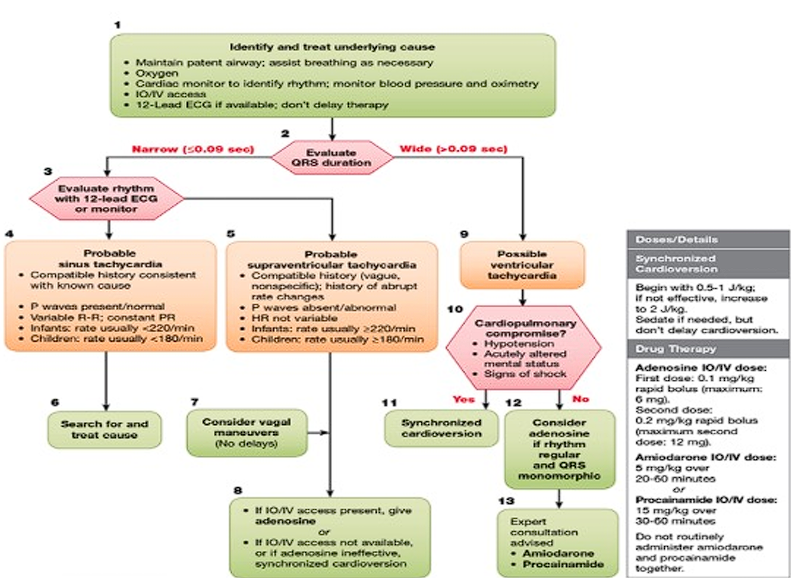
What is the first line medication for pediatric tachycardia
Adenosine
0.1 mg/kg RIVP with a max of 6 mg followed by a rapid flush
0.2 mg/kg RIVP with a max of 12 mg followed by a rapid flush

The patient did not respond to the administration of Adenosine and is now unstable What is your next treatment modality?
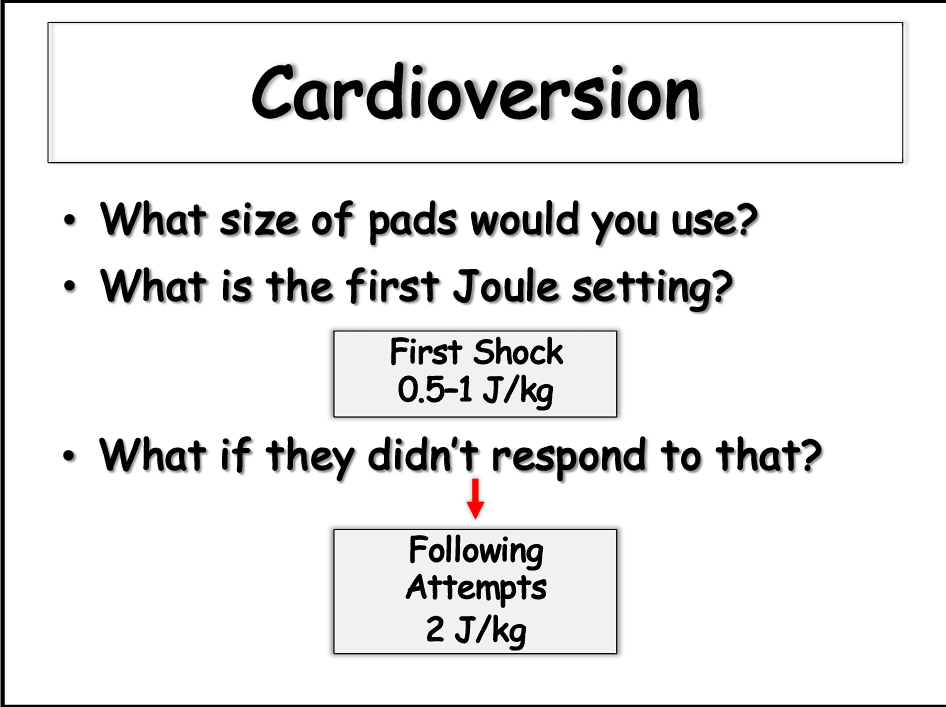
Edison medicine cardioversion hit sync and synchronize on the R ways @ 0.5-1 J/kg
Nevr ever ever go higher than 2j/kg for cardio version
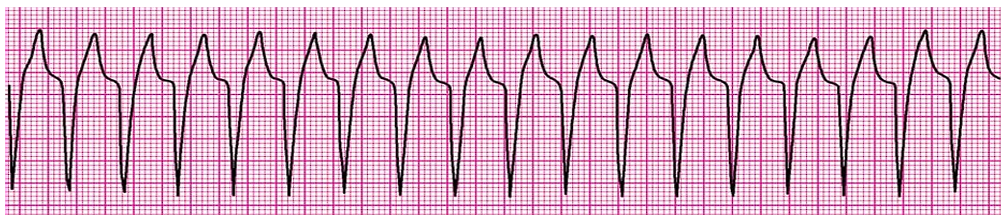
7 year old presents with severe tachycardia tal Signs: R 22, P 180, BP 94/50
Ventricular tach greater than 2 small boxes in kids could be a heart defect or comotiocortus

What is your forst line med for V-tach in pediactric
Amiodarone Life Threatening Ventricular Arrhythmia • 5 mg/kg IV/IO over 20 60 minutes (max single dose of 300 mg) • Can repeat to a maximum of 15 mg/kg (2.2 grams in adolescents) per 24 hours.
or
Lidocaine Life Threatening Ventricular Arrhythmia • 1 mg/kg IV/IO • • • For refractory VT, you may give an additional 0.5 mg/kg Max dose is 3 mg/kg Maintenance: 20 mcg/kg/min

The 7 year old with V Tach is now symptomatic and unstable • Vital Signs: R 28, P 180, BP 60/30 • ECG What is your treatment now?
First Shock 0.5–1 J/kg
Following Attempts 2 J/kg


3 year old found pulseless and apneic • • ECG What is your treatment?
Rigor Mortis, Lividity,
CPR
IV/IO
Epinephrine 0.01 mg/kg •0.1 mL’s/kg
Hypoglycemia
What else are you going to focus on when treating a pediatric patient that is in cardiac arrest?
–H’ s & T’s
Reversible Causes Hypoxia Hypovolemia Hypoglycemia Hydrogen Ion Hypothermia Hypo/Hyperkalemia Tension Pneumothorax Cardiac Tamponade Toxins/Tablets Thrombosis - Pulmonary Thrombosis - Coronary

6 year old in cardiac arrest after getting punched in his chest during a karate sparring match ECG What is your treatment?
First Shock 2 J/kg
Second Attempt 4 J/kg
Following Defib Attempts Up to 10 J/kg

What is the first IV/IO medication that is used for pediatric cardiac arrest?
–Epinephrine 0.01 mg/kg •0.1 mL’s/kg
Amiodarone
V Fib/ pVT mg/kg IV/IO push •5 •Ca n repeat three times to a max of 15 mg/kg (2.2 grams for adolescents) per 24 hours.
Lidocaine
V Fib/ pVT mg/kg IV/IO •1 •Fo r refractory V Fib, you may give an additional 1 mg/kg. x dose is 3 mg/kg •Ma •Ma intenance: 20 50 mcg/kg/min
Dextrose dose for birth to 2 months
A 2-year-old presents with severe respiratory distress, intercostal retractions, and diminished breath sounds bilaterally. The patient has been sick with an upper airway infection for the past twenty-four hours and is not allergic to any medications. What is the most appropriate initial management of this patient?
High-flow oxygen via non-rebreather mask
A 9-month-old presents with a heart rate of 240 bpm, signs of very poor perfusion, and respiratory distress. The ECG shows a narrow complex tachycardia with no P waves present. After attempting vagal maneuvers without success, what is the appropriate next step?
Synchronized cardioversion at 0.5-1 J/kg
You are calculating the dose of Atropine for an infant who weighs 4 kg. Using the standard pediatric dose of this medication, you recognize that you would need to administer:
0.1 mg
What is the recommended compression depth for CPR in a 5-year-old child?
At least 1/3 the depth of the chest (approximately 5 cm)
Epinephrine should be administered to a pediatric patient that presents with severe bradycardia at a dose of: (select all that apply)
0.01 mg/kg 0.1 mL/kg
The heart rate threshold between possible SVT versus sinus tachycardia in an 18-month-old pediatric patient is:
180
The heart rate threshold between possible SVT versus sinus tachycardia in a 3-month-old infant is:
220
Amiodarone may be administered to a pulseless and apneic pediatric patient that presents with ventricular tachycardia at a dose of:
5 mg/kg IV/IO bolus
Which of the following illustrates the correct sequence of events when it comes to the proper assessment steps for pediatric BLS?
Check responsiveness, Activate emergency response, Check pulse, Begin CPR
Which of the following represents the correct dose of IV Dextrose that can be administered to a 17-month-old pediatric patient: (select all that apply)
2-4 mL's/kg of D25
5-10 mL's/kg of D10
You are ventilating a 1-year-old during resuscitation. You recognize the correct appropriate tidal volume to deliver is:
5-7 mL's/kg
The correct initial energy dose for defibrillation of a 15 kg child with pulseless ventricular tachycardia is:
30 Jouls
The correct dose of IV Dextrose for a 1-month-old infant is:
5-10 mL's/kg of D10
The correct initial Joule setting for defibrillation of a pediatric patient is:
2 Joules/kg
At what blood glucose level would you start treating a 2-day-old pediatric patient with IV dextrose?
Less than 45 mg/dL
At what blood glucose level would you start treating a 5-year-old pediatric patient with dextrose?
Less than 60 mg/dL