Genetics and Molecular Biology - EXAM #2
 Call Kai
 Learn
 Practice Test
 Spaced Repetition
 Match
 Flashcards
 Knowt Play
1/204

Earn XP
Description and Tags
Chapters 13, 14, 15, 16, and 17 in Achieve (Macmillian Learning)
205 Terms
What are the two basic functions of life?
The ability to store and faithfully transmit genetic information during reproduction.
The ability to catalyze the chemical transformations that drive life processes.
How did Thomas Cech and his colleagues determine that RNA acts as a catalyst?
They found that some RNA molecules from the protozoan Tetrahymena thermophila can excise 400 nucleotides from its RNA in the absence of any protein.
What are ribozymes?
RNA molecules that act as catalysts, and can cut out parts of their own sequences, connect some RNA molecules together, replicate others, and catalyze the formation of peptide bonds between amino acids.
When did self-replicating ribozymes arise?
Between 3.5 and 4 billion years ago
What are the three major differences between DNA and RNA?
RNA has ribose sugar (2’ hydroxy group); DNA has deoxyribose sugar (NO 2’ hydroxy group)
RNA carries uracil; DNA carries thymine
RNA is single-stranded; DNA is double-stranded
What is ribosomal RNA (rRNA)?
RNA that associates with the ribosomal protein subunits to form a ribosome, the site of protein assembly.
What is messenger RNA (mRNA)?
RNA that carries the coding instructions for a polypeptide chain from DNA to a ribosome. After attaching to the ribosome, an mRNA molecule specifies the sequence of the amino acids in a polypeptide chain and provides a template for the joining of those amino acids.
What are pre-messenger RNAs (pre-mRNAs)?
RNAs that are the immediate products of transcription in eukaryotic cells. Pre-mRNAs are modified extensively before becoming mRNA and exiting the nucleus for translation into protein.
What is transfer RNA (tRNA)?
RNA that serves as the link between the coding sequence of nucleotides in an mRNA molecule and the amino acid sequence of a polypeptide chain. Each tRNA attaches to one particular type of amino acid and helps incorporate that amino acid into a polypeptide chain
What are small nuclear RNAs (snRNAs)?
RNAs that participate in the processing of RNA, converting pre-mRNA into mRNA.
What are small nuclear ribonucleoproteins (snRNPs)?
Structure found in the nuclei of eukaryotic cells that consists of small nuclear RNA (snRNA) and protein; functions in the processing of pre-mRNA.
What are small nucleolar RNAs (snoRNAs)?
Small RNA molecules found in the nuclei of eukaryotic cells; function in the processing of rRNA and in the assembly of ribosomes.
What are micro RNAs (miRNAs)?
Small RNA molecules, typically 21 or 22 bp in length, produced by cleavage of double-stranded RNA arising from small hairpins within RNA that is mostly single stranded. The miRNAs combine with proteins to form a complex that binds (imperfectly) to mRNA molecules and inhibits their translation.
What are small interfering RNAs (siRNAs)?
Single-stranded RNA molecule (usually 21 to 25 nucleotides in length) produced by the cleavage and processing of double-stranded RNA that binds to complementary sequences in mRNA and brings about the cleavage and degradation of the mRNA. Some siRNAs bring about changes in chromatin structure.
What is RNA interference (RNAi)?
A process in which miRNA and siRNA molecules help trigger the degradation of mRNA or inhibit its translation into protein.
What are Piwi-interacting RNAs (piRNAs)?
Small RNA molecule belonging to a class named after Piwi proteins, with which these molecules interact; similar to microRNA and small interfering RNA, has a role in suppressing the expression of transposable elements in reproductive cells.
What are long non-coding RNAs (lncRNAs)?
A class of relatively long RNA molecules found in eukaryotes that do not code for proteins; they provide a variety of functions, including regulation of gene expression.
What are CRISPR RNAs (crRNAs)?
Small RNA molecules found in prokaryotes that assist in the destruction of foreign DNA molecules.
What three major components does transcription require?
A DNA template
The raw materials (ribonucleotide triphosphates) needed to build a new RNA molecule
The transcription apparatus, consisting of the proteins necessary for catalyzing the synthesis of RNA
What did Oscar Miller, Jr. and Barbara Beatty demonstrate in their RNA experiment?
They broke open salamander oocytes, extracted chromatin, and spread the chromatin onto a fine-mesh grid. Under the electron microscope, they observed Christmas-tree-like structures, each consisting of a thin central fiber (the trunk of the tree) to which were attached strings (the branches) bearing granules. The addition of deoxyribonuclease (an enzyme that degrades DNA) caused the central fibers to disappear, indicating that the “tree trunks” were DNA molecules. Ribonuclease (an enzyme that degrades RNA) removed the granular strings, indicating that the branches were RNA.

What strand of DNA is transcribed, the template or non-template strand?
Template
What is the transcription unit and what are the three major components?
A stretch of DNA that encodes an RNA molecule and the sequences necessary for its transcription. The three major components are a promoter, and RNA coding region, and a terminator.

What is the promoter region?
DNA sequence that the transcription apparatus recognizes and binds so as to initiate transcription; indicates the direction of transcription, which of the two DNA strands is to be read as the template, and the starting point of transcription.
What is the RNA coding region?
Sequence of DNA nucleotides that is copied into an RNA molecule.
What is the terminator region?
Sequence of DNA nucleotides that brings about the termination of transcription.
The transcription apparatus is said to move ___ (upstream/downstream) during transcription.
Downstream
What are ribonucleoside triphosphates (rNTPs)?
Substrate of RNA synthesis; consists of a ribose sugar and a base (a nucleoside) attached to three phosphate groups. In transcription, two of the phosphates are cleaved, producing an RNA nucleotide.
What is the RNA synthesis equation?

What is RNA Polymerase?
Enzyme that synthesizes RNA from a DNA template during transcription.
Describe RNA Polymerase in bacteria.
There is only one type of RNA Polymerase—one that includes five subunits to make up the core enzyme: two copies of a subunit called alpha (α) and single copies of subunits beta (β), beta prime (β’), and omega (ω).
What is the core enzyme in bacterial RNA Polymerase?
A cluster of protein subunits that catalyzes the elongation of the RNA molecule by the addition of RNA nucleotides. Other functional subunits join and leave the core enzyme at particular stages of the transcription process.

What is the sigma factor?
Subunit of bacterial RNA polymerase that allows the RNA polymerase to recognize a promoter and initiate transcription.
What is a holoenzyme?
Complex of an enzyme and other protein factors necessary for its complete function.
How do rifamycins affect bacterial transcription?
They bind to the part of the bacterial RNA polymerase that clamps onto DNA and then jam the RNA polymerase, thus preventing RNA polymerase from interacting with the promoter on the DNA.
Describe RNA Polymerase in eukaryotes.
There are three distinct types: RNA Polymerase I, RNA Polymerase II, and RNA Polymerase III . Two additional RNA polymerases have been found in plants: RNA polymerase IV transcribes siRNAs that silence transposons and RNA polymerase V transcribes siRNAs that play a role in DNA methylation and chromatin structure.
What does RNA Polymerase I transcribe in eukaryotes?
rRNA
What does RNA Polymerase II transcribe in eukaryotes?
pre-mRNAs, snoRNAs, some miRNAs, and some snRNAs
What does RNA Polymerase III transcribe in eukaryotes?
Small RNA molecules—specifically tRNAs, small rRNAs, some miRNAs, and some snRNAs
How does α-Amanitin affect eukaryotic transcription?
It binds to RNA polymerase II and jams the moving parts of the enzyme, interfering with its ability to move along the DNA template.
What are the three stages of transcription?
Initiation
Elongation
Termination
What are the four components of initiation in transcription?
Promoter recognition
Formation of a transcription bubble
Creation of the first bonds between rNTPs
Escape of the transcription apparatus from the promoter
What is a consensus sequence?
Sequence that comprises the most commonly encountered nucleotides found at a specific location in DNA or RNA.

What is the Pribnow Box / -10 Consensus Sequence?
Consensus sequence (TATAAT) found in most bacterial promoters approximately 10 bp upstream of the transcription start site.

What is the -35 Consensus Sequence?
Consensus sequence (TTGACA) found in many bacterial promoters approximately 35 bp upstream of the transcription start site.
The -10 and -35 consensus sequences are also referred to as…
Down mutations
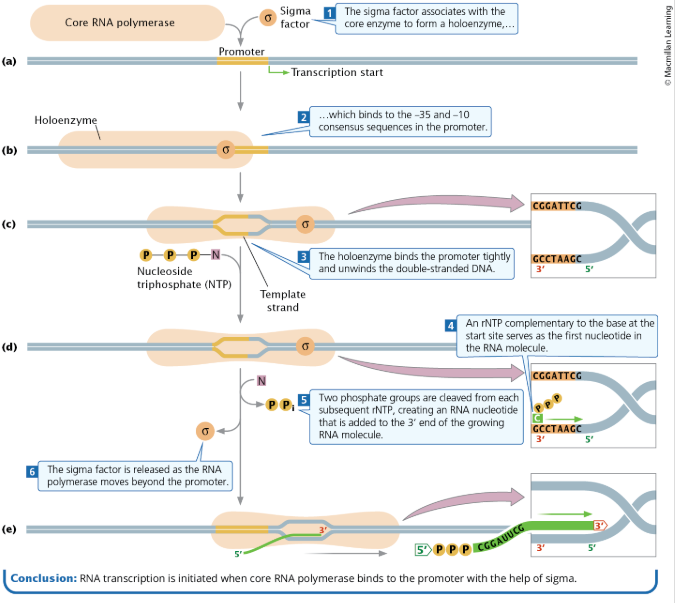
Diagram the process of holoenzyme binding.
What is the upstream element?
Consensus sequence found in some bacterial promoters that contains a number of A–T pairs and is located about 40 to 60 bp upstream of the transcription start site.
How many phosphate groups are at the 5’ end of an RNA molecule?
Three
What is abortive initiation?
Process during initiation of transcription in which RNA polymerase repeatedly generates and releases short transcripts, from 2 to 6 nucleotides in length, while still bound to the promoter. Occurs in both prokaryotes and eukaryotes.
Describe bacterial initiation.
Once the holoenzyme is bound to the promoter, RNA polymerase is positioned over the transcription start site (at position +1) and has unwound the DNA to produce a single-stranded template. To begin the synthesis of an RNA molecule, RNA polymerase pairs the base at the start site on the DNA template strand with its complementary base on an rNTP. Two of the three phosphate groups are cleaved from each rNTP as the nucleotide is added to the 5’ end of a growing RNA molecule.

Describe bacterial elongation.
RNA Polymerase undergoes a conformational change and is this unable to bind to the promoter. As it moves downstream along the template, RNA polymerase progressively unwinds the DNA at the leading (downstream) edge of the transcription bubble, joining nucleotides to the growing RNA molecule according to the sequence of the template, and rewinds the DNA at the trailing (upstream) edge of the bubble.
Describe bacterial termination.
RNA polymerase adds nucleotides to the 3’ end of the growing RNA molecule until it transcribes a terminator. Most terminators are found upstream of the site at which termination actually takes place. This process involves several overlapping events: RNA polymerase must stop synthesizing RNA, the newly made RNA molecule must be released from RNA polymerase, the RNA molecule must dissociate fully from the DNA, and RNA polymerase must detach from the DNA template.
What is the transcription bubble?
A short stretch of about 18 nucleotides of unwound DNA where RNA is continuously synthesized. About 8 to 10 nucleotides of newly synthesized RNA are paired with nucleotides on the DNA template at any one time. As the transcription apparatus moves down the template, it generates positive supercoiling ahead of the transcription bubble and negative supercoiling behind it.

What is transcriptional pausing?
The obstruction of RNA polymerase by secondary structures, specific sequences, or nucleosomes during the elongation stage of transcription. Such pauses are often caused by backtracking—when the RNA polymerase slides backward along the DNA template strand. Backtracking disengages the 3’-OH group of the RNA molecule from the active site of RNA polymerase and temporarily halts further RNA synthesis.
What are rho-dependent terminators?
Sequences in bacterial DNA that require the presence of the rho factor to terminate transcription. There are two major components of these terminators. First is the DNA sequence of the terminator itself; this sequence causes the RNA polymerase to pause. The second feature is a DNA sequence upstream of the terminator that encodes a stretch of RNA that is usually rich in cytosine nucleotides and devoid of any secondary structures.
Describe rho-dependent termination.
Once rho binds to the rho utilization site (rut), it moves toward the RNA 3’ end, following the RNA polymerase. When RNA polymerase encounters the terminator, it pauses, allowing rho to catch up. The rho factor has helicase activity, which it uses to unwind the DNA–RNA hybrid in the transcription bubble, bringing transcription to an end.

What are rho-independent terminators?
Sequences in bacterial DNA that do not require the presence of the rho factor to terminate transcription. There are two major components of these terminators. First, they contain inverted repeats, which are sequences of nucleotides on the same strand that are inverted and complementary. Second, they have a string of seven to nine adenine nucleotides that follow the inverted repeat in the template DNA.
Describe rho-independent termination.
When the inverted repeats are transcribed into RNA and bind to each other, a hairpin forms. Then, the transcription of the adenine repeats produces a string of uracil nucleotides after the hairpin in the transcribed RNA. The string of uracils in the RNA molecule causes the RNA polymerase to pause, allowing time for the hairpin structure to form. Evidence suggests that the formation of the hairpin destabilizes the DNA–RNA pairing, causing the RNA molecule to separate from its DNA template. Separation may be facilitated by the adenine–uracil base pairings, which are relatively weak compared with other types of base pairings. When the RNA transcript has separated from the template, RNA synthesis can no longer continue.

What is polycistronic mRNA?
Single RNA molecule transcribed from a group of several genes; uncommon in eukaryotes.
What are transcription factors?
Protein that binds to DNA sequences in eukaryotic cells and affects levels of transcription.
How does RNA Polymerase ensure accuracy of transcription?
When RNA polymerase incorporates a nucleotide that does not match the DNA template, it backtracks and cleaves the last two nucleotides (including the misincorporated nucleotide) from the growing RNA chain. RNA polymerase then proceeds forward, transcribing the DNA template again.
What are general transcription factors?
Protein that binds to a eukaryotic promoter near the transcription start site; part of the basal transcription apparatus that initiates transcription.
What is the basal transcription apparatus?
Complex of transcription factors, RNA polymerase, and other proteins that assemble on the promoter and are capable of initiating minimal levels of transcription.
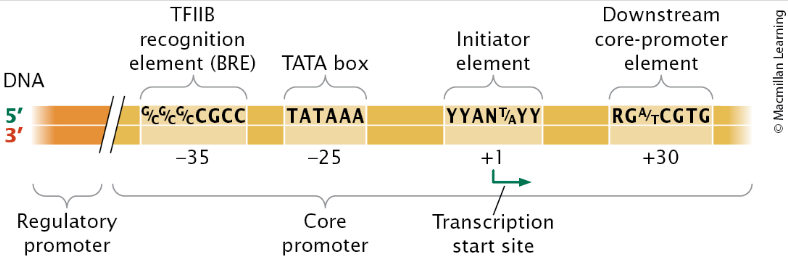
What is the core promoter?
The DNA sequence located immediately upstream of a eukaryotic gene, and the site to which the basal transcription apparatus binds.

What is the TATA box?
Consensus sequence (TATAAA) commonly found in eukaryotic RNA polymerase II promoters; usually located –25 to –30 bp upstream of the transcription start site. The TATA box determines the start point for transcription.

What is the regulatory promoter?
DNA sequence located immediately upstream of the eukaryotic core promoter; contains consensus sequences to which transcription factors bind.
What are enhancers?
Sequence that stimulates maximal transcription of distant genes; affects only genes on the same DNA molecule (is cis acting), contains short consensus sequences, is not fixed in relation to the transcription start site, can stimulate promoters in its vicinity, and may be upstream or downstream of the gene. The function of an enhancer is independent of sequence orientation.
What are internal promoters?
Promoter located within the sequences of DNA that are transcribed into RNA.
Diagram initiation of transcription in eukaryotes.

What is the role of TFIID in initiation of transcription?
It binds to the TATA box and helps to center RNA Polymerase over the transcription start site.
What did Kornberg and his colleagues discover in 2006?
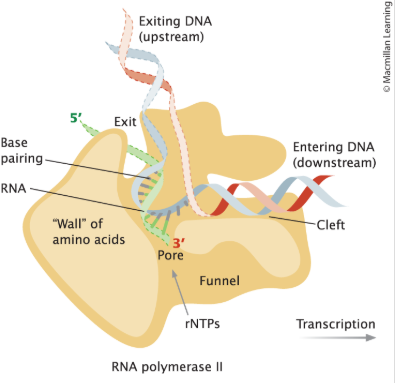
During elongation, the DNA double helix enters a cleft in the polymerase and is gripped by jawlike extensions of the enzyme. The two strands of the DNA are unwound, and nucleotides that are complementary to the template strand are added to the growing end of the RNA molecule. As it funnels through the polymerase, the DNA–RNA hybrid hits a wall of amino acids and bends at almost a right angle; this bend positions the end of the DNA–RNA hybrid at the active site of the polymerase, where new nucleotides are added to the end of the growing RNA molecule.
Does termination occur at a specific sequence in eukaryotes or prokaryotes?
Prokaryotes
What is Rat1 in yeast?
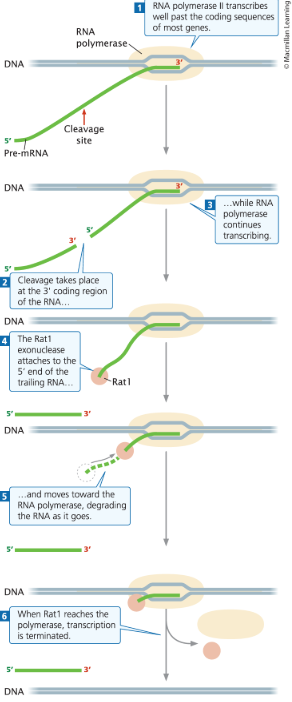
An exonuclease (capable of degrading RNA in the 5’ → 3’ direction). Like a guided torpedo, Rat1 homes in on the polymerase, chewing up the RNA as it moves. When Rat1 reaches the transcription machinery, transcription terminates.
What are modified bases?
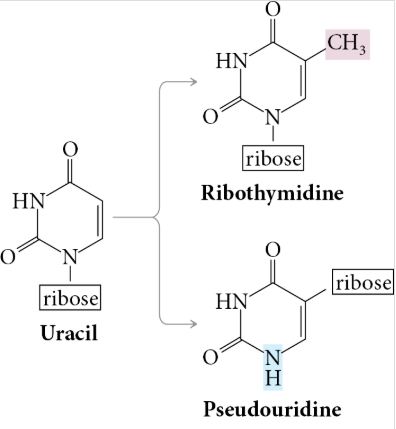
Any of several rare bases found in some RNA molecules. Such bases are modified forms of the standard bases (adenine, cytosine, guanine, and uracil). These changes are enacted by tRNA-modifying enzymes.
Describe the cloverleaf structure of tRNA.
There are four major arms; the acceptor arm, the TΨC arm, the anticodon arm, and the DHU arm. Three of the arms (the TΨC, anticodon, and DHU arms) consist of a hairpin formed by the pairing of complementary nucleotides. A loop lies at the end of the arm formed by the hairpin, where there is no nucleotide pairing.

What sequence is the attachment site of amino acids on the acceptor arm of tRNA?
CCA
What is an anticodon?
Sequence of three nucleotides in tRNA that pairs with the corresponding codon on mRNA to ensure that the amino acids link in the correct order during translation.
Name the four arms of a tRNA molecule.
Acceptor arm
TΨC arm
Anticodon arm
DHU arm
How are most tRNAs processed?
They are transcribed as part of larger precursors that are then cleaved, trimmed, and modified to produce mature tRNAs.

What did Alfred Hersey discover in 1953?
Findings from later studies showed that short-lived RNA synthesized after infection had a nucleotide composition similar to that of the phage DNA but quite different from that of the bacterial RNA. These observations were consistent with the idea that RNA was copied from DNA and that this RNA then directed the synthesis of proteins.
Describe how Brenner, Jacob, and Meselson demonstrated that ribosomes do not carry genetic information.
Using isotopes of nitrogen and carbon and equilibrium density gradient centrifugation they demonstrated that new ribosomes are not produced during the burst of protein synthesis that accompanies bacteriophage infection. Thus, ribosomes could not be the carriers of the genetic information needed to produce new phage proteins.

What type of RNA did Francois Gros discover?
mRNA
What is a codon?
Sequence of three nucleotides that encodes one amino acid in a protein.
What is the 5’ untranslated region (5’ UTR) / the leader?
Sequence of nucleotides at the 5’ end of mRNA; does not encode the amino acids of a protein.
What is the Shine-Dalgarno Sequence?
Consensus sequence found in the bacterial 5’ untranslated region of mRNA; contains the ribosome-binding site.

What is the protein-coding region?
The part of mRNA consisting of the nucleotides that specify the amino acid sequence of a protein.
What is the 3’ untranslated region (3’ UTR) / trailer?
Sequence of nucleotides at the 3’ end of mRNA that is not translated into amino acids; affects the stability of the mRNA and helps regulate the translation of the mRNA protein-coding sequence.
Transcription and translation occur simultaneously in ___(prokaryotes/eukaryotes).
Prokaryotes
What is the function of adding the 5’ cap to mRNA?
This facilitates binding of the ribosome to the 5’ end of mRNA, increases mRNA stability, and enhances RNA splicing.
What is added to mRNA to create a 5’ cap?
7-methylguanosine and additional methyl groups

What is the function of adding the poly-A tail to mRNA?
It increases stability of mRNA, aids in export of mRNA from the nucleus, facilitates binding of ribosome to mRNA
How is the poly-A tail added to mRNA?
Via polyadenylation

What are some internal modifications of mRNA?
The most abundant internal modification of mRNA is the formation of N6-methyladenosine by the addition of a methyl group to the nitrogen atom in the 6 position of adenine. Other modifications found in mRNA include m1A (addition of a methyl group to the 1 position of adenine), ac4C (addition of an acetyl group to the 4 position of cytosine), and modified bases such as inosine and pseudouridine (which also occur in tRNAs).
What is RNA splicing?
Process by which introns are removed from RNA and exons are joined together.
When does RNA splicing occur?
Cotranscriptionally
What are the three sequences in the intron necessary for splicing (splicing code)?
5’ split site
3’ split site
Branch point

What is the branch point in RNA splicing?
Adenine nucleotide in nuclear pre-mRNA introns that lies 18 to 40 nucleotides upstream of the 3’ splice site.
What is the spliceosome?
Large complex consisting of several RNAs and many proteins that splices protein-encoding pre-mRNA; contains five small nuclear ribonucleoprotein particles (U1, U2, U4, U5, and U6).
What is a lariat?
Loop-like structure created in the splicing of nuclear pre-mRNA when the 5’ end of an intron is attached to the branch point.
Describe the process of RNA splicing.
Before splicing takes place, an intron lies between an upstream exon (exon 1) and a downstream exon (exon 2). The pre-mRNA is first cut at the 5’ splice site, freeing exon 1 from the intron, and the 5’ end of the intron attaches to the branch point, forming a structure called a lariat. In this reaction, the guanine nucleotide in the consensus sequence at the 5’ splice site bonds with the adenine nucleotide at the branch point. As a result, the phosphate group of the guanine nucleotide becomes attached to the 2’-OH group of the adenine nucleotide at the branch point. A cut is made at the 3’ splice site, and simultaneously, the 3’ end of exon 1 becomes covalently attached (spliced) to the 5’ end of exon 2. The intron is released as a lariat. A lariat-debranching enzyme then breaks the bond at the branch point, producing a linear intron that is rapidly degraded by nuclear enzymes. The mature mRNA, consisting of the exons spliced together, is exported to the cytoplasm, where it is translated.
