Heart
 Call Kai
 Learn
Learn Practice Test
 Spaced Repetition
 Match
Match Flashcards
 Knowt Play
1/236

There's no tags or description
Looks like no tags are added yet.
Name | Mastery | Learn | Test | Matching | Spaced | Call with Kai | Chat |
|---|
No analytics yet
Send a link to your students to track their progress
237 Terms
What lies between the sternum of the anterior chest?
The heart
What is the precordium?
Area of chest overlying the heart
What is the upper portion of the heart called?
base
What is the narrower lower tip of the heart called?
apex
For a tall slender patient, what position does the heart tend to hang?
Vertical position, more central
For a shorter patient, what position does the heart tend to hang?
More horizontal, more to left side
What is dextrocardia?
heart condition either rotated or displaced, where heart positions more to right
What is situs inversus?
Congenital condition where heart & stomach are placed to right side, liver is on the left side of body
Two thirds of the heart lies on what side of the sternum?
On the Left side
What are the three layers encased in the pericardium?
Epicardium (outer)
Myocardium (middle)
Endocardium (inner)
What side of the heart pumps de-oxygenated blood to the lungs?
Right Side
What side of the heart pumps oxygenated blood to the rest of the body?
Left side
True or false? Pressure within the RV, RA, and pulmonary artery are greater than the L side
True
What are the two cardiac cycle phases?
Systole and Diastole
What happens in systole stage of cardiac cycle?
Ventricles start to contract
Forces Mitral and tricuspid (AV) valves close (S1)
Atria refills at same time
Pressure of Systole rises until it exceeds in aorta and pulmonary arteries
Aortic and pulmonic valves open (no sound), allowing for blood to be ejected into arteries
Pressure falls
Aortic and pulmonic valves close (S2)
What is happening to the heart during S1 sound?
Mitral and tricuspid valves closing (LUB)
**beginning of systolic cardiac phase where ventricular contraction raises pressure in ventricles forcing these valves close
What is happening to the heart during S2 sound?
Aortic and pulmonic valves closing
What occurs during the diastole cardiac cycle phase?
Mitral and tricuspid (AV) valves open (no sound)
Ventricles dilate
Blood from atria moves/fills into ventricles (S3)
Atria contracts (S4)
True or false? Blood moving from atria to ventricles can produce S4 sounds d/t rapid ventricular filling.
False. Can produce S3
What heart sound is heard when the atria contracts, allowing for forceful ejection of blood into ventricles?
S4 sound
Which type of examination are you performing when you identify a bruit?
A. inspecting the skin
B. observing chest movement
C. auscultating the artery
D. palpating the artery
C. auscultating the artery
Which events occur during the systolic phase of the cardiac cycle?
A. The atria and the ventricles contract
B. The ventricles contract and the atria relax
C. The atria contract and the ventricles relax
D. The right side of the heart contracts and the left side relaxes
B. The ventricles contract and the atria relax
Mr. Herrara is a 42-year-old patient who presents for routine well visit. On examination during cardiac auscultation, you note a midsystolic murmur with a medium pitch; a coarse thrill is palpated as well. These findings are consistent with which condition?
A. Aortic regurgitation
B. Mitral stenosis
C. Aortic stenosis
D. Pulmonary stenosis
C. Aortic stenosis
Which of the following changes occur at birth in a normal infant?
A. The ductus arteriosus closes
B. Pressure in the right atrium rises
C. The foremen ovale opens
D. The relative mass of the left ventricle decreases
A. The ductus arteriosus closes
In most adults, the apical pulse should be visible at the:
A. costoverebral angle
B. sternal notch
C. Midaxillary line in the fifth right intercostal space
D. Midclavicular line in the fifth left intercostal space
D. Midclavicular line in the fifth left intercostal space
A condition that results in progressive ischemia caused by insufficient perfusion is referred to as:
A. Raynaud’s
B. Peripheral atherosclerotic disease
C. arterial aneurysm
D. venous thrombus
B. Peripheral atherosclerotic disease
Which person is most at risk for developing venous thrombosis? A person:
A. Who takes 0.35 mg of estrogen a day
B. With aortic insufficiency
C. On bed rest for four days following a trauma
D. Who smokes one pack of cigarettes per day
C. On bed rest for four days following a trauma
A disruption to the flow of blood into, though, or out of the heart produces which cardiac sound?
A. S3
B. friction rub
C. prediastolic gallop
D. murmur
D. murmur
Stroke volume is defined as the
A. Amount of blood ejected per minute
B. Amount of blood ejected per heartbeat
C. Combined amount of blood contained within each atria
D. Amount of blood ejected per second
B. Amount of blood ejected per heartbeat
Where would you place your stethoscope to auscultate the aortic valve area?
A. Fourth left intercostal space along the lower left sternal border
B. Second left intercostal space at the left sternal border
C. Second right intercostal space at the right sternal border
D. Third left intercostal space at the left sternal border
C. Second right intercostal space at the right sternal border
Mrs. Bower is a 55-year-old patient who presents to your office with a complaint of fatigue. On palpating the precordium during her examination, a heave OR lift is identified with lateral displacement of the apical pulse. Which problem might this finding indicate:
A. aortic stenosis
B. pericarditis
C. mitral regurgitation
D. left ventricular enlargement
D. left ventricular enlargement (LV hypertrophy)
Mr. Sherman is a 65-year-old patient who has long-standing hypertension. Which clinical finding would you expect?
A. Decreased cardiac irritability
B. Increased stroke volume
C. Decreased blood volume
D. Thickened myocardium
D. Thickened myocardium
Opening between the left and right ventricles
ventricular septal defect
Systemic connective tissue disease that commonly occurs after streptococcal infection
rheumatic fever
Sinoatrial node dysfunction
sick sinus syndrome
Bacterial infection of the endothelial layer of the heart
endocarditis
Syndrome in which the heart fails to propel blood forward
heart failure
Elevated serum cholesterol
hyperlipidemia
Inflammation of the pericardium
pericarditis
Increase in mass and lateral displacement of the left ventricle
left ventricular hypertrophy
Thickening and calcification of the aortic valve
aortic stenosis
Substernal pain or intense pressure
angina
What are the atrioventricular cardiac valves?
Tricuspid valve and mitral valve
What are the semilunar cardiac valves?
Pulmonary valve and aortic valve
What does the tricuspid valve separate? How many cusps (leaflets) does this valve have?
Separates RA and RV, has 3 cusps
What does the mitral valve separate? How many cusps (leaflets) does this valve have?
Separates LA and LV, has two cusps
What does the pulmonic valve separate? How many cusps (leaflets) does this valve have?
Separates RV and pulmonary artery; has three cusps
What does the aortic valve separate? How many cusps (leaflets) does this valve have?
Separates LV and aorta; has three cusps
3/4 cardiac valves have three cusps. Which valve only contains two cusps?
Mitral valve
When considering pregnant women, what hemodynamic changes to the heart occurs in this population?
Maternal blood volume increases 40-50% above pre-pregnant levels
HR and stroke volume (SV) increase to accommodate blood volume increase
LV increases in wall thickness & mass
Heart positions more horizontally
Diaphragm moves upwards d/t uterine enlargement
When considering older adults, what hemodynamic changes to the heart occurs in this population?
Heart size can decrease
LV and endocardium thickening
Fibrosis and calcification of heart valves
HR slows
Stroke volume (SV) and cardiac output during exercise decreases
Myocardium losses elasticity
Enhanced electrical irritability
What does cardiac health history revolve around?
Symptomology of chest pain (angina pectoris)
**providers must assume all patients with symptoms of chest pain is related to a cardiac nature to rule out
How would a provider assess HPI of chest pain in relation to cardiac?
the use of OLDCARTS and current medication use
How would a provider assess HPI of fatigue?
Unusual or persistent
Inability to keep up with peers
associated symptoms
medications: ex. beta blockers
How would a provider assess HPI of cough?
onset and duration
character
Medcations: ex. ACE inhibitors - common is lisinopril
How would a provider assess HPI of dyspnea?
Aggravated by exertion (at rest or with activity)
Worsening from onset vs. remains stable
Lying flat and is relieved by sitting up or with pillows (orthopnea)
Paroxysmal nocturnal dyspnea
How would a provider assess HPI of loss of consciousness (syncope)?
Palpitations
Dysrhythmias
Unusual exertion
Sudden turning of neck
Looking upward
Change in posture
A patient comes in with complaints of a syncope episode. When assessing subjective data, the patient explains the episode preceded after turning their neck fast. What cardiac structure would the provider assume this would be related to?
Carotid sinus
A patient comes in with complaints of a syncope episode. When assessing subjective data, the patient explains the episode preceded after attempting to look upward at their ceiling. What cardiac structure would the provider assume this would be related to?
The vertebral artery
Under past medical history, what should a provider address when considering the cardiovascular system?
Cardiac surgery and hospitalization
Rhythm disorder
Acute rheumatic fever, unexplained fever, swollen joints, inflammatory rheumatism
Chronic illness
Under family history, what should a provider address when considering the cardiovascular system?
• Long QT syndrome
• Diabetes
• Heart disease
• Dyslipidemia
• Hypertension
• Congenital heart defects
• Family members with cardiac risk facto
Under personal and social history, what should a provider address when considering the cardiovascular system?
• Employment
Physical demands
Environmental hazards
• Tobacco use
• Nutritional status
• Personality assessment
• Relaxation activities
• Use of alcohol and/or drugs
What are common older adult symptoms of a cardiovascular-related disorder?
• Confusion and syncope
• Palpitations
• Coughs and wheezes
• Hemoptysis
• Shortness of breath
• Chest pain and tightness
• Incontinence, impotence, and heat intolerance
• Fatigue
• Leg edema
When assessing the cardiovascular system during inspection, what abnormalities is the provider looking for?
Apical impulse, pulsation, heaves, or lifts
When assessing the cardiovascular system during palpation, what abnormalities is the provider looking for?
Apical impulse, thrill, heaves, or rub
When assessing the cardiovascular system during percussion, what abnormalities is the provider looking for?
trick question, there is little value to percussion in cardiovascular assessment
When assessing the cardiovascular system during auscultation, what abnormalities is the provider looking for?
Systematically evaluate aortic, pulmonic, tricuspid and mitral (apical)
True or false? Remember to inspect, palpate, and percuss before auscultating the heart and lungs.
True
What landmark helps locate the apical impulse?
the mid-clavicular line in the 5th intercostal space

To help visualize a presence of jugular vein distention (JVD), what position should a patient be in?
recombinant position

When performing cardiac palpation, what sequence should a provider follow?
Palpation of apex
Left sternal border
Base
Right sternal border (into the epigastrium or axillae if circumstance dictates)
Apical impulse
Carotid artery palpation
How would you characterize an apical impulse that is more vigorous or forceful than expected?
As a heave or lift
True or false? Point of maximal impulse (PMI) is the point at which the apical impulse is most readily heard.
False, it is the point at which it is most SEEN or FELT
What is a thrill?
a fine, palpable, rushing vibration, sometimes found as a palpable murmur
Because percussion has limited value in defining borders of the heart and determination of size, how is the LV size best judged?
By assessing the location of the apical impulse
If the RV size becomes enlarged, how would the provider expect this cardiac region to anatomically expand?
RV would enlarge in the antero-posterior diameter rather than laterally
What comorbidity can cause unusual muscular development and distortion of cardiac findings?
Obesity
What diagnostic test is best used for defining heart borders?
Chest X-Ray
What are the 5 traditionally designated auscultatory areas to assess for the heart?
Aortic valve
Pulmonic Valve
Second pulmonic area
Tricuspid area
Mitral (apical) area
When you auscultate the aortic valve area, what anatomical landmark do you reference?
Second right intercostal space at the right sternal border.
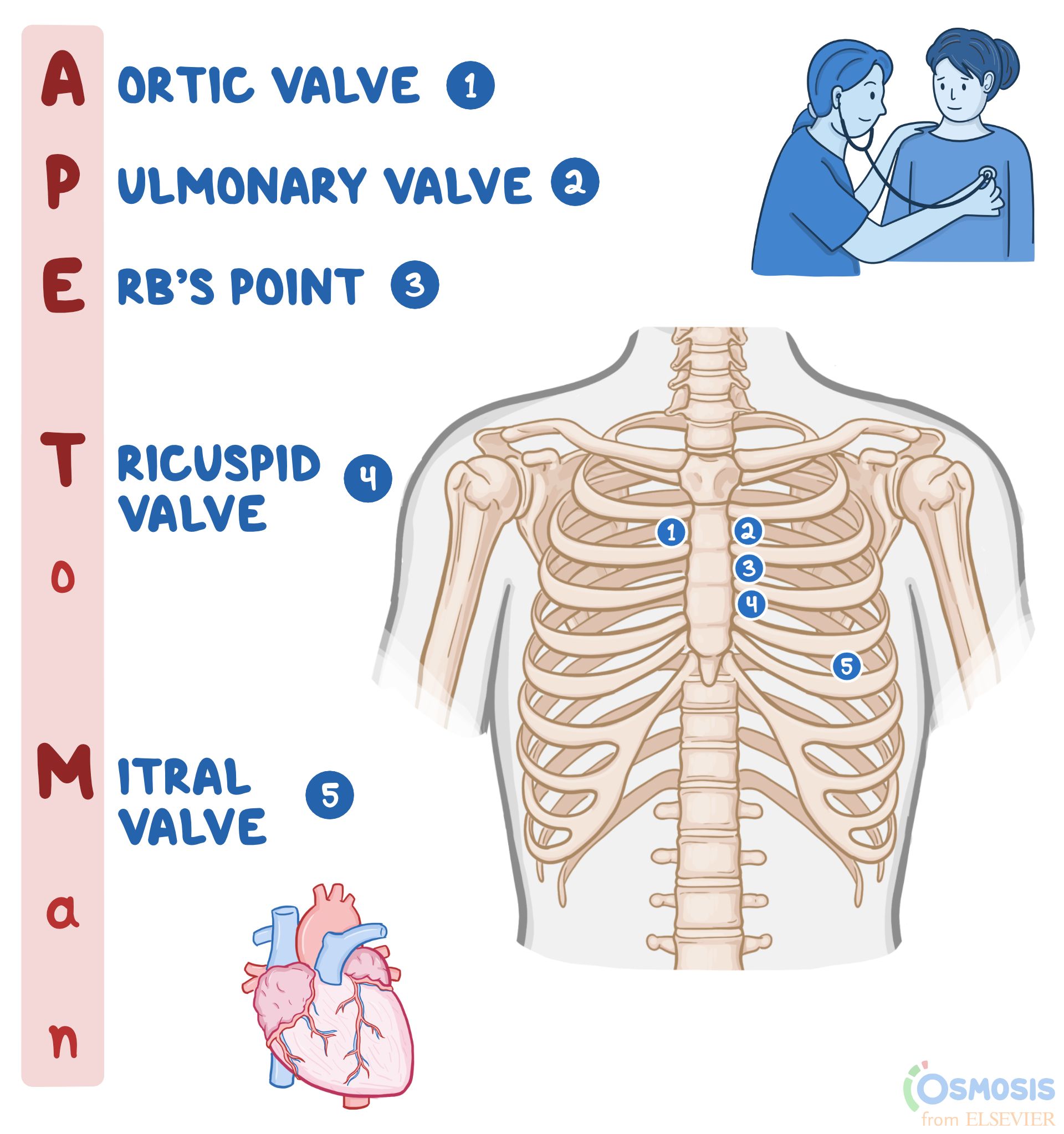
When you auscultate the pulmonic valve area, what anatomical landmark do you reference?
Second left intercostal space at the left sternal border.

When you auscultate the second pulmonic valve area, what anatomical landmark do you reference? What is this area also commonly known as?
Third left intercostal space at the left sternal border; also known as Erb's point.

When you auscultate the tricuspid valve area, what anatomical landmark do you reference?
Fourth left intercostal space along the lower left sternal border
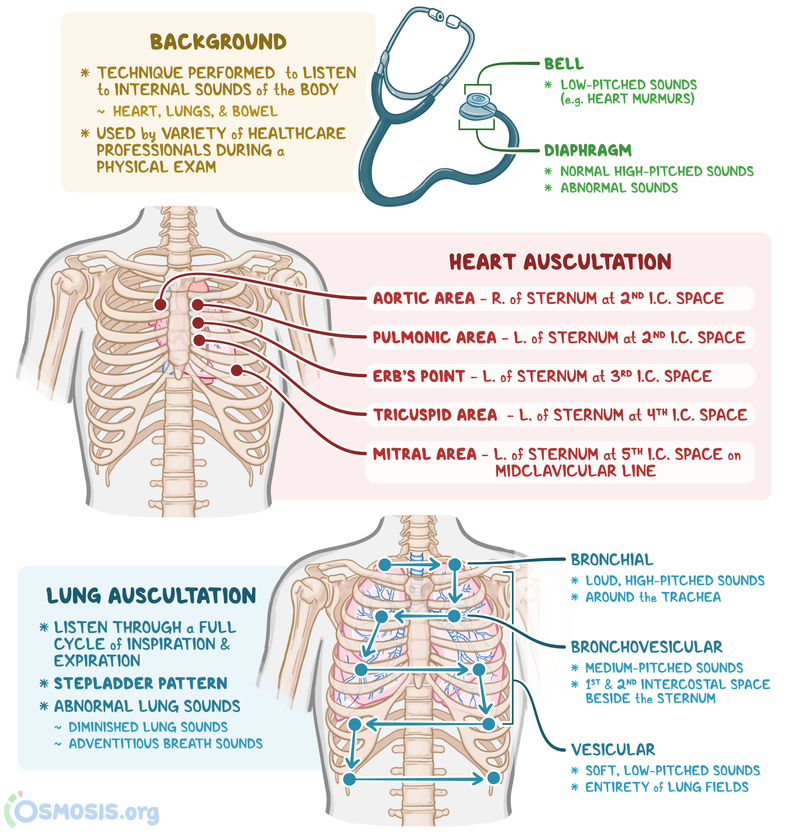
When you auscultate the mitral valve area, what anatomical landmark do you reference?
Apex of the heart in the fifth left intercostal space at the midclavicular line

When you are auscultating the heart, what things are you assessing?
Rate/rhythm
Frequency
Intensity
Duration
Pathology
What are some abnormal heart sounds?
Gallops
Mitral Snaps
Ejection Clicks
Friction Rubs
When a provider evaluates a patient’s heart rhythm what do they obtain?
The heart rate
Steadiness of the rhythm (regular)
If irregular, determine pattern
If a patient’s heart pattern is irregular and repetitively occurs, what could this indicate?
A cyclic variation of heart rate, such as sinus dysrhythmia
If a patient’s heart pattern is irregular and is unpredictable, what could this indicate?
heart disease or conduction impairment
What is a cardiac murmur?
Extra heart sounds during systole and diastole secondary to some type of disruption of flow
Characteristics of a cardiac murmur depend on what?
Adequacy of valve function (stenosis/regurgitation)
Size of valve opening
Rate of blood flow
Vigor and thickness of myocardium
What day after conception can a heart beat be found?
Day 23 of gestation
What week of gestation can a heart valve be formed? What week is valve formation complete?
4th week formed, 8th week complete
What is a patent foramen ovale?
A hole between the R & L atriums

What is a patent ductus arteriosus?
An opening between the pulmonary artery and aorta

What part of a blood pressure is preload?
diastole
What part of a blood pressure is afterload?
Systole
When considering preload (diastole), what is occurring in the heart?
Amount of blood in the ventricles at the end of diastole (ventricle relaxation)
**amount of STRETCH at the end of ventricular filling
When considering afterload (systole), what is occurring in the heart?
Amount of resistance of flow the ventricles must OVERCOME to contract and eject blood volume (ventricle contraction)
**amount of pressure the LV of the heart needs to exert force to open the aortic valve during systole
What is the difference between ventricular functions in systole and diastole?
Systole: Ventricular contraction
Diastole: ventricular filling and relaxation