Energy Midterm 2
 Call Kai
 Learn
 Practice Test
 Spaced Repetition
 Match
 Flashcards
 Knowt Play
1/211

There's no tags or description
Looks like no tags are added yet.
212 Terms
Current (i)
measures flow of electrons, measured in amperes (A)
Amperes (A)
coloumbs/sec
Voltage (V)
Potential difference
Volts
joules/coloumb
Resistance (R)
opposes current, measured in ohms
Ohms
Volts/ampere
Electrons
Subatomic particles, negative charge, circle protons
Insulator
Tightly bound valence electrons, electrons not looking to move or bond
Conductor
Weak bonds, electrons eager to move, induced electric field causes negative charges to go to one side and positive charges to go to another, creates a chain of hopping across the conductor
What is going on in a battery?
Sea of electrons moving simultaneously, electric field is created, which drives electrons to move, movement stops when the switch opens
Explain what happens in a lightbulb.
The thin wire in the light bulb creates more resistance (friction) since it is so thin, meaning electrons bump into each other, which generates more heat, so much that that heat is released as a form of radiant energy.
Direct current
One directional current
Alternating current
Two directional current
Explain what happens during alternating current.
A changing magnetic flux induces a voltage, and as the rotor turns, this voltage falls to 0, and then back up again to maximum, creating a sin curve
Frequency
Refers to how many cycles the electric current can complete in 1 second, where 1 Hz equals 1 cycle per second
Standard frequency in the United States
60 Hz
Lenz’s Law
states that an induced electric current flows in a direction such that the magnetic field it creates opposes the original change in magnetic flux that produced it
What is going on inside of a lightbulb?
Thin wire in light bulb creates more friction because there is less room for the electrons to move around, which generates more heat, and releases heat in the form radiant energy.
What happens when a switch is closed on a battery?
Electrons move through the external circuit from the negative towards the positive terminal. Chemical reactions inside the battery restore the charge separation and supply energy to the circuit.
Conventional current
Defined in the opposite direction, from positive to negative
Electromagnetism
Changing electric field produces a magnetic field. A changing magentic field will produce an electric field.
When a conductor is moving parallel to the magnetic field…
the induced voltage is 0
When a conductor is moving perpendicular to the magentic field…
the induced voltage is at its max
How do you generate an AC with a moving wire?
By rotating a wire in a fixed magnetic field, it exposes the wire to a changing field, which induces an alternating current
How does an electromagnetic generator work?
Contains a rotor, which is the magnet that spins and has a series of alternating magnets along it axes
Contains stator: stationary component of generator, contains series of wires for power to flow through
Contains 3 wires that create the 3 phase current
What turns the electromagnetic generator?
Hydroelectrc: dam or natural heigh rasies water’s potential energy, water flows through the penstock across the turbine, which turns the generator
Wind: wind flows over turbine blades to turn turbine
Thermoelectric: heat changes a working fluid from liquid to steam, which turns the turbine, fuels include coal, natural gas, and nuclear
Basic steam plant process
1) Water starts as a liquid
2) Water is pumped into furnace and converted into steam
3) Steam does work and moves the turbine
3) Steam is condensed back into water
The Rankine Cycle
IDEALIZED thermodynamic cycle that converts heat energy into mechanical work or electricity
1) Water is a liquid: volume and pressure are low
2) Water is pumped into furnace: pressure increases, therefore temperature also increases
adiabatic compression: no heat enters or leave, so temp only rises because work is done on the water
3) Water turns into steam and spins the turbine: occurs at constant temperature and volume increases
Adiabatic expansion (work out): steam expands to push the turbine, which is work out, temperature and pressure drop due to work, not heat exchange
4) Heat leaves the steam and is condensed back into water, occurs at constant temperature and volume shrinks

Energy lost in a power plant is an effect of the difference between the cold temperature of the liquid water and the hot temperature of the steam. True or False.
True
The bigger the difference in temperature between liquid water and steam…
the higher the efficiency
Carnot efficiency
An ideal efficiency for power plants, does not take into account heat losses, which reduces the amount of work you can get out of the plant

Actual efficiency of a power plant will always be more or less than the Carnot efficiency
Less
What is the most efficient power plant?
Natural gas combined cycle (NGCC) plant, carnot efficiency is about 80-85% while the actual efficiency is 63-64%
Plants are more effficient in the summer or the winter
Winter. Cooler external temps increase temp difference between water and steam
Brayton Cycle Plants
Used in natural gas combustion turbines and engines
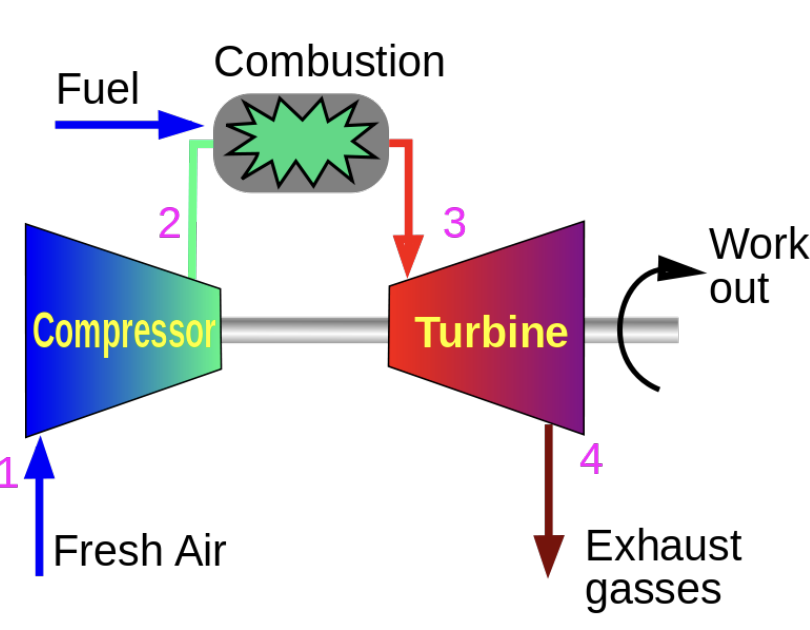
This is when air is compressed, mixed with natural gas, and combusted. Heat released drives the turbine, and exhaust is released into the atmosphere (no recycling of air)
Combined Cycle Plant
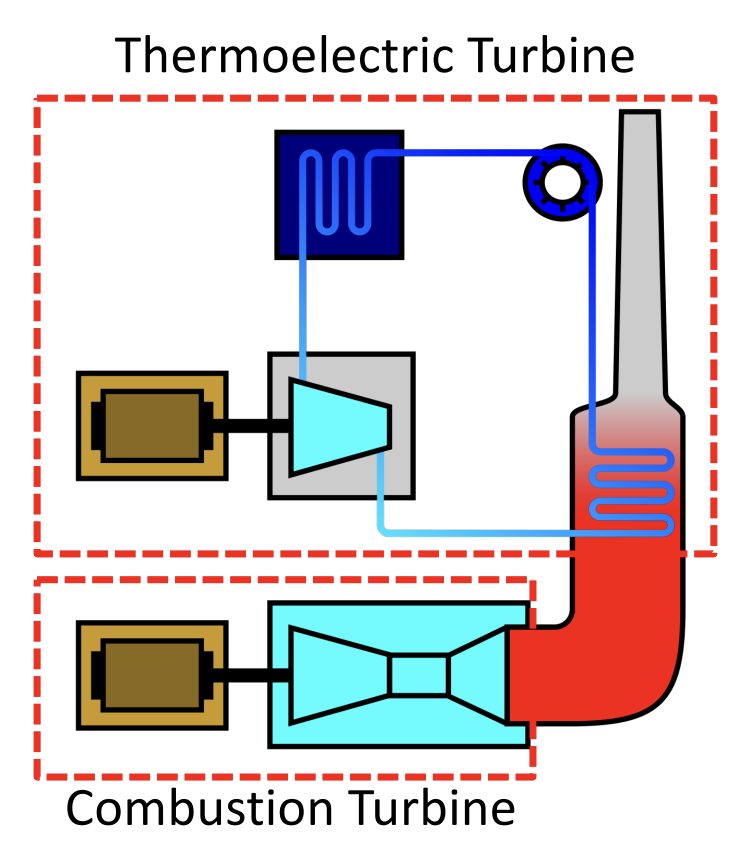
Pairs the Rankine cycle with the Brayton Cycle: uses both a gas turbine and steam turbine to generate electricity
Air is compressed, combusted with natural gas, exhaust is created to spin gas turbine, exhaust is also used to boil water into steam, which drives second steam turbine, more efficient than either cycle alone
Combined heat and power plant
When a plant uses the wasted heat for some other form of work
Plant capacity
max power output of a plant, expressed in Megawatts (MW)
Types of plant capacity
Nameplate capacity, net summer capacity, and net winter capacity
Nameplate capacity
Maximum output within design thermal limits, almost like what the label says on the box
Net summer capacity
Actual maximum output during the summer, basically what energy is actually put into the grid
Net winter capacity
Actual maximum output during the winter, basically what energy is actually put into the grid
Plant efficiency
Actual electric output of the plant.

How do thermo electric power plants express plant capacity?
They express it has a heat rate, which can then be multiplied by the fuel cost to get the cost of electricity in dollars per MWh.

How do efficiency of plants rank?
Hydroelectric plants are the most efficient, then steam power plants, then wind and solar
Plant capacity factor
Metric that is based on the performance of a plant over a period of time, usually 1 years, is the amount of energy produced in a year/plant’s capacity if running 24/7/365

Plant capacity of factor of nuclear
93%, can run continously all year long
Plant capacity of solar, wind, and gas turbine
Solar and wind: 25 to 35%
Gas turbine: 12%
What is the frequency of AC current in the United States?
60 Hz
Explain the three phases of AC current.
The complete cycle takes 360 degrees, peaks are separated by 120 degrees, when you have (voltage x current) across three phases you get constant power

How does a step up transformer work?
The voltage coming out of a plant is low (2kV), so transformers increase the voltage to higher levels (10-100s kVs), as voltage is stepped up, current decreases, voltage is stepped up to reduce energy losses
How do high voltage transmission towers work?
Three wires carry the current, above three wires there is a ground line for safety

What is the order in which current flows?
Generator —> step up transformer —> high voltage transmission lines —> transmission substation with step-down transformers —> distribution lines —> neighborhood transformer
What is the material that power lines are made of?
Copper
Copper power line has BLANK and BLANK.
Material resistivity and overall resistance
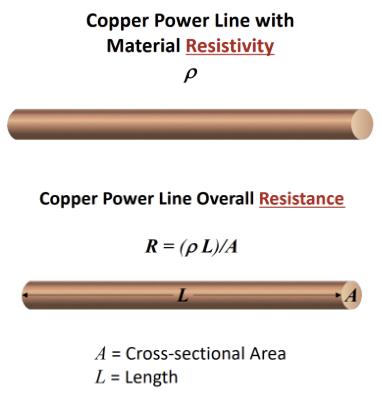
Material resistivity is a property of the material itself, describes how strongly a material opposes flux, copper has low resistivty, therefore great conductor
Overal resistance: depends on material, length, and area, so longer wires have more resistance and thicker wires have less resistance, low resistance is the goal because it loses less power
Power loss due to transmission
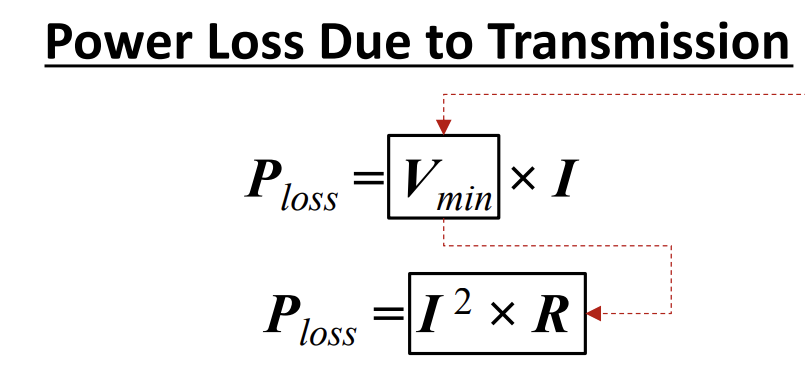
P1 - P2 = Ploss

Equation for electric power
P = V x I

Ohm’s Law
V = I x R

On a transmission line, what is fixed?
Material, length, and area are all fixed, therefore overal resistance is fixed, current is also constant
Power loss due to transmission

Explain how a step down transformer works.
AC in the primary coil creates a changing magnetic field in an iron core, which induces a lower voltage in the secondary coil because it has fewer wire turns
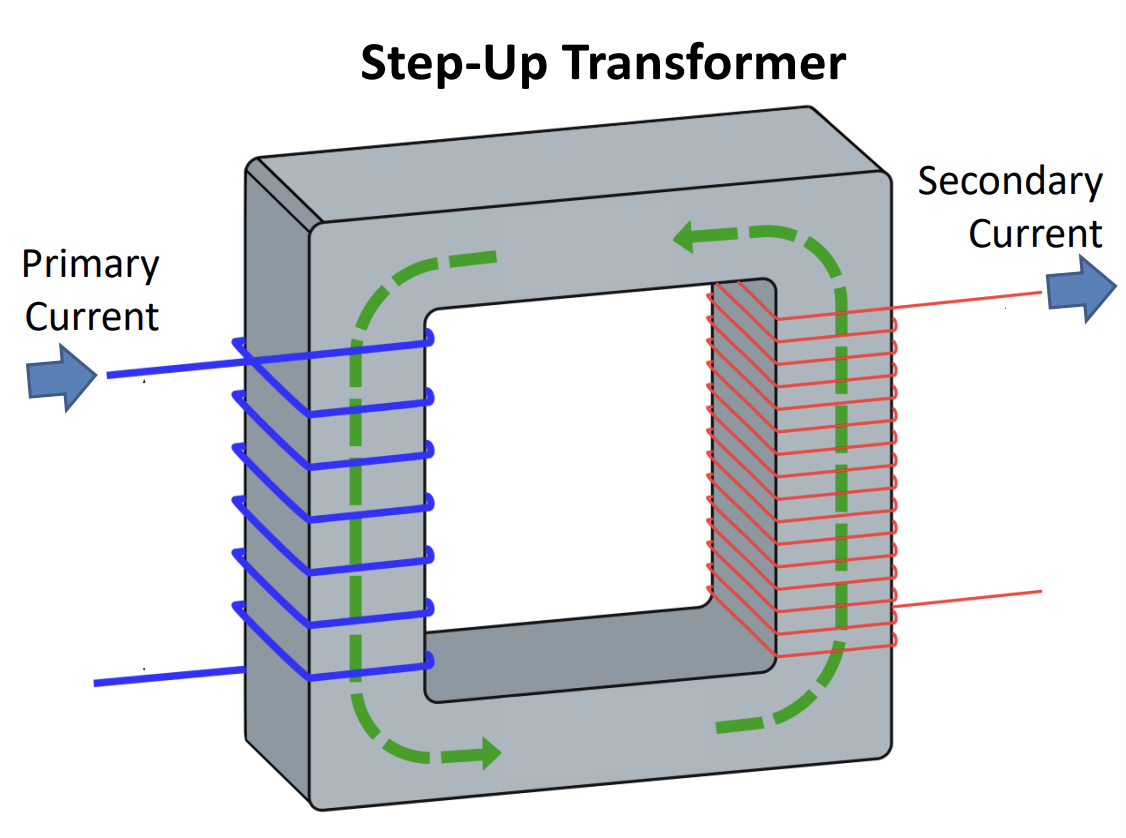
Explain how a step up transformer works.
Primary current enters, current creates a changing magnetic field since the current is AC, core carries flux around the loop, passes through the secondary winding on the right, since the right has more coils, the output voltage is twice the input voltage, since voltage goes up, current goes down, which reduces power loss
Apparent power is always more or less than true power.
More. The power that goes into a transformer will always be greater than the true power actually leaving the transformer because of small losses, losses are known as reactive power

Homes get BLANK-phase power; bigger customers get BLANK-phase.
Single; 3
Distribution transformers
Transformers that step down electricity before it enters homes
When you increase the load (need for energy) what happens?
When load increases, the generator will slow down, so frequency drops, which is an indicator that power output must be increased
The only way for a generator to increase power output is to…
burn more fuel
Since there is no way to store a lot of power, the supply of electirc power must be…
In balance with the demand
Describe what a winter load profile looks like.
At min during the early hours of the morning, 5:30am the demand rises (people waking), peak at 9:30am, declines throughout the day because it gets warmer therefore not as much heating, peaks at 7:30pm (dinner + ppl at home again)
Describe what a summer load profile looks like.
At min during nighttime but still higher than the in the winter, peaks in the afternoon because of AC use
What are the two components that characterize a power plant?
Price and flexibility
What are the costs for a power plant?
Capital costs: fixed and variable
fixed: labor
variable: costs that scale with the amount of power you generate, like fuel
Levelized cost of electricity (LCOE)
A metric that folds all the costs into a single number, creates the cost to generate one Megawatt hour of electricity over its expected lifetime
Ramp rate
How quickly the power plant can come online, natural gas combustion can come off and on quickly, nuclear takes a long time
Explain how the flexibility of a plant correlates with its cost.
Very expensive plants like NGCC are expesnive to build, however, they are very flexible and you can run them for much of the year, whereas cheap plants like nuclear have a very low flexibility
Base load
Level of constant power during a day, the load that MUST be met, usually met with plants that have high capacity factors (nuclear or coal)
Load following
Generation that occurs to match the load of the day, supplied by the cheapest plant, usually natural gas combined cycle
Peak demand
Only needs to be met for a short period of time, met with natural gas turbine (referred to as peaking plants), capacity factor is very low, costs the most to operate
What are the responsibilties of system operators?
Forecast day ahead electricity demand, schedule generation, schedule backup generation and other ancillary services, schedule use of transmission lines, share schedule with operators of connected systems, adjust generation in real time, fix grid and resotre power if there is an outage
What are ancillary services?
Support services that keep the grid stable and reliable
Automatic Generation Control (AGC)
Computer signal from operators that tells the plants to produce more or less power automatically
Spinning reserves
Generators that are already runnng and connected to the grid, but operating below full capacity, so they have room to ramp up
Non-spinning reserves
Generators that are offline but can start up and reach full output very quickly
Supplemental reserves
Backup in case spinning and non spinning reserves have been used, slower to come online
Types of power plants used to meet different loads summary.
Nuclear and some coal plants may provide steady output; natural-gas combined-cycle plants and hydroelectric facilities can follow demand; simple-cycle gas turbines, batteries, and demand response can meet peaks
What is the timing of the different ancillary services?
Regulation reserve comes on the fastest, then stops pretty quickly, spinning and non-spinning reserves also pretty fast and can last around 20 minutes, replacement reserves take longer to come online, 30 minutesish, but last a lot of longer

What are the three NERC interconnections in the United States?
Eastern, ERCOT, and Western
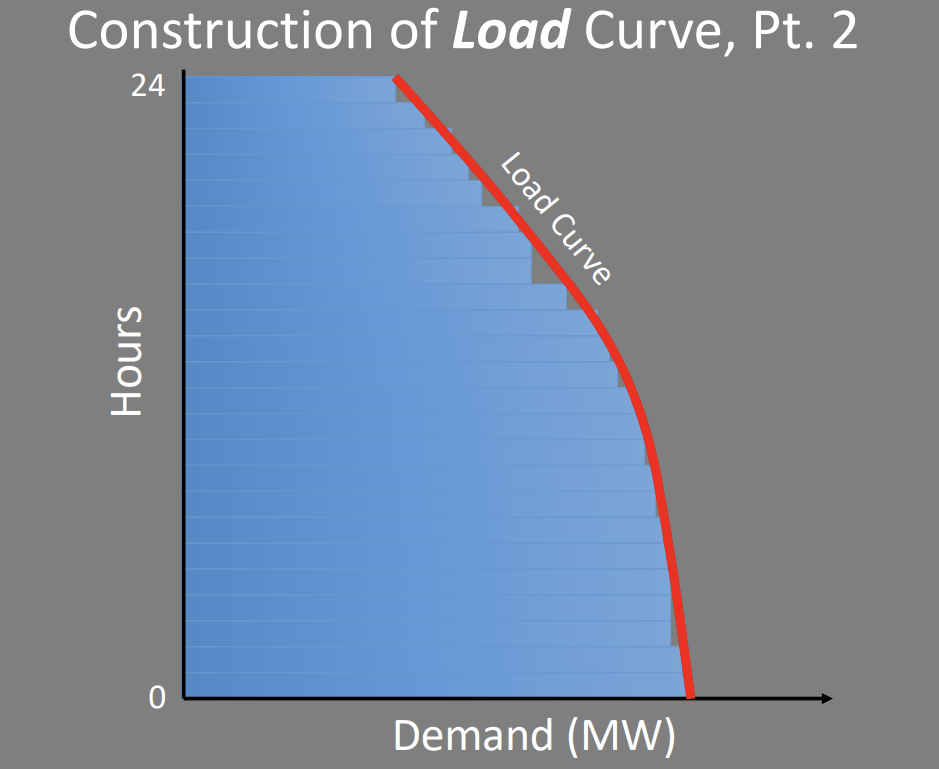
Explain how to construct a load curve for the day ahead forecast.
For each hour, you estimate the demand in MW. Then, put demand on the x axis and hours on the y axis, with the hours in order of most demand to least demand. Shortest bar is the base load, longest bar is the peak load, and everything in between represents the amount of hours you need demand for.
Explain how to construct a dispatch (supply) curve for the day ahead forecast.
Get offers from plants: “how many MW of power can you provide and at what cost?”, baseload plants are bidding in very low (low flexibility), while other plants that are more expensive bid at higher prices, take plant capacity (width) and price (height), and order bids from lowest price to highest price

How is the load curve used in conjuction with the dispatch curve?
Wherever the baseload falls on the load curve, the plants on the dispatch curve that match up is whose power will be used to supply the baseload, same thing for load following and peaking, can also determine the price per MWh each hour of the day

The most expensive plants sets the price for the rest of the plants in day ahead supply. Why?
At peak demand, you need to call on every plant, including the very expensive peaker plants. The peaker plant’s high bid sets the price for the rest of the plants, so the cheapest plants like nuclear, get a very high payoff since they are getting paid the same as the peaker plants.
If operating a power plant, you want to bid at a low price. Why?
If you are a power plant and you bid too high, you risk not getting dispatched. This means you miss out entirely on a paycheck, whereas if you had just bidded low, more expensive plants above you would have raised the bid anyway.
Energy-only market
ERCOT in Texas, as a plant, you are only paid for the electricity you actually sell, there is no payment for just beign available
Capacity markets
Most of US other than Texas, as a plant, you get an additonal capacity payment for being available and ready to run
Real-time market
Market that occurs every 5 minutes ahead, this is when plants need to ramp on and off very quickly based on demand, this is why prices are so high in the real time market since peaker plants must come on at a very high bid

Must-run plants
Nuclear and hydro plants
Fast ramping plants
Combined cycle natural gas plant
Explain what locational marginal pricing is.
Congestion = wires are full. When wires are full, cheap power can’t reach everyone, so local (pricier) plants have to fill the gap, and the price at that location rises. LMP is just the system of assigning each location its own price to reflect that. Higher price is reflected in consumers bills in restructured markets, in regulated markets, high prices are muted.

Capital costs
Investment costs
Total costs
Capital costs + operating costs