APAH Test (after mock trial competition)
 Call Kai
 Learn
Learn Practice Test
 Spaced Repetition
 Match
Match Flashcards
 Knowt Play
1/69

There's no tags or description
Looks like no tags are added yet.
Name | Mastery | Learn | Test | Matching | Spaced | Call with Kai | Chat |
|---|
No analytics yet
Send a link to your students to track their progress
70 Terms
What are the main characteristics of Greek Archaic style?
Frontal and rigid poses, Archaic smile, stylized hair, idealized bodies, Egyptian influence, and increasing interest in naturalism.
What are the main characteristics of Greek Classical Severe style?
Transition from Archaic rigidity to naturalism; serious expressions, contrapposto, realistic anatomy, and less stylized bodies.
What are the main characteristics of Greek Classical style?
Idealized naturalism, balanced proportions, contrapposto, calm expressions, harmony, restraint, and controlled movement.
What are the main characteristics of Greek Hellenistic style?
Dramatic movement, intense emotion, realism, complex poses, theatrical compositions, interaction with space, and diverse ages/body types.
How can you distinguish Archaic from Classical Greek sculpture?
Archaic figures are rigid, frontal, and stylized with Archaic smiles; Classical figures use natural anatomy, contrapposto, balance, and restrained expressions.
How can you distinguish Classical from Hellenistic Greek sculpture?
Classical art emphasizes ideal beauty, balance, calm, and restraint; Hellenistic art emphasizes drama, emotion, movement, realism, and theatricality.
What visual evidence supports attributing an unknown sculpture to the Archaic period?
Frontal rigidity, Archaic smile, patterned hair, symmetrical pose, idealized anatomy, and Egyptian influence.
What visual evidence supports attributing an unknown sculpture to the Classical Severe period?
Early contrapposto, realistic weight shift and anatomy, serious expression, and movement away from Archaic rigidity.
What visual evidence supports attributing an unknown sculpture to the Classical period?
Contrapposto, ideal proportions, natural anatomy, calm expression, balanced composition, and controlled movement.
What visual evidence supports attributing an unknown sculpture to the Hellenistic period?
Strong emotion, dramatic gestures, twisting bodies, diagonal movement, deep drapery, realism, and interaction with surrounding space.
Acropolis
Elevated fortified or sacred area of a Greek city; Athens's Acropolis contains major temples including the Parthenon.
Agora
Central public space in a Greek city used for politics, commerce, religion, and social activity.
Canon
Set of ideal mathematical proportions; Polykleitos developed a Canon for the perfect human body.
Contrapposto
Weight shift onto one leg that causes the hips and shoulders to tilt naturally in opposite directions.
S-curve
Figure's body follows a curving S-shaped line, creating a more relaxed and graceful pose.
Weight shift
Uneven distribution of body weight that creates a more natural standing pose; central to contrapposto.
Nike
Greek goddess/personification of victory.
Column
Vertical architectural support consisting generally of a base, shaft, and capital.
Frieze
Horizontal band of decoration, often containing relief sculpture, on a building.
Gigantomachy
Mythological battle between the Olympian gods and Giants; symbolizes order defeating chaos.
Titanomachy
Mythological battle in which the Olympian gods defeated the Titans.
Golden ratio / mean
Mathematical proportion associated with harmonious relationships between parts of a composition or structure.
Isocephalism
Convention in which the heads of figures are positioned at approximately the same level.
Kore
Archaic Greek statue of a young woman, usually clothed and often used as a votive offering.
Kouros
Archaic Greek statue of a nude young man, often used as a grave marker or votive offering.
Archaic smile
Slight stylized smile on Archaic Greek figures indicating life or vitality rather than a specific emotion.
Krater
Large ancient Greek vessel used for mixing wine and water.
Registers
Horizontal bands used to organize figures or scenes in an artwork.
Ionic order
Greek architectural order recognized by slender columns and scroll-shaped volutes on the capital.
Corinthian order
Ornate Greek architectural order recognized by capitals decorated with acanthus leaves.
Doric order
Sturdy Greek architectural order with simple capitals and a frieze divided into triglyphs and metopes.

Stoa
Long covered walkway or portico supported by columns, often surrounding an agora.
Acropolis vs. Agora
Acropolis = elevated sacred/religious center; Agora = public civic, political, commercial, and social center.

Pediment
Triangular space beneath the roof at the front or back of a Classical temple, often filled with sculpture.

Apadana
Large Persian audience hall used for royal ceremonies and receiving delegations.
Pantheon of Greek gods
Collective group of Greek gods and goddesses, especially the major Olympian deities.
Panathenaic procession
Religious procession honoring Athena during Athens's Panathenaic Festival; represented on the Parthenon frieze.
Alexander the Great
Macedonian ruler whose conquests spread Greek culture widely and helped lead to the Hellenistic period.
Zeus
King of the Greek gods and god of the sky and thunder.
Athena
Goddess of wisdom and warfare and patron goddess of Athens.
What are the three major Greek architectural orders?
Doric, Ionic, and Corinthian.
How do you recognize a Doric column?
Simple capital, sturdy proportions, usually no base, and a frieze containing triglyphs and metopes.
How do you recognize an Ionic column?
Slender proportions, a base, and a capital with scroll-shaped volutes.
How do you recognize a Corinthian column?
Elaborate capital decorated with carved acanthus leaves.

Metope
Square sculptural panel between triglyphs in a Doric frieze.

Triglyph
Grooved rectangular element alternating with metopes in a Doric frieze.

Entablature
Horizontal structure supported by columns; includes the architrave, frieze, and cornice.
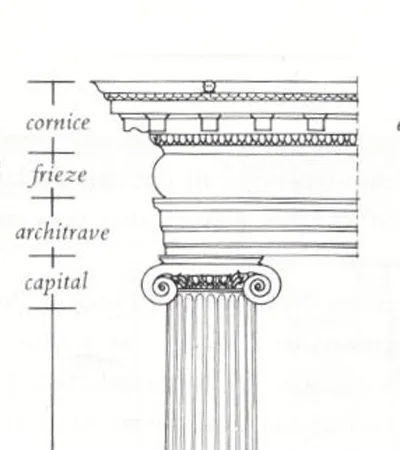
Architrave
Lowest horizontal section of the entablature, directly above the columns.

Naos / Cella
Main interior chamber of a Greek temple containing the cult statue.

Peristyle
Continuous row of columns surrounding a building.
What was the main function of a Greek temple?
House the cult statue of a deity and provide a sacred setting for worship; rituals usually occurred outside.

What does the Apadana communicate about the Persian Empire?
Imperial power, centralized rule, wealth, cultural diversity, and the king's authority over a vast empire.

How do the Apadana reliefs demonstrate Persian power?
Orderly delegations from different peoples bring tribute, presenting the empire as diverse but unified under Persian rule.
What was the function of the Athenian Agora?
Civic center for government, law, commerce, religion, social interaction, and public life.
What does the Athenian Agora reveal about Greek priorities?
Importance of civic participation, democracy, public debate, commerce, religion, and community.

What was the function of Anavysos Kouros?
Grave marker commemorating Kroisos, an Athenian soldier.

What makes Anavysos Kouros Archaic?
Frontal pose, left foot forward, stylized hair, Archaic smile, symmetry, and idealized anatomy.

What was the function of Peplos Kore?
Votive dedication to Athena on the Athenian Acropolis.
What evidence shows Greek marble sculpture was originally colorful?
Traces of pigment survive on works such as Peplos Kore; Greek sculpture was originally painted rather than plain white.
Why is Kritios Boy important?
Early major example of contrapposto, marking the transition from rigid Archaic sculpture toward Classical naturalism.

What innovation is visible in Kritios Boy?
Natural weight shift: one leg bears weight while the other relaxes, causing realistic shifts in hips and shoulders.
What was Polykleitos's goal in Doryphoros?
Demonstrate an ideal human body based on mathematical proportions, balance, harmony, and his Canon.
What is the key visual feature of Doryphoros?
Contrapposto with balanced oppositions between relaxed and engaged limbs, creating harmony and naturalism.

What innovations appear in the Niobides Krater?
Multiple ground lines, overlapping figures, varied poses, and attempts at spatial depth.

What does the Niobides Krater depict?
Apollo and Artemis killing Niobe's children; reverse includes Herakles and warriors.

Why is the Parthenon important?
Major symbol of Athenian religion, civic identity, democracy, military success, wealth, and Classical artistic achievement.
What was the Parthenon's primary function?
Temple dedicated to Athena and home of Phidias's monumental Athena Parthenos cult statue.
What architectural orders are used on the Parthenon?
Primarily Doric exterior with Ionic elements, including the continuous interior frieze.
What does the Parthenon reveal about Athens after the Persian Wars?
Athens was wealthy, powerful, confident, religiously devoted, and increasingly dominant within the Greek world.

What is wet drapery?
Clothing carved to cling closely to the body, simultaneously covering and revealing the figure's anatomy.