Learn: Sensory Physiology: Receptors, Pathways, and Sensory Modalities
 Call Kai
 Learn
Learn Practice Test
 Spaced Repetition
 Match
Match Flashcards
 Knowt Play
1/52

There's no tags or description
Looks like no tags are added yet.
Name | Mastery | Learn | Test | Matching | Spaced | Call with Kai | Chat |
|---|
No analytics yet
Send a link to your students to track their progress
53 Terms
What are sensory receptors?
Specialized cells or structures that transduce different forms of energy into electrical signals.
What is the role of sensory modalities?
Different modalities arise from unique neural pathways and synaptic connections associated with each receptor type.
Name the five functional categories of sensory receptors.
Chemoreceptors, Photoreceptors, Thermoreceptors, Mechanoreceptors, Nociceptors.
What do chemoreceptors sense?
Chemical stimuli in the environment, such as taste and smell.
What is the function of photoreceptors?
To sense light and enable vision.

What do thermoreceptors respond to?
Changes in temperature, sensing either cold or heat.
What stimuli do mechanoreceptors respond to?
Mechanical deformation such as touch, pressure, vibration, and hearing.
What are nociceptors?
Pain receptors that depolarize in response to tissue damage.
What are proprioceptors?
Receptors found in muscles, tendons, and joints that provide a sense of body position.
What are cutaneous receptors responsible for?
Sensations of touch, pressure, heat, cold, and pain located in the skin.
What are the characteristics of tonic receptors?
They adapt slowly and continuously provide information about a stimulus.
What distinguishes phasic receptors?
They respond with a burst of activity when a stimulus is first applied and quickly adapt.
What does the Law of Specific Nerve Energies state?
The sensation perceived depends on which nerve fiber is stimulated, not how it is stimulated.
What is a receptor potential?
Local, graded depolarizations in receptors similar to excitatory postsynaptic potentials (EPSPs).
What is the function of Merkel's Disks?
To sense sustained touch and pressure; they are slow-adapting.
What do Meissner's Corpuscles detect?
Texture and slow vibrations; they are fast-adapting.
What do Pacinian Corpuscles sense?
Deep pressure and fast vibrations; they are very fast-adapting.
What type of receptors are cold receptors?
More numerous than hot receptors and located deeper in the dermis.
What is the role of taste buds?
To detect chemical changes from food and drink through chemoreception.

What are the five categories of taste?
Salty, Sour, Sweet, Umami, Bitter.
How do olfactory receptors function?
They bind specific odorant molecules, activating a G-protein coupled system to produce a graded depolarization.
What is the vestibular apparatus responsible for?
Providing our sense of equilibrium (balance).
What do otolith organs detect?
Linear acceleration and gravity.
What is the function of sensory hair cells in the inner ear?
They are mechanoreceptors that respond to movement and position changes.
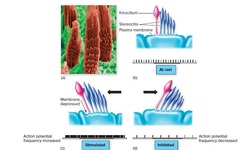
What happens when stereocilia bend toward the kinocilium?
K+ channels open, causing depolarization of the sensory hair cell.
What is the effect of bending stereocilia away from the kinocilium?
The channels close, leading to hyperpolarization of the sensory hair cell.
What are the two types of acceleration detected by the otolith organs?
Linear acceleration (horizontal and vertical motion)

What structures are responsible for detecting rotational acceleration?
Semicircular canals

What is the function of the utricle and saccule?
The utricle senses horizontal motion, while the saccule senses vertical motion.
What is the role of hair cells in the macula?
Hair cells detect changes in motion and orientation.
What is the function of the ampulla in the semicircular canals?
The ampulla contains the crista ampullaris where hair cells are located.
What are otoliths?
Crystals of calcium carbonate embedded in the otolithic membrane.
How does the otolithic membrane respond to acceleration?
It lags behind, bending the stereocilia of hair cells.
What is the function of the cochlea?
The cochlea is involved in hearing and contains the spiral organ.

What are the three chambers of the cochlea?
Scala vestibuli (upper), scala tympani (lower), and cochlear duct (middle).

What is the role of the spiral organ (Organ of Corti)?
It contains sensory receptors for hearing, including inner hair cells.
What happens during sound transduction in the spiral organ?
Sound waves cause the basilar membrane to vibrate, leading to hair cell depolarization.
What is the place theory of pitch perception?
The brain perceives pitch based on the location of maximum vibration along the basilar membrane.
What is the function of the iris in the eye?
The iris controls the size of the pupil, regulating light entry.
What is lens accommodation?
The ability of the lens to change shape to focus light on the retina.
What occurs in the retina when light is detected?
Light passes through layers to reach photoreceptors, which convert light into nerve impulses.
What are the two types of photoreceptors in the retina?
Rods (for low light) and cones (for color vision).
What is the bleaching reaction in phototransduction?
The change of rhodopsin from 11-cis to all-trans retinal upon light absorption.

How do rods and cones differ in terms of sensitivity and function?
Rods are highly sensitive to light for black-and-white vision; cones provide color vision and high acuity.
What is the fovea centralis?
The area of the retina with the highest density of cones, providing sharp vision.
What is the role of ciliary bodies in vision?
They contract or relax to change the shape of the lens for focusing.
What is the significance of the optic nerve?
It transmits visual information from the retina to the brain.
What happens to photoreceptors in the dark?
They are depolarized and continuously release an inhibitory neurotransmitter.
What is the role of glutamate in hearing?
It stimulates the sensory neuron of the cochlear nerve, sending action potentials to the brain.
What is the function of the aqueous humor?
It nourishes the lens and cornea.
What is the relationship between cone types and color perception?
The brain perceives color based on the ratio of stimulation of S-cones, M-cones, and L-cones.
What is the significance of the round window in the cochlea?
It allows vibrations to exit the inner ear after passing through the cochlear duct.
What is the dark current in photoreceptors?
The constant influx of Na+ ions that keeps photoreceptors depolarized in the dark.