Physics - Electric Fields
 Call Kai
 Learn
 Practice Test
 Spaced Repetition
 Match
 Flashcards
 Knowt Play
1/17

There's no tags or description
Looks like no tags are added yet.
18 Terms
What are electrical conductors?
They contain lots of free electrons.
What are electrically insulating materials?
They do not contain free electrons.
What is the gold leaf electroscope used for?
To detect charge. If a charged object is in contact with the metal cap of the electroscope, some of the charge on the object transfers to the electroscope. As a result, the gold leaf and the metal stem which is attached to the cap gain the same type of charge and the leaf rises because it is repelled by the stem.
What is a line of force or a field line?
Any two charged objects exert equal and opposite forces on each other without being directly in contact. An electric field is said to surround each charge. Suppose a small positive charge is placed as a test charge near a body with a much bigger charge which is placed as a test charge near a body with a much bigger charge which is also positive. If the test charge is free to move, it will follow a path away from the body with the bigger charge. The path a free positive test charge follows is called a line of force or a field line.
What field lines are created by two oppositely charge objects.
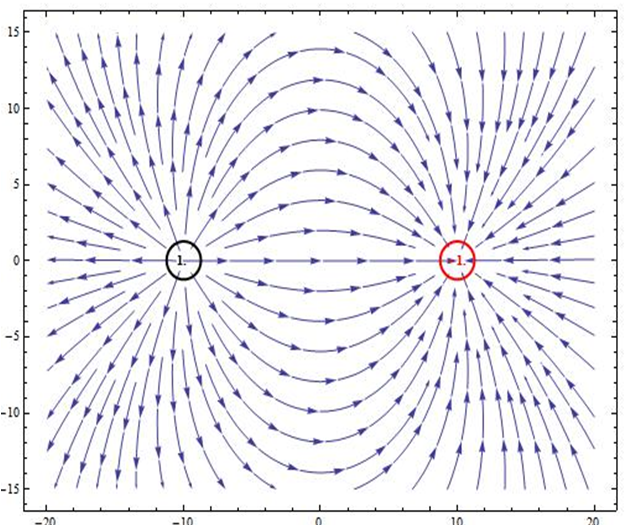
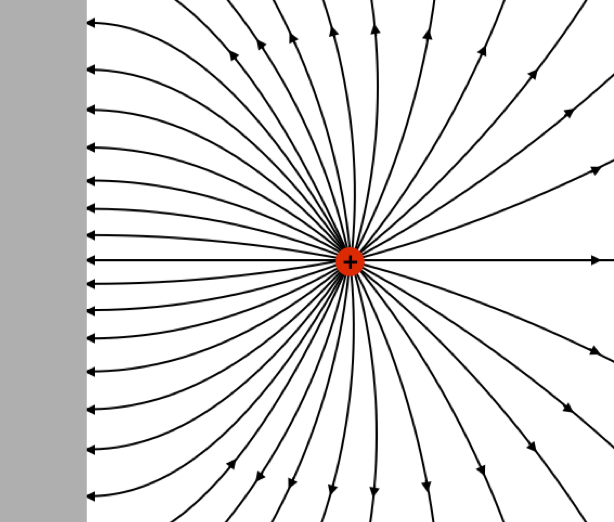
What do the field lines look like near a point object near an oppositely charged flat plate?
What do the field lines look like for two oppositely charged plates?

What is the electric field strength?
Electric field strength, E, at a point in the field is defined as the force per unit charge on a positive test charge placed at that point.
Unit N C-1
E = F/Q
What are electric fields like between two parallel plates?
Parallel to each other
At right angles to the plates
From the positive plate to the negative plate
What is the electric field strength E between two plates?
E = V/d
Where V is the potential difference and d is there separation.
What is ε0?
The permittivity of free space. It represents that charge per unit area on a surface in a vacuum that produces an electric field strength of one volt per metre between the plates.
What is electric potential?
The electric potential at a certain position in any electric field is defined as the work done per unit positive charge on a positive test charge when it is moved from infinity to that position.
Ep = QV
Unit of V is J C-1
What are equipotentials?
Equipotentials are surfaces of constant potential. A test charge moving along an equipotential has constant potential energy. No work is done by the electric field on the test charge because the force due to the field is at right angles to the equipotential. The lines of force of the electric field cross the equipotentials are right angles.
What is a potential gradient?
The potential gradient at any position in an electric field is the change of potential per unit change of distance in a given direction.
If the field is non-uniform, the potential gradient varies according to position and direction. The closer the equipotentials are, the greater the potential gradient is at right angles to the equipotentials.
If the field is uniform, such as the field between the two oppositely charged parallel plates, the equipotentials between the plates are equally spaced lines parallel to the plats. The potential relative to the negative plate changes with perpendicular distance x from the negative plate.
What is the electric field strength in terms of the potential gradient?
The electric field strength is equal to the negative of the potential gradient.
Radial field:
E = -ΔV/Δx
Where ΔV is the change of potential between two closely spaced points at a distance Δx apart
Uniform Field:
V/d
What is Coulomb’s Law?
F = kQ1Q2/r2
For the force F between two point charges Q1 and Q2.
Where k is 1/(4𝝅ε0)
What is electric field strength in terms of ε0,Q and r?
E = Q/(4𝝅ε0r²)
What is the equation for the electric potential at distance r from Q?
V = Q/(4𝝅ε0r²)