AP World History Unit 6 Vocab
 Call Kai
 Learn
 Practice Test
 Spaced Repetition
 Match
 Flashcards
 Knowt Play
1/77

There's no tags or description
Looks like no tags are added yet.
78 Terms
Imperialism
A policy of extending a country's power and influence through diplomacy or military force.
New Imperialism
Historians' term for the late-nineteenth- and early-twentieth-century wave of conquests by European powers, the United States, and Japan, which were followed by the development and exploitation of the newly conquered territories.
Colonization
One country taking over another area to be used for their benefit
Nationalism
A strong feeling of pride in and devotion to one's country
Sino-Japanese War
a war between China and Japan for influence, power, and territory, ended in a Japanese victory
Charles Darwin
English natural scientist who formulated a theory of evolution by natural selection

Darwinism
the theory of the evolution of species by natural selection
Social Darwinism
The application of ideas about evolution and "survival of the fittest" to human societies - particularly as a justification for their imperialist expansion.
King Leopold II
King of Belgium active in encouraging the exploration of Central Africa and became the infamous ruler of the Congo Free State

East India Company
An English company formed in 1600 to develop trade with the new British colonies in India and southeastern Asia.
Dutch East India Company
Government-chartered joint-stock company that controlled the spice trade in the East Indies.
Suez Canal
A ship canal in northeastern Egypt linking the Red Sea with the Mediterranean Sea

Corvee Labor
type of annual tax that is payable by labor. Used to complete state projects and to maintain roads and public facilities.
Settler Colony
A form of colonization where foreign family move into a region and an imperial political power oversees the immigration of these settlers.
Berlin Conference
A meeting from 1884-1885 at which representatives of European nations agreed on rules colonization of Africa
Boers
Dutch settlers in South Africa
Boer Wars
a conflict, lasting from 1899 to 1902, in which the Dutch and the British fought for control of territory in South Africa.
Concentration camps
Detention centers for civilians considered enemies of the state
Spheres of influence
Areas in which countries have some economic control but do not govern directly (ex. Europe and U.S. in China)
Taiping Rebellion
(1850-1864) A revolt by the people of China against the ruling Manchu Dynasty because of their failure to deal effectively with the opium problem and the interference of foreigners.
Boxer Rebellion
1899 rebellion in Beijing, China started by a secret society of Chinese who opposed the "foreign devils". The rebellion was ended by British troops.
Dutch East Indies
Colony controlled by the Dutch East India company exported cash crops of sugar, tea, coffee, and tobacco
Penal Colony
a colony to which convicts are sent as an alternative to prison
Maori
indigenous people of New Zealand
Maori Wars
A series of wars that took place from 1845 to 1872 between the New Zealand government and the native Maori people
Trail of Tears
the forced removal of Cherokees and their transportation to Oklahoma
Monroe Doctrine
A statement of foreign policy which proclaimed that Europe should not interfere in affairs within the United States or in the development of other countries in the Western Hemisphere.
Manifest Destiny
A notion held by a nineteenth-century Americans that the United States was destined to rule the continent, from the Atlantic the Pacific.

Spanish American War
In 1898, a conflict between the United States and Spain, in which the U.S. supported the Cubans' fight for independence
Roosevelt Corollary
Roosevelt's 1904 extension of the Monroe Doctrine, stating that the United States has the right to protect its economic interests in South And Central America by using military force
Great Game
Used to describe the rivalry and strategic conflict between the British Empire and the Russian Empire before WWI.
Quinine
a drug used for fighting malaria and other fevers

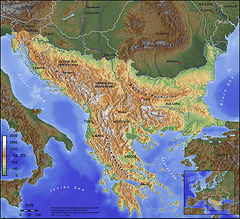
Balkan Peninsula
triangular arm of land that juts from southeastern Europe into the Mediterranean
Indian Removal Act
(1830) a congressional act that authorized the removal of Native Americans who lived east of the Mississippi River
Ghost Dance
A religious movement that tried to call the spirits of past warriors to inspire the young braves to fight. It was crushed at the Battle of Wounded Knee after spreading to the Dakota Sioux.
Tupac Amaru II
(1738-1781) Mestizo leader of Indian revolt in Peru; supported by many among lower social classes; revolt eventually failed because of Creole fears of real social revolution
Benito Juarez
Mexican national hero; brought liberal reforms to Mexico, including separation of church and state, land distribution to the poor, and an educational system for all of Mexico
Sepoys
Indian troops who served in the British army
Indian Rebellion of 1857
A revolt led by the "Sepoy" soldiers against the British rule in India. Sparked by the use of animal fat in gun cartridges.
British Raj
The name for the British government's military rule of India between 1858 and 1947.
Indian National Congress
A movement and political party founded in 1885 to demand greater Indian participation in government.
Jose Rizal
Filipino revolutionary leader who fought for sovereignty from the Spanish
Philippine Revolution
started in 1896, colonial people in full scale rebellion against Spain.
Pan-Africanism
A movement that stressed unity among all Africans
Sokoto Caliphate
large Muslim state founded in 1809 in what is now northern Nigeria.
Anglo-Zulu War
Between the British and Zulu's that was caused by the Zulu refusing to sign treaty with Britain
Xhosa Cattle Killing Movement
South African Xhosa people believed that killing all cattle would bring back ancient chiefs and ancestors.
Samory Toure
led a revolt against the French in Senegal
Muhammad Ahmad
a Sudanese man who announced he was the Mahdi (guided one), setting off resistance to British expansion in northern Africa
Cash Crops
a crop produced for its commercial value rather than for use by the grower.
Cecil Rhodes
British entrepreneur and politician involved in the expansion of the British Empire from South Africa into Central Africa.

Export economy
A type of economy in which goods are produced mainly for export rather than for domestic use
Monoculture
the cultivation of a single crop in a given area.
Economic Imperialism
An independent but less developed country controlled by private business interests rather than other governments
Spice Islands
Europeans' name for the Maluku's, islands rich in cloves and nutmeg
cultivation system
System of forced labor used in the Dutch East Indies in the nineteenth century; peasants were required to cultivate their land or become laborers
Opium War
a conflict between Britain and China, lasting from 1839 to 1842, over Britain's opium trade in China
Treaty of Nanking
a treaty with Britain and China that gave Hong Kong to Britain and opened 4 cities for trade
Pampas
a vast area of grassland and rich soil in south-central South America

Banana Republic
a small country (especially in Central America) that is politically unstable and whose economy is dominated by foreign companies and depends on one export (such as bananas)
Indentured Servants
Colonists who received free passage to a colony in exchange for working without pay for a certain number of years
contract labor system
Labor sold on a contractual basis to private employers. Private employers provided the equipment and inmates made products to sell.
Diasporas
the migration of religious or ethnic groups to foreign lands despite their continued affiliation with the land and customs of their origin
Great Famine in Ireland
The result of four years of potato crop failure in Ireland, a country that had grown dependent on potatoes as a dietary staple.
Emigrate
To leave one country or region and settle in another
Ethnic enclaves
neighborhoods where people from similar cultures live together and assert cultural distinction from the dominant group
Gold Rush
a period from 1848 to 1856 when thousands of people came to California in order to search for gold.
Chinese Exclusion Act
1882 law that prohibited the immigration of Chinese laborers to the United States
White Man's Burden
idea that many European countries had a duty to spread their religion and culture to those less civilized
Scramble for Africa
Sudden wave of conquests in Africa by European powers in the 1880s and 1890s.
Protectorate
A country whose affairs are partially controlled by a stronger power.
Exploitation Colonialism
A form of colonialism with the primary goal of extracting existing resources, and involving few colonists
Surrogate colonialism
a colonial power encourages one ethnic group or groups from the colonized country itself to take over land previously controlled by another group
Internal colonialism
the economic and political subjugation of the minority group by the dominant group within a nation
Indirect Control
Strategy of Colonization used by England and the USA. Local governments were allowed, and limited self rule. Eventually the colonies would be able to rule themselves.
Direct Control
type of control where foreign officials were brought in to rule
United Fruit Company
U.S. corporation that controlled the banana trade in much of Latin America
colonial service
British government services in colonies