AP Biology Unit 1 Concept Checks
 Call Kai
 Learn
 Practice Test
 Spaced Repetition
 Match
 Flashcards
 Knowt Play
1/20

There's no tags or description
Looks like no tags are added yet.
21 Terms
How are gasoline and fat chemically similar?
Both consist largely of hydrocarbon chains.
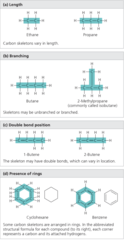
Which molecules in Figure 3.4 are isomers? For each pair, identify the type of isomer.
The forms of C4H10 in (b) are structural isomers, as are the butenes (forms of C4H8) in (c).
What does the term amino acid signify about the structure of such a molecule?
It has both an amino group (—NH2), which makes it an amine, and a carboxyl group (—COOH), which makes it a carboxylic acid.
How many molecules of water are needed to completely hydrolyze a polymer that is ten monomers long?
Nine, with one water molecule required to hydrolyze each connected pair of monomers
Suppose you eat a serving of fish. What reactions must occur for the amino acid monomers in the protein of the fish to be converted to new proteins in your body?
The amino acids in the fish protein must be released in hydrolysis reactions and incorporated into other proteins in dehydration reactions.
Write the formula for a monosaccharide that has three carbons.
C3H6O3
A dehydration reaction joins two glucose molecules to form maltose. The formula for glucose is C6H12O6. What is the formula for maltose?
C12H22O11
Compare the structure of a fat (triglyceride) with that of a phospholipid.
Both have a glycerol molecule attached to fatty acids. The glycerol of a fat has three fatty acids attached, whereas the glycerol of a phospholipid is attached to two fatty acids and one phosphate group.
Why are human sex hormones considered lipids?
Human sex hormones are steroids, a type of compound that is hydrophobic and thus classified as a lipid.
Suppose a membrane surrounded an oil droplet, as it does in the cells of plant seeds. Describe and explain the form it might take.
The oil droplet membrane could consist of a single layer of phospholipids rather than a bilayer, because an arrangement in which the hydrophobic tails of the membrane phospholipids were in contact with the hydrocarbon regions of the oil molecules would be more stable.
Why does a denatured protein no longer function normally?
The function of a protein is a consequence of its specific shape, which is lost when a protein becomes denatured.
What parts of a polypeptide participate in the bonds that hold together secondary structure? Tertiary structure?
Secondary structure involves hydrogen bonds between atoms of the polypeptide backbone. Tertiary structure involves interactions between atoms of the side chains of the amino acid monomers.
Where would you expect a polypeptide region rich in the amino acids valine, leucine, and isoleucine to be located in a folded polypeptide? Explain.
These are all nonpolar, hydrophobic amino acids, so you would expect this region to be located in the interior of the folded polypeptide, where it would not contact the aqueous environment inside the cell.
How would sequencing the entire genome of an organism help scientists to understand how that organism functioned?
The DNA of an organism encodes all of its proteins, and proteins are the molecules that carry out the work of cells, whether an organism is unicellular or multicellular. By knowing the DNA sequence of an organism, scientists would be able to catalog the protein sequences as well.
Given the function of DNA, why would you expect two species with very similar traits to also have very similar genomes?
Ultimately, the DNA sequence carries the information necessary to make the proteins that determine the traits of a particular species. Because the traits of the two species are similar, you would expect the proteins to be similar as well, and therefore the gene sequences should also have a high degree of similarity.
Describe the molecular composition of nucleoli, and explain their function.
Nucleoli consist of DNA and the ribosomal RNA (rRNA) made according to its instructions, as well as proteins imported from the cytoplasm. Together, the rRNA and proteins are assembled into large and small ribosomal subunits. (These are exported through nuclear pores to the cytoplasm, where they will participate in polypeptide synthesis.)
Imagine a protein that functions in the ER but requires modification in the Golgi apparatus before it can achieve that function. Describe the protein's path through the cell, starting with the mRNA molecule that specifies the protein.
The mRNA is synthesized in the nucleus and then passes out through a nuclear pore to be translated on a bound ribosome, attached to the rough ER. The protein is synthesized into the lumen of the ER and perhaps modified there. A transport vesicle carries the protein to the Golgi apparatus. After further modification in the Golgi, another transport vesicle carries it back to the ER, where it will perform its cellular function.
How would the membrane lipid composition of a native grass found in very warm soil around hot springs compare with that of a native grass found in cooler soil? Explain.
The grasses living in the cooler region would be expected to have more unsaturated fatty acids in their membranes because those fatty acids remain fluid at lower temperatures. The grasses living immediately adjacent to the hot springs would be expected to have more saturated fatty acids, which would allow the fatty acids to "stack" more closely, making the membranes less fluid and therefore helping them to stay intact at higher temperatures. (Cholesterol could not moderate the effects of temperature on membrane fluidity in this case because it is not found within plant cell membranes.)
What property allows O2 and CO2 to cross a lipid bilayer without the help of membrane proteins?
O2 and CO2 are both nonpolar molecules that can easily pass through the hydrophobic interior of a membrane.
Why is a transport protein needed to move many water molecules rapidly across a membrane?
Water is a polar molecule, so it cannot pass very rapidly through the hydrophobic region in the middle of a phospholipid bilayer.
Sodium-potassium pumps help nerve cells establish a voltage across their plasma membranes. Do these pumps use ATP or produce ATP? Explain.
The pump uses ATP. To establish a voltage, ions have to be pumped against their gradients, which requires energy.