Chapter 6: Viruses and Bacteriophages
 Call Kai
 Learn
 Practice Test
 Spaced Repetition
 Match
 Flashcards
 Knowt Play
1/53

There's no tags or description
Looks like no tags are added yet.
54 Terms
What is a virus?
A noncellular particle that is an obligatory intracellular parasite, infecting a host cell to produce progeny particles (more viruses).
What is a virion?
The virus particle that consists of a viral genome (DNA or RNA) contained within a protein capsid.

How do viruses enter host cells?
By insertion (bacteriophage) or by entry of the entire virus (most eukaryotic viruses).
What are bacteriophages?
Viruses that specifically infect bacteria.
How do bacteriophages attach to host cells?
They contact and attach to the surface of an appropriate host cell mediated by cell-surface receptors.

Which bacteriophages infect the following bacterium: Prochlorococcus and E. coli
P-SSP7; T2
When are visions released?
When the host cell lyses
What is a plaque in bacteriophage studies?
A clear spot of lysed cells on a lawn of bacteria, each arising from a single virion and spreading progeny to infect adjacent cells
What is the measles virus?
an infection in children caused by the virus budding out of human cells in tissue culture; presents as a rash of red spots on the skin due to the immune system constantly fighting the virus
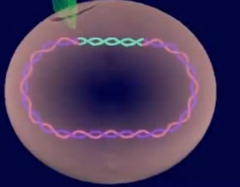
What is a prophage?
A bacteriophage that integrates its genome into the DNA of a bacterial genome.

What is a provirus?
An integrated viral genome within a human cell.
What is an endogenous virus?
A permanently integrated provirus transmitted from one human to another via the germ line.
What are the three forms a virus may interconvert among?
1. Virion/virus particle
2. Intracellular replication complex
3. Viral genome integrated within host DNA.

What is the role of the capsid in a virus?
It packages the viral genome and delivers it into the host cell, protecting the genome from degradation; does NOT carry out metabolism

What is a virocell?
A virus-infected cell that is directed by viral gene products to make and assemble progeny virions.

What is the role of the viral genome within the host DNA?
to integrate as a provirus or replicate as a part of the host; can be permanent of reactivated to start assembling visions (if stressed, can be kicked out)
What is the argument regarding the living status of viruses?
Viruses are debated as nonliving due to their inert nature, lack of metabolism, and inability to reproduce independently, yet they exhibit characteristics of living organisms during the vision assembly process inside the host cell
What is the significance of the viral genome?
It can either be DNA or RNA and is crucial for the virus's ability to replicate and infect host cells.
What is the function of the capsid (aka nucleocapsid)?
package the viral genome and deliver it into history cell, protect viral genome from degradation

What is the function of the viral envelope?
It is derived from the membrane of the previous host cell and incorporates glycoproteins (spike proteins) that enable the virus to attach to and infect the host cell.

What is the role of spike proteins in viruses?
They enable the virus to attach to and infect the host cell.
What is the structure of a tailed virus like bacteriophage T4?
It has a protein capsid containing double-stranded DNA, a sheath, and tail fibers that attach to the host cell and contracts/penetrate the cell surface

What happens to the phage capsid during infection?
The empty capsid remains outside the host cell, while only the phage genome enters.
What are viroids?
Infectious agents simpler than viruses in plants, consisting of circular, ssRNA that avoids breakdown by host RNase enzymes and interacts with host cell proteins.

What happens when a virus infects a host cell?
The viral gene products direct the host's enzymes to make and assemble progeny virions.
How do viruses replicate within a host?
By directing the host cell's machinery to produce new virions.
What is the difference between a virus and a bacteriophage?
A virus can infect a variety of organisms, while a bacteriophage specifically targets bacteria.
What is the importance of the gut bacteriophage community?
It plays a crucial role in the health and balance of the gut microbiome.
What is the function of the viral envelope in some viruses?
It helps the virus evade the host's immune system and facilitates entry into host cells.
What is the process of viral assembly?
The assembly of new virions occurs within the host cell, utilizing host resources.
How do viroids infect plants?
They infect plants through a damaged cell wall.
What is a prion?
An aberrant form of a normal protein arising from the host cell that has no nucleic acid component and can cause prion diseases due to abnormal conformation

What happens when prions bind to normally folded proteins?
They alter the conformation of those proteins, leading to harmful aggregates and cell death; prion-induced cell death in the brain leads to tissue deterioration + dementia
Which host molecules serve as a phage receptor for Salmonella?
1. LPS components (endotoxins), 2. membrane proteins/complexes (OmpF/TolC porins), and 3. flagellar proteins (flagellin)

What are the two criterion's that determine which cycle the virus enters?
A. environmental cues that activate or repress genes needed for virus replications ex. UV light
b. events that threaten host cell's survival, trigger lytic cycle (unhealthy vs healthy)
What is the lytic cycle in bacteriophages?
A replication cycle where phages immediately reproduce many progeny phage particles after genome entry ex. acute infection

What are the steps involved in the lytic replication cycle?
Host recognition and attachment, genome entry, assembly of phages, and exit and transmission; leading to rapid replication of progeny phage particles

What is the burst size in the lytic cycle?
The number of virus particles released after lysis of the host cell.
What do early genes express during the lytic cycle?
ribosomes/enzymes used to synthesize viral proteins
What do late genes express during the lytic cycle?
an enzyme that lyses the host cell wall, releasing the mature virions
What is lysogeny in bacteriophages?
A process where a temperate phage infects/lyses cells like a virulent phage; integrates its genome into the host DNA as a prophage by a recombinase enzyme

What is transduction in bacteriophages?
The process of transferring host genes from one bacterium to another during the exit from lysogeny; lysogeny can reactive to become lytic
What is the difference between lytic cycle and lysogeny?
Lytic cycle involves immediate multiplication of the virus, while lysogeny integrates the viral genome into the bacterial chromosome.
What distinguishes the slow-release replication cycle from lytic and lysogenic cycles?
Phage particles reproduce without destroying the host cell, allowing the host to grow slowly; perfected by a filamentous phase M13

What role does the circular ssNDA play in the slow-release replication cycle?
serves as a template to synthesis a ds-intermediate, which slowly generates many copies of ssDNA that is packaged by supercoiling and coated with capsid proteins
What bacterial product is produced as a result of an infection by the phage C1?
Botulinum toxin (from Clostridium botulinum)
What bacterial product is produced as a result of an infection by the prophage Beta phage?
Diphtheria toxin (from Corynebacterium diptheriae)
What bacterial product is produced as a result of an infection by the prophage CTSp (Vibrio chloerae)
Cholera toxin (ctxAB)
What are the three forms of bacterial defenses against bacteriophage infection?
Genetic resistance, restriction endonucleases, and CRISPR.
How does genetic resistance and restriction endonuclease create a defense for bacteria against infection?
encoding altered/different receptor proteins; cleaving viral DNA lacking methylation to degrade the viral protein
What does CRISPR stand for?
clustered regularly interspaced short palindromic repeats
What is the role of CRISPR in bacterial defense?
It involves short DNA sequences that provide an adaptive immune system against phages.
What are gut bacteriophages?
Bacteriophages (aka "coliphages") that are part of the mammalian intestinal community, modulating digestion, immune system, and mental health.

What is the significance of the gut virome?
It plays a crucial role in modulating human digestion, immune response, and mental health.
