Michniak exam 3 - lecture 1 Bioadhesive polymers
 Call Kai
 Learn
 Practice Test
 Spaced Repetition
 Match
 Flashcards
 Knowt Play
1/56

There's no tags or description
Looks like no tags are added yet.
57 Terms
Definition of a Bioadhesive Polymer
A polymer is a substance formed by the linkage of a large number of small molecules known as monomers
A bioadhesive polymer is a synthetic or natural polymer which binds to biological substrates such as mucosal membranes
Such polymers are sometimes referred to as biological ‘glues’ because they are incorporated into drugs to enable the drugs to bind to their target tissues
Mucosal membranes
These are moist membranes that line passageways and structures in the body that lead to the outside environment such as the mouth, respiratory tract, gastrointestinal tract, nose and vxgina.
They secrete a viscous fluid as mucus, which acts as a protective barrier and also lubricates the mucosal membrane
the primary constituent of mucus is a glycoprotein known as mucin as well as water and inorganic salts
History of Bioadhesive drug
Bioadhesive drug delivery formulations were introduced in 1947 when gum tragacanth was mixed with dental adhesive powder. The aim was to deliver penicillin into the oral mucosa. This later became orabase, a formulation used to treat mouth ulcers. This product is available as a paste which will stick to the wet surfaces of the mouth and form a protective film over the mouth ulcer. Orabase paste contains polymers such as gelatin, pectin and carboxymethylcellulose (CMC).
Polymer - Acacia gum
This natural polymer is a dried gum obtained from the stem and branches of the three acacia Senegal.
it is used as a thickener in pharmaceuticals
Polymer - Alginic Acid
Is a natural polymer found in the cell walls of brown algae.
It is widely used in the manufacture of alginate salts such as sodium alginate
Polymer - Carbomers/Carbopols
Are polyacrylic acid polymers widely used in the pharmaceutical and cosmetic industries as thickening agents
Carbomers have a huge advantage in formulation science because they adhere strongly to mucosal membranes without causing irritation. They exhibit low toxicity profiles and are compatible with many drugs
Hydroxypropyl Methylcellulose (HPMC)
This polymer is included in preparations used to moisten contact lenses in oral gels
Sodium hyaluronate
A high molecular weight biological polymer made of repeating disaccharide units of glucuronic acid and N-acetyl-D-glucosamine. This polymer is used during intraocular surgery to protect the cornea and also acts as a tear substitute in the treatment of dry eyes.
Other examples of polymers include:
pectin
Polyvinylalcohol (PVA)
polyvinylpyrrolidone (PVP)
tragacanth
Transdermal Drug Systems adhesives
The addition of additives to TDDS (e.g. active ingredients, penetration enhancers, stabilizers, anti-crystallization agents) to the adhesive matrix causes unpredictable variations in patch adhesive properties.
Adhesion is guaranteed by a class of materials called
pressure sensitive adhesives - PSAs
Defined as adhesive capable of “bonding to skin surfaces with application of light pressure and, when removed, do not leave any visually noticeable of light pressure and, when removed, do not leave any visually noticeable residues or cause irreversible skin damage.”
Most challenging are the matrix patches (drug-in adhesive type) in which the PSA is the main constituent of the dosage form
Drug and other excipients have to be incorporated/dissolved into adhesive matrix & be stable and also release drug when placed on skin.
Pressure sensitive adhesives
Classified into solvent based, water based and hot melt types
Polyisobutylenes - most common now less allergic reactions & used in scopolamine patch
Acrylic-based adhesives
Silicon based adhesives
others: Polyvinyl pyrrolidone (PVP) & polymethyl methacrylate & mixtures of the two-good for hydrophilic APIs & proteins since more water can be present
TDDS rate controlling membranes
Three types:
ethylene vinyl acetate copolymer (EVA)
Silicon rubber
Polyurethane
The EVA is most commonly used since permeability can be changed by changing the vinyl acetate content of the polymer
USP regulates types of in vitro drug release tests that should be used for these patches
Bioadhesion and Drug Absorption
Drug absorption is the process by which a drug leaves its site of administration and enters the general circulation.
These membranes act as barriers which control the transport of drugs and other molecules across cells. The general structure of a cell/plasma membrane consists of a matrix of proteins surrounded by a phospholipid bilayer
Drugs may cross a cell membrane by passive diffusion, facilitated passive diffusion, active transport or pinocytosis. Drug absorption is determined by physicochemical properties of drugs, their formulations (e.g. tablet, capsules, solution, TDDS) and routes of administration such as oral, dermal, parenteral or rectal.
Passive Diffusion
Diffusion is the tendency of molecules to spread into an available space. In the process of passive diffusion the transport of molecules across cell membrane depends very much on the concentration of the molecules
Most drug molecules are transported across membrane by diffusion from a region of high concentrations (e.g. gastrointestinal fluids) to one of a lower concentration such as blood
since cell membranes are lipid in nature, lipid soluble drugs are able to diffuse across the membrane more rapidly than non-lipid soluble drugs. Small molecules are also able to penetrate the membrane more rapidly than larger ones
Facilitated passive diffusion
This is when molecules are transported across membranes and into cells with the help of carrier proteins. These proteins only interact with certain molecules and therefore exhibit specificity.
The process of carrier-mediated transport depends on the availability of carriers, the means that a particular point during transport the carrier will become saturated.
An example of this type of diffusion is the transport of glucose form blood
Active Transport
active transport is the movement of molecules and ions against their concentration gradients, from lower to higher concentrations. This form of transport requires an input of energy from cells which is obtained from ATP (Adenosine Triphosphate)
Pinocytosis
Pinocytosis (a form of endocytosis) allows a cell to engulf large molecules and fluids that may be present in the extracellular region. The cell membrane folds inwards, encloses the fluid or particle to be transported and then fuses to form a vesicle
The vesicle detaches from the membrane and moves to the interior of the cell. Pinocytosis plays a role in transport of protein drug.
The adhesion of bioadhesive drugs to mucosal membranes leads to…
an increase in the concentration of the drug at its site of action. This means that a greater amount of drug is available at the specific target site to cause the desired therapeutic effect
The concept of using bioadhesive polymers in drug delivery systems is therefore quite important because it enhances the absorption of drugs
The term Bioadhesion is used to describe…
The bonding between a synthetic or natural polymer and soft tissues such as epithelial cells. The term mucoadhesion is used to describe adhesion interactions between polymers and mucus or mucosal surfaces
Mechanisms of bioadhesion
The mechanisms responsible in the formation of bioadhesive bonds are not fully known, however most research has described bioadhesive bond formation as a three step process
step 1: wetting and swelling of polymer
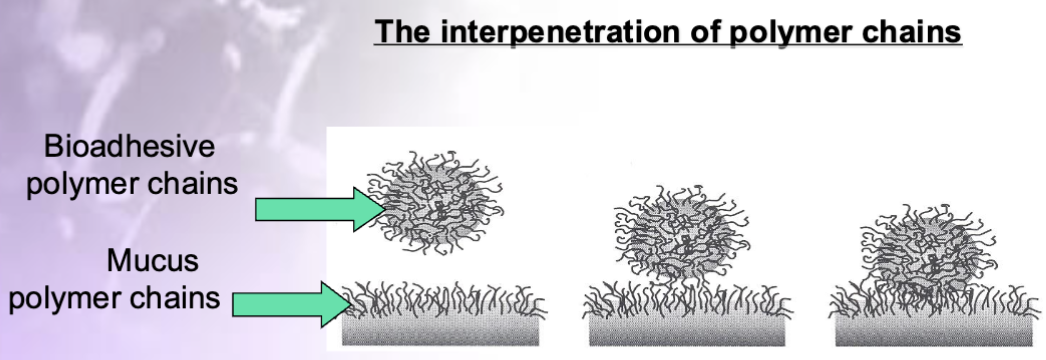
step 2: interpretation between the polymer chains and the mucosal membrane
step 3: formation of chemical bond between the entangled chains
Step 1 - Bioadhesive drug delivery systems
The wetting and swelling step occurs when the polymer spreads over the surface of the biological substrate or mucosal membrane in order to develop an intimate contact with the substrate. This can be readily achieved for example by placing bioadhesive formulation such as a ta or paste within the oral cavity or vagina.
Bioadhesives are able to adhere to or bond with biological tissues by the help of the surface tension and forces that exit at the site of adsorption or contact. Swelling of polymers occurs because the components within the polymers have affinity for water
Step 2 - Bioadhesive drug delivery systems
The surface of mucosal membranes are composed of high molecular weight polymers known as glycoproteins. in step 2 of the bioadhesive bond formation, the bioadhesive polymer chains and the mucosal polymer chains intermingle and entangle to form semi permeable adhesive bonds. The strength of these bonds depends on the degree of penetration between the two polymer groups. In order to form strong adhesive bonds, one polymer group must be soluble in the other and both polymer types must be similar chemical structure4
Step 3 - Bioadhesive drug delivery systems
This step involves the formation of weak chemical bonds between the entangled polymer chains. The type of bonding formed between the chains include primary bonds such as covalent bonds and weaker secondary interactions such as van der waals interactions and hydrogen bonds. Both primary and secondary bonds are exploited in the manufacture of bioadhesive formulations in which strong adhesions between polymers formed.
In order for polymers to adhere to mucosal surfaces or epithelial cell they must ideally possess certain characteristics:
Flexibility
Hydrophilicity
Hydrogen bonds
High molecular weight
Surface tension
Characteristics of Bioadhesive Polymer - Flexability
The flexibility of bioadhesive polymers is important because it controls the extent of the interpenetration between the polymers and mucosal/epithelial surfaces
Characteristics of Bioadhesive Polymer - Hydrophilicity
Polymers that are hydrophilic in nature are able to form strong adhesive bonds with mucosal membranes because the mucus layer contains large amounts of water
Characteristics of Bioadhesive Polymer - Hydrogen bonding
Hydrogen bonding between the entangled polymer chains forms strong adhesive bonds, therefore the presence of hydrogen bond — forming groups such as OH and COOH groups are vital in large quantities.
Characteristics of Bioadhesive Polymer - High Molecular weight
Polymers with high molecular weight are desirable because they provide more available bonding sites
Characteristics of Bioadhesive Polymer - Surface Tension
Surface tension is needed to spread the bioadhesive polymer into the mucosal layer epithelial surface
Targets for Bioadhesive Formulations
Bioadhesive or mucoadhesive formulations have been targeted to various anatomical locations to aid drug delivery and absorption. These structures possess mucous membranes which protect the cell from damage.
Eye - mucoadhesive eye drops/inserts
Nasal Cavity - Nasal drug delivery systems
Oral cavity - Dental gels / buccal systems
Skin - Patches, tapes, dressings
Vagina - Local Vaginal delivery systems
Rectum - Local/Systemic rectal delivery systems
Target for bioadhesive Formulations - The Eye
The eye is most important and complex organ of the body, because of its complicated anatomy many things can go wrong with the eye. Topical drug delivery systems to the eye can be very difficult to achieve because the eye has several protectant mechanisms in place to get rid of foreign substances
An effective ocular drug delivery system must be easy to use, comfortable to the patient and maintain substantial concentrations of the drug in the eye to produce therapeutic effects

Some conditions of the eye - Conjunctivitis
This is inflammation of the conjuctivae, which are mucous membrane covering the whites of the eye and the inside of the eyelids.
It is caused by bacteria, viruses or allergens and the signs and symptoms displayed by the patient will be dependent on the type of conjunctivitis.
The symptoms include: redness of the eye, grittiness or itchy eyes and the presence of a sticky or watery discharge
Some conditions of the eye - Dry eye
This occurs when people don’t have enough tears or the adequate composition of tears required to lubricate the eyes
The occurrence of dry eye increases with age and is therefore common in older people. The eye become itchy, gritty, painful and have burning sensations
Some conditions of the eye - Glaucoma
This disorder is characterized by pressure in the eyeballs and causes excessive amounts of aqueous humour. (the fluid that fills the eyeballs)
This puts pressure on the optic nerve and compresses the blood vessels in the eye
The resultant effects include abnormalities in vision and total blindness
Ocular Bioadhesive Formulations
Various ocular bioadhesive formulations have been designed to treat specific conditions affecting the eye. Such formulations can produce a prolonged or sustained release of drugs into the eye. Drugs containing polymers attach to the mucin on the conjunctival surface by means of non-covalent bonding. The polymer is able to remain in contact with the surface of the eye until mucin replaces itself or until the pressure of blinking removes the drug from the eye.
Example of Products:
Eye drops used for dry eye and tear deficiency (artifical tears) and they generally lubricate the eyes. They both contain the polymer polyvinyl alcohol (PVA) which increases tear production and protects the eye from further irritation
Targets of Bioadhesive Formulations - Nasal Cavity
The nasal cavity is the air passage behind the nose. This is the source of the moisture which is added to air during the breathing process. The nasal cavity has complex structure and can become inflamed during conditions such as the common cold, nasal allergies and flu
Drugs such as antihistamines and steroids are administered as nasal drops or nasal sprays to treat conditions affecting the nose. However, Nasal mucociliary clearance affects the retention and therefore the effects of the drugs in the nose. Mucociliary clearance transports mucus from the cells lining the nose and protects the respiratory tract from damage caused by inhaled substances including dirt particles and medicine
Nasal Bioadhesive Formulations
By mixing drugs targeted for the nose with bioadhesive polymers, the process of mucociliary clearance of the drug can be overcome. For example, methylcellulose exhibits the most reduction in mucoiliary clearance whilst carbopol 934P shows the least reduction.
Examples of Products
Rhinocort - nasal spray is a powdered mixture of the steroid Beclomethasone Dipropionate (50 ug) and 30mg of hydroxypropylcellulose (HPC).
The powder sticks to and swells on the cells lining the nose and remains there until approximately six hours after administration.
Flonase and nasonex (OTC) with steroids
Nasal Bioadhesive Formulations - Beconase
Nasal spray is used to treat nasal inflammation and nasal allegies associated with hayfever. It contains the active ingredient beclomethasone dipropionate and the bioadhesive polymers carboxymethl cellulose and microcrystalline cellulose
Nasal Bioadhesive Formulations - Nasacort
Nasal spray is used to treat allergies that result in infammation of the nose. The active ingredient in this product is triamcinolone acetonide as well as the bioadhesive polymer microcrystalline cellulose. The polymer swells in the presence of water and is able to spread across the nasal mucosa thus helping the distribution of the drug over the mucosal surface.
Targets for Bioadhesive Formulations - The oral activity
The oral cavity or the mouth comprise of the cheeks, hard and soft palates and the tongue. It is an entrance of digestive system and plays many important functions which include chewing, speaking, and tasting. Some of these functions are impaired by disease such as ulcers, microbial infections and inflammation
Common conditions affecting oral cavity - Mouth ulcers
A mouth ulcer can be described as a breach or break in the mucous membrane that lines the inside of the mouth. The majority of patients suffer from minor aphthous ulcers. These ulcers are roundish, shallow, grey-white in color and are painful. They are small and appear in small crops
Common conditions affecting oral cavity - Oral Thrush/Candida
This is an infection caused by the fungus Candida Albicans. In the oral cavity, it can also arise due to risk factors such as diabetes, recent antibiotic therapy and inhaled corticosteroids. Oral thrush presents itself as soft creamy-white patches which can be wiped off. The lesions are painful and can occur anywhere in the oral cavity
Common conditions affecting oral cavity - Gingivitis
Gingivitis means inflammation of the gums. It can be caused by the build-up of plaque (a layer of bacteria) on the teeth. The gums become reddened, swollen and bleed easily with slight trauma such as brushing the teeth
Target for Bioadhesive Formulations - The buccal Mucosa
The buccal mucosa refers to the inner lining of the lips and cheeks. The epithelium of the buccal mucosa is about 40-50 cells thick and the epithelial cells become flatter as they move from the basal layers to the superficial layers
The buccal mucosa is less permeable compared to other oral drugs delivery systems and is unable to retain dosage forms at the site of absorption. The use of bioadhesive polymers in buccal drug delivery systems allows a better retention of a dosage form by spreading it over absorption site
Target for Bioadhesive Formulations - The sublingual Mucosa
The sublingual mucosa surrounds the sublingual gland which is mucin-producing salivary gland located underneath the tongue
The mucosa is relatively permeable and gives a rapid absorption of many drugs due to its excellent blood supply. The sublingual route of drug delivery is convenient, accessible and generally well accepted by patients
Drugs administered via the sublingual route are formulated as tabs, powders, solutions or aerosol sprays. This route is appropriate for many drugs as long as the drug is able to go into solution with saliva in the mouth
Examples of sublingual products include nitroglycerin sublingual tablets which is administered under the tongue for the prophylactic treatment of angina
Target for Bioadhesive Formulations - The Skin
The skin is the outer covering of the body and consists of different layers. It performs several functions which include:
Protecting the body from injury and invasions by pathogens
Preventing the body from becoming dehydrated
Regulating body temperature
Productions of Vitamin D
Topical Bioadhesive Formulations
Drug Delivery Systems used in this case are required to adhere to the skin for the purpose of:
Collecting body fluids
Protecting the skin
Providing local or systemic drug delivery
Adhesion can be described as the formation of a new mechanical bond between the skin and the adhesive agent. Bioadhesive products targeted to the skin are formulated into different dosage forms which include liquids, powders and semi-solids such as ointments and transdermal patches.
Transdermal patches are sustained-release devices that release a specific amount of drug whilst firmly attached to the skin. They must provide a firm, soft contact with the skin but also allow the patch to be easily removed with minor effort
Targets for Bioadhesive Formulations - The vagina
The vagina is the lower part of the female reproductive tract. It is a muscular tube lined with mucous membrane which is covered with a layer of stratified squamous epithelium with an underlying layer of connective tissue (lamina propria)
Common Conditions affecting the vagina
The epithelium of the vagina contains glycogen, which is broken down by enzymes and bacteria into acids such as lactic acid. This maintains a low vaginal pH which is normally between 4 and 5.
Such a pH is desirable because it males the vagina inhospitable to pathogens. Decreased levels of glycogen in the vagina leads to increase in vaginal pH and makes the vagina more susceptible to infection
Common Vaginal Infections - Vaginitis
Vaginitis means inflammation of the vagina and it creates discharge, odor, irritation or itching. It has many causes which includes infection with Trichomonas vaginalis, dietary deficiency or poor hygiene
Common Vaginal Infections - Bacterial Vaginosis
The causal organism often implicated in this infection in Gardnerella vaginalis, although other bacteria present in the vagina also contribute to the cause. The infection arises due to the overgrowth of these bacteria. About 50% of patients will have a thin white discharge with a strong fishy odor
Common Vaginal Infections - Candidiasis (Thrush)
Is a common yeast infection caused by the organism Candida Albicans. The signs and symptoms of thrush are a white cheesy discharge that itches and irritates the vagina
Common Vaginal Infections - Trichominasis
is a sexually - transmitted infection caused by the organism Trichomonas vaginalis. The symptoms in women include vaginal itching as well as frothy, foul-smelling, greenish-yellow discharge.
Vaginal Bioadhesive Formulations
The intravaginal route has been used to deliver contraceptives as well as anti-infective agents such as anti-fungal drugs to exert into various dosage forms including creams, gels and vaginal tablets.
Localized application of vaginal formulations enables the spread of these formulations over the target area, which allows an effective therapy
Bioadhesive polymers are incorporated into vaginal formulations to aid the adhering of the dosage form to its target site. Polymers also increase the retention of the active drug in the vagina and also optimizes the spread of the formulation over the vaginal epithelium
Targets for Bioadhesive Formulations - The rectum
The rectum is the terminal or end portion of the gastrointestinal tract. it is an important route of administration for drugs that have severed gastrointestinal side effects. This route is also suitable for patients who cannot take medicines via the oral route such as unconscious patients and infants
The drug absorbed from the rectum can escape breakdown by hepatic enzymes. For this reason mucoadhesive suppositories have been developed for the local treatment of diseases such as hemorrhoids and rectal cancer.
Rectal Bioadhesive Formulations
Bioadhesive polymers are incorporated into rectal suppositories to prolong the retention of the active drug in the rectum increases the chances of reaching a therapeutic outcome.
Examples of Products
Preparation H - suppositories help shrink the hemorrhoidal tissue which is swollen by irritation. It contains polymer polyethylene glycol
Summary