Microbio - Module 6: Control of Microorganisms in the Environment
 Call Kai
 Learn
Learn Practice Test
 Spaced Repetition
 Match
Match Flashcards
 Knowt Play
1/34

There's no tags or description
Looks like no tags are added yet.
Name | Mastery | Learn | Test | Matching | Spaced | Call with Kai | Chat |
|---|
No analytics yet
Send a link to your students to track their progress
35 Terms
8.1 Microbial Growth and Replication: Targets for Control
Common Microbial Control Methods

8.1 Microbial Growth and Replication: Targets for Control
whats biocide?
Antimicrobial agents that control microorganisms.
• Physical, chemical, mechanical or biological
8.1 Microbial Growth and Replication: Targets for Control
Define these Frequently Used Terms:
Sterilization
Disinfection
Disinfectants
Sanitization
Antisepsis
Antiseptics
Sterilization—process by which all living cells, spores, and acellular entities are destroyed or removed from an object.
• Sterilant is the chemical agent.
Disinfection—killing, inhibition, or removal of disease-causing microorganisms.
• Disinfectants—agents, usually chemical, used for disinfection, usually used on inanimate objects.
• Does not always sterilize as spores or a few organisms can remain.
Sanitization—reduction of microbial population to levels deemed safe by public health standards.
Antisepsis—destruction of microbes on living tissue.
• Antiseptics—chemical agents applied to tissue to kill or inhibit growth of pathogen.
8.1 Microbial Growth and Replication: Targets for Control
Antimicrobial Agents
Chemotherapy—generic term that describes application of
chemicals to kill microorganisms.
Cidal agents kill (-cide suffix indicates agent that kills).
• May be especially effective against a specific group.
• Include bactericides, fungicides, and viricides.
Static agents inhibit growth (-static suffix indicates growth
inhibiting agent).
• May be especially effective against a specific group.
• Include bacteriostatic and fungistatic
8.1 Microbial Growth and Replication: Targets for Control
Resistance to Biocides
Resistance to antimicrobial biocides has been increasing
similar to the rate of resistance to antibiotics.
Mechanisms of resistance similar to antibiotic resistance.
• Efflux pumps
• Alter membrane permeability
• Modify the target
• Specific resistance genes
8.1 Microbial Growth and Replication: Targets for Control
The Pattern of Microbial Death Mirrors the Pattern of
Microbial Growth
Microorganisms are not killed instantly when exposed to lethal agent.
Population death usually occurs exponentially.
• Reduced by the same fraction at constant intervals.
Decimal reduction time (D value): time required to kill 90%
of microorganisms.
• D value is time required to drop by 10-fold.
• The D-value, which denotes the decimal reduction time, is the time required at a specific temperature and under specified conditions to reduce a microbial population by one decimal. The decimal reduction time is dependent on the temperature, the type of microorganism and the composition of the medium containing the microorganism. Thus, after an organism is reduced by 1 D, only 10% of the original organisms remain. The population number has been reduced by one decimal place in the counting scheme. When referring to D values it is proper to give the temperature as a subscript to the D. For example,
a hypothetical organism is reduced by 90% after exposure to temperatures of
300ºF for 2 minutes, Thus the D-value would be written as D300ºF = 2 minutes.

8.1 Microbial Growth and Replication: Targets for Control
The Z-value
The Z-value is the increase or decrease in temperature required to reduce or increase the decimal reduction time by one decimal.
It is a measure of the change in death rate with a change in temperature. The number of degrees Fahrenheit or Centigrade required for a thermal death time curve to traverse 1 log cycle.
The z-value gives an indication of the relative impact of different temperatures on a microorganism, with smaller values indicating greater sensitivity to increasing heat.
Z value is the temperature change that decreases the microbial population by 90%

8.1 Microbial Growth and Replication: Targets for Control
D and Z Values

8.1 Microbial Growth and Replication: Targets for Control
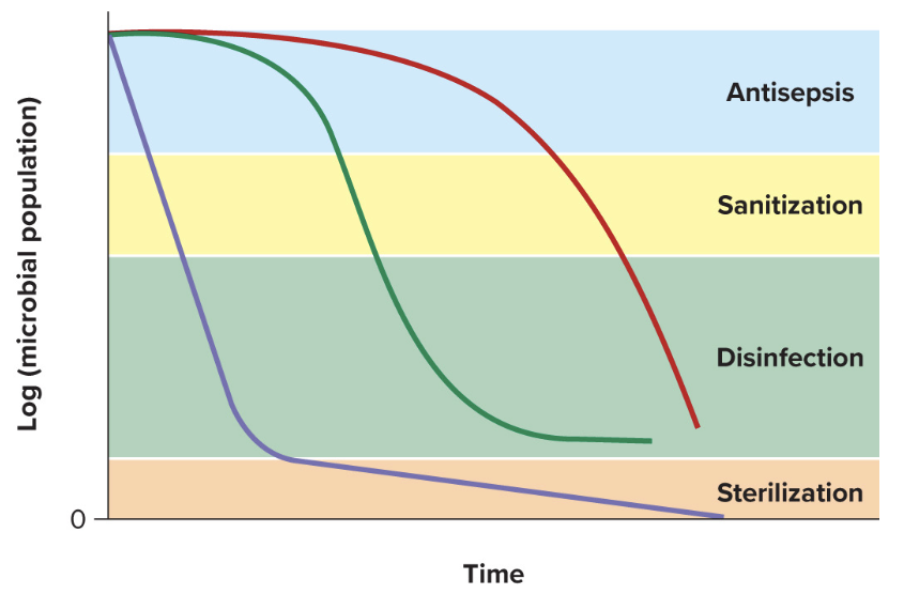
Impact of Biocide Exposure
Three possible population reduction curves from different
biocides.
8.2 Microbes Can Be Controlled by Physical Means
Filtration
Reduces microbial population in heat-
sensitive materials by removing
microorganisms.
Also used to reduce microbial
populations in air.
Depth filter—fibrous materials that
have been bonded into a think layer
filled with narrow, twisting channels.
• Solution with microbes is sucked
through the layer under vacuum
and microbes adsorb to the surface
of the filter material

8.2 Microbes Can Be Controlled by Physical Means
Filtering Liquids
describe membrane filters
Membrane filters
• Porous membranes with defined
pore sizes that remove
microorganisms.
• Often used after a depth filter.
8.2 Microbes Can Be Controlled by Physical Means
Filtering air
Surgical masks
• N95 disposable mask
• Exclude 95% of particles.
High-efficiency particulate air (HEPA) filters
• Used in laminar flow biological safety cabinets.
• Exclude 99.97% of particles.
• During the COVID-19 pandemic, airlines showed this filter to be effective.

8.2 Microbes Can Be Controlled by Physical Means
Moist Heat
Destroys viruses, fungi, and bacteria by degrading nucleic
acids, denaturing proteins, and disrupting cell membranes.
Boiling will not destroy endospores and does not sterilize.
• Can be used to disinfect drinking water.
Average conditions for moist heat inactivation: (look at picture)

8.2 Microbes Can Be Controlled by Physical Means
Steam Sterilization
Autoclave—device used in steam
sterilization.
Carried out above 100oC which
requires saturated steam under
pressure.
Effective against all types of
microorganisms, including spores.
Quality control
• Geobacillus stearothermophilus
strips or color changing tape
8.2 Microbes Can Be Controlled by Physical Means
Pasteurization
• Controlled heating at temperatures well below boiling.
• Used for milk, wine, and other beverages.
• Process does not sterilize, but does kill pathogens and
slows spoilage by reducing the total load of organisms
present
8.2 Microbes Can Be Controlled by Physical Means
Tyndallization
For materials that cannot withstand the high temperature of
the autoclave.
Intermittent sterilization
• 30 to 60 minutes of steam exposure with 23 to 24 hours
between incubations.
• 2 or 3 times this is repeated
8.2 Microbes Can Be Controlled by Physical Means
Dry Heat Sterilization
Less effective than moist heat sterilization, requiring higher
temperatures and longer exposure times.
• Items subjected to 160 to 170oC for 2 to 3 hours.
Oxidizes cell constituents and denatures proteins which
causes microbial death.
Not suitable for heat-sensitive materials (that is, plastic)
Advantage
• Does not corrode glassware and metal instruments
8.2 Microbes Can Be Controlled by Physical Means
Ultraviolet (UV) Radiation
which wavelength is the most lethal?
what does it cause, and this ultimately prevents?
its limitations?
used for what treatment?
• Wavelength of 260 nm is most lethal.
• Causes thymine dimers preventing replication and
transcription.
• UV limited to surface sterilization because it does
not penetrate glass, dirt films,
water, and other substances.
• Has been used for water treatment
8.2 Microbes Can Be Controlled by Physical Means
Cold Plasma
what state of matter?
how is it made?
What is RONS?
what are its key benefits?
QUESTION FR HERE
Fourth state of matter.
Made of ionized gases operating near room temperature (35-40 deg)
where the atoms and/or molecules are stripped of outer-shell electrons.
Generated by applying high-voltage electric fields to gases like helium or
argon, producing reactive oxygen and nitrogen species (RONS) that effectively
kill bacteria, viruses, and fungi by damaging their cell wall and DNA.
• Damages nucleic acids
• Oxidizes nucleic acids, proteins, and lipids.
• Safe for direct contact with skin and biological tissues.
• Key benefits include accelerated wound healing, acne treatment, skin
regeneration, and sterilization without thermal damage.
8.2 Microbes Can Be Controlled by Physical Means
Ionizing Radiation
Explain how gamma radiation penetrates deep and what is it used for?
Gamma radiation penetrates deep into objects.
• Dislodges electrons from atoms or molecules, producing
chemically reactive free radicals.
• Used for sterilization and pasteurization of antibiotics,
hormones, sutures, plastic disposable supplies, and food.
8.3 Microorganisms Are Controlled with Chemical Agents
Chemical Control Agents and Their Requirements
explain disinfection and Antisepsis
Disinfection
• Ideally the biocide is effective against wide variety of
infectious agents at low concentrations and in the
presence of organic matter.
• Balance between effectiveness and low toxicity.
Antisepsis
• Reduce number of pathogens on human tissues to
prevent infection.
8.3 Microorganisms Are Controlled with Chemical Agents
Phenolics
what are they commonly used for?
How do they act?
Name an example of this in real world
• Commonly used as laboratory and hospital disinfectants.
• Act by denaturing proteins and disrupting cell membranes.
• Tuberculocidal, effective in presence of organic material, and
long lasting.
• Lysol®, a commercial disinfectant, is a mixture of phenolics

8.3 Microorganisms Are Controlled with Chemical Agents
Alcohols
what are the two most common alcohols?
They are not effective for which ones—bactericidal,fungicidal, sporicidal
how do they act?
• Among the most widely used disinfectants, antiseptics,
and sanitizers.
• Two most common are ethanol and isopropanol.
• Bactericidal, fungicidal, but not sporicidal.
• Inactivate some viruses.
• Act by denaturing proteins and dissolving membrane
lipids.

8.3 Microorganisms Are Controlled with Chemical Agents
Halogens—Iodine
what kind of antiseptic?
how does it act?
what can it cause?
What is iodophor?
Skin antiseptic.
Acts by oxidizing cell constituents and iodinating proteins.
At high concentrations may kill endospores.
May cause skin damage, staining, and allergies can be a
problem.
Iodophor
• Iodine complexed with organic carrier.
• Released slowly to minimize skin burns
8.3 Microorganisms Are Controlled with Chemical Agents
Halogens—Chlorine
how does it act?
important in disinfecting what?
Why’s it so well-loved as a household disinfectant?
• Acts by oxidizing cellular materials and destroys
vegetative bacteria and fungi.
• Important in disinfection of water supplies, swimming
pools, and used in dairy and food industries.
• Chlorine is a household disinfectant as well because it is
inexpensive and effective
8.3 Microorganisms Are Controlled with Chemical Agents
Metals
Ions of mercury, silver, arsenic, zinc, and copper were used for many years as ___.
whats used topically on burns?
Copper sulfate is an effective algicide for what?
Ions of mercury, silver, arsenic, zinc, and copper were used
for many years as germicides.
• Silver and copper only used now.
Silver sulfadiazine is used topically on burns.
Copper sulfate is an effective algicide in lakes and swimming
pools.
Act by inactivating proteins, often via sulfhydryl groups
8.3 Microorganisms Are Controlled with Chemical Agents
Quaternary Ammonium Compounds
detergents that have broad spectrum antimicrobial activity are ____ disinfectants
what are detergents?
___ r detergents are effective disinfectants?
does it kill bacteria and endospores?
ON EXAM
Detergents that have broad spectrum antimicrobial activity and are
effective disinfectants.
• Detergents—amphipathic organic cleansing agents.
Cationic detergents are effective disinfectants.
• Kill most bacteria, but not M. tuberculosis or endospores.
• Stable and nontoxic, but inactivated by hard water and soap
8.3 Microorganisms Are Controlled with Chemical Agents
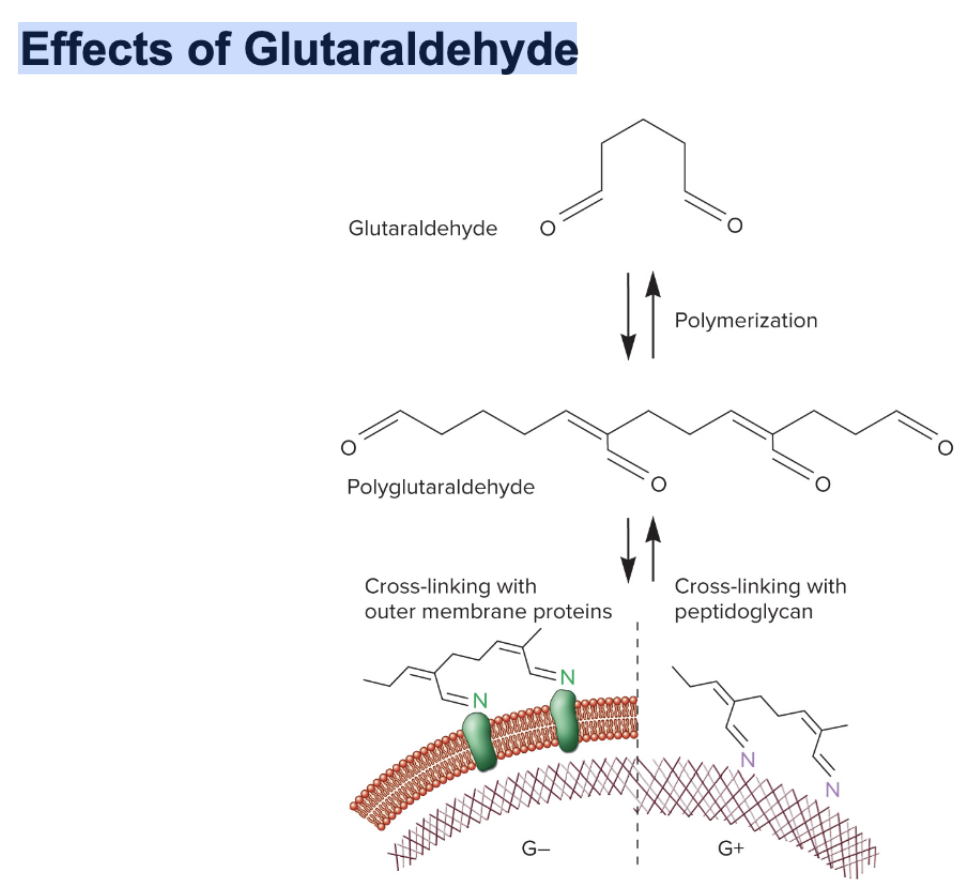
Aldehydes
• Commonly used agents are formaldehyde and
glutaraldehyde.
• Highly reactive molecules that act by inactivating nucleic
acids and proteins.
• Sporicidal and can be used as chemical sterilants.
8.3 Microorganisms Are Controlled with Chemical Agents
Effects of Glutaraldehyde
ON EXAM
8.3 Microorganisms Are Controlled with Chemical Agents
Sterilizing Gases
sterilizes what materials?
it can kill what?
name an example of one. and used in what equipment?
• Used to sterilize heat-
sensitive materials.
• Microbicidal and sporicidal. (kills them)
• Ethylene oxide sterilization
is carried out in equipment
resembling an autoclave.
• Vaporized hydrogen
peroxide can also be used.
8.4 Antimicrobial Agents Must Be Evaluated for Effectiveness
Evaluation of Antimicrobial Agent Effectiveness
what is this?
who regulates disinfectants?
who regulates agents used on humans and animals and establishes guidleines under which of these agents are used and agent effectiveness is measured?
Complex process regulated by two U.S. federal agencies:
• Environmental Protection Agency regulates disinfectants.
• Food and Drug Administration (FDA) regulates agents used on humans and animals.
Establish guidelines under which these agents are used and agent effectiveness is measured.
8.4 Antimicrobial Agents Must Be Evaluated for Effectiveness
Conditions Influencing the Effectiveness of Antimicrobial Agent Activity
what are they? (6)
Population size
• Larger populations take longer to kill than smaller
populations.
Population composition
• Microorganisms differ markedly in their sensitivity to
antimicrobial agents (endospores more resistant).
Concentration or intensity of an antimicrobial agent
• Usually higher concentrations kill more rapidly.
• Not a linear relationship, small changes can have large effect
Contact time
• The longer the exposure, the more organisms killed.
Temperature
• Higher temperatures enhance chemical activity.
Local environment
• Population to be controlled is not isolated but surrounded
by environmental factors that can either prevent or aid in
destruction.
• pH, viscosity, and concentration of organic matter.
• Organisms in biofilms are less susceptible to many antimicrobial
agents.
8.4 Antimicrobial Agents Must Be Evaluated for Effectiveness
Efficiency Evaluation of Chemical Agents
three tests
Phenol coefficient test
• Potency of a disinfectant is compared to that of phenol.
• Useful for initial screening but may be misleading.
test not 100% correct so u need another test to add on to it
Use dilution test
• Determines rate at which selected bacteria are destroyed
by various chemical agents.
Normal in-use testing
• Testing done using conditions that approximate normal
use of disinfectant
8.5 Microorganisms Can Be Controlled by Biological Methods
Biological Control of Microorganisms
what is this?
what are bacteriophages?
what are enzybiotics?
Emerging field showing great promise.
basically abt using natural organisms or substances to kill harmful microorganisms, especially bacteria istead of using traditional antibiotics or chemicals
Natural control mechanisms:
• Predation by Bdellovibrio.
• Bacteriophages—A spray format recently approved by the FDA can be used on food
products.
• Enzybiotics—Proteins purified from bacteriophage that cause host cell lysis.
• Toxin-mediated killing using bacteriocins
8.5 Microorganisms Can Be Controlled by Biological Methods
Enzybiotics
what are they?
What are their advantages over Conventional Antibiotics?
ON EXAM
Enzybiotics are a promising class of protein-based, antibacterial, and antifungal agents derived from bacteriophage-encoded enzymes (endolysins) or microorganisms that degrade bacterial cell walls.
proteins/enzymes tht kill bacteria by damaging their cell wall
Advantages over Conventional Antibiotics:
High Specificity: They target specific pathogens without destroying beneficial microbiota.
Low Resistance: Due to their mechanism, bacteria find it difficult to develop resistance.
Effective against Persisters: They can kill metabolically inactive ("persister") bacteria that conventional antibiotics often miss.
Biofilm Disruption: Some, such as polysaccharide depolymerases, can break down protective biofilms.
Applications: Primarily under development for treating infections (e.g., Staphylococcus aureus, Pseudomonas aeruginosa), with some in clinical trials. They are also researched for food bio-preservation to reduce pathogens.
Limitations: Their proteinaceous nature can limit stability, and they can be challenging to
produce and purify.