Patient care Finals: Exams: 1,2,and3
 Call Kai
 Learn
 Practice Test
 Spaced Repetition
 Match
 Flashcards
 Knowt Play
1/100

There's no tags or description
Looks like no tags are added yet.
101 Terms
If a patient cannot assist with a bed-to-table transfer,
Option A
a draw sheet or transfer assist device should be used.
Option B
ask one other colleague to help you do the lifting.
Option C
disregard the transfer and do a portable examination with the patient on the cart.
Option D
none of the above are appropriate.
a draw sheet or transfer assist device should be used.
All of the following are nonverbal communication characteristics EXCEPT
Option A
volume of voice.
Option B
body language.
Option C
amount of eye contact.
Option D
professional appearance.
Volume of Voice
When you must touch a patient, you are less likely to unintentionally offend if you
1. tell the patient in advance what you are about to do.
2. use a firm, appropriate touch.
3. have a professional purpose that is clear to the patient.
1,2, and 3
Which of the following may be used as an immobilizer?
1. Sandbags
2. Sponges
3. Velcro straps
4. Sheet
A: 2 Only
B: 1,2, and3
C: 2,3, and 4 only
D: 1,2,3,and 4
D: 1,2,3,and4
Which of the following is the most effective way to meet legal requirements when obtaining informed consent from a patient who does not speak English?
Provide a pen and point to the correct signature line.
Use facial expressions and gestures to explain.
Obtain a qualified interpreter.
Ask the patient’s family to help.
Obtain a qualified interpreter.
A patient of color arrives for a GI series in a bright flowing gown and turban. You wish to be empathetic, so your first question might be
“Have you had this procedure done before?”
“Where did you get that outfit?”
“Can you speak English?”
“What country are you from?”
“Have you had this procedure done before?”
Ageism is a term that refers to
A condition in which one’s appearance does not accurately reflect one’s age
Discrimination againt peiple because of age
the study of age-related behaviors
a condition in which behaviors is not typical of ones age
discrimination against people because of age.
Use of side rails on stretchers is required
when transporting children
when restrans are ordered
when patients are uncoopertive or unconscious
Answers
A: 2 and 3 only
B: 1, 2, and 3
C: 1 and 3 only
D; 1and 2 only
1, 2, and 3
true or false: restrains require a physicians order
True
The first step you should follow in assisting a patient from a wheelchair to the X-ray table is to
Fold up the footrests
Assist the patient to a standing position
position the wheelchair parallel to the table and lock the brakes
Lower the table to chair height.
position the wheelchair parallel to the table and lock the brakes.
What is the correct term for the -ostomy labeled #1?

Option A
Ascending Colostomy
Option B
Sigmoid Colostomy
Option C
ileostomy
Option D
Transverse Colostomy
Option E
Jejunumostomy
Option F
Descending Colostomy
Option G
Duodenumostomy
Option H
Left colic flextureostomy
ileostomy
Patients who have back injuries are more comfortable moving to a supine position from
A prone position
A lateral recumbent position
a sitting position
a standing position
A lateral recumbent position
When working with an elderly patient,
Option A
speak slowly and clearly and ask for understanding and feedback.
Option B
write down your instructions first for the patient to read.
Option C
give the patient breathing instructions while you’re positioning him or her in order to hasten the procedure.
Option D
assume the patient can see and hear you clearly and move quickly and deliberately in order to get done.
speak slowly and clearly and ask for understanding and feedback.
True or false. The Pigg-O-Stat is used to immobilize infants for chest radiographs.
True
True or false. A colostomy is always permanent.
False
True or false. After placing the bedpan under the patient, the patient should remain flat until they are done defecating.
False
All of the following are true of good body mechanics EXCEPT
Option A
Do most of the lifting with your legs and keep your back stationary.
Option B
extend your reach beyond the center of gravity to broaden your arm coverage.
Option C
Stand with your feet far apart to broaden your base of support.
Option D
Ensure your center of gravity is over your base of support.
Extend your reach beyond the center of gravity to broaden your arm coverage
When communication has been validated, this means that the speaker has
Option A
reviewed the material.
Option B
presented the information accurately.
Option C
received a response from the listener that demonstrates comprehension.
Option D
spoken clearly.
Received a response from the listener that demonstrates comprehension
The acronym PASS is a helpful way to remember
Option A
the steps involved cleaning up a hazardous spill.
Option B
the steps for using a fire extinguisher.
Option C
the steps in preparing a patient for transport.
Option D
the basic principles of body mechanics.
The steps for using a fire extinguisher.
When assisting a stroke patient to walk, you should place yourself
Option A
behind the patient gripping the gait belt.
Option B
in front of the patient.
Option C
on the patient’s weak side.
Option D
on the patient’s strong side.
On the patients weak side
Patients who suffer from orthopnea need to have
Option A
padding under bony prominences.
Option B
their heads elevated in order to breathe.
Option C
a skin graft.
Option D
their feet elevated to relieve pain.
their heads elevated in order to breathe.
When a hazardous spill occurs, your first duty is to
Option A
limit access to the area.
Option B
clean it up immediately.
Option C
attend to your patients and let someone else handle it.
Option D
call housekeeping to clean it up.
limit access to the area.
Patients who have undergone hip replacement via the posterior surgical approach should avoid which of the following movements?
Extending the ip to 180 degress
adduction
abduction
External rotation
Abduction
The term recumbent refers to a position in which the patient is
lying down
The Occupational Health & Safety Administration (OSHA):
ensure workplace safety
enforceces standars for a healthy working environment
provides safety training and regulations
all of the above
all of the above
Which of the following must be present to create and sustain a fire?
Oxygen
carbon dioxide
source/heat
fuel
chemicals
Oxygen, source/heat, and fuel
Fire marshals state that common infractions of fire safety rules in hospitals involve
1. improper storage of flammables.
2. fire doors blocked open.
3. unapproved extension cords.
4. storing equipment in corridors.
Answers
A. 2 and 3 only
B: 1,2,3,and 4
C: 1 and 2 only
D: 1, 3, and 3 only
1,2,3, and 4
A _______ base of support creates greater stability.
wide
narrow
short
all of the above
wide
The principle of providing healthcare services with full respect for the dignity of humankind is
included in the ASRT Code of Ethics
established by the law
applcable only to physicians
impossible to implement
Include in the ASRT Code of Ethics
What is a stoma?
an opening in the abdominal wall to allow for the removal of body waste
a surgical excision of a kidney stone
a surgical excision of the stomach
an opening in the thorax to allow for the elimination of urine
an opening in the abdominal wall to allow for the removal of body waste
Which of the following is the best method of transportation to the imaging department for a toddler who is an inpatient?
The safest and most convenient method is to transport the child in a crib.
The patient may walk with you if physician’s orders allow the patient to stand
You should carry the patient.
The patient’s parent should bring the child to the department
The safest and most convenient method is to transport the child in a crib.
A sudden drop in a patient’s blood pressure caused by standing or sitting upright is called
hypertension
anemia
orthostatic hypotension
postural emesis
orthostatice hypotension
Which of the following items are not an essential part of a “spill kit”?
heavy plastic bags
broom and dustpan
rags and sponges
kitty litter
rags and sponges
Electrical equipment used on or near patients must
1. be approved for hospital use.
2. have grounded plugs.
3. be inspected regularly and repaired if needed.
Answers
1 and 3 only
1,2, and 3
2 only
1 only
1,2, and 3
How many people should assist during a log roll?
2-3 people
1 person
4-5 people
none of the above
4-5 people
Mrs. Elizabeth Dunbar is 86 years old and a bit confused. She is most likely to respond appropriately if you address her as
Sweetie
Elizabeth
Betty
Mrs. Dunbar
Mrs. Dunbar
When moving a patient from a stretcher to the radiographic table, it would be appropriate to
A: ask the patient how much he or she can help with the transfer.
B: wrap the patient up in a sheet and roll him or her over completely.
C: allow the patient to safely help with the transfer as much as he or she is able
D: do both a and c
do both a and c
In the image below, the patient’s feet is elevated higher than their head. What position is the patient in?

A: Sims
B: fowlers
C: Trendelenburg
D; Reverse Trendelenburg
Trendelenburg
When an elderly female outpatient has bruises, abrasions, and decubitus ulcers, you should
understand that the elderly have tender skin and fall easily.
Report suspected elder abuse to your supervisor while the patient is still present.
pay no attention; it is none of your business
ask the patient if she is being mistreated.
report suspected elder abuse to your supervisor while the patient is still present.
The acronym RACE is a helpful way to remember
the steps for using the fire extinguisher
the steps to follow in the event of a fire
the steps involved in cleaning up a hazardos spill
the basic principles of body mechanics
the stps to follow in the event of a fire
In the image below, the patient is lying on their stomach. What position is the patient in?

sims
Prone
supine
lithotomy
Prone position
When a physician orders NPO for a patient, this means that
only water and ice chips can be given by mouth.
All urine must be saved.
Nothing is to be given by mouth.
The patient is on bed rest.
Nothing is to be given by mouth
All of the following apply to the correct use of a fire extinguisher, except:
Use a side-to-side sweeping motion.
Pull the pin and squeeze the handle.
Steadily aim at the hottest area of the fire.
The nozzle pointed at the base of the fire
steadily aim at the hottest area of the fire
In the language of body mechanics, the center of gravity is located
through the center of the body at the waist/pelvis
through the center of the body at the thorax/axilla
through the inferior portion of the body at the ankles
through the superior portion of the body at the skull
through the center of the body at the waist/pelvis
True or false. The image seen below is a regular bedpan.
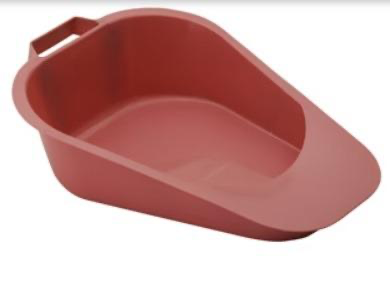
False
If you smell smoke and smoldering insulation in the area of an x-ray control panel, the first thing you should do is
turn off the main power switch
call a fire code
evacuate the area
call for an x-ray service engineer
Turn off the main power switch
A conscious patient whose hands are moist and trembling is most likely suffering from
fever
fear
anxiety
an acute illness
anxiety
In the image below, the patient’s head has been elevated about 20 degrees. What position is the patient in?

high-fowler
semi-fowler
trendelenburg
Lithotomy
Semi-fowler
What type of transfer technique is seen in the image below?
Wheelchair
Sliding Transfer board
Hydraulic lift
Log roll
Hydraulic lift
The most common cause of back strain is
bending and twisting while lifting.
Lifting more than 30 pounds.
Lifting while keeping the back straight.
Pushing heavy equipment on wheels.
Bending and twisting while lifting
Aphasic patients are unable to
hear
respond to instructions
speak
make decisions
speak
When moving a patient to or from a stretcher,
have the patient hold the stretcher from moving
lock the stretcher securely against the examination table
prop a cheelchair against the end of the cart
protect the stretcher with woolen blankets
lock the stretcher securely against the examination table
True or false. A fire can be "smothered" to be put out.
true
Because oxygen supports combustion, the safety rules regarding oxygen use state that there should be no
1. smoking.
2. ungrounded appliances.
3. candles or other open flames.
Answer
1,2, and 3
1 and 2 only
1 only
3 only
1,2, and 3
The acronym RACE stands for
Rescue, alarm, calm, execute
Rescue, alarm, contain, execute
Rescue, alarm, contain,evacuate
Rescue,Announce, contain evacuate
Rescue, alarm, contain,evacuate
A body position in which the patient is lying on his or her back with the head and upper body elevated is called
Supine position
trendelenburg position
fowler posistion
Lithotomy position
flowler position
When an Asian patient is apprehensive about the examination, you should
maintain a respectful distance, use a calm voice, and smile while minimizing eye contact.
Use sign language to communicate.
maintain eye contact while providing reassurance
show friendliness by placing your arm around his shoulders.
maintain a respectful distance, use a calm voice, and smile while minimizing eye contact.
When a patient who has not stood or walked since an accident, stroke, or surgery and must be taken to the imaging department, the best method is to
use a wheelchair, and assist the patient when standing and getting onto the table.
walk with the patient and take the elevator, not the stairs.
use a stretcher
use a wheelchair but do not let the patient stand; use two person lift
use a stretcher
To avoid the possibility of decubitus ulcer formation in the elderly, the radiographer should:
1. ensure that the patient’s skin stays clean and dry.
2. avoid bumps that may cause contusions and abrasions in the skin.
3. provide padding under bony prominences.
4. leave the patient in the same position for the duration of the examination.
Answer
1,2,3, and 4
1,2, and 3 only
1 and 3 only
1 and 2 only
The radiographer should:
1, 2, and 3 only.
When assisting a patient from bed to wheelchair, you should
1. elevate the head of the bed.
2. lower the bed as far as possible.
3. use the face-to-face assist to help the patient stand.
4. assist the patient to pivot with back to wheelchair before sitting down.
Answer
1 and 2 only
1 and 3 onl
1,2,3, and 4
1,2,and 4 only
The caregiver should:
1, 2, 3, and 4.
What is the correct term for the -ostomy labeled #6?

A. Ascending Colostomy
B. Sigmoid Colostomy
C. ileostomy
D. Transverse Colostomy
E. Jejunumostomy
F. Descending Colostomy
G. Duodenumostomy
H. Left coloc flextureostomy
Sigmoid colostomy
When you are scheduled for lunch and you have not completed a procedure, the best course of action is to
delay completion of the procedure until you return from lunch.
postpone your meal until the procedure is completed.
send out for a snack and eat hurriedly.
request that someone else take over for you.
postpone your meal until the procedure is completed.
When a patient needs to void (urinate) during an examination in the imaging department
all urine should be saved.
nursing service should be notified
the chart should be checked to see if qualitative or quantitative specimen samples are needed to be collected.
it is not necessary to collect a specimen; this is a nursing function.
the chart should be checked to see if qualitative or quantitative specimen samples are needed to be collected.
Which of the following statements regarding nonverbal communication is not true?
Hand gestures, facial expressions, and posture can convey feelings nonverbally.
Nonverbal behaviors have the same interpretations in all cultures.
Nonverbal messages may be either positive or negative.
Nonverbal behaviors reveal a great deal about how we feel.
Nonverbal behaviors have the same interpretations in all cultures.
Typically, during an evacuation plan which patients are evactuated last?
Ambulatory
Non-ambulatory, Non-Crtical
Non-ambulatory, Critical
None of the above
Non-ambulatory, Critical
When a qualified interpreter is used for non-English-speaking patients, the interpreter will
insist that the family remain in the room for legal protection.
tell the patient what is likely to happen.
edit the conversation to save valuable time.
translate only what is said by and to the patient.
translate only what is said by and to the patient.
Which of the following statements is true with regard to comatose patients?
They do not need side rails because they cannot move.
They may hear and comprehend while apparently unconscious.
They are unable to swallow.
They are always confused when first awakened.
They may hear and comprehend while apparently unconscious.
Which of the following is the best choice to reduce involuntary motion?
communication
use lead shielding
use short exposure time
increase kvp
use short exposure time.
5 stages of grief
1st: Denial
2nd: Anger
3rd: Bargaining
4th: Depression
5th:Acceptance
When communicating with a young child as part of a radiographic examination, an effective strategy to communicate would be to
1. kneel down to the child’s eye level and lower your voice.
2. speak loudly and quickly so the child knows you’re in charge.
3. allow one of the younger radiographers in the department to perform the study.
4. speak exclusively to the parent so the child cooperates.
Ansers
1 and 3 onl
1 only
3 only
2 and 4 only
1 only
Which of the following statements does not apply to the Rules of Body Mechanics?
Keep your load out beyond the front of your body.
Avoid pulling or lifting heavy objects.
Use a wide base of support.
Bend your knees when you lift heavy objects.
Keep your load out beyond the front of your body.
True or false. The urinary catheter collection system should always be kept above the level of the urinary bladder.
false
Fear and anxiety cause many patients to suffer from a dry mouth. When a patient complains of thirst, you should
offer a choice of fruit juice, water, or ice chips.
check the chart before offering anything.
provide a cup of ice chips within reach.
offer a drink of water with a straw.
check the chart before offering anything
Your patient, Joan Gordon, 72, has dentures, glasses, and a hearing aid. You should
place them in a container in the x-ray room and inform her of their location.
tell her to leave them at home next time.
carefully place them in the department office.
instruct her to leave them with her clothes in the dressing room.
place them in a container in the x-ray room and inform her of their location.
When a patient has impaired hearing, which of the following strategies is least likely to be helpful?
Shout loudly with your lips close to the patient’s ear.
Provide written instructions.
Speak in a quiet place to minimize background noise
Face the patient while speaking.
Shout loudly with your lips close to the patient’s ear.
In the language of body mechanics, the center of gravity refers to
an imaginary vertical line passing through the center of the body.
an imaginary horizontal line passing through the shoulders
a line between the points of contact with a horizontal surface.
the point around which body weight is balanced.
the point around which body weight is balanced.
In preparing to radiograph a patient who has come to the medical imaging department with a complaint of abdominal pain, you begin to question the patient. Which of the following are good questions to ask to obtain quality medical history?
“Can you tell me what brings you in today?”
“How long have you had this pain?”
“Is the pain sharp or dull?”
All of the above
All of the above
With respect to the type of fire extinguisher needed, an electrical fire is designated as
class A
class B
class C
class D
Class C
A patient weighing 260 pounds arrives from an intermediate care facility via wheelchair for an examination of the hip. He is unable to bear weight on either leg. The most appropriate method for placing this patient on the x-ray table is to
send the patient back to the care facility with instructions to return by stretcher.
get the strongest coworker you can find and perform a two-person lift.
call for a hydraulic lift and personnel who are experienced in its use.
get as many people as you can find to help.
call for a hydraulic lift and personnel who are experienced in its use.
Checking transportation equipment for safety is the responsibility of
the nursing service.
the person transporting the patient.
the head of the department to which the equipment is assigned.
the hospital safety committee.
the person transporting the patient.
When lifting patients, it is important to
lift with your back and save your leg strength.
twist at the waist to improve your center of gravity
bend at the waist to improve stability.
keep your back stationary and lift with your legs.
keep your back stationary and lift with your legs.
In preparation for a patient transfer to the imaging department, the radiographer should
1. check with nursing service.
2. check the patient’s chart.
3. assess the patient.
4. check patient identification.
Answer
2 and 3 only
2,3 and 4 only
1,2,3,and 4
1 and 3 only
1,2,3 and 4
True or false. Restraints should only be used after all other safety measures have failed.
true
Which of the following is the best choice to reduce voluntary motion?
communication
use lead shielding
use short exposure time
increase kvp
communication
When positioning or transporting a patient who has undergone hip replacement via the anterior surgical approach, which of the following movements is usually well tolerated
Flexion to no more than 90 degrees
potation
abduction
hyperextension
Flexion to no more than 90 degrees
When transferring patients for medical imaging procedures, communication is an essential component of a safe and efficient transfer. Which of the following is not a recommended communication strategy to achieve a safe transfer?
Call the nursing floor to learn of the patient’s mobility.
During the transfer, try to stay quiet so as not to alarm the patient.
Ask the patient how much he or she can assist with the movement.
Ask the patient if he or she has been moved recently and how the experience went.
During the transfer, try to stay quiet so as not to alarm the patient.
A gait belt is used to
maneuver a slider board.
provide safety on a stretcher.
assist a weak patient to stand and walk.
hold a patient securely in a wheelchair.
assist a weak patient to stand and walk.
In the language of body mechanics, the base of support refers to
a perpendicular line through the center of gravity.
the bottom of an object being lifted.
a line between the points of contact with a horizontal surface.
the floor.
a line between the points of contact with a horizontal surface.
Who is in charge and gives directions during a log roll?
The person at the patient’s head supporting the neck
The lead technologist
The person at the back of the patient
The doctor ordering the exams for the patient
The person at the patient’s head supporting the neck
In the image below, the patient’s legs are supported in stirrups. What position is the patient in?

Reverse Trendelenburg
semi-fowler
trendelenburg
Lithotomy
Lithotomy
Where are Decubitus ulcers more likely to form ? (Select 2 pairs)
A: hips and Buttocks
B: face and hands
C: chest and abdomen
D; elbows and heels
A: hips and Buttocks, D: elbows and heels
When a child is too young to understand instructions and will not hold still for a radiograph, before we ask a parent hold the child, which of the following should be used?
1. Communication
2. Immobilizers
3. Short Exposure time
4. Increased KVP
Answers
1 only
1,2,and 3 only
2 and 3 only
2 and 4 only
2 and 3 only
A brief, mild reduction in the oxygen supply to the brain occurring with changes in body position that may cause the patient to feel faint is called
syncope
orthopnea
orthostatic hypotension
vertigo
orthostatic hypotension.
If an irritating chemical has splashed in your eye, you should
go to the emergency department.
flood the eye with running water from the closest eyewash station or most convenient source.
cover the eye with an eye patch.
go immediately to the eyewash station in the laboratory at the opposite end of the building.
flood the eye with running water from the closest eyewash station or most convenient source.
A patient is in the imaging department the day after undergoing hip surgery. The patient tells you she needs to use the restroom. What would the next appropriate steps be? (Select 3)
A: Get assistance to help turn the patient and assist with cleaning
B:Place a regular bed pan under the patient
C:Close curtains and doors to give the patient some privacy
D:Place a fractured bed pan under the patient
A, C, and D
According to the U.S. Department of Labor, one of the most common work-related injuries resulting in lost work time and disability is
carpal tunnel syndrome.
torn rotator cuff injury.
back injury.
torn knee meniscus
back injury.
Which of the following observations should cause you to suspect child abuse?
1. Cigarette burn marks
2. Bruises shaped like hands, fingers, or objects, such as a belt
3. Failure to seek prompt treatment for a serious injury
4. Isolated fracture of the radius (bone in forearm)
Answer
2 and 3 only
1 and 2 only
1,2, and 3 only
1,2,3, and 4
1,2,and 3 only
When family members make angry and persistent demands on the staff, this is most likely the result of
normal frustration with the hospital system.
fear over the condition of their relative.
lack of confidence in your ability.
habitual rudeness.
fear over the condition of their relative.
If there is a fire in your immediate area, the first thing you should do is
evacuate the area
call the fire code
close the fire doors
shout “fire”
evacuate the area
A patient displaying criticism and abuse toward family members or staff may be going through which phase of grief?
acceptance
bargaining
anger
depression
anger