Engineering Studies: CIVIL STRUCTURE
 Call Kai
 Learn
 Practice Test
 Spaced Repetition
 Match
 Flashcards
 Knowt Play
1/79

There's no tags or description
Looks like no tags are added yet.
80 Terms
Civil Structures
All engineered structures in our world
BEAM BRIDGES - defintion
A member that is supported so that its supports do not carry longitudinal force, ONLY VERTICAL
Beams can be classified into 2 types:
Simply supported beam
Cantilvered Beam
Simply supported Beam
Supported at both ends
Cantilvered Beam
Supported at one end
Outline the history of technological change as applied to civil structures. (3) timbe-sto-steel
The first civil structures were developed using materials that were readily available such as timber.
Later bridges were constructed from stone.
During the Industrial Revolution, steel replaced timber and stone
Who were early Beam Bridges made by…
Romans
Truss Girder Bridges (when was it developed)
Developed in 1500s
Box Girder Bridge
Most common form of Beam Bridge today
Consists of a tube with a rectangular cross-section stiffened by a series of internal walls.
Arch Bridges
A bridge with a curved structure that supports the load and transfers forces to the ground at each end.

Materials used on Arch Bridges
Stone
Cast iron and steel.
Modern arch bridges use concrete.
Characteristics of Stone (3) + 1 disavdtage
High compressive strength, weak in tension – withstands large squeezing forces.
Durable – lasts a long time and resists weathering.
Heavy – provides stability to the bridge.
Characetirics of Cast Iron (2 advantage +.1 disad
Strong in compression, weak in tension
Cheaper
Characteristics of Steel (3 ADV+ 1 DISA (corro..)
High tensile strength – withstands large pulling forces.
High compressive strength – withstands large squeezing forces.
Ductile – can bend or deform without breaking easily.
CAN CORRODE EASILY
Suspension Bridge
A bridge where the deck is supported by vertical cables suspendes between tall towers

Suspension Bridges description (made from what, more ligh.., what material used mainly)
Early suspension bridges used twine, vine or chains
Suspension bridges are much more lightweight so can span further distances
Steel is commonly used in the manufacture of suspension bridges
Opening Bridge
Moves or lifts to let ships pass underneath.
Engineering Innovations in Civil Structure and their Effect on Peoples Lives (innovation vs invention
Invention is the development of something new
Innovation refers to altering something already made
Construction and Processing Materials used in Civil Structure
T,S, B, CI, WI, S, C, SS
Timber
Stone
Bricks
Cast Iron
Wrought Iron
Steel
Concrete
Stainless Steel
Timber (2 Advantages + 2 disadvantages)
Advantages
Offered ease of manufacture
Readily available resource
Disadvantages
Rots away easily
Stone (1 advantage + 1advantage)
Strong in compresion, weak in tension
Durable
Brick
Strong in compression
Weak in Tension
Same as stone
Occasionally used in bridge construction.
Cast Iron (strong compres, melte and cast, reduce weigh..)
Strong in compression but weak in tension
It can be melted and cast, saving time and money.
Greatly reduced weight
Wrought Iron (where was it used in)
Earlu suspension bridges
Wrought Iron disadvnatage - (unreliab… due to its fibr
Unreliable due to its fibrous ferrite structure, tended to weaken it
When Wrought Iron was replaced by steel suspension….
suspension bridges could be built more longer
Steel (when founded and who)
1856 Henry Bessemer
Steel ( 2 advantage, used in…)
Strong in Tension, Compression, Malleable and easy to construct with
Enabled construction of much greater spans.
Used in arch bridges, steel cables for suspension bridges, and reinforced concrete.
Concrete - not used until…
Was not used in bridge construction until shrinkage problem was adressed by 3rd Hinge
Strong in compression but weak in tension.
Pre-stressed and post-stressed concrete are commonly used in modern bridges.
Stainless Steel
Used for corrosion resistant and pedestrian bridges
Enviromental Implications of Materials used in Civil Structure
Timber
Resulted in deforestation of the surrounding area
Trees take centuries to grow
Stone
Had to mine stone, digging large quarries
Impacting fauna and flora and damaging ecosystem
Bricks (subsidence meaning
Bricks require large amounts of clay and shale to manufacture, similar to stone
Subsidence: The ground sinks or settles, which can be a problem at old brick pit sites.
Cast and Wrought Iron
Fossil fuel combustion for smelting cast and wrought iron caused environmental degradation.
Required mining and smelting of iron, which damaged the landscape.
Steel
Fossils fuel combustion and mining - SIMILAR TO CAST AND WROUGHT IRON
Enabled longer bridges with fewer piers, reducing disruption to waterways.
Concrete
Requires large amounts of minerals to manufacture, causing environmental damage.
Societal Advancements (steel and concrete enab larger…
Steel and concrete enabled larger, stronger, and more durable bridges, improving infrastructure and connectivity significantly.
Engineering Mechanics
VERY IMPORTANT TABLE - COMING IN EXAM (Supports for beams or trusses)

Support 1: ___
Fixed

Freebody diagram of “Fixed Support” + ATTRIBUTES
Can support
VERTICAL
HORIZONATAL
MOMENTS

Reason for use (to firmly ancho… a strcy
To firmly anchor a structure
Support 2: ___
Hinge/ Pin

FBD of hinge + attributes (free to rotat…
Vertical
Horizontal
Free to rotate
Reason for use (To provide a non movin… supp for
To provide a non moving support for a bridge
Support 3_____
Roller
FBD + Attributes
Only reaction normal to surface
free to rotate

Reasons for use ( to allow side movemen for expansio in tru.)
To allow side movement for expansion in truss
Engineering Materials
Testing of Materials
Allow us to watch and analyse material behaviour under load
Non Destructive testing
Destructive testing
Non Destructive Testing (X, DP, U)
X ray
Dye Penetrant
Ultrasonic
X- RAY (USE AND METHOD) - passed throu, expose on a photosen, locartion can be fou
USE: X rays are used to locate the cavaties
METHOD
X-ray passed through material/object
and exposed onto a photosensitive film
on the opposite side.
The location of cavities and internal
faults can be found.
Diagram of X-Ray Testing

Dye Penetrant Testing (USE AND METHOD)
(remo oi, area heat and dy, wip, devel, coo dow, dye squee ou)
Use: To determine if cracks are present in metallic items
METHOD
Remove any oil or surface contaminents in the area
Area is heated and dye is placed over the surface
Wipe of excess
A developer (white powder) sprinkled on the area
Then cooled
If crack is present, dye will be squeezed out by the contraction of cooling item
How can you spot cracks more visbly undeer DYE PENETRANT TESTING
UV Light
Ultrasonic Testing (use and method)
(metho: high f radi sent by tran throu comp, refl sig show the cav
USE: Determining the location of cavities.
METHOD:
High freqency radio waves are sent by the transmitter through components
The reflected signals show the results
of any cavities on the surface.
Deconstructive/ Concrete Testing (T, C,T, T, S)
Tensile
Compressive
Transverse
Torsion
Slump
Tensile Test
Used to determine tensile test
Method
A testing machine stretches a piece of
material.
The elongation and load are recorded as it breaks
Compressive test
Used to determine compressive strength of material
Method
A piece of material is crushed by a
testing machine
The deformation and load are recorded
as it breaks.
Effect of Testing concrete for compreesive tests (if it fails)
If the concrete fails compression test, material was faulty and may need be to removed, being expensive and time consuimg
Transverse Test (when ben, method: support both end, measure of bending lo at rup)
Used to determine how a material peform when bent
Method
. Material is supported on both ends and a load is applied on oppiste side
Measure of bending load and total deflection at rupture
Torsion Test
How well a material copes with twisting forces
Slump Testing (USE, METHOD AND if it collapses= , if ir cracks=
Measures the workability of concrete more specifcally fluidity
Method
The concrete is cast into a conical mould
Wet Concrete poured in
If it collapeses = TOO WET
If it cracks= TOO DRY
Bending Stress
A positive bending beam (whagt does it consits of)
Ends are up and centre is down
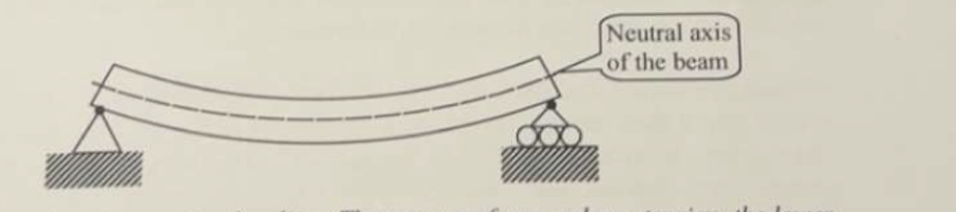
Upper surface will undergo…
COMPRESSION
Lower surfaces will be in….
Tension
The greater the distance from the neutral axis the greate…
The stress present
Formula for Bending Stress
BENDING STRESS= Moment y / I

3 formulas (3 fractions to represent)
M/I = E/R = BENDING STRESS/Y
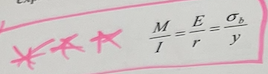
What is “E”
Young Modulus (PA)
What is “I”
Second moment of area
What does “I” Measure
The second moment of area measures the resistance of the beams cross section to bending
More I=, Less I
Better for bending as more resistant
Less I= worse as it is bent easily
N/ m 2 (what unit) vs N/mm 2
N/m2 = PASCALS
N/mm2= MEGA PASCAL
I Beams (cross section w greater d then b, high strenth to wei ra, making it eff to resi bend)
Has a cross section with greater depth then breadth, high strength-to-weight ratio, making it efficient at resisting bending forces.
Uniformly Distributed Loads
A load that is uniformly spread across a beam
Example of UDL (win agaiant bui, fihs tank on she)
Wind blowing agaisnt a building
Fish tank on a shelf
Know how it looks like
