8. Social Cognitive Theory
 Call Kai
 Learn
 Practice Test
 Spaced Repetition
 Match
 Flashcards
 Knowt Play
1/10

There's no tags or description
Looks like no tags are added yet.
11 Terms
Bandura and the Social Cognitive Approach
Bandura developed social learning theory and later used the name social cognitive theory
The new name highlights thought, expectations, goals, and self-reflection
People learn from models, but they also interpret what they observe
Four human capacities:
Language, observational learning, purposeful behavior, and self-analysis
Behavior changes with the person, setting, social rules, and expected results
Wangari Maathai
A Kenyan environmental and community organizer. As a child, she lived close to the natural world. Later, she studied, returned to Kenya, and worked to protect trees and support women.
She helped build the Green Belt Movement. Her work took place in a political setting that included threats and violence.
Her beliefs, actions, social relationships, and environment all mattered. No one factor explains her life.
In 2004, she received the Nobel Peace Prize for her “contribution to sustainable development, democracy, and peace.” She was the first African woman to win the prize.

Albert Bandura’s Theory

Observational Learning and Modelling
Observational learning occurs by watching people, groups, and symbolic models
Attention: notice the model and the important actions
Retention: remember words, images, actions, and outcomes
Reproduction: practice the action with skill and support
Motivation: consider expected outcomes, costs, values, and rewards
Learning may occur without immediate performance
Self-Efficacy
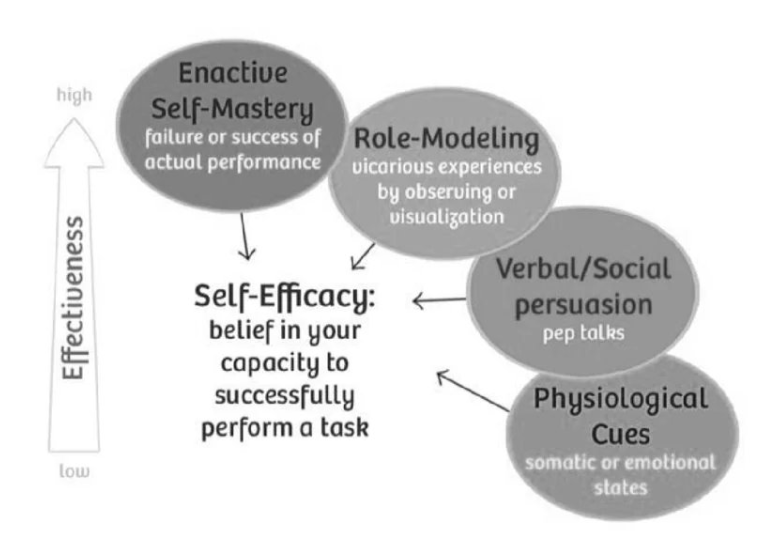
Self-efficacy is belief in the ability to organize and carry out a specific task
It’s task-specific and differs from self-esteem
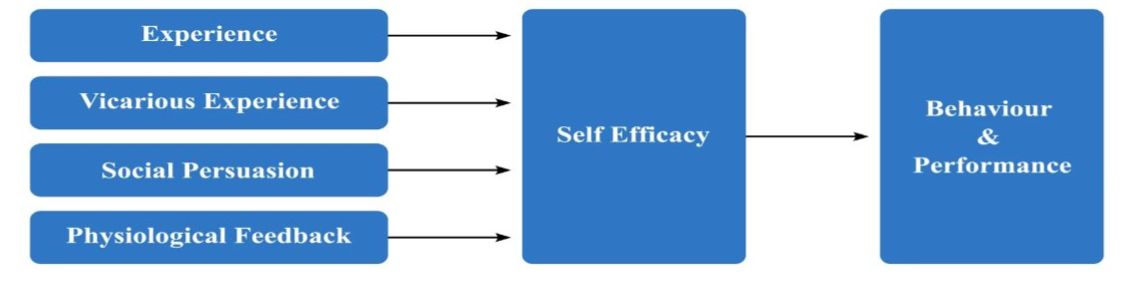
Sources: mastery experience, vicarious experience, social persuasion, and emotional and bodily feedback
Self-efficacy influences goals, effort, persistence, and strategy
Confidence supports action; it does not guarantee success or remove barriers
Outcome Expectations
Self-efficacy asks: “Can I perform this action?”
Outcome expectations asks: “What may happen if I act?”
Expected outcomes may be practical, social, or personal
A student may feel able to ask a question but expect ridicule
Support can build skill and make participation safer
Reciprocal Determinism
Person ↔ Behavior ↔ Environment
Person: beliefs, goals, skills, emotions, roles, and biological features
Behavior: actions, words, expressions, and choices
Environment: relationships, rules, institutions, culture, and physical settings
Each factor can influence the others over time.
Example: student silence and class response can reinforce ach other
Eask what each factor contributes and how change can begin

Aggression and Prosocial Behavior
Observed models can teach aggression, helping, and cooperation
Bobo doll studies showed that children can imitate observed actions
One laboratory study cannot explain every kind of aggression
People observe consequences, group norms, and how leaders use power
Models can show help, respect, conflict, apology, and repair
Personal Proxy and Collective Agency
Agency is the capacity to act with purpose and influence events
Personal agency: act directly
Proxy agency: act through people or institutions with resources or authority
Collective agency: coordinate with others toward shared goals
Agency includes intention, forethought, self-regulation, and reflection
Agency is shaped by support, opportunity, and structural conditions

Sociostructural Context and Applications
Social structures include laws, institutions, economic conditions, norms, and power
Culture shapes valued action; people differ within every society
Education: model steps, support practice, and give useful feedback
Helping relationships: identify skills, support, and barriers
Community work: combine peer learning, collective goals, resources, and policy change
The Green Belt Movement links environmental goals, women’s work, and collective action
Confidence matters, and opportunity and access matter too
Critical Review and Summary
Strengths: connects person, behavior, and environment; supports research and behavior change
Limits: beliefs alone cannot explain action; emotion, development, biology, power, and history also matter
Ask: What has the person learned? What outcomes do they expect? What does the setting allow? Who can change it?
Core concepts: observational learning, modelling, self-efficacy, recpirocal determinism, and collective agency
