Module 10 - Cellular Respiration
 Call Kai
 Learn
 Practice Test
 Spaced Repetition
 Match
 Flashcards
 Knowt Play
1/30

Earn XP
Description and Tags
included on exam 3
31 Terms
glycolysis
the splitting of glucose into two pyruvates
occurs in the cytoplasm (all reactions)
3 phases: energy investment, 6C→3c sugar cleavage, energy generation (payoff)
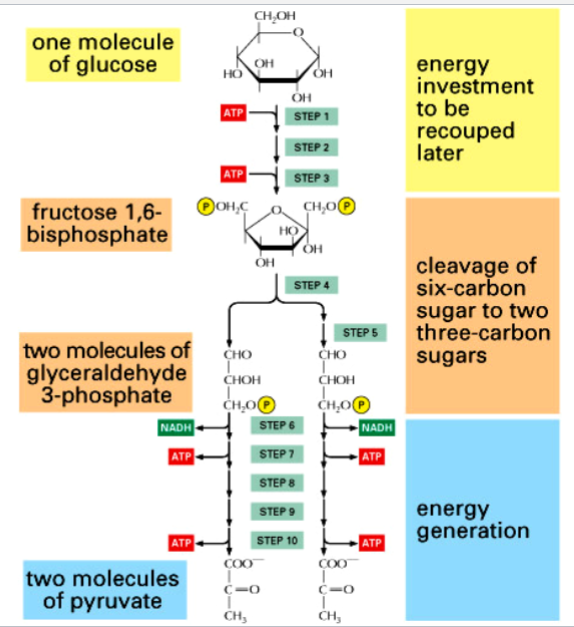
the 3 phases of glycolysis
investment: steps 1-3
cleavage: steps 4-5
payoff: steps 6-10
steps 1-3 of glycolysis (investment phase) explained
1) phosphorylation:
glucose + ATP → glucose 6-phosphate (G6P) + ADP + H+
enzyme: hexokinase
irreversible
2) isomerization:
G6P → fructose 6-phosphate (F6P)
enzyme: phosphoglucose isomerase
reversible
3) phosphorylation:
F6P + ATP → fructose 1,6-bisphosphate (F1,6-BP) + ADP + H+
enzyme: phosphofructokinase
irreversible
all molecules in this step have 6 carbons
steps 4-5 of glycolysis (cleavage phase) explained
4) cleavage:
F1,6-BP → glyceraldehyde 3-phosphate (G3P) and dehydroxyacetone phosphate (DHAP)
enzyme: aldolase
reversible
note for step 4: G3P and DHAP both have 3 carbons
5) isomerization:
DHAP → G3P
enzyme: triose phosphate isomerase
reversible
note: at the end of the cleavage phase, 1 F1,6-BP has become 2 G3P
steps 6-10 of glycolysis (payoff phase) explained
6) oxidation (x2):
G3P+ NAD+ + Pi → 1,3-bisphosphoglycerate (1,3-BPG) + NADH + H+
(2 NAD+ are reduced to 2NADH, and a Pi (inorganic phosphate) is attached to each C1)
enzyme: G3P dehydrogenase
reversible
7) ATP synthesis by substrate-level phosphorylation (x2):
1,3-BPG + ADP → 3-phosphoglycerate (3PG) + ATP
transfer of 1P from BPG to ADP
enzyme: phosphoglycerate kinase
reversible
8) isomerization (x2):
3PG → 2-phosphoglycerate (2PG)
enzyme: phosphoglycerate mutase
reversible
9) dehydration (x2):
2PG into phosphoenolpyruvate (PEP)
2H2O are removed
enzyme: enolase
reversible
10) ATP synthesis by substrate-level phosphorylation (x2):
PEP + ADP + H+ → pyruvate + ATP
transfer of 1P from PEP to ADP
enzyme: pyruvate kinase
irreversible
all steps in this phase are repeated twice, because of the 2 G3P yielded in the cleavage phase
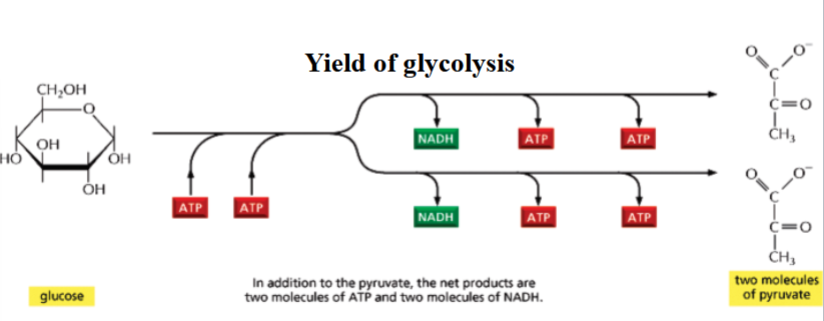
yield of glycolysis
2 ATP consumed during energy investment phase
4 ATP and 2 NADH produced during payoff phase
net yield: 2ATP + 2 NADH
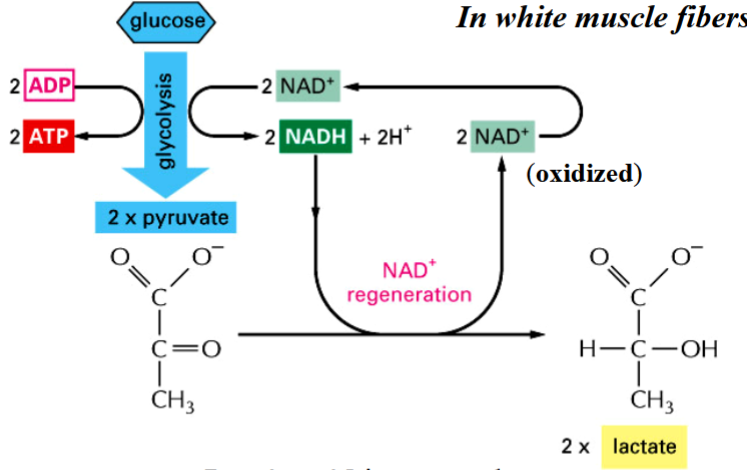
glycolysis under anaerobic conditions
pyruvate and NADH (some products of glycolysis) are consumed in fermentation
NAD+ is regenerated and reused in step 6 of glycolysis (oxidation of G3P)
3 types of muscle fibers
slow
fast
intermediate
slow muscle fibers
muscle fibers that generate ATP in mitochondria by oxidative phosphorylation
have high density of myoglobin → appear dark red
myoglobin
the oxygen-carrying protein in the muscles of most mammals
very dense in slow muscle fibers
fast muscle fibers
muscle fibers that generate most of their ATP by fermentation (anaerobic respiration)
appear white because of lack of myoglobin
intermediate muscle fibers
muscle fibers that generate some ATP by oxidative phosphorylation and some by fermentation
appear lighter red because of moderate density of myoglobin
fermentation (aka anaerobic respiration)
reduction of pyruvate in the absence of oxygen
NADH gets oxidized to NAD+
occurs in the absence of oxygen
driven by the oxidation of NADH generated from glycolysis
end products are excreted
net yield: 2 ATP (from glycolysis)
fermentation in white muscle fibers
pyruvate is reduced to lactic acid
NADH is oxidized to NAD+
(lactate gets excreted)
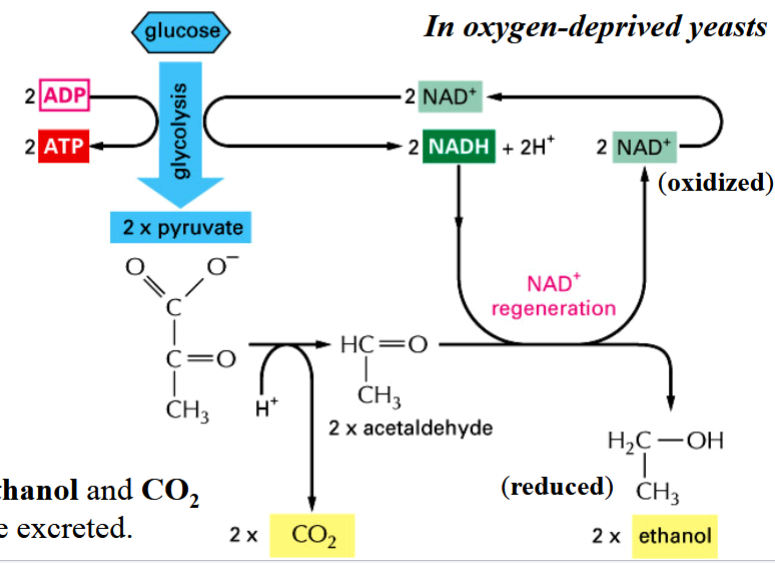
fermentation in oxygen-deprived yeasts
pyruvate is hydrolyzed to acetaldehyde
acetaldehyde is reduced to ethanol
note: acetaldehyde and ethanol have 2 carbons, not 3 like pyruvate
CO2 is produced during hydrolysis
NADH is oxidized to NAD+ during reduction
(ethanol and CO2 get excreted)
aerobic respiration
occurs in aerobic conditions, following glycolysis
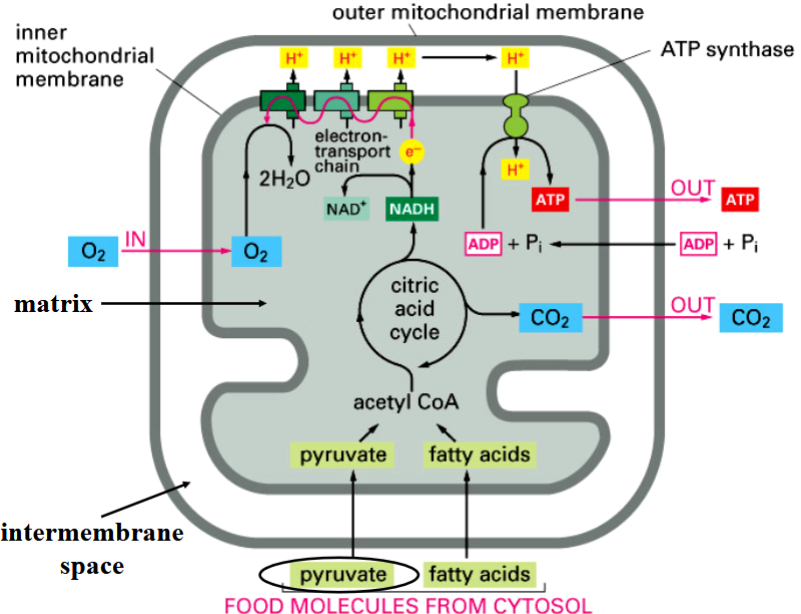
pyruvate and NADH go to the mitochondria
pyruvate reacts with coenzyme A → converted into acetyl CoA, enters the citric acid cycle
NADH powers oxidative phosphorylation reactions (electron transport chain)
mitochondrion (plural mitochondria)
the membrane-closed organelle that generates most of the cell’s supply of ATP
found in most eukaryotic cells
necessary for earobic respiration
consists of matrix, inner membrane, and cristae with intermembrane space
site of citric acid cycle, electron transport chain, and oxidative phosphorylation
matrix
the site of oxidation of pyruvate and the citric acid cycle, in mitochondria
inner membrane of mitochondria
site of the electron transport chain and oxidative phosphorylation, in mitochondria
cristae
infoldings of the inner membrane of the mitochondria
contain intermembrane space inside
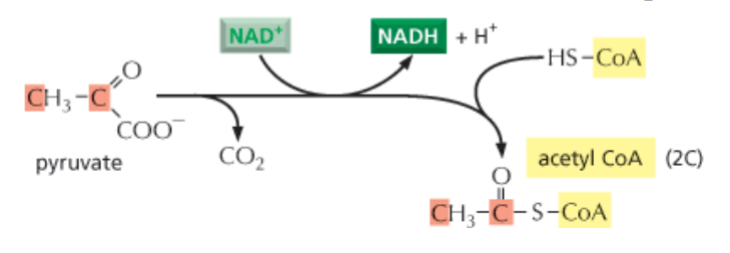
oxidation of pyruvate
pyruvate + CoA-SH → acetyl CoA + CO2
occurs in the mitochondrial matrix
1 NAD+ is reduced to NADH + H+
acetyl CoA
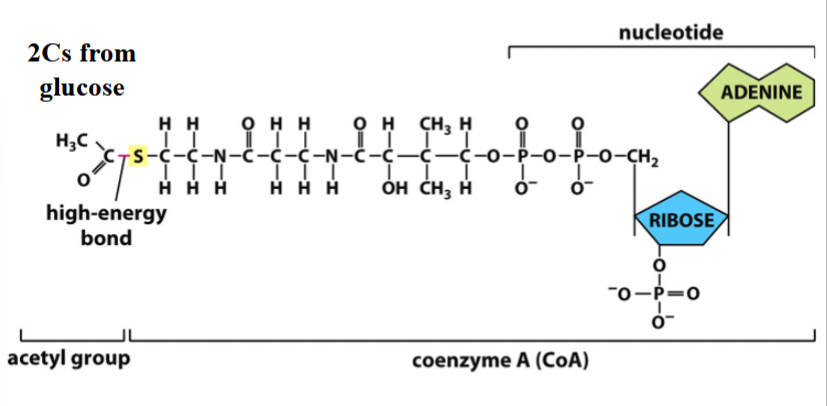
a 2-carbon product of the oxidation of pyruvate
contains a thieoster bond that releases a large amount of energy when hydrolyzed
the 2 carbons are derived from glucose
citric acid cycle (CAC), aka Kreb’s cycle, aka TCA cycle
the production of several NADHs, FADH2, and GTP from acetyl CoA
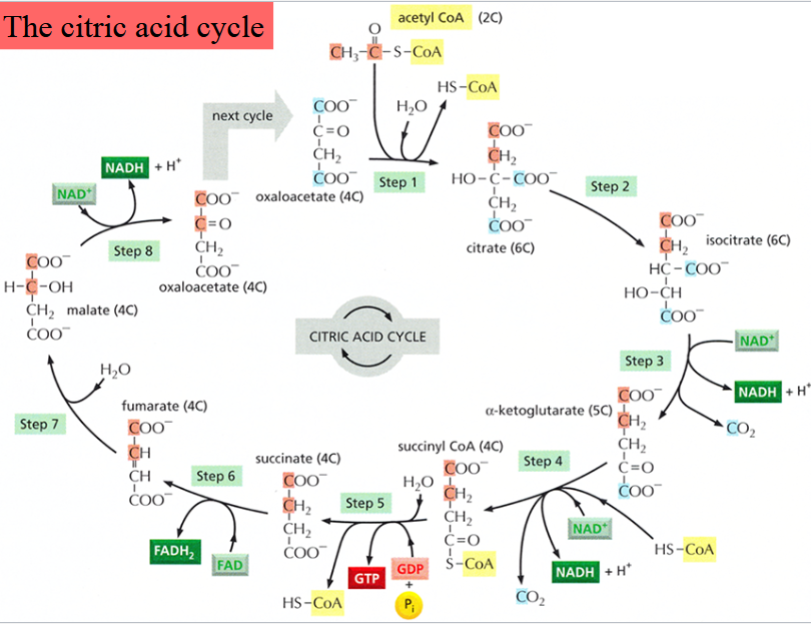
steps of the citric acid cycle
1) condensation:
acetyl CoA (2C) + oxaloacetate (4C) → citric acid (aka citrate) (6C)
driven by the hydrolysis that removes CoA
2) isomerization:
citric acid (6C) → isocitrate (6C)
3) oxidation of isocitrate:
isocitrate (6C) → alpha-ketoglutarate (alpha-KG) (5C)
CO2 produced, NAD+ reduced to NADH
4) oxidation of alpha-KG:
alpha-KG (5C) → succinyl CoA (4C)
CO produced, NAD+ reduced to NADH
CoA-SH added back
5) hydrolysis:
succinyl CoA (4C) → succinate (4C)
CoA-SH removed, GTP synthesized and hydrolyzed to GDP, ATP synthesized
6) oxidation of succinate:
succinate (4C) → fumarate (4C)
FAD reduced to FADH2
7) hydrogenation:
fumarate (4C) → malate (4C)
H2O consumed
8) oxidation of malate:
malate (4C) → oxaloacetate (4C)
NAD+ reduced to NADH
oxaloacetate and a new acetyl CoA restarts the cycle
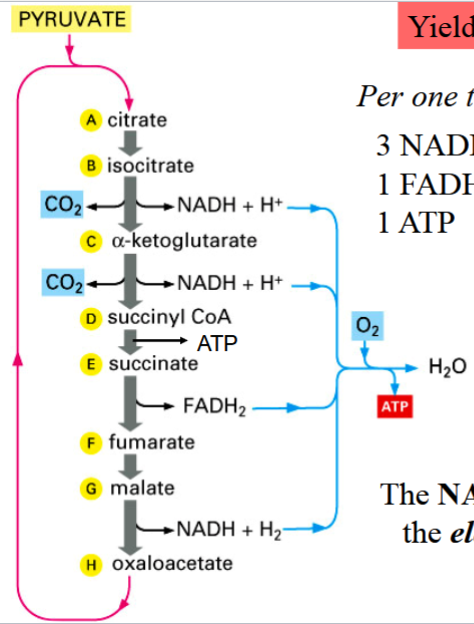
yield of the CAC
3 NADH, 1 FADH2, 1 ATP per turn
2 pyruvates are used, so 2 turns:
total: 6 NADH, 2 FADH2, 2 ATP
NADHs and FADH2s go to the electron transport chain (high-energy electrons get donated after being released by oxidation)
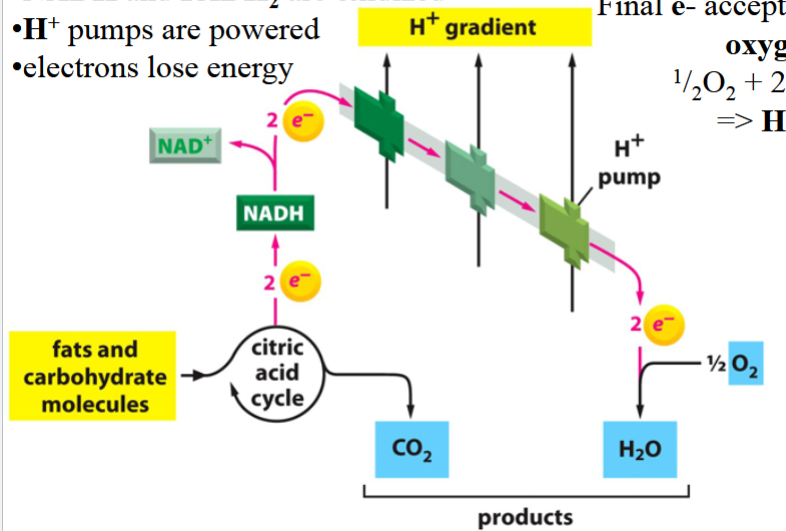
oxidative phosphorylation: the ETC
occurs in the mitochondria, after the CAC
H+s get pumped from the matrix into the intermembrane space (by respiratory enzyme complexes in the inner membrane, containing electron-carrying cofactors)
H+ pumping is driven by the energy of the electrons from NADH and FADH2 (oxidation) → generates a H+ gradient across the inner membrane
flow of H+ back into the matrix powers ATP synthesis
electrons lose energy
oxygen is the final electron acceptor: ½O2 + 2H+ → H2O
ETC complexes
I: NADH dehydrogenase complex (accepts electrons from FADH2) (NADH → NAD+)
Q: ubiquinone (coenzyme Q10)
II (FADH2 → FAD)
III: cytochrome b-c1 complex
IV: cotychrome oxidase complex (produces ½O2 + 2H+ → H2O)
ATP synthase (technically separate from the complexes)
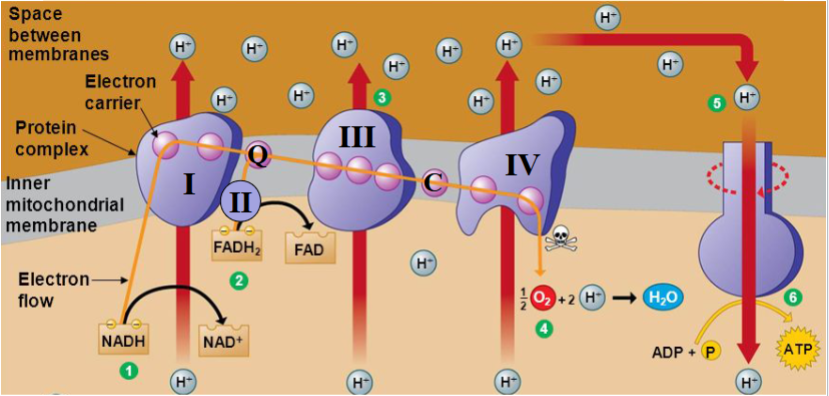
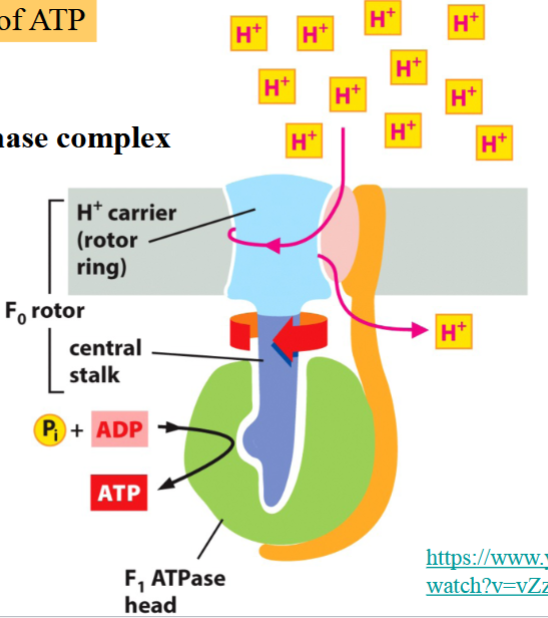
ATP synthase complex
where ATP is synthesized in the ETC
powered by the H+ gradient generated by the ETC
H+s flow back into matrix → central unit of the complex rotates → ATP synthesis is powered
result: oxidative phosphorylation of ATP → ATP
(result of oxidation of all the electron carriers)
yield of aerobic respiration, per 1 glucose molecule
from glycolysis and CAC: 4 ATP
from oxidative phosphorylation:
2 NADHs from glycolysis
2 NADHs from oxidation of pyruvate
6 NADHs from citric acid cycle
2 FADH2s from CAC
1 NADH → 2.5 ATP → 25 ATP
1 FADH2 → 1.5 ATP → 3 ATP
4 + 25 + 3 = 32 ATP made
1 ATP spent to transport each NADH from glycolysis to mitochondria → 2 ATP spent
net yield: 30 ATP
metabolism of different foods
proteins → amino acids
polysaccharides → simple sugars → glucose
fats → fatty acids and glycerol
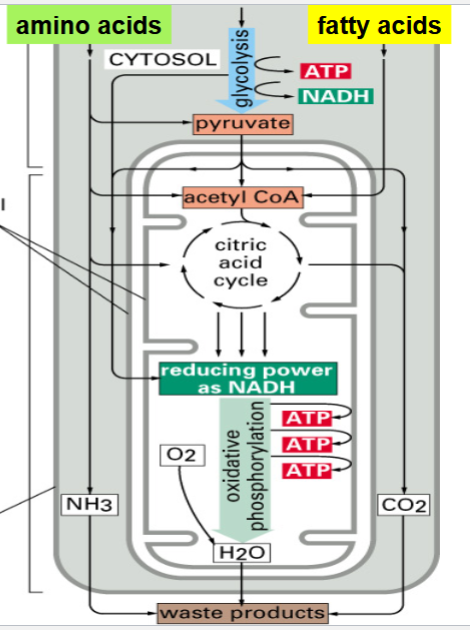
amino acids, fatty acids, and glycerol get converted into intermediates of aerobic respiration and used to harvest stored energy (e.g. NH3 and CO2)
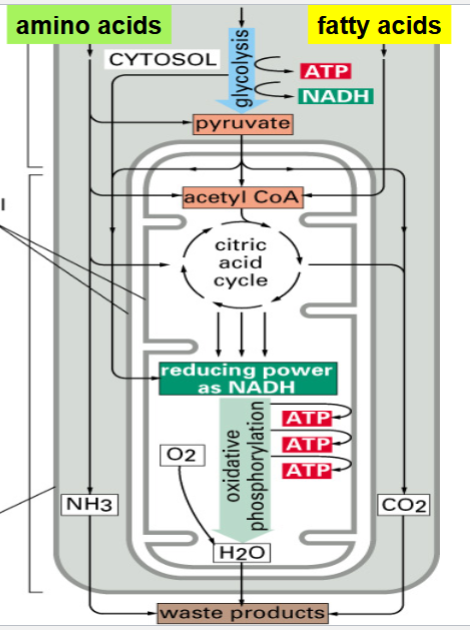
stages of metabolism
1) breakdown of large macromolecules into simple subunits
2) breakdown of simple subunits to acetyl CoA (with production of limited amounts of ATP and NADH)
3) compete oxidation of acetyl CoA to H2O and CO2, with production of large amounts of NADH and ATP in mitochondria