Chemistry Unit 2 Revision
 Call Kai
 Learn
Learn Practice Test
 Spaced Repetition
 Match
Match Flashcards
 Knowt Play
1/58

There's no tags or description
Looks like no tags are added yet.
Name | Mastery | Learn | Test | Matching | Spaced | Call with Kai | Chat |
|---|
No analytics yet
Send a link to your students to track their progress
59 Terms
electron cloud
The region around an atomic nucleus where electrons are likely to be found.
valence
electrons involved in bonding
electorn shielding
the outer electrons are blocked from feeling the full positive charge froim the nucleus because of the inner electrons
anion
gain electrons
cation
lose electrons
energy level
a region around the nucleus of an atom where electrons are likely to be found, associated with a specific amount of energy.
sublevel
energy levels which are subdivided into sublevels, s,p,d,f
orbital
a region where the electron is found, there is one orbital for 2, three for p, etc.
electron configuration
arrangement of electrons int the energy levels, subshells, and orbitals, (electorn cloud) e.g. 1s²2s²3p^6, etc.
atomic radius
how big an atom is (distance from center of the nucleus to outermost valence electrons)
first ionization energy
energy required to move an electron
electronegativity
tendency to attract electrons to itself
group/family
a coulumn on the periodic table
period
a horizontal row in the periodic table
ground state
the lowest energy state of an atom
excited state
the energy state of an atom when it has absorbed energy and its electrons have moved to higher energy levels.
photon
a type of quantum; tiny particle of light and electromagnetic energy. (energy that travels through space in waves)
effective nuclear charge/attraction
metals/non-metals/metalloids(semi-metals)
atomic mass
measured in amu, protons + neutrons in the nucleus of an atom.
atomic number
the number of protons in an atom
Periodic trends
AR - increases down the group, and right to left (to the left) of the periodic table
EN & IE increases up the group, and to the right of the periodic table

Hund’s rule of Multipicity
within a sublevel, e’s go in separately (singly) with the same spin and pair only when needed (which checkout electron is going to)
Aufbau Principle
lowest energy orbital fills first (like a pool level represents each orbital and it must fill to reach to a higher sublevel)
Pauli Exclusion Principle
within an orbital, the two e’s must spin opposite ways (to prevent violating quantum rules)
Mendeleev
organised by atomic mass
Moosely
organised by atomic number
overtime the atomic model
became more and more complex as scientists discovered more and more parts about atoms and subatomic particles
quantum numbers
a set of unique numerical values for each electron which are depicted by the energy levels, sublevels, orbitals, and the electron spin of each electron.
only used on ground state diagrams (for now)
1st, energy level
n; s = the different levels of each electron (e.g. 2p means n = 2) etc. describes the size and energy of the orbital that the electron is in; principal quantum number; the further the distance is (down the energy levels) the more energy required for the electron to be there (nucleus is positive, electron is negative, so it is weaker attraction (magnets being close, vs far), the electron needs to work against the attraction
higher energy level - depicts size and energy, because the further the energy level the greater the distance between the nucleus and the electrons, and the greater energy required for the electrons to stay that way, and the weaker attraction (like a magnet)
2nd sublevel
the angular quantum number describes the shape of the orbital that the electron is in, which is the sublevel. l; l = the sublevel the electron is in. for s - l = 0, for p - l = 1, for d - l = 2, for f - l = 3
the different sublevels represent the different shape of the electron because of the different orbitals
3rd - orbitals
the magnetic quantum number; ml defined the orientation of the electron in an orbital.
s = 0
p = -1, 0, 1
d = -2, -1, 0, 1, 2
etc.
4th spin
ms; the direction which the electron is spinning, either up or down; +1/2 = up, -1/2 = down (rotational movement of an electron)
parts of the periodic table
alkali metals, 2. alkaline earth metals, 3. transition metals, 4. semi-metals (metalloids), 5. non-metals, 6. halogens, 7. noble gases 8. lanthanides, 9. actinides (8,9 are rare metals)
left is metal, right is nonmetal
when drawing excited state
move any electron to any higher level, make sure to draw circle to arrow.
energy of a photon
E = hc/wavelength = (planck’s constant) x (speed of light) / wavelength]
also equals e = hv, v being frequency bcoz c = wavelength x frequency, but that’s irrelevant as of right now
plancks constant
6.626 × 10^-34 J x s
speed of light in a vacuum
2.998 × 10^8 m/s
if wavelength is in nanometers
then to convert to joules, must add 10^-9 to the wavelength value, e.g. 461 nm would be 461 × 10^-9
to calculate wavelength
1/wavelength = -0.01097nm^-1[1/n² high - 1/n² low]
high = the higher energy level (high)
low = the lower energy level (low)
for a photon to be visible, and the wavelength determines, atomic spectrum
wavelength determines colour of the light, and the photon to be visible, the photon must have a wavelength for 400 -700nm. the observed wavelengths create a pattern of light called the atomic spectrum
relaxation
the process by which an excited electron returns to a lower energy level, emitting a photon in the process (may or may not be visible)
photoelectric effect
electron absorbs sm energy that it moves past the excited state and becomes ionized as a cation.
1st; speed = distance/time, c is speed of light, so it is also c = distance/time.wavelength is the distance while the frequency (v) is per time (nm) (1/sec) = nm/sec. E = mc², so MC = h/wavelength
s orbital
holds up to two electrons

p orbital

dumbbell shape; each can hold up to 2 electrons, but all shape of three orbitals hod up to 6 electrons, x = horizontal, y = vertical, z = diagonal

this is the complete one which holds 6
d orbital
dumbbell shape with a ring; contains five orbitals, each can hold up to 2 electrons, allowing for a total of 10 electrons.

f orbital
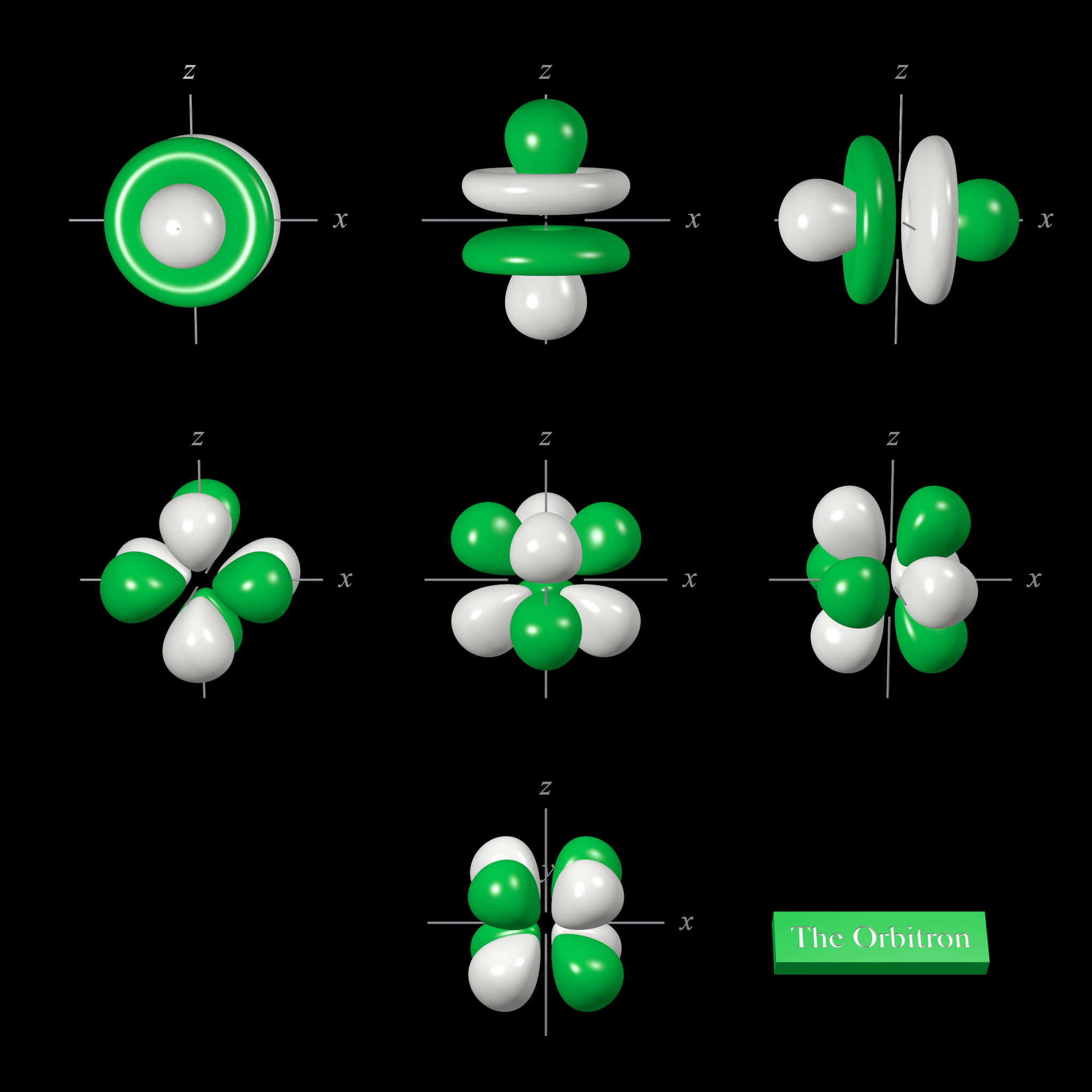
complex shapes; contains seven orbitals, each can hold up to 2 electrons, allowing for a total of 14 electrons.
history of an atom
Solid Sphere, Plum Pudding, Saturnian, Nuclear, planetary (modern day model)

Atomos
Democritus; 400 BC; atoms are the building blocks of matter, the shape of an atom explain elements behavior.
Solid Sphere
John Dalton - 1803, solid, uniform, indivisble mass with no internal structure
Plum Pudding
J.J. Thompson - 1904, with a positive charge in the middle and electrons negative charge surrounding it/ negative electrons embedded in a sea of positive charges
Saturnian
Hantaro Nagaoka - 1904, positive charge in the middle and negative charges (electrons) around the positive charge like Saturn rings,
Nuclear
Ernest Rutherford - 1911 where the electrons are surrounding the central nucleus (positive charge)
Model Day (Planetary)
Niels Bohr (electrons on fixed circular orbits or shells surrounding on a central nucleus) - 1913 2,8,2
Quantum
1926 - Schrodinger, electrons are in clouds, surrounding the nucleus, and this cloud is less dense.
left to right a period the attraction
increases because the number of protons increase which creates a higher positive charge for the nucleus, making attractive forces higher, pulling the electrons closer to the nucleus.
moving up a group/family, the attraction
increase because the energy levels decease meaning that there is less electron shielding, attraction forces increase because the nucleus is closer to the electrons
the greater the distance
the weaker the attraction force, the atomic radius is larger, but the lower ionization energy and electronegativity (because the attraction of the electron to itself is lower); electron shielding increased which means that the valence electrons are shielded from the nuclear charge due to inner electrons.