e stim
 Call Kai
 Learn
 Practice Test
 Spaced Repetition
 Match
 Flashcards
 Knowt Play
1/470

There's no tags or description
Looks like no tags are added yet.
471 Terms
pain, muscle strength, edema (chronic and acute), tissue healing, iontophoresis
5 main estim protocols
transcutaneous electrical nerve stimulation
what does TENS stand for?
4, conventional (tens), acupuncture like (tens), brief intense (tens), burst (tens)
there are ________ types of TENS treatments. name them
conventional, acupuncture like, burst, brief intense (CABBI)
what order should you try the different TENS methods in?
conventional (tens)
what type of TENS is effective for movement-based pain?
pain
TENS are used for what indication of estim?
frequency: 80-120 Hz (high)
amplitude: sensory levels (comfy), no pain
pulse width: 40-75 us (microseconds)
mode: continuous
sensation: pleasant tingling
duration: NO TIME LIMIT
CONVENTIONAL TENS:
frequency:
amplitude:
pulse width:
mode:
sensation:
duration:
conventional: 80-120 Hz (high)
acupuncture like: 1-10 Hz (low)
brief intense: 100-150 Hz (high)
burst: 70-100 Hz (high)
TENS FREQUENCIES:
conventional:
acupuncture like:
brief intense:
burst:
conventional: sensory levels, no pain
acupuncture like: sensory and motor levels, tolerance
brief intense: highest tolerable intensities (noxious level)
burst: sensory and motor stimulation (paresthesias), motor contraction levels
TENS AMPLITUDES:
conventional:
acupuncture like:
brief intense:
burst:
conventional: 40-75 us
acupuncture like: 200 us
brief intense: 150-250 us
burst: 100-200 us
TENS PULSE WIDTHS
conventional:
acupuncture like:
brief intense:
burst:
conventional: continuous
acupuncture like: continuous
brief intense: continuous
burst: burst
TENS MODES
conventional:
acupuncture like:
brief intense:
burst:
conventional: pleasant tingling
acupuncture like: regular muscle contractions
brief intense: irregular contractions
burst: mild-moderate contractions
TENS SENSATIONS
conventional:
acupuncture like:
brief intense:
burst:
low
high frequency = ________ impedance
true
true/false: conventional tens is always on
conventional
most comfortable TENS
people adjust quickly because no modulation, only works while on
what are the cons to conventional tens? (2)
frequency: 1-10 Hz
amplitude: sensory and motor levels, tolerance
pulse width: 200 us
mode: continuous
sensation: regular muscle contractions
treatment duration: 20-30 min
ACUPUNCTURE LIKE TENS:
frequency:
amplitude:
pulse width:
mode:
sensation:
treatment duration:
low frequency, which resembles traditional acupuncture needle
why is acupuncture like tens called that?
acupuncture like, brief intense, burst
TENS types that can be uncomfortable
20-30, 4-5 hours
use acupuncture like TENS for ______-______ minutes, which allows pain relief for how long?
acupuncture like (tens)
which TENS type: lasts a long time but takes a long time
low, long, high, uncomfortable
acupuncture like tens: __________ frequency, ____________ duration, ___________ amplitude, and ____________
false
true/false: there is pain relief during the acupuncture like TENS treatment
frequency: 100-150 Hz
amplitude: highest tolerable intensity (noxious level)
pulse width: 150-250 us
mode: continuous
sensation: irregular contractions
BRIEF INTENSE TENS
frequency:
amplitude:
pulse width:
mode:
sensation:
conventional: no time limit
acupuncture like: 20-30 minutes
brief intense: 5-15 minutes
burst: 20-60 minutese
TREATMENT DURATION
conventional:
acupuncture like:
brief intense:
burst:
high, long, high
brief intense tens: ___________ frequencies, ___________ duration, __________ amplitude
brief, painful
brief intense TENS triggers a somewhat _________ yet intense and ______________ stim during therapy
opioid
brief intense TENS: pain modulation occurs through the ___________ system
rapid onset, sustained
analgesia with brief intense TENS
brief intense (TENS)
which TENS type: onset of analgesia is relatively rapid and analgesia is sustained for a longer period
burst (TENS)
aggressive TENS type
carrier frequency: 70-100 Hz
burst frequency: 1-5 Hz
amplitude: sensory and motor stimulation (paresthesias), motor contraction levels
pulse width: 100-200 us
mode: burst
sensation: mild-moderate contractions
treatment time: 20-60 minutes
BURST TENS:
carrier frequency:
burst frequency:
amplitude:
pulse width:
mode:
sensation:
treatment time:
burst (tens)
which TENS type: onset of analgesia is slow but lasts a longer time
slow onset, lasts a longer time
analgesia with burst TENS
intensity, pulse duration, frequency
different TENS modulation methods (3)
intensity
TENS modulation method

pulse duration
TENS modulation method

frequency
TENS modulation method
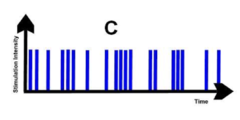
false (just slows it down)
true/false: TENS modulation stops adapatation
acute pain, chronic pain, non-analgesic effects, antiemetic effects
4 main categories of TENS indications
deviates patient's attention
how does TENS help with angina pectoris?
3
if you try a modality up to ______ times and it doesn't work, use something different
TENS, IFC
can use __________ or ___________ estim methods for pain
IFC (for pain)
what is similar to TENS but with a more sophisticated machine?
electrodes around target tissue, dynamic vector setting
how to use IFC for pain that is:
easily identifiable and pinpointed:
hard to pinpoint:
5000 Hz, 100 Hz
IFC:
carrier frequency below _______________ and beat frequency of ______________
more, less
higher frequencies are _________ comfortable, but ________ effective
high
IFC uses _________ frequencies
acute (pain)
IFC: does acute or chronic pain have higher beat frequencies?
deep, can
IFC for pain: __________ penetration, __________ do muscle contraction
deep penetration, muscle contraction
2 key points for IFC for pain
greater, less
IFC crosses the skin with ______________ ease and ________________ stimulation of cutaneous nociceptors, allowing greater patient comfort during electrical stimulation
IFC
is IFC or TENS more comfortable?
skin
because interferential current is tolerated better by the __________, the dosage can be increased
IFC, TENS
the left image is __________ placement
the right image is _________ placement

false (never cross them!)
true/false: have to cross TENS electrodes
true
true/false: have to cross IFC electrodes
pacemakers, malignancy, over carotid sinus (vasovagal reflex), pregnancy, active infections, skin conditions, impaired sensation, cardiac conditions, neuro conditions, non-cooperative patients
contraindications to estim (10)
PINS + POM CAN (pacemakers, impaired sensation, neuro conditions, skin conditions, pregnancy, over carotid sinus, malignancy, cardiac conditions, active infections, non-cooperative patients)
acronym to remember estim contraindications
dysesthesia, contact dermatitis, autonomic reactions (nausea, dizziness, fainting)
precautions of estim (3)
sensation loss
what is dysesthesia?
nausea, dizziness, fainting
3 autonomic reactions that are precautions to estim
patient contracts (muscle) at same time
muscle strengthening protocols for estim are not effective unless what?
false (order of recruitment is reversed, fast twitch recruited first)
true/false: estim follows the size principle
fast twitch (opposite the size principle)
does estim innervate fast or slow twitch muscle fibers first?
fast twitch fibers recruited first, fatigue quickly
why should you provide long rest times between estim treatments?
rapidly, synchronized, jerky
estim: muscles are activated _______________ in a more __________________ way, thus contractions appear ____________
jerky
when estim is used for muscle strengthening, contractions appear ____________
overload (increase force = increase strength), specificity (prefers type 2)
2 muscle strengthening theories
50% of max voluntary isometric contraction (MVIC)
when using estim for strength gains, have to use ______% of what?
patient tolerance
what percent of max voluntary isometric contraction (MVIC) do you use with injured patients?
bipolar (one proximal, one distal), electrodes 2 inches apart
electrode placement for estim strength gains
direction of muscle fibers
in bipolar electrode placement for muscle strength, one electrode is over the motorpoint and the other electrode is placed on the muscles, aligned with what?
symmetrical biphasic pulsed alternating, russian
wave form options for muscle strengthening
tetany
constant muscle contraction
pulse frequency: 35-80 pps (50-70 typical)
pulse duration: 150-200 us (small muscles), 200-350 (large muscles)
amplitude: >10% MVIC in injured, >50% MVIC in healthy
on:off times ratio: 1:9 (weak muscles)
ramp time: 1-4 seconds
treatment time: 10-20 min or 10-20 contractions
MUSCLE STRENGTH PARAMETERS
pulse frequency:
pulse duration:
amplitude:
on:off times ratio:
ramp time:
treatment time:
short
_________ duration = more comfortable stimulus
short, high
small muscles: patients tend to prefer ___________ duration and ___________ amplitude
long, low
large muscles: patients tend to prefer ____________ duration and ___________ amplitude
frequencies for:
twitch contractions:
smooth contractions:
fatigue:
effect of stimulus frequency on type of muscle contraction produced graph
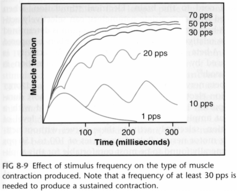
30
a frequency of at least ______ pps is needed to produce a sustained contraction
1:9
what is the on:off ratio for weak muscles?
1-4 seconds, patient tolerance
ramp time for muscle strength, but depends on what?
quick
a _________ ramp time can zap the patient
true
true/false: the stronger the current amplitude, the better
10-20 minutes or 10-20 contractions
treatment time for muscle strength
pulse frequency: 35-50 pps
pulse duration: 150-200 us (small muscles), 200-350 us (large muscles)
amplitude: sufficient for functional activity
on:off times ratio: 1:9 (weak muscles)
ramp time: 1-4 seconds
treatment time: 10-20 minutes or 10-20 contractions
MUSCLE RE-EDUCATION PARAMETERS
pulse frequency:
pulse duration:
amplitude:
on:off times ratio:
ramp time:
treatment time:
pulse frequency: 35-50 pps
pulse duration: 150-200 us (small muscles), 200-350 us (large muscles)
amplitude: visible contraction
on:off times ratio: 1:9 (weak muscles)
ramp time: 1-4 seconds
treatment time: 10-20 minutes or 10-20 contractions
MUSCLE SPASM REDUCTION PARAMETERS
pulse frequency:
pulse duration:
amplitude:
on:off times ratio:
ramp time:
treatment time:
acute, chronic
two types of edema
lack of motion
chronic edema is due to what?
inflammation
acute edema is due to what?
chronic
_____________ edema is due to lack of motion
acute
_____________ edema is due to inflammation
swelling, cool/pale skin
chronic edema is indicated by what?
pumping action (increase muscle activity around venous system/push fluid out of area)
why do you use estim for chronic edema?
30 minutes
duration for russian current
swelling, warm/red skin, local pain
what is acute edema indicated by?
produce sensation but no muscle contraction
why do you use estim for acute edema?
pulsed biphasic, russian
wave form options for chronic edema