Unit 4. Physical Examination of Urine
 Call Kai
 Learn
Learn Practice Test
 Spaced Repetition
 Match
Match Flashcards
 Knowt Play
1/150

There's no tags or description
Looks like no tags are added yet.
Name | Mastery | Learn | Test | Matching | Spaced | Call with Kai | Chat |
|---|
No analytics yet
Send a link to your students to track their progress
151 Terms
10-15 ml
In the lab, how many mL of urine sample is used for physical exam?
400 RCF
4 mins
0.5-1 ml
To concentrate formed elements in the urine, centrifuge the urine sample at ____ for ___, then decant the supernatant, only leaving ____ of sediment.
20 µL
How many urine sample is needed for microscopic exam?
Color
Clarity
Specific gravity
pH (actually under chemical exam)
Odor (not actually part of the exam, but is clinically helpful)
Parameters under Physical Exam
PHYSICAL EXAMINATION
through investigation and documentation of urine’s physical characteristics
a crucial step in routine analysis procedure; provides preliminary information about the patient’s health status
confirm/explain findings in the chemical and microscopic exams
hydration status.
The urine volume of a certain person reflects his/her _
600-2000 ml
Normal urine volume excreted by a healthy adult in a day
fluid intake,
fluid loss from nonrenal sources,
variations in ADH and
necessity to excrete dissolved substance.
Enumerate several factors that affect urine volume.
T
T or F
When the body loses more water through sweat, the kidneys conserve water by producing less urine to maintain the body's fluid balance.
↑ Sweating = ↓ Urination
_ Sweating = _ Urination
↑ Hydration = ↓ ADH production
_ Hydration = _ ADH production
150 mL
_ of blood enter the tubule within 24 hrs
2 liters
From 150 mL of water > Tubular reabsorption > only ___ of urine is produced
Glycosuria = presence of glucose in urine
Mellituria = presence of other reducing sugars in urine
Glycosuria vs. Mellituria
Hyperglycemia-Associated Glycosuria
↑ glucose in blood/plasma (renal threshold met)
normal, functional kidneys
need to excrete glucose thru urination
Renal-associated glycosuria
↑ glucose in urine
glucose leaks from the GFB
abnormal, nonfunctional kidneys
Differentiate Hyperglycemia-Associated Glycosuria from Renal-associated glycosuria
Hyperglycemia-Associated Glycosuria = (+) glucose (-) proteins
Renal-associated glycosuria = (+) glucose (+) proteins
Hyperglycemia-Associated Glycosuria = __ glucose __ proteins
Renal-associated glycosuria = __ glucose __ proteins
Oliguria
It is related to an abnormal decrease in urine output.
It is always accompanied by hypersthenuria (1.030).
a. state of hydration as a result of excessive water loss from vomiting, diarrhea, perspiration, severe burns
b. obstruction due to renal calculi (renal stones) & tumor of the kidney (carcinomas)
Oliguria can be due to?
Infants: < 1ml/kg/hr
Urine output of infants experiencing Oliguria
Children: <0.5 ml/kg/hr
Urine output of children experiencing Oliguria
Adults: <400 ml/day
Urine output of adults experiencing Oliguria
ANURIA
cessation of urine flow
any serious damage to the kidneys, or from a decrease in the flow of blood to the kidneys
End stage renal disease
functional nephrons are gone/depleted
complete obstruction (renal stones, carcinoma)
toxic agents
Nocturia
It is related to the excretion of more than 500 ml urine at night.
always accompanied by isosthenuria or low urine specific gravity which indicates loss of concentrating ability of the tubules.
diabetes mellitus & diabetes insipidus
Nocturia & Polyuria is a common symptom assoc. with __ and __
Polyuria
increase in daily urine volume
It is because of persistent production of more than 2000-3000ml of urine in 24 hours.
ADH
Polyuria may be induced artificially by diuretics, caffeine, or alcohol which suppress __
Children: >3 ml/kg/day
Urine output of children experiencing Oliguria
Adults: >2.5 L/day
Urine output of adults experiencing Polyuria
elevated (abnormal)
HbA1c
If FBS is __, the nephrologist may request _ to confirm DIABETES MELLITUS.
normal
Total Prostate-Specific Antigen (PSA)
If FBS is _, the nephrologist may request _ to confirm PROSTATITIS.
Urine odor
not routinely reported in the lab
should be notified to the attending physicians for consideration of metabolic disorders or aminoaciduria
aromatic
Normal urine odor
Bacterial decomposition
Urinary Tract Infection (UTI)
Cause of urine odor that is Foul, ammonia-like
Ketones (diabetes mellitus, starvation, vomiting)
Cause of urine odor that is Fruity, sweet
Maple syrup urine disease
Cause of urine odor that is Maple syrup, Burnt sugar
Phenylketonuria
Cause of urine odor that is Mousy
Tyrosinemia
Cause of urine odor that is Rancid
Isovaleric/Glutaric acidemia
Cause of urine odor that is Sweaty feet
Methionine malabsorption
Cause of urine odor that is Cabbage, Hops
Contamination
Cause of urine odor that is Bleach
Trimethylaminuria
Cause of urine odor that is Rotten fish
Hawkinsinuria
Cause of urine odor that is Chlorine, swimming pool
Cystinuria
Cause of urine odor that is Rotten egg, sulfur-like
Urine color
one parameter used in urinalysis to predict urine concentration and probable dissolved substances present in it
a. Normal metabolic functions
b. Physical activity
c. Ingested materials
d. Pathologic condition
e. Abnormal variations caused by bleeding
f. Liver disease g. Infection
Normal variations in urine color are caused by:
Urochrome
Uroerythrin
Urobilin
3 URINE PIGMENTS
urochrome
3 URINE PIGMENTS
product of endogenous metabolism, and under normal conditions, the body produces it at a constant rate
urochrome
3 URINE PIGMENTS
gives the normal yellow coloration of urine
provides an estimate of body hydration
thyroid conditions
fasting states
standing at room temp
Urochrome is increased in what conditions
Uroerythrin
3 URINE PIGMENTS
a pink pigment, is most evident in specimens that have been refrigerated, resulting in the precipitation of amorphous urates in an acid urine.
Uroerythrin
3 URINE PIGMENTS
It attaches itself on amorphous crystals’ surface creating a brick dust appearance especially on amorphous urates.
Urobilin
3 URINE PIGMENTS
It provides orange-brown color in older (unpreserved) urine specimens.
Urobilin
3 URINE PIGMENTS
an oxidation product of the normal urinary constituent urobilinogen.
protoporphyrins
RBC
Urobilin is a derivative of __ that come from _ catabolism
pink precipitate
white precipitate
amorphous urate = acidic = ___
amorphous phosphate = alkaline = ___
pH
amorphous urate = acidic
amorphous phosphate = alkaline
amorphous urate and amorphous phosphate is differentiated by __
Alkaptonuria
a metabolic disorder, most common in infants, wherein an acidic urine > alakaline > black colored urine due to homogentisic acid
phenindione
an acidic urine turning alkaline and appearing as orange is usually due to medication _
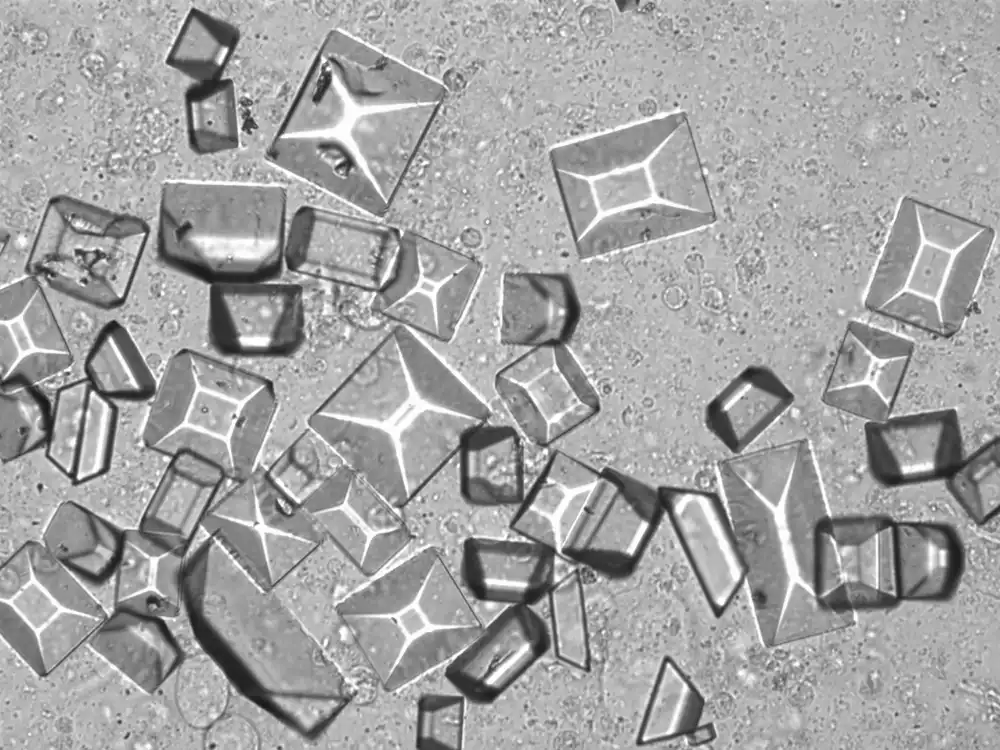
Triple phosphate crystal
coffin-lid crystal ; manila city hall crystal
(-) Chemical test for blood
(+) Watson-Schwartz screening test
A red or port-wine urine due to porphyrin/ phorphobilinogen will be negative for ___ and positive for ___
Rhabdomyolysis
breakdown of skeletal muscle fibers, causing muscle cell contents (especially myoglobin) to leak into the bloodstream.
leiomyolysis
he degeneration or dissolution (breakdown) of smooth muscle cells.
Hemoglobinuria
What disease is being described:
red urine
clear
no intact RBCs (lysed)
red plasma
myoglobinuria
What disease is being described:
red urine
clear
no intact RBCs (lysed)
clear plasma
microscopic hematuria
What disease is being described:
red urine
clear
MANY intact RBCs in the microscopic exam
Macroscopic hematuria
What disease is being described:
Red urine
Cloudy
MANY intact RBCs in the microscopic exam
hemoglobin
myoglobin
iron
These proteins, __ and __, are toxic to the glomerulus due to the presence of ___
Blondheim's Plasma Test (ammonium sulfate precipitation test)
a test is used to differentiate hemoglobinuria from myoglobinuria
red
golden yellow (clear)
Blondheim’s Test results
Hemoglobinuria = __ plasma
Myoglobinuria = __ plasma
5 mL
2.8 g ammonium sulfate
5 mins
Blondheim’s Plasma test:
__ urine sample > add _______ > incubate for ____ > centrifuge > filter > observe the color of sample/plasma
myoglobinuria
Total creatinine kinase is markedly increased in ____
hemoglobinuria
LD1 & LD2 is increased in ___
myoglobinuria
LD4 & LD5 is increased in ___
TRANSPARENCY
It pertains to the clarity or turbidity of a urine specimen
one of the criteria considered in determining the necessity of performing a microsco[pic examination
↑ Clarity/↓Turbidity = ↓ Specific Gravity
Relationship of Clarity/Turbidity with Specific gravity
Clear
CLARITY wherein there’s No visible particulates; transparent
Hazy (slightly cloudy)
CLARITY wherein there’s few particulate; print easily seen
Cloudy
CLARITY wherein there’s Many particulates; print blurred through urine
Turbid
CLARITY wherein Print cannot be seen through urine
Milky
CLARITY wherein there’s Presence of suspended solid in urine; May precipitate or be clotted
manual
If spx is cloudy/turbid use ___ method
automated
If spx is clear/hazy use ___ method
NON PATHOLOGIC TURBIDITY
Pathologic or Non-Pathologic turbidity?
Hazy female specimens with squamous epithelial cells and mucus
NON PATHOLOGIC TURBIDITY
Pathologic or Non-Pathologic turbidity?
Bacterial growth in unpreserved specimens
NON PATHOLOGIC TURBIDITY
Pathologic or Non-Pathologic turbidity?
Refrigerated specimens with precipitated amorphous phosphates and urates
NON PATHOLOGIC TURBIDITY
Pathologic or Non-Pathologic turbidity?
Contamination; fecal talc, semen, vaginal creams, IV contrast media
PATHOLOGIC TURBIDITY
Pathologic or Non-Pathologic turbidity?
RBCs, WBCs, bacteria (most common)
PATHOLOGIC TURBIDITY
Pathologic or Non-Pathologic turbidity?
Nonsquamous epithelial cells, yeast
PATHOLOGIC TURBIDITY
Pathologic or Non-Pathologic turbidity?
Abnormal crystals
PATHOLOGIC TURBIDITY
Pathologic or Non-Pathologic turbidity?
Lymph fluid
PATHOLOGIC TURBIDITY
Pathologic or Non-Pathologic turbidity?
Lipid
1.040
SG of radiographic contrast media (RCM)
Renal Tubular Epithelial (RTE) cells
cells that line the tubule of nephrons
significant cell in urinalysis
suggestive of renal disease
Elephantiasis caused by Wuchereria bancrofti
this caused the presence of lymph fluid in urine
Nephrotic Syndrome
Increased glomerular permeability → protein loss
↑ Hyperlipidemia and lipiduria
Nephritic Syndrome
Inflammation of the glomeruli → bleeding and reduced filtration
Usually normal blood lipid level
Urine pH
determined by the concentration of free H+ ion present in urine sample.
kidneys
lungs
Basically, the _ and the _work in an orchestrated manner to maintain acid - base balance in the body.
carbon dioxide
respiration
To maintain acid base balance, the lung excretes __ through _
bicarbonate
ammonium ions
To maintain acid base balance, while the kidney reclaims and generates _ and secretes _