ARCH 241 History & Theory II Exam 1
 Call Kai
 Learn
 Practice Test
 Spaced Repetition
 Match
 Flashcards
 Knowt Play
1/99

There's no tags or description
Looks like no tags are added yet.
100 Terms
Gian Lorenzo Bernini
Baroque, Italian architect who was invited to Paris, France to submit proposals for the Louvre only to be rejected, created emotion out of stone in 'Saint Teresa in Ecstasy'

Baroque
An artistic style of the seventeenth century characterized by complex forms, bold ornamentation, contrasting elements, and references to the mysteries of the faith, attempts to seduce to revitalize Catholicism and minimize Protestant revolt, "one foot in tradition, one foot in modernity" with geometry as a mediator
Guarino Guarini
Heir to style of Borromini, Palazzo Carignano, west facade, 1679 - 1683

Santa Sindone, 1667-1690, Guarino Guarini, Turin (Italy)

Sant' Andrea al Quirinale, 1658-70, Gian Lorenzo Bernini, "baroque in highest form"

St. Ivo ella Sapienza, 1642-1660, Francesco Borromini, Rome (Italy), oval plan and dome

Modern Social Imaginary
Charles Taylor, provided new practices and institutional forms, ways of living, and malaise; led to Great Disembedding from tradition and ancient ways
Enlightenment
17th and 18th centuries; emphasized mathematical reason and individualism over traditional ways of thinking, upended most previous theories pertaining to scientific reasoning
Divinely sanctioned cosmology
Architectural thought in France at the start of the 17th century was predicated on the notion that the art of architecture participated in this, which was transmitted via architectural forms, numbers, and proportions
6 characteristics of Claude Perrault's notion of Positive beauty
Visible, connected to bilateral symmetry, natural, self-evident, richness of materials, and precision of execution
Arbitrary beauty
historical, fashion, tradition, custom
Entasis
Optical correction to achieve harmony in experience, curved steps of the Greek Parthenon by Ictinus, Perrault claimed it was an excuse for bad craft
Colonnade Eastern Facade of Louvre, 1667-72, Claude Perrault and Louis LeVau, Paris (France), disengaged and paired columns, used Hermogenes (Vitruvius) as a precedent, critiqued as a taint of Gothicism

Louis Le Vau
architect of Versailles

Le Petit Trianon, 1772, Ange-Jacques Gabriel, Versailles (France), originally built for Madame Pompadour

18th century theme
once stable discourse is questioned, architecture becomes more interesting but also potentially more arbitrary
San Carlo alle Quattro Fontane, 1638-1677, Francesco Borromini, Rome (Italy), "complex tapering geometric structure"

Argument of the Ancients in the Quarrel of the Ancients and Moderns
Architecture can do no better than to imitate the great examples of the past (Nicolas Boileau & Francois Blondel)
Argument of the Moderns in the Quarrel of the Ancients and Moderns
raised questions about authority of the past and the nature of human progress, promoted a cartesian worldview and eroded meaning and symbolism of ancient theory, separated faith and scientific inquiry (Claude & Charles Perrault)
Ordinance of the Five Kinds of Columns
1683 book by Claude Perrault, established proportions for columns based on Greek measurements, purpose was to prove ideas in practice; juste milleu, rejects optical correction, established positive vs. arbitrary beauty

juste milieu
right mean, Perrault averages columns
Unify church divisions
One reason the Catholic Church promoted Baroque architecture's direct, emotive, and sumptuous attributes after the Council of Trent (1545-63 in Rome, Italy)
Human progress and Authority of the Past
The two primary issues discussed by the Quarrel of the Ancients and Moderns
Blondel's criticism of Perrault's view of architecture
compared it to excesses of gothic architecture
the Great Disembedding
a process of disenchantment of the cosmos, led to secular individualism, lateral society
"physics is written in a grand book, the universe, which is written in the language of mathematics"
Galileo Galilei

Rene Descartes
17th century French philosopher; wrote Discourse on Method; 1st principle "i think therefore i am"; duality of mind and body; known as father of modern rationalism, thought an idea was true if it was understandable and explanatory, agreed with Galileo

Modernity
neo-platonic hierarchy between sublunar and supralunar, body mechanism as a machine, ration over experience, transcendal intentions, design becomes more interesting but more arbitrary, math and instrumental know-how acquires a special status
Factors of change that remained constant of Modernity from place to place
Mechanization of the city, introduction of materials (iron, glass, steel), and creative architects who wanted to express the new state of things in spaces and forms
Corinthian Order
the most decorative of the classical Greek architectural styles, featuring a fluted column shaft, capitals with flowers and leaves below a small scroll, and a large base; used more by the Romans

Ionic Order
middle of the classical Greek orders, characterized by volutes (spiral, scroll-like form), capitals, columns with bases, uninterrupted frieze, base

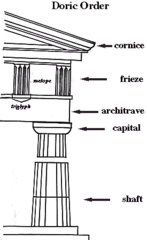
Doric Order
the simplest of the classical Greek architectural styles, featuring unadorned columns with no base
Rood Screen
a screen that separates the nave and the choir in a church, removed from Catholic Churches after the Council of Trent (1545-1563 in Rome, Italy)

Madame de Pompadour
The mistress of Louis XV who intervened politically to enable the publication of the "Encyclopedia, or a Systematic Dictionary of the Sciences, Arts, and Crafts"

Craftsmen
Pierre Patte (1723-1814) argued that this person's knowledge still mattered in the making of architecture
Disengaged columns
Laugier claimed these collapsed beauty and durability, the east Louvre facade

Isaac Newton (1643-1727)
English scientist that established Newtonian Natural Philosophy: Wonder (Thaumata) appears as the simple rationality of nature, mathematical basis

Positivism
Aguste Comte; the application of the scientific approach to the social world, every rational assertion can be proven with logic or mathematical reason, rejects religion and decreases architecture's social, cultural, and artistic values, fulfillment of modernity at the expense of architecture's artistic and cultural values
Three Revolutions (and reasoning)
American Revolution (1775-1783)
French Revolution (1789-1799)
Haitian Revolution (1791-1809)
Equality, Fraternity, Liberty; revolutions led to increased nationalism and consistent changes in architecture
Rigorists
those who championed Greek architecture as the appropriate model
Panopticon
a circular prison with cells arranged around a central well, from which prisoners could at all times be observed.

Rationalism
group who strived to see and discover the formal laws of art
Raumplan
Adolf Loos, system of contiguous, merging spaces and levels

Wonder
(Thaumata) occupies a place of in-between nature and culture, appears in monstrosity, unexpected, miraculous
Jacques-Germain Soufflot
1713-80, St. Genevieve, Ancients, studied Greek architecture itself and not from secondary sources, equated a lot of design to nature, interested in Gothic architecture but not classical ornamentation, studied flying buttresses, devalued craftspeople by emphasizing ideals and not experience

Pierre Patte
1723-1814, criticized Soufflot's method of material experimentation, thought craftsmen knew how to build the best cause they worked with the materials on a daily basis

Cartesian Doubt and Mathematical Reason
Soufflot sought to apply Isaac Newton's understandings to architecture; systematically calls into question and challenges all assumptions and ideas, so that what is left is unquestionable
and solid.
An Essay on Architecture (1753 & 1755). Marc-Antoine Laugier.
Criticism of Perrault and Baroque, based on Newtonian empirical observation, primative hut, durability w/ beauty, convenance
Durand's proposed formula for the Vitruvian triad and his definition of the true aim of architecture
The elements of this proposal are economy, simplicity, and convenience and the true aim of architecture is defined by public and private utility, the well-being, and the maintenance of individuals and society
Treatise on Essential Beauty in the Arts
Published by 90-year old architect Charles-Etienne Briseux (1660-1754)
"Encyclopedia, or Reasoned Dictionary of the Arts, Sciences, and Trades"
Denis Diderot & Jean le Rond D' Alembert, 1751-80, showed plate drawings of trades and sciences both current and new to change the way people think
St. Genevieve (The Pantheon), 1758-1790, Jacques-Germain Soufflot, Paris (France), fusion of Gothic structure & classical proportion

David Le Roy
created drawings of ancient Athens, Greece

Vital Structure with a Normative Aspect
Laugier's "primitive hut" for contemporary architecture of the 18th century; a structure with columns, an entablature (beams), and a pediment (pitched roof)

Convenance
appropriateness, Vitruvian idea of decorum, beauty based on social hierarchy
Exact and accurate proportions
James Stuart and Nicholas Revett's concerns when documenting ancient architecture

Antiquities of Athens
James Stuart and Nicholas Revett, 1754 & 1762, drew and measured Athens ruins precicely, beauties of a correct style, since history is mathematical, you gain knowledge by exactly copying old buildings

Neo classicism
Search for a true style referencing antiquity. Not copying, but going off the principles that they're work was based off of.Simplicity. Serenity. Geometrical Order
Gothic Revival (Neo-Gothic)
Late 18th and 19th century design based on medieval gothic architecture, but was criticized as a mock-up with no intention on looking at the original cultural or political context

Sainte-Chapelle, 1248, Montreuil, Paris (France)

Duomo di Milano (Milan Cathedral), 1386-1965, Bramante and Tibaldi, Milan (Italy)

Mondrian- Compositions
"the complex, accidental appearance of nature was refined to the variations of an irregular orthogonal grid, partly filled in with rectangles of primary color"
Expressionism
movement that gave the primary to the subjective vision

Social and technical context
What made neoclassicism different from earlier classical revivals?
Etienne-Louis Boullee (1728-99)
visionary French neoclassical architect

Cenotaph to Newton, 1784, Etienne-Louis Boullee, unbuilt, wanted to envelop Newton in his discovery (the earth)

Royal Library expansion drawing, 1780, Etienne-Louis Boullee, unbuilt

Jean-Nicolas-Louis Durand (1760-1834)
studied under Boullee, work built upon the idea that past works are problematic, so it is neccessary to only look forward when designing, used Grids though finding patterns between buildings

Grid and Compositional Mechanism
JNL Durand; Architectural parts are arranged and formed on a grid, no use of perspectives, elevations and section on same page to easily compare

Ecole Polytechnique
1789 School established by the French during the French Revolution, emphasized technical, constructional, and material
Summary of Courses offered at the Ecole Polytechnique (1802-05)
JNL Durand; promoted fast, efficient, economic building and denied the social impact and artistic value of architecture by breaking it down into its most basic construction-orientated components, humanistic value system, unquestionably applied theory separate from methodology
Portfolio & Parallel of Buildings of all Types Ancient & Modern (1760-1834)
JNL Durand; three levels of importance: construction (materials and shape), economic efficiency, and fashion; color is un-neccessary when ornamentation is done right; compared elevations and scale of multiple buildings to argue the face values of architecture
Sir John Soane
a wealthy architect that searched for poetic architecture in structural logic, renovated rows of houses in London

Bank of England
Sir John Soane, drew in ruins, used clerestories and central lantern, byzantine technique of vaulting, and melancholy caryatids

Soane's two way of analyzing ruins
to see it as a fragment and pieces of a puzzle, and to see it as picturesque and revel in the effect and damage that time has done on it
Ruskin's condemnation of the industrial society
It led to moral decline, alienated workers from the final project, and replaced craftsmen's traditional skills with machines. Ruskin saw the medieval style as authentic and believed it should be emulated.
Hellenistic decoration
What is not used in the design of the Bank of England?
Prolegomena to Any Future Metaphysics
Immanuel Kant, 1783, explores the possibility of metaphysics
Ornament and Crime, 1908
Written by Adolf Loos, It argues against the use of ornamentation in architecture and design, claiming that it is unnecessary and even detrimental. Loos believed that ornamentation was a sign of cultural backwardness and that it should be eliminated in favor of functional and minimalist design. He saw ornamentation as a form of "crime" against the purity and simplicity of modern architecture. His ideas had a significant influence on the development of modernist architecture.

Project for Pantheon, 1797, Charles De Wailly, Paris (France)

Ecole des Beaux-Arts
French school for artists taught only by academy members with a strong Italian connection because they loved classical elements, design based on ordered method, focused on experience and not structure
Claude Nicolas Ledoux (1736-1806)
claimed Paris was a village, as it had no clear boundary (later made paris tollgates), supported the regime during revolution

Paris toll houses, 1787, Claude Nicolas Ledoux, Paris (France), inspired by Greek classics

City of Chaux, 1789, Claude Nicolas Ledoux, Chaux (France)

Royal Saltworks at Chaux, 1775-1779, Claude-Nicholas Ledoux, Arc et Senans (France), plan shows function

Oikema, 1780, Ledoux, unbuilt, temple of love
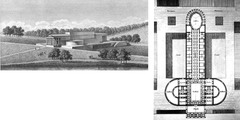
Inspector's House, 1775-79, Ledoux, Chaux (France)

House for Agricultural Guards, 1785, Ledoux, Chaux (France)

Washing place and bridge, 1780, Ledoux, Chaux (France)

Giovanni Battista Piranesi
Architect and engraver (1720-1778) from Venice who worked in Rome. Baroque and Neo-Classical influences. Produced collections of prints of Modern and Ancient Rome, Albano, Paestum, etc. and Carceri prison etchings, not perspectival

Alexander Baumgarten (1739)
invented aesthetics as a way to define nature, "science of sensory knowledge", aesthetics in the body and science in the mind

The Little House
story by Jean-Francois de Batiste in which a House is used to seduce a woman, and architecture is used as a character
Bibiani Brothers
invented the two-point perspective, democratizes perspective in theatre sets
Filippo Brunelleschi (1377-1446)
Florentine architect who was the first great architect of the Italian Renaissance; built first dome over Cathedral of Florence and invented perspective using a mirror

Gaspard Monge (1746-1818)
created Descriptive Geometry, explained techniques for drawing three-dimensional objects on paper, 1:1 relationship, created Cartesian Coordinates
character theory
Boullee; arose to recover and re-describe place following the poetic extension of a mathematical articulation of space as X, Y, Z, "rearticulation and reduction of the problem of decorum"
Architecture Parlante
"Speaking architecture", i.e., architecture which directly expresses its content, more expressive and inventive agenda than character theory, evokes emotion and speaks poetically through artistic elements like scale and proportion while adhering to Newton's natural beauty
Jean-Jacques Lequeu, 1757-1826
Sex obsessed advocate of architecture parlante who sought an architecture that touched all the senses, recovered pagan architecture, drew portraits of emotion-filled faces and translated them through front elevations

Indole
Carl Lodoli's notion that form should be true to material qualities, Tomaso Temmanza's clock tower renovation added a doorway and a column which led to instability and a stone fracture
Carlo Lodoli
1690-1761 , anticipates modern notion of functionalism, truth to materials
