7.1 localization of language
 Call Kai
 Learn
Learn Practice Test
 Spaced Repetition
 Match
Match Flashcards
 Knowt Play
1/13

Earn XP
Description and Tags
localization of language
Name | Mastery | Learn | Test | Matching | Spaced | Call with Kai | Chat |
|---|
No analytics yet
Send a link to your students to track their progress
14 Terms
Why is studying neural basis of language complex?
Most of the brain takes part in language in one way or another
Most patients who add information to studies of language have had strokes, usually of the middle cerebral artery.
Immediately following stroke, symptoms are generally severe but improve considerably as time passes.
Aphasia syndromes described as nonfluent (Broca’s) or fluent (Wernicke’s) have many varied symptoms, each of which may have different neural basis.
Other cognitive functions are also relevant, such as EF, WM, memory, attention & perception.

Anatomical areas associated with language
Inferior frontal gyrus, superior temporal gyrus & surrounding areas: ventral parts of the precentral & postcentral gyri, supramarginal gyrus, angular gyrus & medial temporal gyrus.
Areas 45 and 44 (Broca’s area), area 22 (Wernicke’s area) & parts of areas 4, 6, 9, 3-1-2, 40, 39 & 21.
Insula, Heschl’s gyrus & aSTP & pSTP.
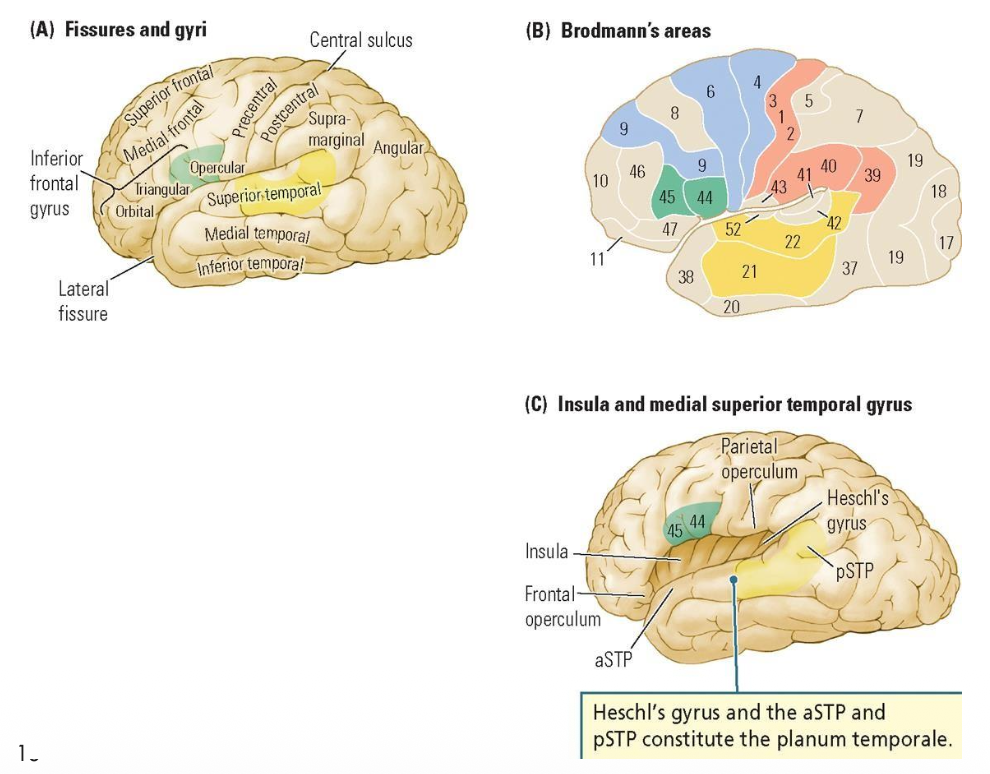
Anterior & Posterior language regions:
Subdivisions of Broca’s area
Subdivisions of Broca’s area:
Anterior & posterior region in area 45.
Dorsal & ventral region in area 44
Ventral premotor area 6 (facial movements)
Surrounding areas containing mirror neurons
Dronkers et al. (2017)
Selective damage to Broca’s area & Wernicke’s area do not produce its equivalent in aphasia.
To produce a Broca aphasia a larger area needs to be affected.
It doesn’t just manifest an aphasia, also cognitive & memory deficits as well.

Anatomical areas associated with language

Dual pathways for language
two pathways → dorsal & ventral
the information flows both ways between temporal & frontal cortex
Ventral or what pathway
Transform sound information into meaning (phonological → semantics).
It assigns meaning to words : semantics
Dorsal or where pathway
transform sound information into motor representation (phonological → articulation)
phonemes
Integration of semantic-syntactic
information through Broca’s area & Insular cortex.
Inferior Fronto-occipital fasciculus
cerebral areas:
inferior frontal cortex
temporal cortex
occipital cortex
parietal cortex
functions of the fasciculus:
semantic process
visual mapping of the words with the semantic meaning (reading)
Uncinate fasciculus
Cerebral areas:
Anterior Broca’s area (AB45 → triangular area),
Area Broadmann 47
Temporal lobe
functions of the fasciculus:
Semantic processing of the word (lexicon-semantic access, categorizing & judgement), of the phrase (plausible semantic)
Arcuate fasciculus
Cerebral areas:
Posterior area of Broca (AB44 → opercular area)
Wernicke area (medial posterior & superior temporal gyrus)
functions of the fasciculus:
Complex syntax by prediction top-down for entering words.
Activation related to the complexity.
Comprehension of the semantic structure
Phonological processing related to phonological knowledge.
Superior longitudinal fasciculus
cerebral areas:
Dorsal premotor cortex
Parietal cortex
Medial & superior temporal gyrus
functions of the fasciculus:
A guideline from what I hear to the praxia.
A guideline of the representation of the grapheme to a motor representation.
Repetition of the words that are heard