Genetic Elements and Genetic Changes
 Call Kai
 Learn
 Practice Test
 Spaced Repetition
 Match
 Flashcards
 Knowt Play
1/17

There's no tags or description
Looks like no tags are added yet.
18 Terms
Genetic Elements
Chromosomes
Transposable elements
Plasmids
Genome
All genetic material in an organism
Mutation
A heritable change in the genetic material (can be passed down as the chromosomes replicate)
Mutations may be neutral, beneficial, or harmful
Mutagen
Agent that causes mutations (chemicals, radiation), can increase mutation rate
Spontaneous mutations
Occur without external intervention (no mutagens)
Most result from occasional errors by DNA polymerase during replication
Rate is 1 in 10^-6 per replicated gene, which is relatively rare
Induced mutations
Caused environmentally or deliberately
Can result from exposure to natural radiation or chemicals that chemically modify DNA
Point mutations
Change only one base pair
Occurs via single base-pair substitutionPhenotypic change depends on exact location
Base-Pair Substitutions
Silent mutations
Missense mutations
Nonsense mutations
Silent mutations
Don’t affect sequence of encoded polypeptide or phenotype
Almost always third base of codon because of degeneracy/wobble
Missense mutation
Change the sequence of amino acids in polypeptide
If at active site, could alter activity
Not all missense mutations lead to dysfunction/nonfunction
Nonsense mutation
Typically results in truncated (incomplete) protein
“Stop this nonsense”
Stop codon
Frameshift Mutation
Deletions or insertions that result in a shift in the reading frame of a protein
Large insertion or deletion can also occur (multiple base pairs at once)
Genetic Recombination
Genetic variation can also occur by recombination
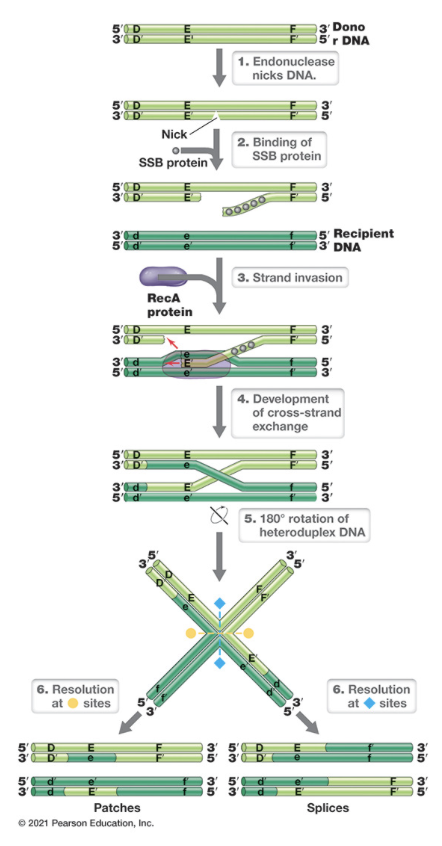
Recombination: Physical exchange of DNA between genetic elements
Homologous recombination: process that results in genetic exchange between homologous (similar) DNA from two different sources
Carried out by recombinase enzyme
Complementary base pairs match together
Endonuclease cuts DNA
Recombinase enzyme allows similar strand to invade the complementary strand
Ends in crosslinking and a combination of two different pieces of DNA from two different sources
Plasmids
Found in many bacteria and archaea
Nearly all double-stranded DNA, mostly circular
Smaller than chromosomes
Present in different copy number (1 to 100+ copies)
May influence host cell physiology
R Plasmids confer resistance
Virulence factors like toxins (allow for variants within a host)
Bacterocins (proteins that kill other bacteria)
Rhizobia and nitrogen fixation
Metabolism for hydrocarbon degradation
F plasmids and conjugation
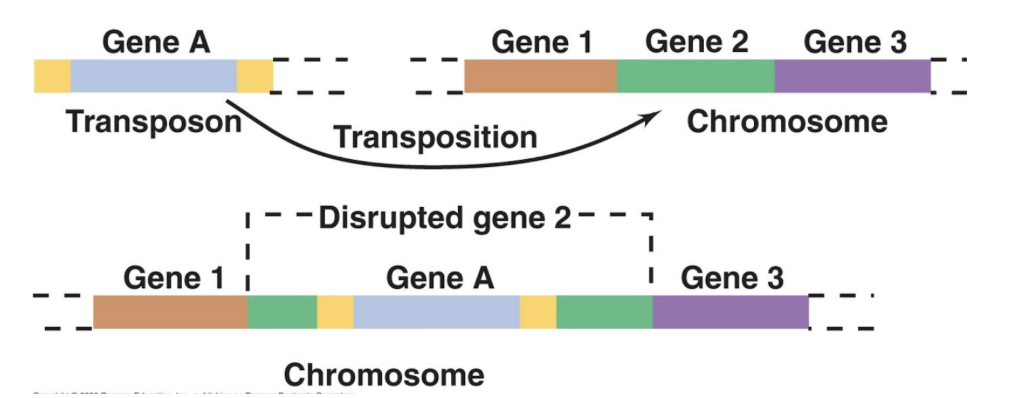
Transposable Elements (Jumping Genes)
Segments of DNA inserted that can move from one site to another site
Can move on the same or a different DNA molecule (ex. Chromosomes, plasmids, viral genomes)
Does not require homology
Found in prokaryotes and eukaryotes and archaea
Types
Insertion sequence
Transposon
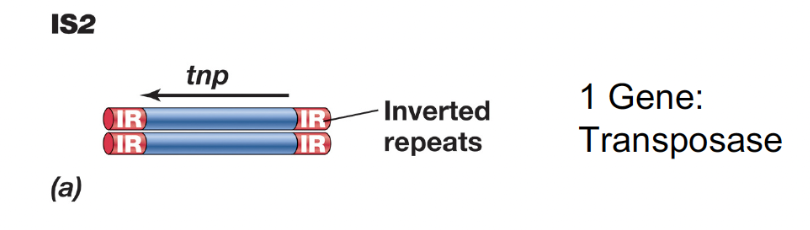
Insertion Sequence
The simplest type of transposable element and it has inverted repeats, like think race car, (same forwards and backwards), and then it has the transposase gene in the middle of that. And the transposase is what's going to allow it to move within the DNA by cutting out the insertion sequence and then putting it into a new piece of DNA.
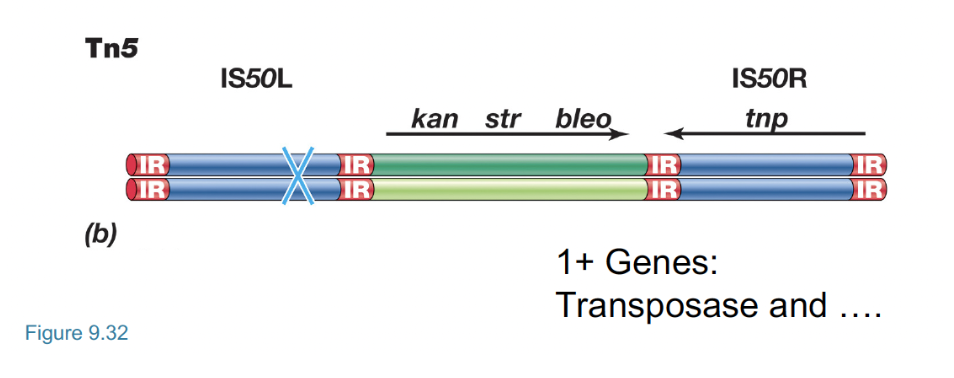
Transposon
The more complicated transposon is shown below. Transposons are two insertion sequences that flank an additional gene or genes. And so here we see a transposon that encodes for kanamycin resistance as well as other functional proteins. Transposons can again take this whole region out of a location of DNA and put it into a new location of DNA and transposons had to have often been associated with antibiotic resistance in various pathogens, because the transposases can have antibiotic resistance genes sandwiched between the insertion sequences.
Transposon Mutagenesis
One of the tools that has been commonly used to study bacteria and other organisms are transposon mutagenesis. So one of the things that you can do with these genetic elements is that you can actually insert transposons into an organism so that it interrupts its chromosome (randomly because transposition doesn't require homology).
This is often used when you're trying to determine which gene allows for a particular function of an organism. And so you insert a transposon which could disrupt gene two (by random chance), and then you look for the properties or for the physiology that you might see when Gene two is not functional.
So for example, it could be motility. You have bacteria that are motile and use transposon mutagenesis and put transposons into the bacteria. You isolate individual bacteria and then determine if they are motile or not, and the ones that are not motile, you could say the transposon may have interrupted something that was essential for motility.