CCRN - Neuro
 Call Kai
 Learn
 Practice Test
 Spaced Repetition
 Match
 Flashcards
 Knowt Play
1/78

There's no tags or description
Looks like no tags are added yet.
79 Terms
If brain swelling occurs, where does it expand toward?
Foramen magnum (where brain stem is attached to the spinal cord)
What artery, formed by 2 vertebral arteries, supplies the lower areas of the brain and the brain stem?
Basilar artery

What arteries supply the upper areas of the brain? Which is dominant for most people?
Carotids
Left internal

Brain function based on anatomic location
Frontal: _________, abstract thought, _____-term memory
Temporal: _________, taste and smell, interpretations
Occipital: _________, visual recognition, reading comprehension
Parietal: _______ recognition by size, weight, shape, touch, body part awareness
Cerebellum: ______, gait, ________
Personality, long
Hearing
Vision
Object
Coordination, balance
Circle of Willis is a circulatory _____________ comprised of various arteries that supply blood to the brain. What is the purpose?
Anastomosis
Allow collateral blood flow to one area from another in the event of an occlusion

T/F: the basilar artery and middle cerebral arteries are part of the Circle of Willis.
False
Arteries include anterior cerebral artery, anterior communicating artery, internal carotid artery, posterior cerebral artery, and posterior communicating artery
Change in _____ is almost always the first sign of a neurological problem. What is the exception?
LOC
Epidural hematoma, pupillary changes occur first
What is included in a LOC assessment?
Arousability - voice, shake, pain
Orientation
Speech/language - dysfunction in dominant hemisphere
Expressive/Broca’s aphasia - dysfunction in frontal lobe
Receptive/Wernicke’s aphasia - dysfunction in temporal lobe
Memory
Attention span/judgment
Personality
What is the RAS?
Reticular activating system
Network of neurons that connects brain stem to cortex
Upper = awareness
Lower = sleep-wake
Motor problems are _________ to the brain problem. Pupillary changes occur _________ to the brain problem.
Contralateral
Ipsilateral
Babinski reflex is _________ in adults and is __________ to the brain injury. It’s d/t pressure on the pyramidal/motor tracts in the __________.
Abnormal
Opposite
Cerebrum
What are the brain stem reflexes? When are they assessed?
Cough
Gag
Corneal
When all other reflexes are absent and brain death is suspected
During the doll’s eye test, the patient’s eyes are held open and movement is watched as the head is rapidly turned side to side. This assesses ________ reflex in unconscious or comatose patients. It is positive if eyes move in the _________ direction of the dead turn. This is ______.
Oculocephalic
Opposite
Good, “it’s good to be a doll”
VS changes are a _____ sign of neurological injury.
Late
What are the factors of Cushing’s triad? What is it indicative of?
Increased systolic pressure and widening pulse pressure
Decreased HR
Decreased RR
Sign of brain herniation
Fill in the respiratory issue associated with brain stem abnormalities
Midbrain - ___________
Pontine - ___________ _____________
Medulla - ________ _________
Hyperventilation
Apneustic breathing
Ataxic breathing, leads to arrest

What is assessed in the Glasgow Coma Scale?
Eye opening
Verbal response
Motor response

____________ _________ is a loss of vision in half the field of each eye r/t damage to the _______ nerve, and it occurs __________ to the problem. This causes neglect of the affected side.
Homonymous hemianopsia
Optic (CN II)
Contralateral
Pupil changes are _________.
Visual changes are _____________.
Motor changes are ___________.
Babinski is __________.
Ipsilateral
Contralateral
Contralateral
Contralateral
Uncal herniation is displacement of the ______ ______ (uncus) against the ________ _______ and CN III.
Temporal lobe
Brain stem

Uncal herniation compresses ___________ innervation to the affected side and causes a ________ pupil ipsilaterally, all of which occur before change in LOC. This can lead to ________, coma, abnormal posturing, or death.
Parasympathetic
Blown
Stupor
What are some contralateral findings in uncal herniation?
Babinski
Slight weakness
Pronator drift
Central herniation is swelling on both sides, causing downward displacement of ______________, and usually caused by diffuse _______.
Hemispheres
Edema
What are some s/s of central herniation?
Slight change in LOC
Initially small pupils bilaterally then dilation d/t parasympathetic innervation
Bilateral babinski
What are some types of encephalopathy?
Hypoxic
Metabolic
Hepatic
Drugs
Infection
What are some signs of encephalopathy?
Loss of memory and cognitive ability
Personality changes
Agitation
Inability to concentrate
Progressive loss of consciousness
Seizures
Coma
Brain death
Types of stroke include
Ischemic: ____ within 24 hours or cerebral infarct
Hemorrhagic: intracerebral, ___ malformation, subarachnoid
TIA
AV
In a right brain bleed, eyes deviate toward the _______, and there is ____ sided muscle weakness, ______ homonymous hemianopsia, left babinski, and emotional __________.
Right
Left
Left
Lability
Note: eyes deviate toward pathology
BP is not treated in acute ischemic stroke until it is outside of what parameters? Why?
SBP >220 or DBP >120
Sudden decrease in BP will decrease perfusion to underperfused area of the brain
rtPA can be used if symptom onset was less than <___ hours ago, CT scan __________, and no contraindications.
4.5
Negative
What are some contraindications of rtPA?
Evidence of hemorrhage
Stroke or head trauma in previous 3 months
Hx of ICH
Major surgery in previous 14 days
Active bleeding in previous 21 days
MI in past 3 months
Seizure at onset of stroke (seizure hx ok)
Plt <100,000/mm3
BG <50
INR >1.7 if on warfarin
Persistent HTN
What BP goal is for the first 24 hours after rtPA?
SBP <180
DBP <105
What is the drug of choice for BP control in stroke pts?
Labetalol
What’s the worst complication of rtPA?
Intracerebral hemorrhage
Watch for change in LOC
What are some important considerations post stroke?
Elevate HOB >45º
Dysphagia screening tool
NPO until swallow screen completed
BG 80-150
What is the most common cause of subarachnoid hemorrhage?
Aneurysm, often middle cerebral artery
The ____ and ____ Scale provides a score based on the pt’s neuro status during a SAH and helps predict outcome and treatment. LOC doesn’t change until the score is >___.
Hunt and Hess
3
Note: Surgery delayed >4
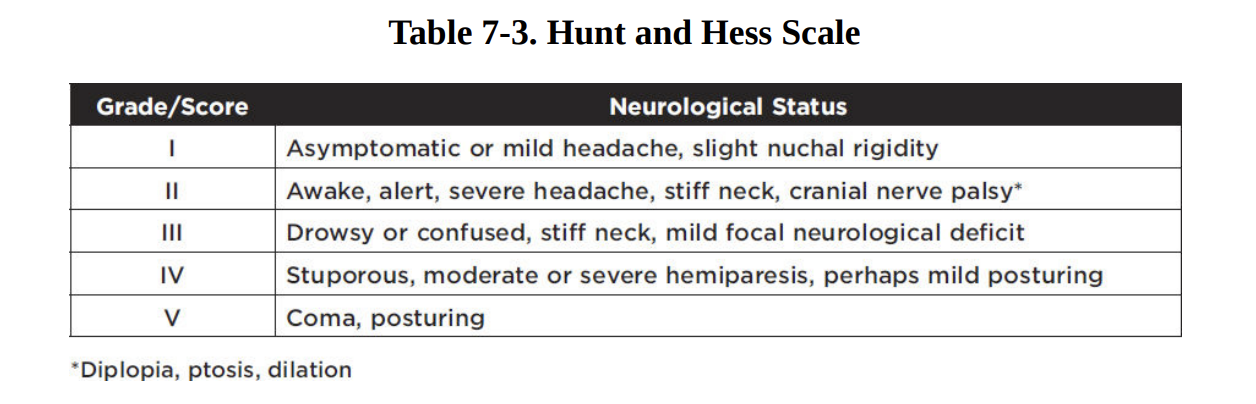
What is the triad of symptoms for a ruptured brain aneurysm?
Sudden explosive headache
Decreased LOC
Nuchal rigidity, positive Kernig’s sign
___________ can develop after SAH because chorionic villi in the subarachnoid space reabsorb CSF.
Hydrocephalus
How is vasospasm prevented in aneurysmal SAH?
CCB Q4
CPP 60-70
Avoid hypotension
Monitor hyponatremia (can precede vasospasm)
An early manifestation of brain tumors is _________. Treatment of tumors also includes __________ like ____________ because it prevents elevated ______.
Seizures
Steroids
Dexamethasone
ICP
What is a normal ICP? What is considered high?
0-10
>20
How is CCP calculated? What is normal? What is minimum for perfusion?
MAP - ICP
Normal is 60-80
50
Note: hypotension in the presence of elevated ICP can be devastating
Ex: pt with MAP 110 and ICP 30 has a CPP of 80, whereas pt with MAP 55 and ICP of 30 has a CPP of 25—>brain death
S/s of increased ICP
Altered LOC
Restlessness/agitation
HA
NV
Seizures
Visual disturbances
Pupillary changes
Motor dysfunction
Cushing’s triad
Where is the transducer leveled to in ICP monitoring? What waves are found on the monitor and what do they mean?
External auditory meatus
A = awful
Caused by cerebral vasospasm and high ICP
B = bad
C = common

ICP is lowered by
Decreasing volume: upright positioning, ___ saline, ____________, _____________
Preventing _____________ (low pH dilates cerebral vessels)
Reduce CSF: _____________
Prevent secondary brain injury
Prevent ________ and agitation with ___________ (can reduce ICP by up to 15 mmHg)
3%, mannitol, furosemide
Acidosis
Keep pH ~7.35 because alkalosis causes vasoconstriction and decreased blood flow
Ventriculostomy
Pain, propofol
Why is 0.45% NS or D5W contraindicated with increased ICP?
Hypotonic fluids bring fluid into the cells, causing swelling
Use isotonic fluids
What are some other things avoided in increased ICP?
Hyperextension of neck —> suboptimal jugular venous outflow
PEEP —> increases thoracic pressure, prevents jugular venous outflow
Low protein —> decreases oncotic pressure, fluid goes into cells from vasculature
Restraints
Agitation and noxious stimuli
Fever
Types of TBI
________: concussion, diffuse axonal injury
________: contusions, intracranial hematomas, skull fractures, open head injuries
Diffuse
Focal

Epidural hematoma is usually d/t __________ __________ artery bleed secondary to temporal bone trauma and is always ________. This can cause ________ herniation.
Meningeal
Acute
Uncal

S/s of epidural hematoma
HA
Irritability and confusion
Vomiting
Ipsilateral pupil dilation BEFORE decreased LOC
Contralateral hemiparesis
Most intracerebral hematomas are ___________, which can be acute, subacute, or chronic.
Subdural

Subdural hematomas have similar symptoms to epidural, minus what?
Less vomiting
Pupil change does not precede LOC
Types of skull fractures
___________: does not require surgery
_____, ________: raised if segment is decreased greater than 5 mm, immediate intervention with gross contamination, dural tear with pneumocephalus, or underlying hematoma
__________: occurs in the floor of the cranial vault and results in a meningeal tear
Requires more force to cause
Rare
Linear
Open, depressed
Basilar
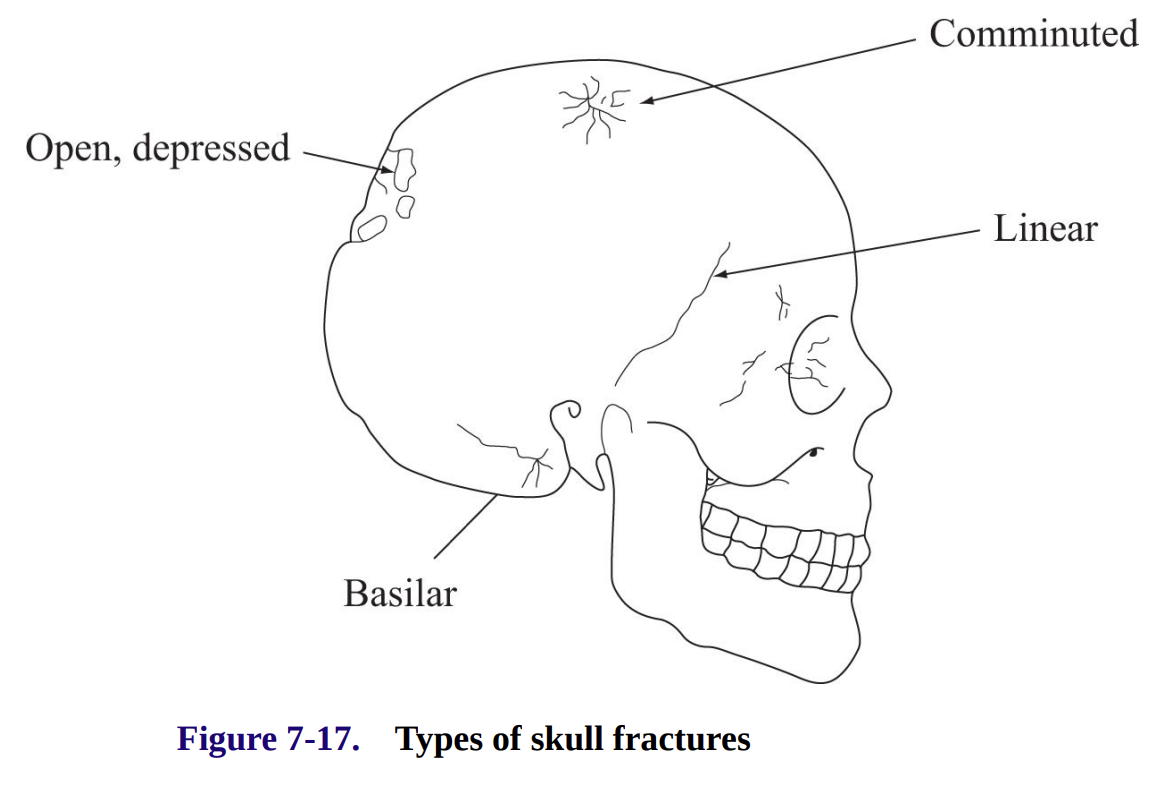
S/s of a basilar skull fracture
Raccoon eyes: periorbital edema and ecchymosis
Battle’s sign: discoloration at the back of the ear
Rhinorrhea d/t meningeal tear —> no nose blowing

How is ear/nose drainage identified as CSF?
Check for sugar; + = CSF
Put drainage on gauze, CSF if positive halo sign
___________ may be elevated post-seizure because normal ventilation does not occur.
PaCO2
What is the preferred drug to stop seizures?
Lorazepam/Ativan
Longer acting than diazepam
What meds are used for seizure prevention?
Phenytoin
Carbamazepine/Tegretol
Phenobarbital
Patients may experience transient signs of decreased LOC during the _______ state.
Postictal
Status epilepticus is seizure activity of ____ minutes or more cause by a single seizure or series of seizures with no return to __________ inbetween.
5
Consciousness
Early stages of SE involve _______ cerebral blood flow, tachycardia, increased _____ and _____ (d/t stress), as well as __________ K+ from destruction of skeletal muscle cells.
Increased
PaCO2
BG
Increased
Late stages of SE (30 mintues) involve inadequate cerebral blood flow, _____________, ______glycemia, very elevated ____, and ___________l
Arrhythmias like VF
Hypo
K+
Rhabdomyolysis
Death from SE is usually d/t what?
Cerebral hypermetabolism
Causes of SE
Withdrawal from anticonvulsants
Acute alc withdrawal
Toxic drug levels
CNS infection
Brain tumor
Metabolic disorders
Stroke
Where is CSF produced?
Choroid plexus in 4th ventricle
What does CSF look like in bacterial meningitis?
LP pressure elevated >180
Purulent
Decreased glucose
Large increase in protein and WBCs
What does CSF look like in viral meningitis?
LP pressure normal
Clear
Normal glucose
Increased protein and WBCs (less than bacterial)
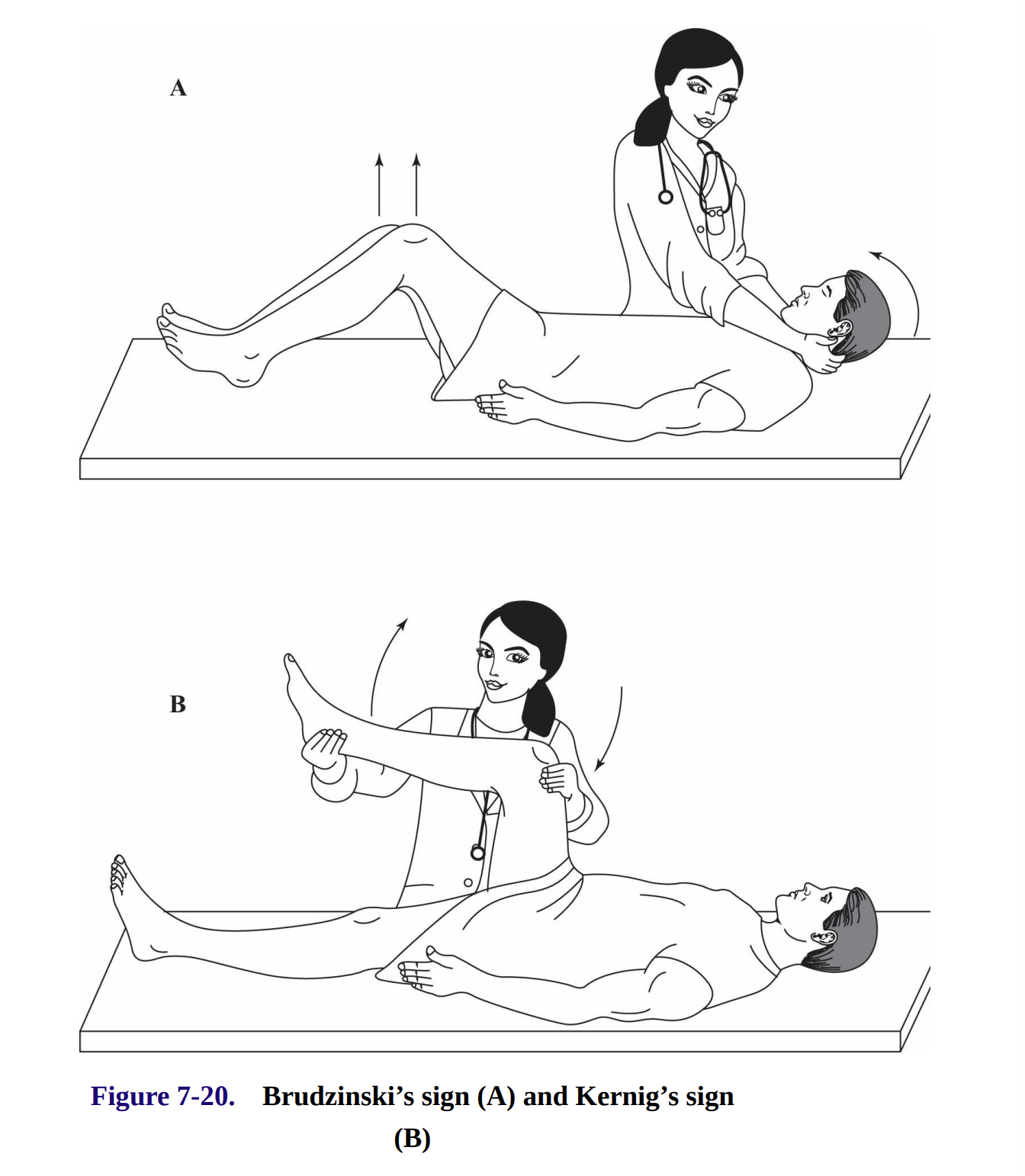
Signs of meningeal irritation include
___________
________ __________: flex pt’s head to chest, if pain or stiffness occur it is positive
__________ sign: move pt’s chin to chest, if leg’s come up it is positive
__________ sign: move legs up and out, if pain in neck and leg it is positive
Headache
Nuchal rigidity
Brudzinski’s
Kernig’s
Brain death is complete cessation of function of what parts of the brain?
Cerebrum
Cerebellum
Brain stem
The following must be confirmed in brain death
______ is irreversible with known cause
Absense of CNS _________ drugs on tox screen
No evidence of residual __________
Absense of severe ______-_____ abnormality
Normo_____
SBP >____ mmHg
No spontaneous respirations
Coma
Depressant
Paralytics
Acid-base
Thermia
100
What are the components of a clinical examination of brain death?
Pupils are _________ to bright light
Absent _________ reflex
Oculocephalic reflex is absent
Oculovestibular reflex is absent
No ________ movement to noxious stimuli at supraorbital nerve
Absent _____ reflex
Absense of motor responses in all extremities
Nonreactive
Corneal
Facial
Gag
A _________ apnea test supports brain death. There are absent ___________ movements and PaCO2 >___ or >20 over baseline
Positive
Respiratory
60
GBS is an __________ response to a viral infection. It results in ___________ paralysis that is usually symmetrical. It can involve the ____________, resulting in ventilatory failure. The LP will be positive for __________.
Autoimmune
Ascending
Diaphragm
Protein
How is GBS treated?
IVIG 2-5 days
Corticosteroids
Monitor breathing, UOP, and dysphagia
Myasthenia gravis an __________ of the neuromuscular junction. It causes __________ skeletal muscle weakness, fatigue, and paralysis later on. 70% of pts have ________ dysfunction, like ptosis, diplopia, and difficulty keeping eyes closed.
Autoimmune
Progressive
Ocular
What are the two types of MG crisis?
___________ crisis: exacerbation, deficiency of ____________
___________ crisis: overtreatment, excess of _____________
Myasthenic
Acetylcholine
Cholinergic
Acetylcholine
How are the two types of MG crisis differentiated?
Tensilon test —> hold arms out during med admin
MC: clinical improvement
CC: salivation, lacrimation, urination, defecation, GI distress, emesis (SLUDGE)
What is the acetylcholinesterase inhibitor used in MG crisis?
Pyridostigmine